Czech University of Defence Picks 14 Quantum Projects From 37 Military Use Cases, Including a Convoy-Planning Study With IBM Hardware Access, 25 November 2026: TRL 2
Quentir Defense Monitor
Evidence-based insights for quantum defense and security. Published by Quentir Systems LLC · November 25, 2026.
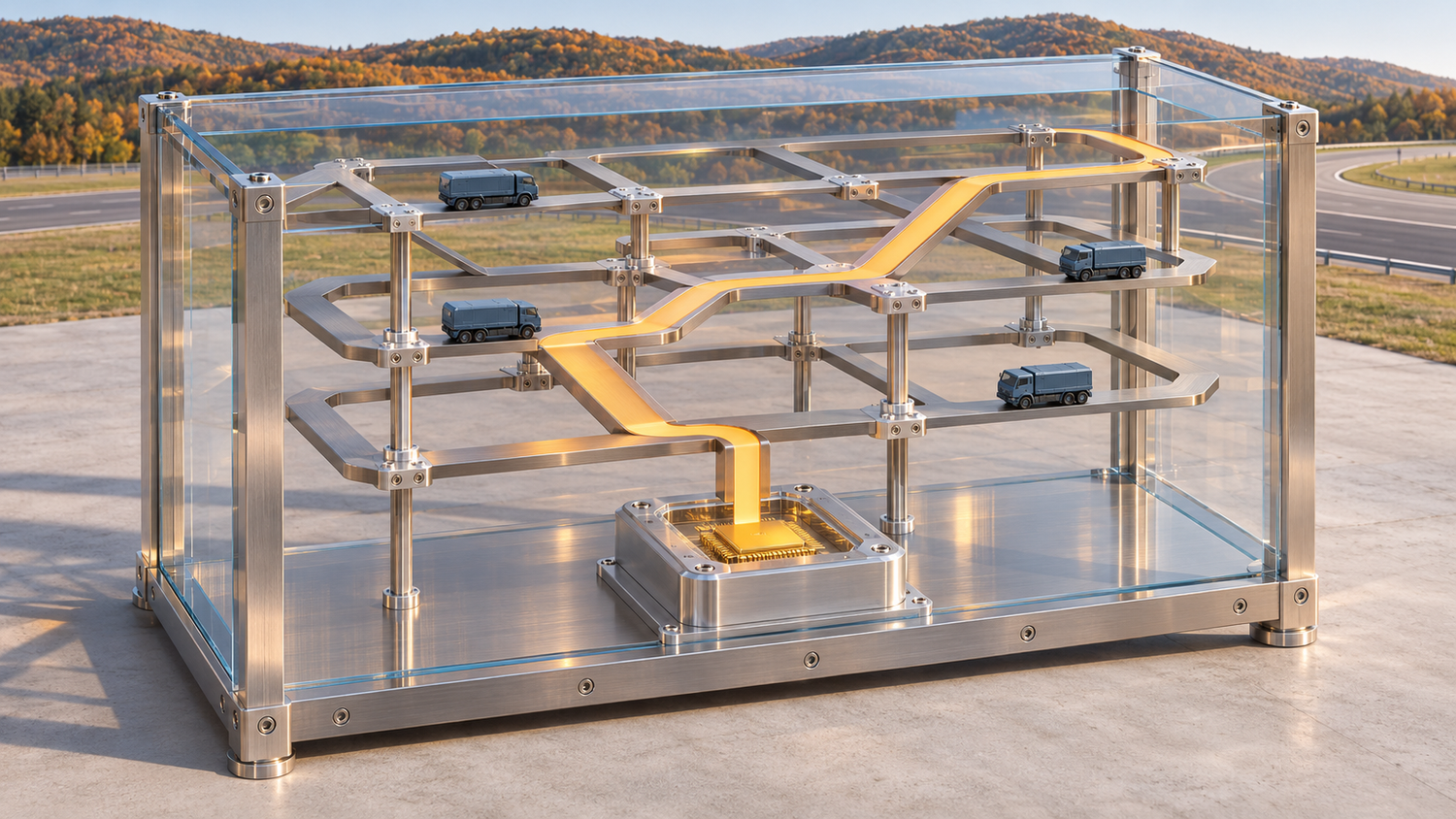
On 25 November 2026, the opening day of Quantum Day 2026 in Brno, Ekonomický deník published an account by Jan Hrbáček of how the University of Defence, the Czech military university, has sorted the quantum technologies on offer against the needs of the Czech Army. The article draws on a university summary document that lists 37 distinct military use cases across six parts of the university, plus two proposals that still lack an owner, and reports that in November 2026 the university selected 14 of them as projects worth moving toward experimental validation. One of the 14 is a study of military logistics: whether a quantum or hybrid computation can help plan and time the movement of a convoy, run through the Czech Quantum Innovation Center and its access to IBM quantum hardware.
This post reads the convoy study as the day's development, because the article describes it in enough detail to place on a readiness ladder, and because it sits in a computing sub-branch the Defense Monitor has not covered in three weeks. The university's method will outlast any single project. It starts from a stated military need, writes the research task from that need, and holds every result against a strong classical baseline before anyone calls it a capability.
How the University of Defence reduced 37 use cases to 14 projects, and the four questions each project must answer
The mapping began in spring 2026, when the university's three faculties, its Institute of Protection against Weapons of Mass Destruction, its Institute of Intelligence Studies and its Centre for Security and Military-Strategic Studies each submitted a first overview of where quantum technology might serve the army. Over the following months those overviews grew into a portfolio that spans inertial navigation under GNSS jamming, quantum clocks, gravimetric and magnetic navigation, quantum communication, cyber threat analysis, intelligence fusion, logistics, decision support, military healthcare and protection against hazardous substances. The university treats that breadth as a starting inventory, and the article makes the reason plain: access to a quantum processor does not by itself give the army a usable capability.
The reduction to 14 projects rests on four questions the university now requires of every candidate: the concrete military need, the future user, the expected result and the method of experimental verification. Two rules follow. A computing task must be compared with a good classical algorithm, and a sensor claim must separate the physical sensitivity of the device from the performance of the whole system in which it would sit. The university adds that a laboratory demonstrator must never be mistaken for a technology ready for operational deployment. For the 14 selected projects the stated intent is to give the army a more active role as project owner and user, to set milestones, and to push results toward verification under conditions close to real military use.
The institutional base for that work is the Quantum Innovation Center, QIC, which the University of Defence founded with the Czech Technical University in Prague. The consortium was contracted in April 2025 and presented publicly on 10 June 2025, when IBM's Czech newsroom announced that the Czech Academy of Sciences and six further universities would gain cloud access to IBM quantum computers through the IBM Quantum Network. In that release Jan Farlík, the rector of the University of Defence, said the IBM equipment would extend the defense sector's modeling capabilities, with logistics as his example, and the Czech Technical University's report of the same day credits the center's opening to the University of Defence and the funds made available to it. By the end of April 2026 the consortium had eight members; its report for the first evaluation period lists five steering committee meetings and 31 submitted project proposals. The November 2026 materials add the Technical University of Liberec and the University of Chemistry and Technology Prague, and state that the steering committee approved the accession of VSB Technical University of Ostrava on 19 November 2026. Alexandr Stefek, the university's vice-rector for digitalization, coordinates the field and sits on that committee.
Quantum pillar: computing (optimization and logistics). Use posture: dual-use. Technology readiness: TRL 2 of 9. For the reader this means the convoy problem has been formulated as a research task and discussed with IBM specialists, a demonstration tool is planned, and no run on quantum hardware, no classical baseline comparison and no result on real movement data has been reported.
What the convoy-planning study examines, what IBM's Road to Utility program adds, and why the readiness reads TRL 2
Planning a convoy move, as the article sets it out, involves far more than finding the shortest route. The planner must account for the number of vehicles, the required arrival time, the capacity of each road, the passability of specific points, the sequencing of several moves that depend on one another, and further operational constraints. As the number of units and conditions grows, the number of feasible variants grows much faster, which is the signature of the combinatorial scheduling problems that quantum optimization research has pursued for a decade. The QIC project asks whether quantum or hybrid procedures could complement classical computation in the planning and timing of military moves. The university states the aim with care: the project is not meant to prove in advance that a quantum computer works faster than a classical one. The researchers are looking for a specific part of the logistics problem in which a quantum computation might bring a measurable advantage, and the project is to produce a demonstration tool for logistics planning and decision support.
The project is tied to IBM's Road to Utility program, in which Czech teams consult IBM experts directly on their work; the October 2026 consultations covered logistics alongside materials and quantum chemistry. The article describes the program as the path from general experimentation toward concrete practical use.
The readiness placement follows from what the article does and does not report. The convoy problem has been formulated, a consortium and hardware access exist, and specialists have reviewed the approach. The article reports no circuit run, published classical baseline or use of movement data. This post assesses the study at TRL 2, a concept formulated and resourced, and uses a hardware run with a classical comparison on the same data as its criterion for TRL 3. The Defense Monitor has covered where that next rung stands. In October 2026 Onah, Hadfield and Michielsen recovered optimal ten-city tours on IBM's 127-qubit ibm_brisbane processor with a classical repair step, demonstrating a ten-city routing instance on superconducting hardware. A convoy schedule adds road capacities and sequencing constraints to the routing problem. The same discipline appears in the medicine lane, where a Padova group encoded a prostate radiotherapy plan in 128 qubits and checked the result against tensor-network simulation, which is the kind of classical comparison the Czech selection rules demand.
What the 14 projects would let a force do, who gains from them, and why the convoy study reads dual-use
A convoy planner that reliably found better schedules would shorten the time a force needs to move a brigade's vehicles and supplies along a road network under capacity limits, and would let a sustainment staff re-plan when a bridge closes or a route is interdicted. The article reports no such result, only the search for a problem component where one might arise. Such a tool would decide how quickly a force arrives and how long its supplies last, and the posture still reads dual-use, because a railway, a port or a relief operation faces the same scheduling problem, and because the hardware, the Qiskit tooling and the IBM program the Czech teams use are open to civil users on the same terms.
The other 13 projects spread across the capability map. Biological dosimetry, which estimates radiation dose from chromosome changes in a blood sample, is to be tested with quantum-assisted image processing to raise the number of samples a laboratory can evaluate after an incident, on the condition that the new method beats a strong classical model on the same data. The wider portfolio holds antidote development, chemical identification, radiation mapping and quantum sensors for navigation and detection. Two QIC projects examined the cryptographic threat from opposite ends: one compared published estimates of future quantum computer capability, the other, with Lieutenant Michal Bures of the university's Department of Computer Science and Cyber Operations, tested what current devices can do and found that present hardware cannot threaten the tested methods. Since migration takes years and some stored data must stay protected for a long time, the university prepares post-quantum cryptography and cryptographic agility regardless.
The military part of Quantum Day follows on 26 November 2026 at the University of Defence club, with sessions on military logistics, cryptanalysis, biological dosimetry, quantum sensing and PNT, decision support, CBRN defense and military healthcare, closing with a discussion with Czech Army representatives. The public program at Brno University of Technology on 25 November, listed by the Confederation of Industry of the Czech Republic as the fourth edition, carries defense quantum projects, the QIC and post-quantum cryptography among its six topics. A larger European effort runs in parallel. On 24 November 2026 Pasqal announced CoPaNA, a three-year European Defence Fund project with ParityQC and Thales Nederland, with a keynote at the European Defence Agency's Quantum Technologies for Defence workshop in Athens on 26 November. Thales Nederland's task in that project is to estimate what a future fault-tolerant computer would need to run a defense application. The Czech project works from the other end, choosing the application the army would use first and testing whether present hardware can handle any part of it.
What stands between the 25 November 2026 article and a program office relying on quantum convoy planning
The article establishes a selection method, an institutional base and a formulated problem, and no quantum result. For a buyer, the open questions follow the university's own four criteria. The first is the baseline: which classical solver, on which instance sizes, the demonstration tool will be measured against, and whether the comparison uses the same movement data. The second is the instance: how many vehicles, road segments and timing constraints the first hardware run will carry, since the ten-city demonstration of October 2026 does not establish the limit of present superconducting processors. The third is the user: which Czech Army staff will own the demonstration tool, and whether its output will be checked against a plan a human logistics cell produced for the same move. The fourth is publication: no preprint, technical report or conference paper on the convoy study has appeared, so the figures above rest on a single press account of a university document the public has not seen.
The method survives those gaps. A ministry that writes its quantum program as 37 needs, 14 projects, four questions per project and a classical baseline for every claim will spend less on demonstrations that prove nothing, and will know, when a result arrives, whether it belongs on the ladder at all. Under this post's criterion, the convoy study earns TRL 3 when a circuit runs on a reduced instance of the problem and the result is compared with a classical solver on the same data, and the Register will move the entry when that evidence is public.
Sources
Primary source: Jan Hrbáček, Ekonomický deník, 25 November 2026, reporting from University of Defence summary materials on the 37 use cases, the 14 selected projects and the convoy-planning study. Other material: IBM Czech newsroom, 10 June 2025; Czech Technical University in Prague, 10 June 2025; Confederation of Industry of the Czech Republic, Quantum Day 2026 page; The Quantum Insider, 24 November 2026, carrying the Pasqal CoPaNA release. The capability reading, the posture argument, the readiness placement and the buyer questions are Quentir analysis.