France's Defense Innovation Agency Launches ALIQUANTE, a Five-Year Classified Quantum Programming Platform From Thales, Bull and CEA for the PROQCIMA Computers, Announced 24 September 2026
Quentir Defense Monitor
Evidence-based insights for quantum defense and security. Published by Quentir Systems LLC · September 26, 2026.
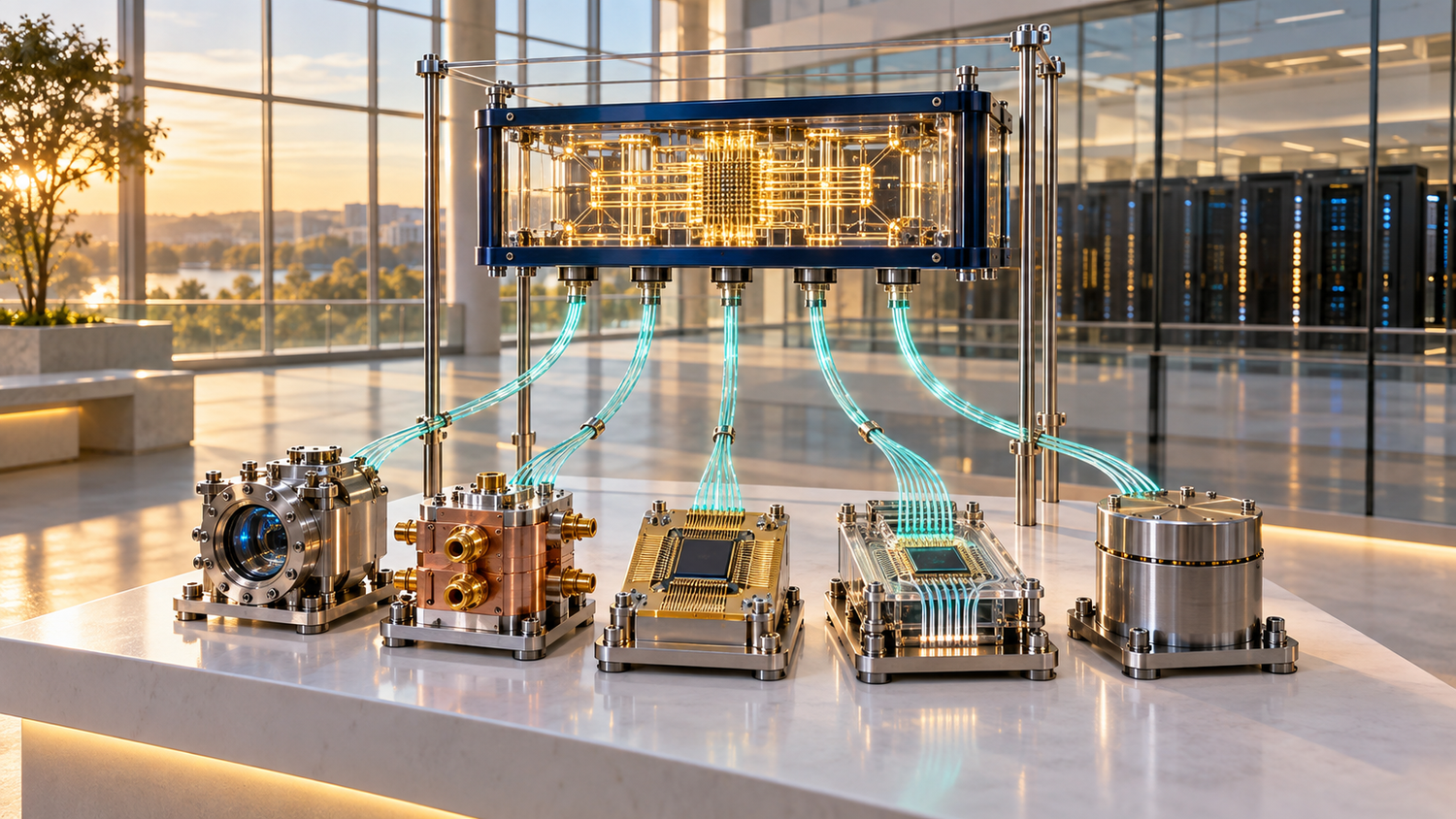
On September 24, 2026, the French Ministry of the Armed Forces announced a project called ALIQUANTE. The Defense Innovation Agency, known in France as the AID, runs it with the support of the Direction générale de l'armement, the DGA. The release describes a defense technology project lasting five years, awarded to a consortium of Thales Research & Technology, BULL SAS and the Commissariat à l'Énergie Atomique, the CEA. Its deliverable is a sovereign quantum programming platform: a toolchain able to program quantum processing units and to prepare the armed forces and the defense industry for the quantum computers the ministry expects from its hardware program, PROQCIMA.
The release is short, and the trade press that followed it repeats it. What makes it worth a defense reader's attention is sequence. France has spent two and a half years and a large budget on the machines. This is the first ministry-run project on the software that would let a military user do anything with them, and the release states plainly that the platform must run in a classified environment and handle classified data. That sentence is the defense-specific part of the story.
What the 24 September 2026 release commits to: a five-year classified platform from Thales Research & Technology, Bull and CEA to program PROQCIMA's processors
The AID release lists the platform's functions in one paragraph, and each of them maps onto a known layer of a quantum software stack. First, emulation: the platform will emulate quantum computers, which means running quantum programs on classical hardware to test them before a processor exists or is available. Second, portability: the tools will be common to the different qubit technologies underneath, which matters because PROQCIMA still carries five competing hardware approaches. Third, compilation: source code will be compiled into gate-model quantum circuits. Fourth, orchestration: the platform will decide which parts of a program run on a conventional high-performance computer and which run on a quantum processing unit. Fifth, resource estimation: the tools will estimate what it would take, in qubits and operations, to scale a given algorithm up to a point where it beats a classical method.
That fifth function deserves a moment. Resource estimation turns a paper algorithm into a number a planner can use: how many logical qubits, how many gates, how long a run. It is the same exercise cryptanalysis papers perform when they reduce the cost of an attack. A ministry that owns it in a classified setting can rank its own candidate applications without publishing which ones it cares about.
The release adds that ALIQUANTE will develop and evaluate algorithms for a number of use cases of defense interest, either through industry or through the ministry itself via the defense quantum laboratory attached to the AID. It does not say which use cases. Clubic's report of the same day makes the gap explicit: the missions remain unstated and the budget is unknown. Clubic also notes that Bull already sells a quantum programming environment called Qaptiva, and draws the parallel with NVIDIA's CUDA, the software layer that made one hardware supplier hard to leave. The parallel is the right one to keep in mind: a sovereign toolchain is as much about who does not control the compiler as about what the compiler can do.
The consortium's shape is conventional for a French defense technology project. Thales Research & Technology is the group's central research arm and already leads the European Defense Fund's ADEQUADE quantum sensing effort, covered here in September. Bull builds the national supercomputers a hybrid platform would sit beside, and the CEA runs the computing center at Bruyères-le-Châtel where France's first two quantum computers were installed. Nothing in the release says how the work divides among the three.
Why the software layer arrives now: PROQCIMA's 500 million euro ladder, the May 2026 doubling and the 1,024 logical qubit target for 2032
ALIQUANTE cannot be read without PROQCIMA. The DGA launched that program on March 6, 2024, with framework agreements for five French companies: Pasqal, Alice&Bob, C12, Quandela and Quobly. The DGA's own announcement set a ceiling of 500 million euros over at least ten years, a target of two prototypes of universal quantum computers of French design with 128 logical qubits by 2032, and an industrial goal of 2,048 logical qubits after that. The program is a knockout competition: 60 million euros shared by five companies to 2026, up to 30 million euros per company selected for 2026 to 2028, 150 million euros for three companies to 2030, and two left standing for the final phase.
That ladder moved in the spring. The strategy portal's account of the government's May 2026 announcement, published on August 28, 2026, states that the funding for the next two PROQCIMA phases has been doubled and that the technological objective has been raised to 1,024 logical qubits by 2032, inside a new one billion euro France 2030 envelope for quantum over 2026 to 2030. On the defense side, the Zone Militaire report of September 25 adds two figures from the funding debate: the updated military programming law allocates a further 500 million euros to upstream studies over 2026 to 2030, and the DGA's director general, Patrick Pailloux, told a Senate committee in May that the ministry wants to invest about 300 million euros in quantum on top of its cyber and digital spending. The Monitor has not read the Senate transcript itself, so that quote rests on Zone Militaire's reporting.
Put the two lines together and the timing of ALIQUANTE is legible. A hardware target that grew eightfold in one revision needs a software layer that can estimate resources and test algorithms long before either prototype exists. Five hardware bets that will be cut to three and then to two need a toolchain that survives each cut. And a ministry that has told its legislature it will spend a few hundred million euros on quantum needs something to show the forces before 2032. A programming platform running in emulation is that thing.
Quantum pillar: computing (cryptanalysis). Use posture: dual-use. Technology readiness: not applicable. This is a program announcement rather than a tested capability: the ministry has awarded a five-year software project and stated its functions, so there is no measured result to place on the ladder, and the sub-branch follows the DGA's own 2024 statement that cryptography heads the list of intended applications for the computers this platform will program.
Who gains from a sovereign quantum toolchain: the dual-use reading, and the cryptography line in the DGA's own 2024 release
The release does not say what the forces would compute. The nearest public statement of intent is the DGA's PROQCIMA announcement of March 7, 2024, which listed the potential applications of quantum technologies for defense in this order: cryptography, communications, perceiving the environment with unprecedented precision, and navigating where GPS is unavailable. The last three belong to sensing and networking and are the subject of other French programs. The first is a computing application, and for a quantum computer "cryptography" means the ability to run the algorithms that break today's public-key systems. That is why the panel above reads ALIQUANTE against the cryptanalysis sub-branch: a toolchain whose stated jobs include estimating the resources needed to reach quantum advantage is the instrument a ministry would use to know when its own machines could attack a given key size, and to test the circuits in emulation until then.
The posture is dual-use for two reasons. The offensive value, if the ministry pursues the cryptography line, lies in acting against an adversary's protected traffic, and the classified environment is exactly what such work would require. The defensive value is independent of any use case: a sovereign compiler, emulator and scheduler means French classified programs do not pass through a foreign vendor's software or a cloud quantum service abroad. That reading of sovereign quantum computing as a supply-chain matter is the one the Monitor's sister blog set out in its account of Europe's sovereignty instruments this summer, where a regulation, an order and a tender all pointed the same way. ALIQUANTE is the software rung of that ladder.
Who gains outside France is a fair question. The platform is described as sovereign and classified, so an allied program office should not expect to license it. What an ally does gain is a reference: a public statement that one European ministry considers a national quantum toolchain, decoupled from any single qubit technology, a prerequisite for military use of quantum computers. Procurement offices elsewhere that still treat quantum software as something a hardware vendor supplies for free now have a counterexample to cite.
What stands between an announced toolchain and a program office relying on it: no budget, no use case, no processor yet
The gaps are easy to list because the release leaves them open. There is no published budget for ALIQUANTE, so the scale of the effort relative to the 500 million euro hardware ceiling is unknown. There is no stated use case, so the algorithms the platform will "develop and evaluate" cannot be checked against any benchmark. There is no processor: the two PROQCIMA prototypes are due in 2032, and the emulation function exists precisely because the hardware does not. And there is no acceptance criterion in the release, so a reader cannot say what the platform must do at year five for the ministry to call it delivered.
Most of those gaps are ordinary for a defense technology project at award. The one a buyer should watch is the portability claim. A toolchain that is genuinely common to neutral atoms, cat qubits, carbon-nanotube spins, photons and silicon spins has to abstract away the properties that make each platform attractive, and quantum software vendors that have tried have tended to end up with a lowest common denominator plus vendor-specific extensions. Whether ALIQUANTE avoids that fate will show first in resource estimates: if the platform can produce credible qubit and gate counts for the same algorithm on two PROQCIMA technologies, the portability is real. Until a figure of that kind appears in a ministry, CEA or consortium publication, the platform remains an intention.
For a buyer the practical reading is this. France has now committed to both halves of a military quantum computing capability, hardware since 2024 and software since this week, with a stated need to handle classified data and a stated ambition of 1,024 logical qubits by 2032. The sources establish the actors, the five-year term, the functions and the hardware timeline. They do not establish a budget, a use case, an acceptance test or any measured result. For a program office elsewhere, the software layer has become a line item in at least one allied ministry, and any proposal that assumes a vendor's toolchain is good enough for classified work now has to answer why Paris decided otherwise.
Sources
Primary source: Agence de l'innovation de défense, Ministère des Armées et des Anciens combattants, "Calcul quantique : la DGA et l'AID renforcent leur action sur le volet logiciel de l'ordinateur quantique," published September 24, 2026. Other material: the DGA's PROQCIMA announcement of March 7, 2024; the national quantum strategy portal's account of the May 2026 one billion euro reinforcement, published August 28, 2026; Laurent Lagneau's Zone Militaire report of September 25, 2026; Clubic's report of September 24, 2026.