IDEMIA and KT Put NIST and KpqC Post-Quantum Algorithms on One SIM for South Korea's Defense Pilot, 26 October 2026: What a Secure-Element Root of Trust Changes for Tactical Endpoints
Quentir Defense Monitor
Evidence-based insights for quantum defense and security. Published by Quentir Systems LLC · October 27, 2026.
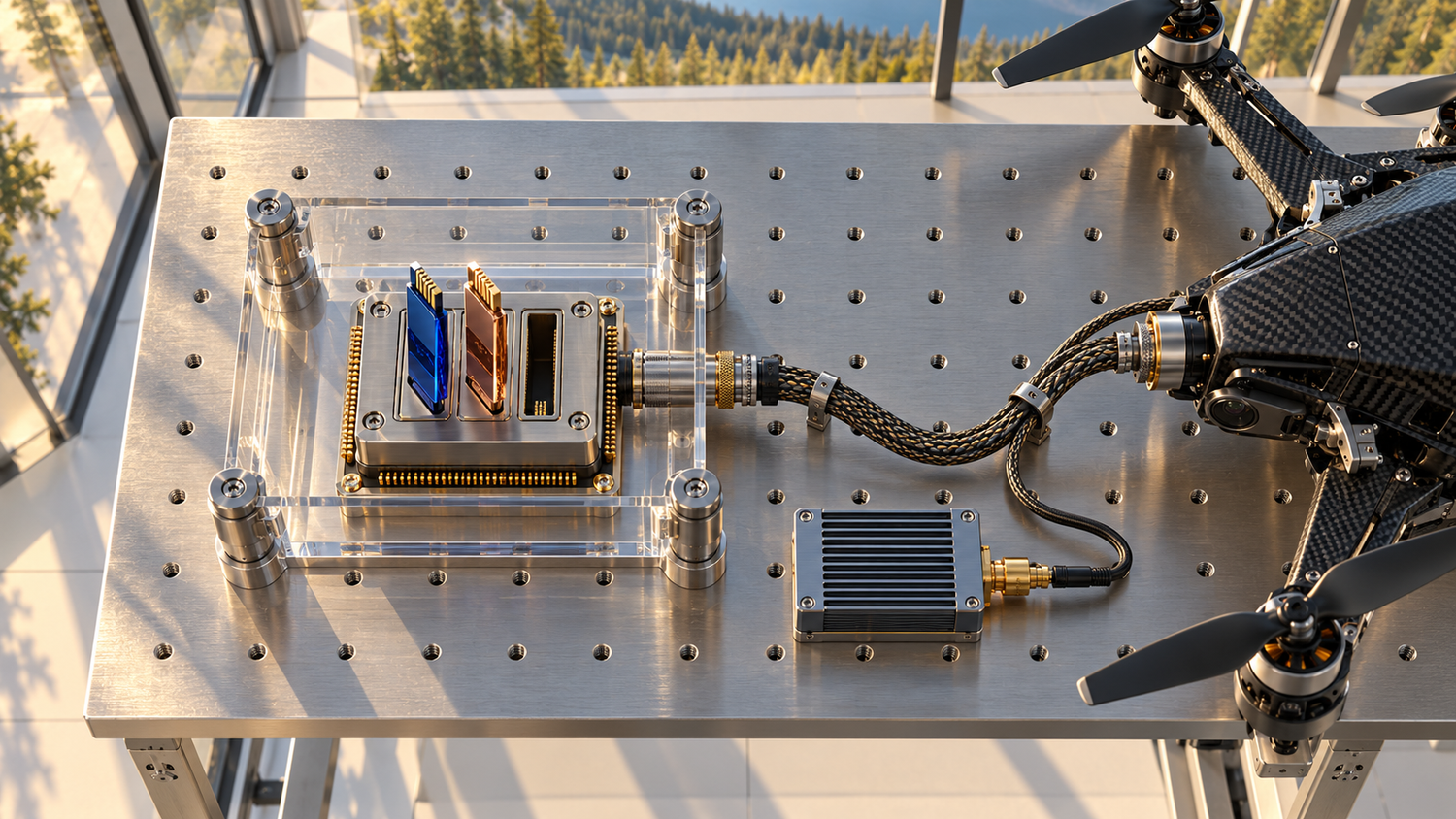
IDEMIA Secure Transactions said on 26 October 2026 that it is implementing both the NIST post-quantum algorithms and South Korea's own KpqC algorithms on a quantum-resistant SIM for KT, the mobile operator running a post-quantum pilot for the Ministry of National Defense and the Army Information and Communication School. The pilot covers smart-unit platforms and user PCs, CCTV and video storage, drones and their ground control stations, and 5G network segments, and the French vendor's release says the KpqC implementation on a smart-card platform would be the first in Korea once it clears final validation.
The release is short, and most of its sentences are claims about intent. It still matters to a defense reader for one reason that the rest of this post works through: it describes a way to move a fleet of tactical endpoints to post-quantum cryptography by changing the secure element each one already carries, with the algorithm choice held on that chip, so that a national algorithm and an allied one can live in the same device and be switched without redesigning the drone, the camera or the PC around it.
This post reads the announcement as a defensive capability. It sets out what IDEMIA and KT have said, which Korean program the work belongs to, what a hardware root of trust in a SIM would let a force do, and what still separates a vendor release of 26 October from a program office relying on the cards.
What IDEMIA Secure Transactions announced on 26 October and what KT's pilot for the Ministry of National Defense covers
The IDEMIA Secure Transactions release places the work inside South Korea's 2026 Post-Quantum Cryptography Pilot Conversion Project, run by the Ministry of Science and ICT with the Korea Internet and Security Agency. IDEMIA's part is the card. It is putting NIST-standardized algorithms and Korean PQC algorithms on its quantum-resistant SIM and eSIM, which it describes as a dedicated post-quantum secure element built to carry the processing and memory load that lattice-based schemes impose. The release says the project is expected to deliver the first implementation of KpqC algorithms on a smart-card platform in Korea, subject to final validation, and that the aim is to add post-quantum and crypto-agility capability at the secure-element level while limiting changes at device level. Fabien Jautard, the company's executive vice president for connectivity services, is quoted calling the post-quantum transition a strategic imperative to safeguard digital trust for the long term.
KT's side of the pilot was announced in May. The Seoul Economic Daily reported on 19 May 2026 that KT had been selected for the 2026 pilot and would demonstrate post-quantum cryptography across smart-unit platforms and user PCs, CCTV and video storage systems, and drones with their ground control systems, for the Ministry of National Defense and the Army Information and Communication School. Jeon Myung-jun, who heads KT's enterprise service division, called post-quantum cryptography a core technology for national cybersecurity ahead of the quantum computing era. Korean trade coverage from the same week adds that KT leads a consortium with Daeyoung S-Tech and ESE, that the 5G segment runs from routers to the core network, and that the pilot is meant to protect data from generation through transmission and storage to use.
The Korean program behind both announcements has a history. Quantum Computing Report summarized on 7 May 2026 how the science ministry expanded its pilot conversion project, which began in 2023 in the medical, energy and administrative sectors, to five new sectors: telecommunications, finance, transportation, defense and space. The same expansion funded four research initiatives aimed at full-cycle post-quantum self-reliance by 2030, including hardware optimization for mobile and IoT devices, conformance verification standards for implementations, and hybrid security that pairs post-quantum cryptography with quantum key distribution. Quentir read the key-distribution half of that pairing last week, when the same ministry expanded its open quantum testbed into a nationwide QKD network by 2028, with KT again running the commercial hubs. The SIM pilot is the post-quantum half, aimed at the endpoints a fiber network never reaches.
Why two algorithm families on one chip is the point: NIST FIPS 203 and the four KpqC winners of January 2025
The NIST family is the one most readers know. FIPS 203, published on 13 August 2024, specifies ML-KEM, the module-lattice key-encapsulation mechanism derived from Kyber, in three parameter sets, ML-KEM-512, 768 and 1024. FIPS 204 and 205 standardized the ML-DSA and SLH-DSA signatures the same day. These are the algorithms allied forces, NATO suppliers and the United States federal migration are converging on, and they are the ones IDEMIA has been building toward since it announced a quantum-resistant 5G SIM in 2022, a crypto-agility upgrade path for SIM, eSIM and payment products in April 2024, and a post-quantum hardware accelerator in March 2025 that it says will sit in all of its future quantum-resistant chips.
The Korean family is the one that makes this announcement different from every other post-quantum SIM story. South Korea ran its own competition, KpqC, from November 2022, narrowing sixteen candidates to eight in December 2023. PQShield reported on 31 January 2025 that the National Intelligence Service, with the National Security Research Institute, had selected four winners: the signature schemes HAETAE and AIMer, and the key-encapsulation mechanisms SMAUG-T and NTRU+. HAETAE and SMAUG-T are lattice schemes that take different design routes from ML-DSA and ML-KEM; NTRU+ descends from the oldest lattice proposal in the field; AIMer rests on a symmetric-key primitive and shares no mathematical structure with the lattice schemes at all. The NIS roadmap that accompanied the result targets a national transition by 2035.
For a defense buyer the combination is the capability. A Korean military network has every reason to run a national algorithm on its own traffic and a NIST algorithm where it must interoperate with United States forces and allied suppliers. A secure element that holds both, with the active choice set by profile, lets one card population serve both requirements and lets a cryptographic authority retire one algorithm or promote another without touching the host device. That is what crypto-agility means at the hardware level, and it is the property that migration guidance everywhere now asks buyers to demand; Germany's post-quantum guideline of 12 October 2026 starts with a cryptographic inventory for exactly this reason, because an operator cannot swap what it cannot locate.
Quantum pillar: post-quantum cryptography (migration and crypto-agility). Use posture: defensive. Technology readiness: not applicable. The release is a vendor and program announcement of an implementation that is still subject to final validation, so it places no measured result on the ladder; IDEMIA's quantum-resistant SIM with NIST algorithms has been a shipping product line since 2022, while the KpqC implementation and the defense pilot that would exercise it in drones, cameras and 5G segments have not yet published a test outcome.
What a SIM as hardware root of trust would let a force do, and who gains
The capability reading starts with the problem the SIM solves. Lattice key encapsulation and signatures carry public keys, ciphertexts and signatures several times larger than their elliptic-curve predecessors, and the arithmetic behind them is heavier. On a server that is a rounding error. On a battery-powered drone controller, a camera head on a perimeter fence or a soldier's handheld, it is latency, power and memory that the original hardware was never sized for. A dedicated secure element with its own accelerator takes the key generation, the encapsulation and the signing off the host processor and keeps the private keys inside a tamper-resistant boundary that the host never sees. The host still runs its own transport stack and its own symmetric traffic encryption, so the card is a hardware root of trust for identity and key establishment rather than an encryptor for the link.
What that lets a force do is concrete. It can authenticate a drone to its ground control station, a camera to its video recorder and a PC to its unit platform with a post-quantum credential that an adversary recording the handshake today cannot later open with a quantum computer. It can re-key those sessions with ML-KEM or SMAUG-T rather than an elliptic-curve exchange. And it can do this across equipment of many vintages, because the change is a card and a profile rather than a new airframe. The posture is defensive in the sense the Quentir capability map uses: the value lies in protecting one's own communications and credentials, and nothing in the announcement acts against anyone else's systems. The gain goes to the Republic of Korea's forces first, to KT as the integrator of the pilot, and to IDEMIA as the vendor that would hold the reference implementation of KpqC on a smart card if the validation succeeds.
The threat the design answers is real on both sides of the table. Quentir reported in August how a Lazarus Group campaign fitted its own command channel with an ML-KEM handshake, which shows an adversary treating the standardized primitive as an off-the-shelf tool; the defensive counterpart is to make sure the credentials on one's own endpoints move at least as fast.
What stands between a vendor release and a program office: validation, conformance, performance figures and the supply chain
Four gaps separate the 26 October announcement from a procurement decision, and each has a checkable milestone.
The first is validation. IDEMIA's own release conditions the KpqC claim on final validation, and the Korean program's conformance verification standards for post-quantum implementations are one of the four research initiatives funded this year, which means the test regime the SIM must pass is itself being written. A buyer should look for a KISA conformance result for the KpqC implementation on the card, and for a FIPS 140-3 or Common Criteria evaluation covering the ML-KEM and ML-DSA side.
The second is numbers. Neither IDEMIA nor KT has published a handshake time, a card throughput, a power figure or a count of devices in the pilot. The claim that the SIM relieves the host is plausible from the accelerator IDEMIA announced in 2025, and it is unmeasured in public. A pilot report from the Army Information and Communication School with per-segment results, especially for the drone-to-ground-control link where latency matters most, is the document that would move this entry.
The third is the host. A root of trust on a SIM covers identity and key establishment. The video recorder's storage encryption, the ground station's software update chain and the 5G core's own key hierarchy still depend on the host and the network, and a post-quantum SIM does nothing for a firmware image that is signed with RSA. The pilot's scope, from generation through storage to use, is the right ambition; what it delivers at each hop is the thing to read when the results appear.
The fourth is the supply chain. The secure element for a Korean defense network would come from a French vendor's platform, which raises the ordinary questions of sovereign evaluation and personalization that the Korean program's self-reliance goal is designed to answer by 2030. Smart-card implementations of lattice schemes have also been the target of fault and side-channel work in the open literature, so an evaluation that covers physical attacks on the KpqC code, and not only the NIST code, is part of what a program office should ask for.
The practical reading for a buyer is this. The announcement establishes that two post-quantum algorithm families, one national and one allied, are being put onto a single commercial secure element for a military pilot, and that the pilot is scoped to the endpoint classes a force actually fields. It does not yet establish that the card works at the speed those endpoints need, that it has passed a conformance test, or that the pilot has run. Each of those, when published, is a reason to revisit this entry.
Sources
Primary source: IDEMIA Secure Transactions, "IDEMIA Secure Transactions Collaborates with KT in Advancing Post-Quantum Security for South Korea's Defense Communications," press release, 26 October 2026, quoting Fabien Jautard. Other material: Seoul Economic Daily, "KT to Apply Quantum-Resistant Cryptography to Korea's Defense Systems," 19 May 2026, quoting Jeon Myung-jun, with consortium and 5G scope details from e4ds news of the same date; Quantum Computing Report, "South Korea Expands PQC Pilot to Telecommunications, Finance and Defense," 7 May 2026; NIST, FIPS 203, 13 August 2024; PQShield, "South Korea announces winners of KpqC competition," 31 January 2025; IDEMIA releases of 22 April 2024 and 18 March 2025. The capability reading, the posture argument and the buyer milestones are Quentir analysis.