South Korea's Science Ministry Expands the Open Quantum Testbed Into a Nationwide QKD Network by 2028, 21 October 2026: KT and SK Broadband, Overseas Hubs in Singapore, Poland and Bulgaria
Quentir Defense Monitor
Evidence-based insights for quantum defense and security. Published by Quentir Systems LLC · October 25, 2026.
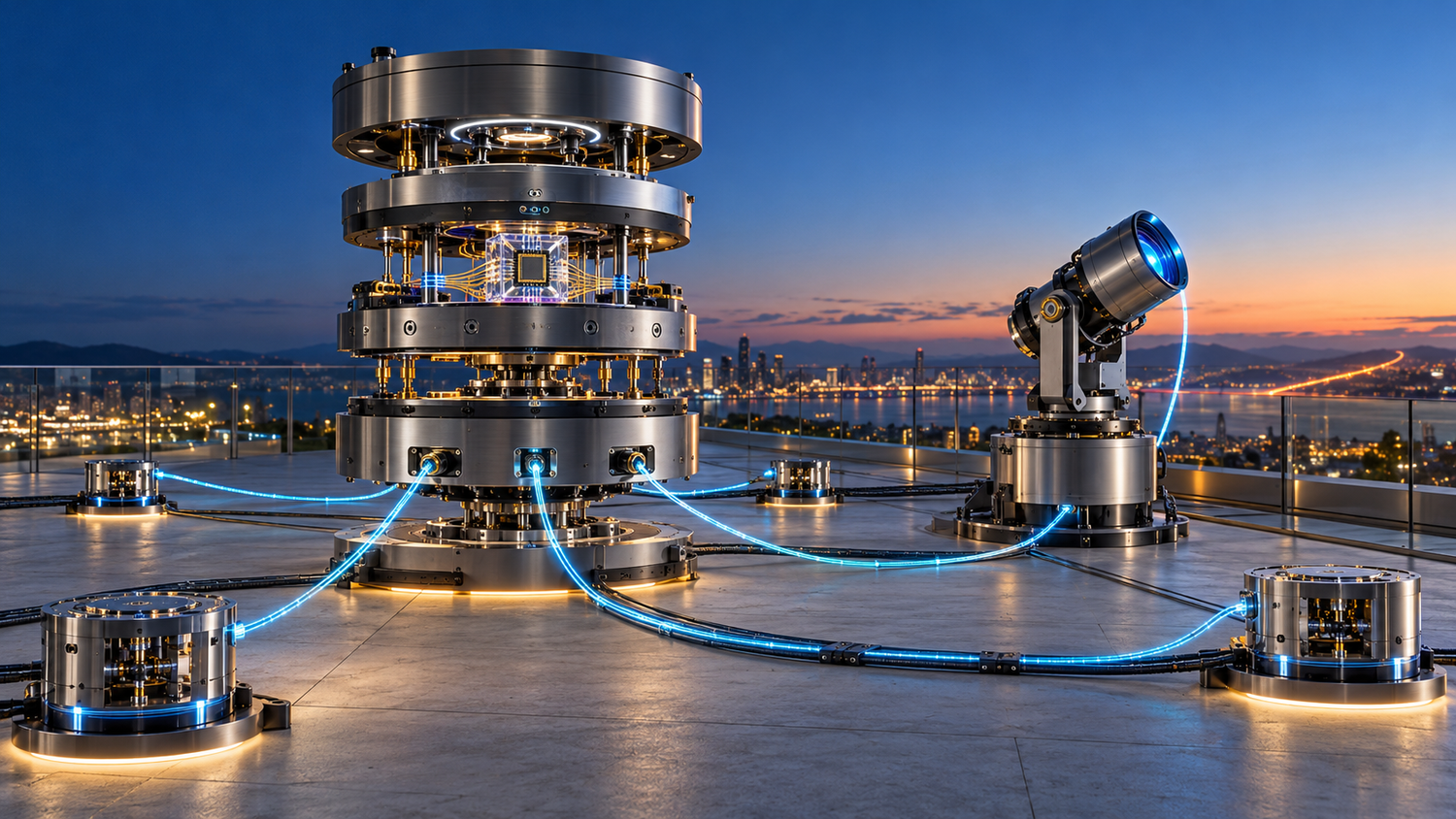
South Korea's Ministry of Science and ICT held the kickoff meeting for its Open Quantum Testbed Advancement and Expansion Project at the Pangyo Enterprise Support Hub on 21 October 2026, together with the National Information Society Agency. The plan it set out grows the country's quantum cryptography test network from a spine linking Seoul, Pangyo and Daejeon into a nationwide fabric by 2028, with a KT-led consortium running the commercial and future hubs and an SK Broadband-led consortium running the overseas hub. The ministry's release of 21 October puts the 2026 budget at 7.4 billion won, of which the government pays 3.75 billion and industry 3.65 billion.
The release is a program announcement, so it carries plans rather than measurements. It still tells a defense reader three concrete things. It fixes the order in which Korean cities join the network. It states, in one sentence, how the government intends to pair quantum key distribution with post-quantum cryptography by distance once the network reaches across borders. And KT's own statement of 22 October adds the one engineering number in the whole story: the wireless key-distribution distance it means to raise from about 4.8 kilometers to about 15.
This post reads the announcement as a defensive networking capability. It asks what the testbed would let Korean public bodies, including the defense sector KT lists as a user, do with their data traffic, who gains from it, and what still separates a kickoff meeting from a program office relying on the links.
What the 21 October 2026 release commits to: three hubs, 7.4 billion won in 2026, and Daegu, Gwangju, Busan and Gangwon by 2028
The ministry and the National Information Society Agency have run the open quantum testbed since 2024 on sections linking Seoul, Pangyo and Daejeon. The testbed is a shared demonstration space. Companies and research institutes bring quantum communication products to a key-distribution test network fitted with measurement equipment that few of them could afford alone, and have the performance checked. The new project keeps that purpose and splits the growth into three hubs, as The Quantum Insider summarized the same day.
The commercial hub, run by KT, extends the test network to Daegu this year, to Gwangju and Busan in 2027, and to the Gangwon region by 2028. KT's statement lists the four new sections: Daejeon to Daegu, Daejeon to Gwangju, Daegu to Busan, and Seoul to Chuncheon, which together tie the Chungcheong, Honam, Yeongnam and Gangwon regions to the existing Daejeon node. On that network, quantum key distribution is to be applied to research, medical and financial data transfers, and the interoperability of domestic equipment from different manufacturers is to be verified. KT says the expansion runs on Korean-made equipment, and that the use cases will widen from finance and medicine into the public and defense sectors.
The overseas hub, run by SK Broadband, links the Korean testbed to counterpart testbeds in Singapore, Poland and Bulgaria for state-to-state demonstrations. The future hub, again KT, is to build a demonstration environment for long-distance wireless quantum cryptography and for entanglement distribution among several sites, while developing and verifying the core technologies a later quantum network would need.
The money is modest. Seven point four billion won is around five million US dollars at recent exchange rates, split almost evenly between government and industry, and the release gives it as the 2026 figure for a project that runs to 2028. Yoon Kyung-sook, the ministry's director of basic and fundamental research policy, framed the purpose as commercialization in remarks carried by Money Today: broadening the demonstration base so that companies can verify technologies and products in varied environments, with testing and technical support matched to demand on site.
How the overseas hub splits the work: QKD on short domestic sections, PQC on long international sections to Singapore, Poland and Bulgaria
The sentence in the release that deserves the closest reading is the one on architecture. For the overseas demonstrations, quantum key distribution is applied to the relatively short domestic and local overseas sections, and post-quantum cryptography to the long international sections. The two protect the same traffic, which the release describes as research data transfers and the data of future air traffic systems such as urban air mobility.
That split is a design decision, and it follows how the physics and the economics fall. Fiber-based QKD exchanges keys on single photons and loses them with distance. A metropolitan link of tens of kilometers runs on commercial equipment today, while a link from Seoul to Warsaw or Sofia would need trusted relay nodes at every stage or a satellite overhead. PQC runs in software on existing routers and servers and is indifferent to distance. A government that wants a quantum-era key exchange with a foreign partner next year, rather than after a satellite constellation exists, has little choice other than to put PQC on the long haul and reserve QKD for the sections where photons can actually arrive.
The choice of partners fits that reading. Poland and Bulgaria are European Union members, and the EU's European Quantum Communication Infrastructure is building terrestrial segments in member states while its first satellite, Eagle-1, is listed by the European Space Agency for launch in late 2026 or early 2027, followed by three years of in-orbit validation. A Korean link to either country will therefore meet a national QKD segment at the far end and nothing in between, which is exactly the situation the release's split anticipates. For a Korean agency the lesson is practical. Whatever the testbed proves about QKD will apply to domestic metropolitan sections and to campus or base networks. Anything that crosses a border will be protected by the lattice-based algorithms standardized in 2024, and the international demonstrations are as much a test of PQC interoperability between national networks as of QKD.
Quantum pillar: networking (quantum key distribution links). Use posture: defensive. Technology readiness: provisionally assessed at TRL 6 of 9 for the demonstrated wireless section, pending verification against the governing readiness rubric. This is a government program announcement that funds a test network and lists demonstrations still to come, so a level belongs to each link once it has run; the fiber sections will use equipment already sold commercially, the wireless section has been shown over 4.8 kilometers and is to be extended to 15, and entanglement distribution among several nodes remains laboratory work.
What KT's future hub adds: wireless QKD from 4.8 to 15 kilometers, turbulence-adaptive optics and multi-node entanglement distribution
KT's statement of 22 October, carried in English by Nocut News, is where the engineering detail sits. In the future hub, the company extends fiber-based QKD into the wireless and satellite domains and verifies entanglement distribution between nodes. The wireless demonstration distance, about 4.8 kilometers so far, is to reach about 15 kilometers. To get there KT plans to modularize the equipment and to apply adaptive optics that correct the distortion the atmosphere imposes on the beam, and it describes both as the basis for a later extension to satellite-to-ground links. Jeon Myeong-jun, head of the enterprise service division at KT Enterprise, said the company would carry out the next-generation demonstrations on its nationwide network infrastructure.
Fifteen kilometers of wireless quantum key distribution over land is a meaningful target for a defense user because of where fiber does not go: between a headquarters and a field site across a river or a valley, between a shore station and a vessel in harbor, between two buildings on a base where trenching is ruled out. Free-space links at that range have been demonstrated by several groups worldwide. What KT would add is a Korean-built, modular terminal tested on a national testbed under Korean weather, with its key rate and availability on the public record. The satellite remark stays a remark. The project funds ground-side optics and procedures, and no Korean QKD satellite is part of it.
Entanglement distribution among several nodes is the longest reach in the plan. It is the building block for quantum repeaters and for networks that would one day link quantum sensors or processors, and it sits at the laboratory stage everywhere. Its presence here says the ministry wants the national testbed to carry research hardware as well as commercial equipment, which is what the future hub label means.
What the testbed would let a Korean force or agency do, and who gains: a defensive reading
The capability on offer is protection of one's own traffic. QKD gives two endpoints keys whose secrecy rests on the physics of single photons rather than on the hardness of a mathematical problem, and an intercept attempt shows up as errors in the key. For a defense user that means a key supply for high-value fixed links, such as those between command sites, data centers and research establishments, that does not depend on any assumption about when a large quantum computer arrives. The testbed's job is to show that Korean-made QKD gear from different vendors can be chained on one network, hand keys to the encryptors the sectors already use, and stay up. KT lists finance, medicine, the public sector and defense as the fields where it means to apply the result.
Who gains is clear in the sense of the capability map, and the posture is defensive. Nothing in the release degrades an adversary's sensing or breaks anyone's cryptography. The gain accrues first to Korean operators and equipment makers, who get a venue to prove products, second to the agencies that will buy those products, and third to the partner states, who get an interoperability test with a network outside Europe. India's DRDO ran a comparable exercise this month, placing a QKD platform on the live network of its proof and experimental establishment and passing artillery trial telemetry over it, and the medical use the Korean release lists echoes what Stony Brook is doing with its hospital quantum network. The pattern is the same in all three: a trusted public network, real traffic, and a measured result a buyer can read.
What stands between a testbed kickoff and a program office: budget scale, interoperability evidence and the 2028 clock
Three things stand in the way.
The first is scale. Around five million dollars a year buys test sections and demonstrations. It does not buy a national key-distribution service. A defense program office that wants QKD on its own links will have to fund the equipment and the trusted nodes itself, and the testbed's value to it is evidence rather than capacity.
The second is evidence that does not yet exist. The release promises interoperability verification between domestic vendors, operation on real research, medical and financial traffic, and a 15-kilometer wireless link. None of those has a number yet. The milestones to watch are specific: a published interoperability result between at least two Korean QKD vendors on the Daejeon hub, key rates and availability on the first new section to Daegu this year, a wireless link at or near 15 kilometers with its key rate and weather conditions stated, and the first cross-border session with Singapore, Poland or Bulgaria in which PQC on the international leg and QKD on the local legs are shown working together.
The third is the clock. The commercial hub reaches Gangwon in 2028, and the same year closes the project's funding window. A buyer who expects to specify QKD in a procurement before then will be working from interim testbed results and should ask for them section by section rather than wait for the closing report. The announcement is real and the architecture it states is sound. The evidence behind it is, for now, a plan, and the Register entry will move when the first section reports.
Sources
Primary source: Ministry of Science and ICT of the Republic of Korea, Quantum Innovation Technology Development Division, "양자통신 상용화를 위한 실증 기반 확대 본격 착수," press release of 21 October 2026, read via the Korea Development Institute's government press release archive (https://eiec.kdi.re.kr/policy/materialView.do?num=288381) while msit.go.kr was under maintenance. Other material: Money Today English, 21 October 2026; KT statement of 22 October 2026 via Nocut News, Newspim and ET News; The Quantum Insider, 21 October 2026; ESA Eagle-1 mission page. The exchange-rate approximation, the posture reading, the architecture analysis and the buyer milestones are Quentir analysis.