INAF Recasts AGILE Gamma-Ray Source Detection as a QUBO for Quantum Annealing, arXiv 2610.37040, 27 October 2026: 97 Percent Correct Positions on 500 Simulated Maps With an Emulated Solver, TRL 2
Quentir Defense Monitor
Evidence-based insights for quantum defense and security. Published by Quentir Systems LLC · October 28, 2026.
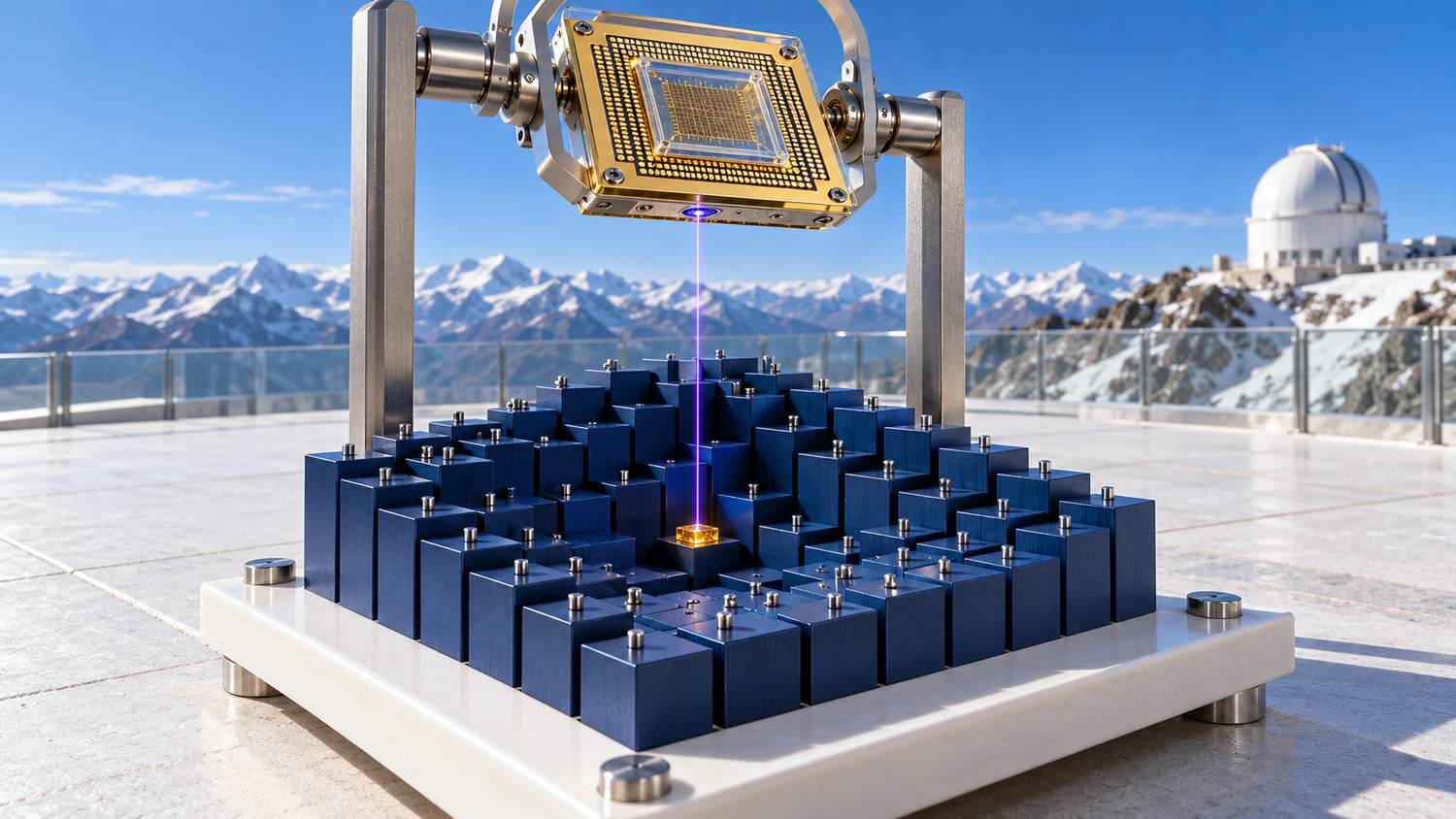
Fifteen researchers from five institutes of Italy's National Institute for Astrophysics posted a nine-page paper on 27 October 2026 that takes a routine job in space-based gamma-ray astronomy, finding a point source in a noisy photon map and fixing its position and brightness, and rewrites it as the kind of problem a quantum annealer is built to solve. The paper, arXiv 2610.37040, was presented at the AIQxQIA workshop of the AIxIA conference in Perugia in October 2026 and is headed for the CEUR-WS proceedings. Alessandro Rizzo of the INAF observatory in Catania is the corresponding author; co-authors sit in Bologna, Rome and Trieste.
The data come from AGILE, the small gamma-ray mission of the Italian Space Agency that flew from April 2007 until its re-entry in February 2024. Its Gamma-Ray Imaging Detector covered 30 MeV to 50 GeV across a wide field of view, and at the low end of that band a single photon's arrival direction is known only to within degrees. Locating a source is therefore a statistical fit over many photons, and that fit is what the team moved onto an annealing formulation.
For a defense reader the interest lies past the astronomy. Finding a faint emitter in a sparse count map, deciding whether it is real, and placing it on a grid is the same mathematical task that space-based detonation detection, radiological search and several intelligence, surveillance and reconnaissance workflows perform with their own sensors. This post reads what the paper establishes about quantum annealing for source localization, what it does not, and how far it sits from anything a program office could use.
How INAF turned a maximum-likelihood scan into a Quadratic Unconstrained Binary Optimization with 81 candidate positions and 12-bit fluxes
The classical method is a likelihood scan. For each candidate position the analyst fits a source flux and a background level to the counts in every pixel, computes a test statistic against a background-only model, and moves to the next grid node. The node with the highest test statistic wins. On AGILE data the team ran this over a 50 degree field with 0.5 degree pixels in the 100 MeV to 10 GeV band, using AGILEpy, the open-source analysis package the Bologna institute maintains for the mission.
An annealer cannot run that loop. It accepts one object, a quadratic cost function over binary variables, and returns the assignment of zeros and ones that makes the cost smallest. The paper's contribution is the translation. The Poisson likelihood is approximated by a Gaussian so that the fit becomes a least-squares problem, which is quadratic. The isotropic background normalization and a separate source flux amplitude for each of the 81 candidate positions are written as fixed-point binary expansions of 12 bits each. The position is handled by 81 candidate grid nodes, one binary variable per node, with a penalty term that forces exactly one node to be chosen, weighted at five times the largest single-node test statistic. The whole instance runs to 12 × (1 + 81) + 81 = 1,065 binary variables.
The solver was not a quantum annealer. The team used the simulated quantum annealing sampler in OpenJij, the open-source library maintained by Jij Inc., which emulates an annealer's transverse-field dynamics with path-integral Monte Carlo on a conventional processor, at 100 reads and 1,000 sweeps per run. The authors say so themselves: the work is "laying the ground for its deployment on actual quantum annealers."
The test set was synthetic. Five hundred AGILE observations were generated with AGILEpy, each with one point source of flux drawn log-uniformly between 5 by 10 to the minus 5 and 3 by 10 to the minus 4 photons per square centimeter per second, over an isotropic background drawn uniformly between 5 and 15 in the package's units. The authors describe this as "a dataset with high source fluxes" chosen for "the exploratory nature of this work."
What the 500 maps showed: the right node 97 percent of the time, a 1.9 percent flux bias and a 20 percent background offset
The headline result is clean. The QUBO solution identified the correct grid node in 97 percent of the maps, and in the remaining three percent the chosen node was displaced by a single grid step of 0.5 degrees. Recovered flux carried a mean bias of minus 1.9 percent with a standard deviation of 8.3 percent, inside the statistical uncertainty of the classical fit. The classical and QUBO test statistics were almost perfectly correlated across the set, with a Pearson coefficient of 0.997.
Two numbers in the paper deserve more attention than the headline. The isotropic background normalization was systematically underestimated by 20 percent, with a spread of 10.8 percent. And the QUBO detection significance, the square root of the test statistic, ran from 17 to 145 with a mean of 65, higher than the classical values for the same maps. The authors trace the inflated test statistic to the cost function: the QUBO minimizes an unweighted least-squares chi-square that assigns unit variance to every pixel, while the classical test statistic comes from the Poisson likelihood, which weights pixels by their expected counts. They connect the flattening of the recovered background values to the finite encoding range, but leave the systematic background offset unresolved. On bright sources the approximation holds well enough to find the node. On fainter sources, where Poisson statistics dominate, the authors expect it to degrade, and the background bias "deserves further investigation" in their own words.
Quantum pillar: computing (machine learning for ISR). Use posture: dual-use. Technology readiness: assessed at TRL 2 of 9, pending verification against the governing readiness rubric. The INAF team formulated gamma-ray source detection and localization as a quantum annealing problem and validated the formulation on 500 synthetic AGILE maps with a classical emulator of an annealer; the quantum step was never run on hardware, and the instance as written would not fit on an existing annealer, which places the work at a concept worked out with its numbers, one step below an experimental proof.
Why the paper sits in the ISR detection branch, who gains, and why it reads as dual-use
The capability map Quentir uses for the Defense Monitor files detection and classification over intelligence, surveillance and reconnaissance data under the computing pillar, and this paper belongs there even though its method is an optimization formulation with no trained model involved. The task is detection and localization of an emitter in sensor counts, the input is a sky map from a space-borne detector, and the output is a decision plus a position. That is the ISR shape.
The nearest defense analog is public and old. The Global Burst Detector payloads carried on GPS satellites have flown since April 1980, as Los Alamos National Laboratory describes, and their modernized form combines a hard-radiation sensor for x-rays, gamma rays and particles with an electromagnetic-pulse sensor. The laboratory's own description of the downstream job is a likelihood problem in plain words: when the right products are detected in the right proportions, ground systems can identify a blast, estimate where and when it occurred, and gauge how big it was. Radiological search with mobile gamma spectrometers, and the separation of a real emitter from cosmic-ray background in any space sensor, carry the same structure. The INAF paper discusses none of those systems, and this post makes no claim about how any of them process data today. The point is narrower: the task INAF moved onto an annealing formulation is one that defense sensor chains also perform.
What would a force gain if the formulation matured? Two things, in principle. The first is a different compute path for a search that today scans a grid node by node; the formulation jointly encodes all 81 candidates in one cost function. Its penalty weight still requires preprocessing to find the maximum single-candidate test statistic across the grid, and detection significance requires separate full-model and null-model solves. Joint encoding therefore establishes no constant end-to-end work or sampling effort as the grid grows. The second is a route to running source detection on hardware other than a conventional processor, which matters to anyone weighing compute diversity in a ground segment. Neither gain is demonstrated. The paper shows that the formulation returns the right answer when a classical emulator solves it, which is a statement about the mathematics, not about speed or hardware.
The posture is dual-use in the map's sense. The same formulation serves a civil observatory hunting flares, a treaty-monitoring ground station, and a military sensor chain that wants to know where an emitter is. The direction of benefit depends on who owns the detector, and the paper itself is civil science with no defense funding statement. Quentir read a related annealing story in the C12 and Thales QuantumTrack radar tracker, where the association problem of a multiple-hypothesis tracker ran on annealing hardware with a bench-measured latency; that work sits further up the ladder because the hardware step was taken.
What stands between an emulated QUBO and a program office: qubit count, embedding, faint sources and a real annealer
The first obstacle is size, and the authors state it plainly. An instance with about a thousand binary variables and dense quadratic couplings "would exceed the approximately 5000 qubits available on current D-Wave Advantage devices." The reason is connectivity. D-Wave's documentation puts each Advantage processor at 5,640 qubits and 40,484 couplers in a Pegasus topology where each qubit couples to 15 others, and the Advantage2 Zephyr topology raises that to 20. A least-squares cost over a thousand variables couples far more pairs than that, so embedding the problem requires chains of physical qubits standing in for one logical variable, and the chain budget runs out. The paper's own next steps are problem-size reduction, embedding tools for sparse topologies, and a run on real hardware. Quentir's Medicine Monitor met the same reshaping question when it read QCI's Dirac-3S search for INmune Bio, where an optimization problem had to be fitted to a machine's variable type before any speed claim could be weighed.
The second obstacle is the faint regime. The synthetic set used bright sources so that the Gaussian approximation would hold, and the authors say it degrades where photons are few. The emitters a defense sensor chain cares most about are often the faint ones, close to threshold, where the Poisson weighting the QUBO drops is what separates a detection from a fluctuation. A follow-up on faint synthetic sources, then on real archival AGILE maps, is the result that would move this entry to TRL 3 and TRL 4 in turn.
The third is multiplicity. The formulation enforces exactly one source per map. Real fields hold several, sometimes close together, and the authors list multiple nearby sources as open work.
The fourth is the comparison a buyer would ask for and that no one has yet run: wall-clock time and energy for the annealing path against the classical scan on the same maps. The classical likelihood scan is a mature pipeline that AGILE ran for sixteen years. An annealer route earns a place only if it is faster, cheaper or more robust at a problem size the classical path finds hard, and the paper makes no such claim.
The practical reading for a buyer is this. The INAF paper establishes that gamma-ray source localization can be written as a QUBO and that the formulation recovers the right node and the right flux on bright synthetic sources when a classical emulator solves it. It does not establish that a quantum annealer can hold the problem, that it would be faster, or that the method survives the faint sources that matter most. A program office with a space-based detection or radiological-search interest should file this as a formulation worth watching, and should expect the next evidence to come from a hardware run on a reduced instance and a faint-source study, each of which is a reason to revisit this entry.
Sources
Primary source: Alessandro Rizzo, Nicolò Parmiggiani, Andrea Bulgarelli, Gabriele Panebianco, Carlo Burigana, Vincenzo Fabrizio Cardone and nine co-authors (INAF: Osservatorio Astrofisico di Catania; OAS Bologna; Istituto di Radioastronomia, Bologna; Osservatorio Astronomico di Roma; Osservatorio Astronomico di Trieste), "Quantum Annealing for Gamma-ray Source Detection and Localization with AGILE Data," arXiv 2610.37040, posted 27 October 2026, presented at the AIQxQIA workshop of the AIxIA conference, Perugia, October 2026. Other material: ASI Space Science Data Center, AGILE mission page; OpenJij project page, Jij Inc.; D-Wave Quantum documentation on QPU topologies; Los Alamos National Laboratory, "Cosmic custodians," 22 April 2022. The capability reading, the posture argument and the buyer milestones are Quentir analysis.