Infleqtion's Tiqker Optical Atomic Clock Runs Two Weeks Aboard the US Navy's RV Merlin During Maritime Big Play Pacific and BARB-26, 30 October 2026: GPS-Independent Timing at Sea, TRL 6
Quentir Defense Monitor
Evidence-based insights for quantum defense and security. Published by Quentir Systems LLC · November 1, 2026.
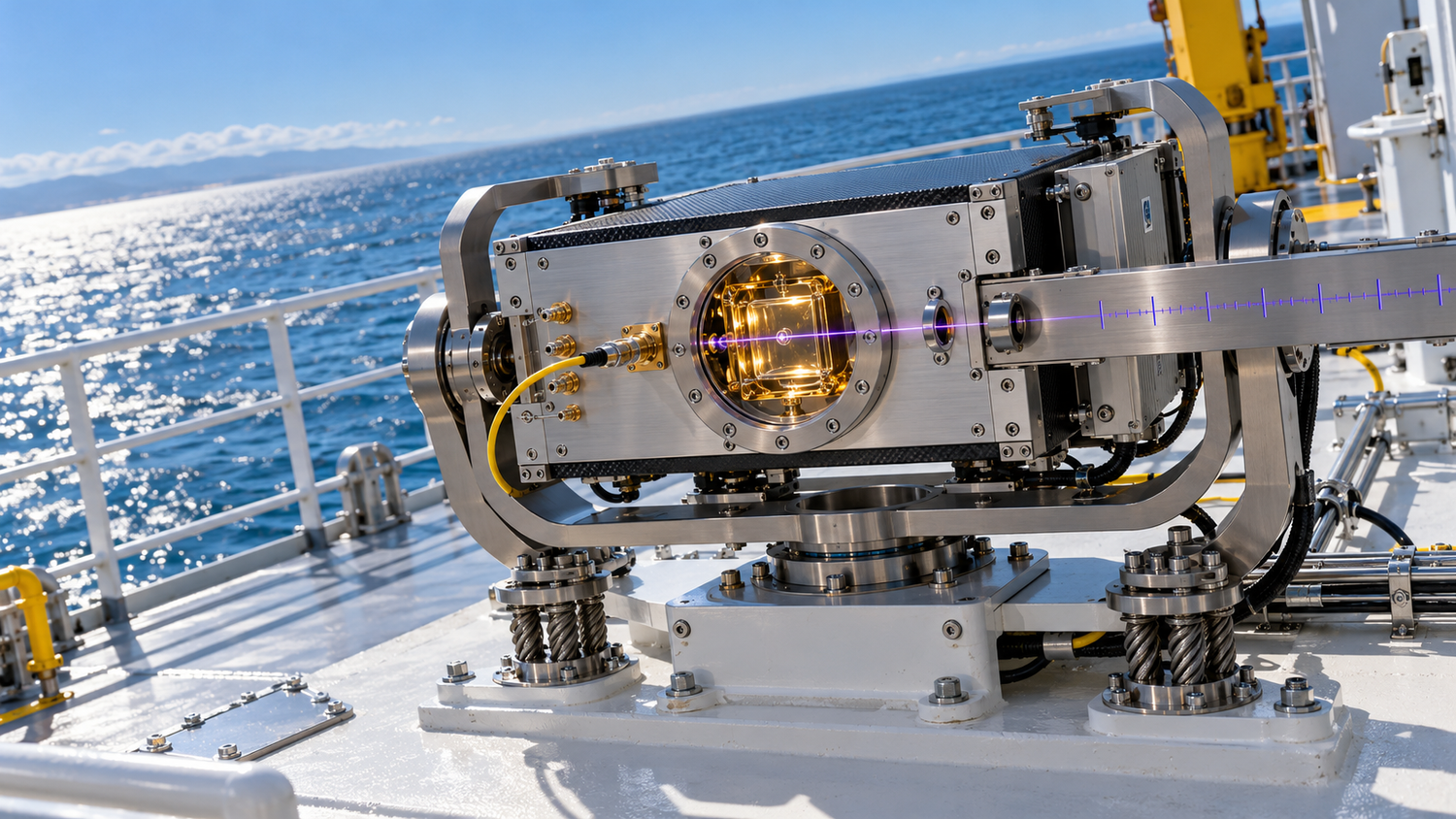
Infleqtion said on 30 October 2026 that its Tiqker optical atomic clock ran continuously for two weeks aboard RV Merlin, a US Navy support vessel, in the Southern California operating area. The trial took place during Maritime Big Play Pacific, an exercise sponsored by the Office of the Under Secretary of War for Research and Engineering with participation from the US Navy, the US Marine Corps and the Australian and UK partners under AUKUS. The company's release adds that the demonstration also supported BARB-26, a Navy exercise on emerging subsea and seabed warfare capabilities, and that the clock kept running through large temperature swings and sustained vibration, above and below the surface, alongside crewed and uncrewed systems.
What the release leaves out matters as much as what it says. It gives no accuracy, drift or stability figure from the two weeks at sea. It announces no purchase and no decision to field the clock. Its stated purpose is to gather the operational data needed to advance integration into naval platforms, in the words of chief executive Matthew Kinsella. This post reads the trial as a GPS-independent timing capability under the sensing pillar, sets out what a stable shipboard clock changes for a fleet when satellite signals fail, and lists what still separates a successful exercise from a requirement a program office can write.
The reason a clock belongs in a defense monitor is simple. Every shipboard system that shares data with another runs on a common sense of time: radars that stitch returns together, data links that hop frequencies, encrypted radios and the inertial navigator. Most platforms take that time from GPS. When the signal is jammed or spoofed, a platform with its own stable reference can maintain local timing and support timing-consistency checks, but that reference alone does not authenticate satellite signals. Maintaining time without the external reference is called holdover, and the question for a buyer is how long a given clock can hold before drift becomes a navigation or communications problem. The release reports continued local timing during interference, not a demonstration of spoof detection.
What Infleqtion's 30 October 2026 release establishes about the RV Merlin trial, and what the Tiqker product page adds in numbers
The release establishes the run, the venue, the conditions and the framing: more than two weeks of continuous operation, a Navy support vessel in a sponsored exercise with AUKUS partners present, large temperature swings and sustained vibration, and an evaluation meant to inform future naval integration, which is the language of an experiment rather than of an acquisition. The numbers come from elsewhere. Infleqtion's Tiqker product page states a minimum Allan deviation of 5.0 x 10^-13 at one second, holdover that outperformed cesium-beam clocks beyond one day in testing, and synchronization between sites of roughly 10 picoseconds. The unit is a 3U, 19-inch rack-mount box under 22 kilograms that draws under 85 watts in steady-state operation, with 5, 10 and 100 megahertz radio-frequency outputs, two pulse-per-second outputs, a 1,556 nanometer continuous optical output and a pulsed comb output. The page says the UK's National Physical Laboratory tested the clock against references traceable to Coordinated Universal Time, and that Safran Electronics and Defense is a partner for timing distribution. None of those figures is a result from RV Merlin; they are the company's bench and prior-trial claims, and a buyer should hold them apart from the sea trial until its own data appears.
That distinction is the heart of the story. The company's report of a two-week run that never stopped is a reliability result for operation in a ship's thermal and vibration environment. It says nothing yet about how far the clock wandered from true time over those two weeks, which is the figure a navigator or a network engineer needs. Infleqtion's release of the Excalibur trial a year earlier promised performance benchmarking against high-grade time standards as the next step, and the RV Merlin release does not report that step as done.
Three trials in three domains: QinetiQ's RJ100 flight in May 2024, XV Excalibur's dives in October 2025, RV Merlin's two weeks in 2026
Tiqker's public trial history now spans air, undersea and surface. The UK government announced on 13 May 2024 that Infleqtion, BAE Systems and QinetiQ had flown the clock and a cold-atom quantum sensor aboard QinetiQ's RJ100 Airborne Technology Demonstrator from Boscombe Down in Wiltshire, with the science minister aboard the final flight on 9 May 2024. The work was supported with nearly 8 million pounds of public funding toward a quantum inertial navigation system, with an aim of deploying quantum navigation on aircraft by 2030, and the release was candid that GPS jamming is relatively rare for aircraft and that quantum systems add a further layer of security.
The Royal Navy reported on 28 October 2025 that Tiqker had gone to sea aboard XV Excalibur, the extra-large uncrewed submarine built by MSubs, with the Submarine Delivery Agency's Autonomy Unit, and had operated reliably during multiple dives. The Navy described the clock as a compact optical clock with performance equivalent to a laboratory-grade time reference that smooths the noise behind navigation drift and serves sonar, fire control and secure communications. Commander Matthew Steele of the Disruptive Capabilities and Technologies Office called the experiment a first critical step toward understanding how quantum clocks can be deployed on underwater platforms, and said the office would champion further trials aboard Excalibur.
Read in sequence, the three trials show a deliberate climb. The 2024 flights lasted hours, the 2025 dives were counted in sorties, and the 2026 surface trial ran for two weeks without interruption, the first duration in the series that resembles a deployment. Sustained operation is what separates a sensor that rides along on an exercise from one a crew can rely on, and it is the element the RV Merlin release adds.
Quantum pillar: sensing (clocks and timing). Use posture: defensive. Technology readiness: provisionally assessed at TRL 6 of 9, pending verification against the governing readiness rubric. For the reader this means a complete clock has now run for two weeks in the real maritime environment it is meant for, aboard a Navy support vessel during a sponsored exercise, while the published evidence still lacks the measured drift figure, a report of integration into a combat platform's timing distribution and a fielding decision; the exact criteria for level 7 and beyond remain unverified.
Why the panel reads defensive and TRL 6: a relevant environment on a support vessel, with no figures and no integration into a combat system yet
The posture is defensive in the sense of Quentir's capability map because the value described lies in holding navigation and timing for one's own force when satellite signals are denied or spoofed. The clock finds no adversary and breaks no one's cryptography; it keeps a ship's own radars, links and navigator coherent when the signal they usually trust is gone. The BARB-26 framing deserves a note. The release says the demonstration supported a Navy exercise on emerging subsea and seabed warfare. A stable clock aboard a platform in that exercise is still a timing reference; what the host platform does with precise time is a separate question the public sources leave open.
The readiness assessment is provisional because the governing house readiness ladder was not supplied for verification. Two continuous weeks aboard a Navy vessel at sea, through the temperature and vibration a ship imposes, during an exercise with the sponsor's observers present, supports a provisional assessment of a system demonstration in a relevant environment at level 6. Three limits constrain that assessment: integration into a combatant's timing architecture was not reported, and cannot be inferred from the vessel type; no performance figure from the trial has been published; and no Navy integration decision has been announced. Earlier this week this lane placed QuantX Labs' TEMPO.Space orbital clock at level 5 with a comb in orbit and a proto-flight clock still in environmental test; the provisional placement of a full clock that has already lived two weeks on a ship one step higher rests on the real environment and complete system, pending verification against the governing rubric.
What the Maritime Big Play series and BARB-26 tell a buyer about where the trial sits in the AUKUS experimentation pipeline
Maritime Big Play is an exercise and experimentation series rather than a single event. Australia's defense department said in August 2026, as reported by Ocean News and Technology on 18 August 2026, that the AUKUS Pillar II subsea and seabed warfare capabilities tested from the Australian naval vessel ADV Guidance during Rim of the Pacific 2026 in July built on earlier testing conducted through the Maritime Big Play series. The Pacific iteration that hosted Tiqker therefore sits inside a standing channel through which the three AUKUS navies move undersea technologies from experiment toward integration, with the partners who would buy already in the room. Its reports stay with the sponsor, so the public sees what the vendor publishes and what the services choose to say. The described Aquark and Saab radar trial remains unverified here because its original passage and direct source reference were not supplied, so it cannot serve as a procurement benchmark.
What still stands between the sea trial and a program office writing a requirement: measured drift, a combatant, and a denial test with a sensor in the loop
Five milestones separate the 30 October 2026 release from a procurement line, and each is checkable when it happens. The first is the trial's own data: a published Allan deviation and holdover figure measured against a shipboard or shore reference over the two weeks would convert a reliability result into a performance result. The second is reported integration into a platform's timing distribution, since the release does not establish the clock's timing connections aboard the support vessel; the company's partnership with Safran on White Rabbit and SecureSync-based distribution is the obvious path. The third is a denial test with a sensor in the loop: GNSS removed or spoofed on purpose, the clock holding the radar or the data link together, and the operators able to see the difference. The fourth is a combatant or an operational uncrewed platform as host, because a support vessel's environment is milder than a destroyer's or a submarine's. The fifth is a procurement vehicle, whether a US Navy program of record, a UK contract through the Disruptive Capabilities and Technologies Office, or an AUKUS Pillar II line, since experimentation funding and acquisition funding are different money.
The capability is real at the level the sources support: a compact optical atomic clock that survives a ship for two weeks is a resilient PNT building block a fleet can plan around. The number that would let a navigator or a network engineer plan with it is still missing: the release provides no measured drift result. Until that figure appears, the two-week run stands as the strongest evidence of sustained operation among the documented Tiqker trials discussed here, with the performance case still to be made in public.
Sources
Primary source: Infleqtion, "Infleqtion Demonstrates Timing and Navigation Capabilities During the Maritime Big Play Pacific Military Exercise," press release, Louisville, Colorado, 30 October 2026. Other material: Infleqtion's Tiqker product page; the Royal Navy's releases of 28 October 2025 (XV Excalibur) and 14 August 2026 (Aquark and Saab radar trial); the UK government's release of 13 May 2024 on the RJ100 flights; Ocean News and Technology, 18 August 2026, on the Maritime Big Play series and the AUKUS Pillar II test at RIMPAC 26. The capability reading, the posture argument, the readiness placement and the buyer milestones are Quentir analysis.