QuantX Labs' TEMPO.Space Optical Atomic Clock Enters Environmental Testing for a 2027 Launch After Its Frequency Comb Ran in Orbit, Australian Space Agency Showcase, October 2026: TRL 5
Quentir Defense Monitor
Evidence-based insights for quantum defense and security. Published by Quentir Systems LLC · October 30, 2026.
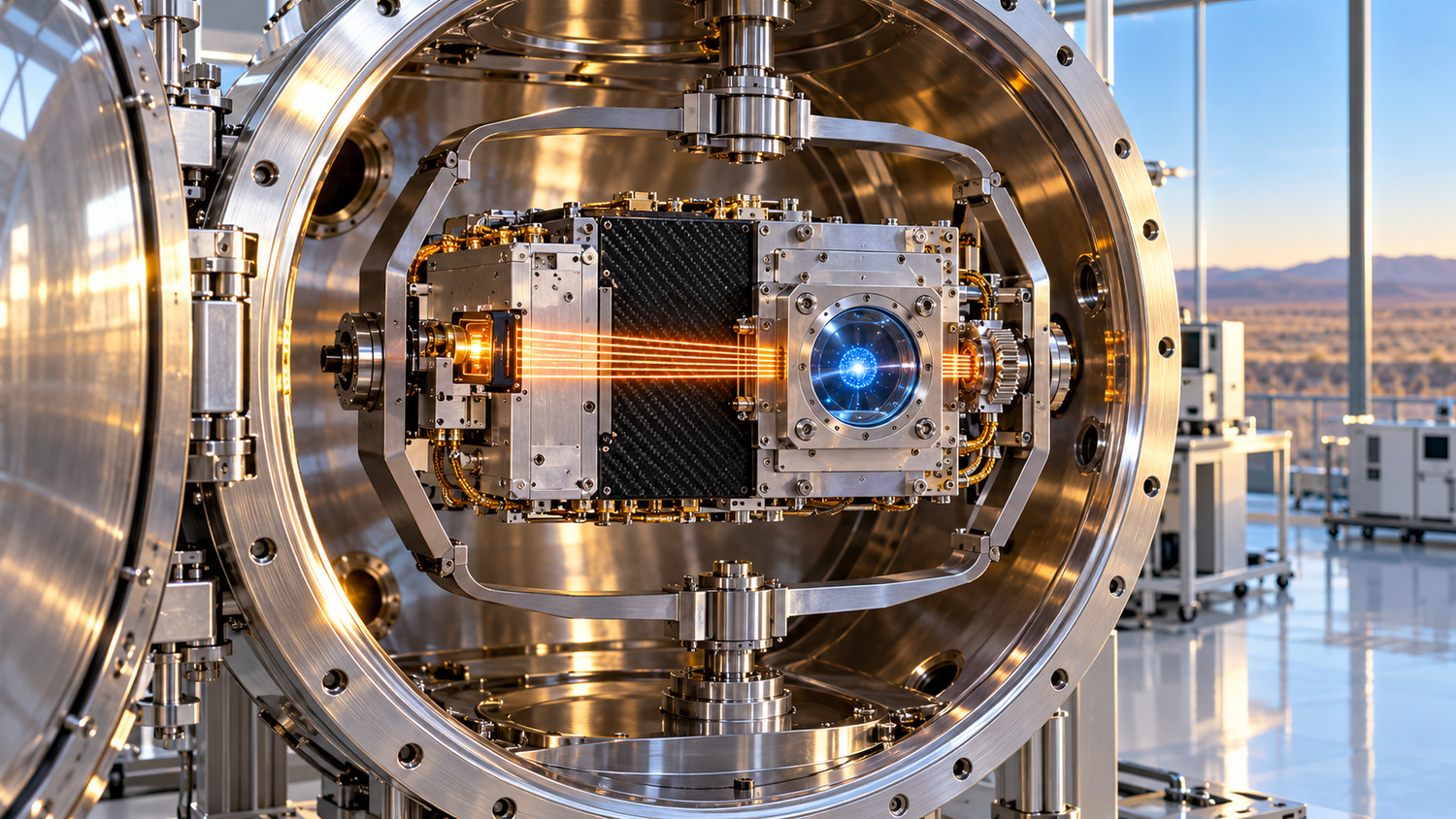
The Australian Space Agency has published a showcase page on TEMPO.Space, an optical atomic clock built for orbit by QuantX Labs of Adelaide, and it makes three claims a defense reader can check. The clock loses one second in 30 million years, its design offers ten times the performance of current GNSS-based timing in space, and it works as a detector of GPS spoofing and jamming. The agency page adds that a core subsystem, the optical frequency comb, has operated in space since a March 2026 ride on Exotrail's spacevan vehicle, and that Surrey Satellite Technology Ltd supports the systems engineering for a demonstration mission.
QuantX Labs' own releases supply the dates the agency page leaves out. The company announced on 21 July 2026 the successful in-orbit commissioning of its optical frequency comb, launched on 30 March 2026 aboard Exotrail's spacevan on SpaceX's Transporter-16 rideshare from Vandenberg. The same release says the full clock's proto-flight model is in environmental testing and that deployment is targeted for 2027. Read together, the two sources describe a space optical atomic clock program with one flight-proven subsystem, one qualification campaign under way, and a launch date that has already moved.
Why this belongs in a defense monitor is plain. Every GNSS constellation is a set of atomic clocks in orbit, and every receiver on a ship, an aircraft or a radio derives time from them. When those signals are jammed or spoofed, a platform that carries its own stable clock keeps its timing, its network synchronization and its ability to tell a false signal from a true one. The question for a program office is how much of that promise the public evidence supports today.
What the agency page and QuantX Labs' releases establish: a comb in orbit since 30 March 2026, a proto-flight clock under test, a date that slipped from 2026 to 2027
The evidence trail is longer than the showcase suggests. In September 2023 QuantX Labs announced its partnership with SSTL through Airbus Australia for a mission it calls KAIROS, with a launch then slated for early 2026. In April 2025 the company said the comb would fly on Exotrail's spacevan "in December 2025 at the earliest" with a 3.7 million Australian dollar grant from the agency's Moon to Mars initiative, and listed the environmental tests the comb had passed: temperature swings, vacuum, vibration, acceleration and radiation beyond the mission lifetime. The launch came on 30 March 2026, and on that day the company wrote that the comb mission would support "an intended launch of the full TEMPO.Space optical atomic clock later this year." By 21 July, with the comb commissioned and returning data, that target had become 2027.
The showcase claims therefore need sorting by what each rests on. The comb's operation in space is a completed fact, confirmed by the operator and the agency. The one-second-in-30-million-years figure is a design statement for the full clock; no in-orbit measurement exists, because the clock has not flown. The ten-times-GNSS comparison appears in QuantX's April 2026 release as "up to ten times," and no source gives the stability number behind it. Spoofing and jamming detection is a stated application, with no reported trial.
An optical clock locks a laser to an atomic transition at hundreds of terahertz, far too fast for electronics to count. The comb, a pulsed laser whose spectrum is a ruler of evenly spaced lines, divides that optical frequency down to a radio-frequency tick a satellite can use. Without a comb in orbit there is no usable output from an optical clock in orbit, which is why QuantX flew that subsystem first and why its commissioning is a real engineering milestone.
Quantum pillar: sensing (clocks and timing). Use posture: dual-use. Technology readiness: TRL 5 of 9. The optical frequency comb subsystem has operated in orbit since March 2026, while the full TEMPO.Space clock exists as a proto-flight model in ground environmental qualification with no in-orbit performance figure published, so the program as a whole sits at subsystem validation in a relevant environment, below the flight demonstration planned for 2027.
What a stable clock on a satellite lets a force do: holdover, spoof detection and synchronized sensing when GNSS is denied
The capability reading starts with time, because position is derived from it. A platform with a better clock of its own can do three things. It can hold accurate time through a jamming episode and re-acquire faster when the signal returns. It can compare the time a received signal implies with the time it knows, which is the simplest detector of a spoofed signal, since a counterfeit transmitter cannot easily reproduce the timing geometry of a real constellation. And it can synchronize a group of sensors or radios without any GNSS reference, which is what distributed radar, passive geolocation and some satellite communications waveforms require.
Those three uses are what the agency means by a secure alternative, deep-space communications and synchronized Earth observation. QuantX's April 2026 release draws the line to the national defense strategy and Integrated Investment Program that Australia published on 16 April 2026, which it says commits 425 billion Australian dollars over the decade and ranks resilient multi-orbit satellite communications seventh among its priorities, with 9 to 12 billion for enhanced space capabilities. That is a vendor's reading of a budget line, and the direction is consistent with how other governments fund the field: Quentir read the same pattern in the UK's 50 million pound quantum sensing and PNT competition of 13 October 2026, which also funded a satellite clock.
The GNSS-denied PNT case is where an orbital clock differs from the vehicle clocks most of the field works on. A clock carried on a ship or an aircraft protects that platform. A clock on a satellite can improve timing for compatible receivers if the satellite also carries a navigation payload and a usable signal link reaches them. Receivers need interference protections sufficient to maintain that link during jamming, and signal authentication or independent checks to detect spoofing; a better satellite clock alone provides neither protection. TEMPO.Space is a timing demonstration, so the near-term value is the heritage it builds and the measurement it will return: how an optical clock behaves through launch loads, thermal cycling and radiation over months, which is the data a future sovereign navigation or timing payload would be designed from.
Who gains from an orbital optical clock, and why Quentir reads the posture as dual-use
Nothing in the clock targets anyone. The agency page frames the mission around communications networks, transport, emergency services and defense forces in one sentence, and its feature list ends with satellite navigation, lunar exploration, Earth observation and terrestrial timing networks. The same clock that lets a telecom operator ride through a timing fault lets a naval task group keep its data links synchronized when GNSS is jammed, and the same spoofing detector that protects a port protects a warship. In Australia's case the program is also a sovereign supply question: QuantX builds the CRYO oscillator for the Jindalee over-the-horizon radar upgrade, and its magnetometer line is pitched at undersea surveillance, so the clock sits inside a portfolio sold to Australia's defense department.
The military value of an orbital clock is entirely about resilience: longer holdover, earlier detection of interference, tighter synchronization. That is the defensive half of a dual-use capability, and it is the half that program offices in Canberra, London and Washington are now paying for.
What stands between the showcase page and a program office: the Tiangong precedent, the missing stability figure and the slipped date
Three things stand between this evidence and a buyer relying on it. The first is the "world's first" claim. A January 2024 feature in Optics and Photonics News by Edwin Cartlidge describes a strontium optical clock launched to China's Tiangong station on 31 October 2022 in the Mengtian module, and calls it the first optical clock to enter Earth orbit. The sources read here do not report that clock's in-orbit performance, and a rack experiment on a crewed station differs from a compact payload on a commercial satellite bus. Those differences do not establish a narrower worldwide first for TEMPO.Space. A scientific first would need a published in-orbit measurement.
The second is the missing number. One second in 30 million years implies an average fractional frequency error of about 1.06 × 10^-15, subject to the source's assumptions about how that time error accumulates. It does not establish frequency stability, which requires a fluctuation statistic and an averaging interval. The sources give no Allan deviation, no averaging time and no in-orbit measurement. The comparison that matters is NASA's Deep Space Atomic Clock, a mercury-ion clock launched on 25 June 2019 as a technology demonstration with General Atomics and now completed, which remains the public precedent for a small ion clock flown and measured in orbit. Until TEMPO.Space flies and publishes, the ten-times claim is the hypothesis the 2027 mission is meant to test.
The third is schedule and qualification. The clock's launch has moved from early 2026 to later in 2026 to 2027 across three company statements, which is normal for a first-of-kind payload and still a fact a program office should carry. The proto-flight model is in environmental testing now; passing it, integrating with the host spacecraft, launching and commissioning in orbit are each a step that can fail, and each a step that Europe's quantum payloads have taken one at a time, as Quentir noted when ESA's QKDSat photon source passed space qualification in Valencia in September 2026.
For a buyer the practical reading is this. The comb has flown and works, which retires the hardest subsystem risk for an orbital optical clock and is the one claim on the page that is fully established. The full clock is at TRL 5, in qualification, with a 2027 flight and no published stability figure. A program office with a resilient PNT or satellite communications interest should file TEMPO.Space as a demonstration to watch, ask QuantX for the comb's in-orbit frequency data and the proto-flight model's test matrix, and write any requirement around measured holdover and spoof-detection performance once the 2027 flight reports them, since those are the figures that would move the clock from a showcase page to a procurement line.
Sources
Primary source: Australian Space Agency, "TEMPO.Space Optical Atomic Clock," industry showcase page, October 2026. Other material: QuantX Labs, in-orbit commissioning release of 21 July 2026 and the company's releases of 29 September 2023, 15 April 2025, 30 March 2026 and 27 April 2026; NASA, Deep Space Atomic Clock mission page; Edwin Cartlidge, "Timekeepers in Space," Optics and Photonics News, January 2024. The capability reading, the posture argument and the buyer milestones are Quentir analysis.