IonQ and Duke Entangle a Trapped Barium Ion With a Diamond Silicon-Vacancy Memory at 1,032 Bell Pairs per Second and 87.9 Percent Fidelity, arXiv 2610.10705, 9 October 2026, TRL 4
Quentir Defense Monitor
Evidence-based insights for quantum defense and security. Published by Quentir Systems LLC · October 11, 2026.
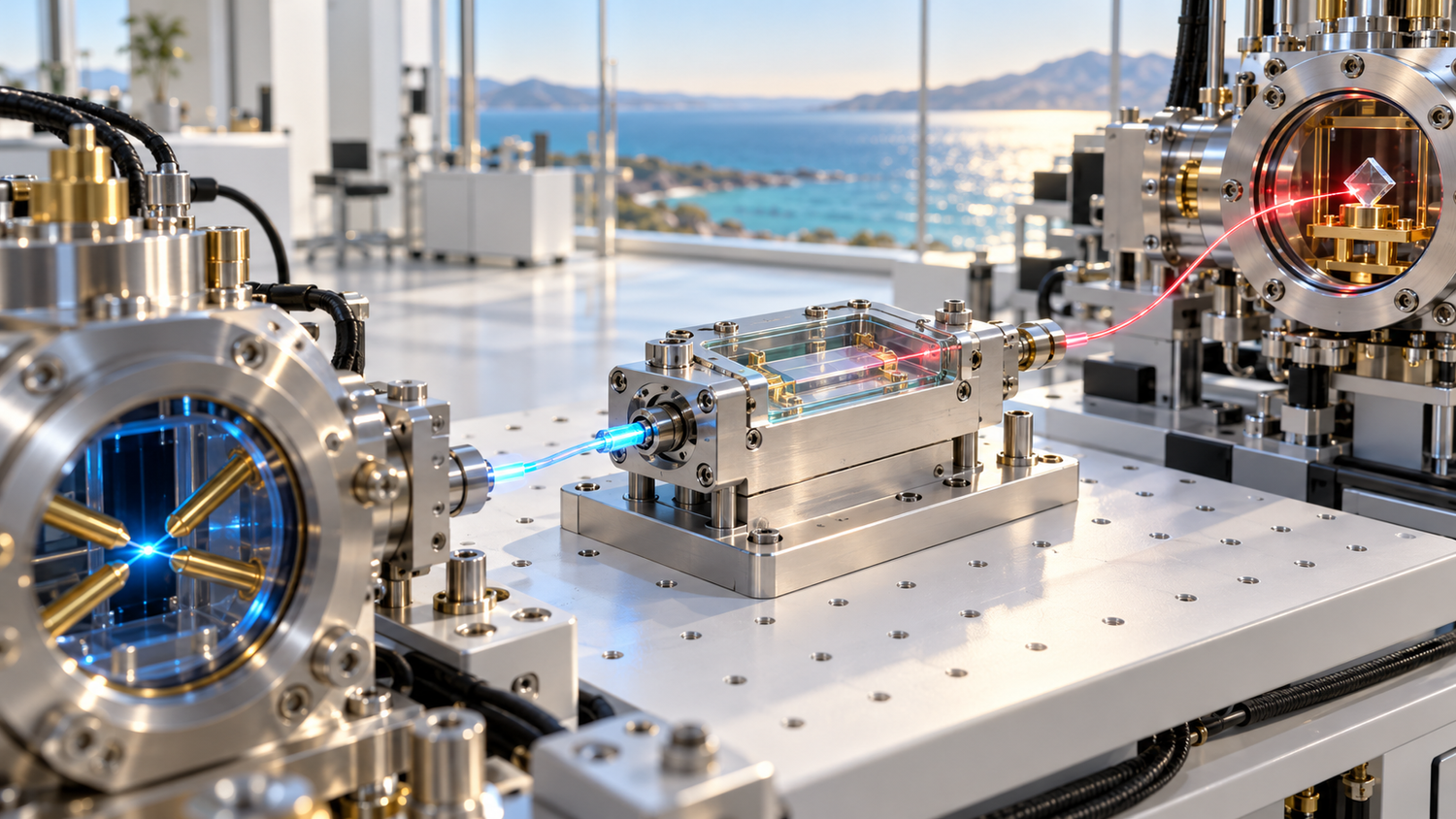
On October 9, 2026, IonQ announced from College Park, Maryland, that a photonic link between a trapped ion and a solid-state quantum memory had produced more than 1,000 entangled pairs per second. The technical paper behind the release, arXiv 2610.10705, was posted two days earlier by Lukas Hartung and 38 co-authors from IonQ in Boston and the Duke Quantum Center in Durham, with Christopher Monroe, Mihir Bhaskar and David Levonian among the senior authors. Its abstract states the result in one sentence: ion and silicon-vacancy Bell pairs at an average rate of 1.03 kilohertz with a fidelity of 87.9 percent, including all conversion losses.
The number that matters for a defense reader is the rate, and the reason it matters is the comparison the authors draw. One Bell pair per millisecond matches the cycle time of the trapped-ion processors IonQ plans to build, which means a link between two modules could in principle keep pace with the computation inside each module. The paper is explicit that this is four times the rate of any earlier photonic link between two trapped ions, which it cites at 250 pairs per second from an Oxford group in 2024.
This post reads the result as a quantum interconnect capability in the networking pillar. The questions it answers are what the two nodes are, how the rate and fidelity were measured, why a link between two dissimilar qubits is the thing DARPA is paying for, and what still separates a laboratory link in Boston, interpreted here as sharing one optical bench, from a modular system a program office could rely on.
What Hartung, Monroe, Bhaskar and 36 co-authors built: a room-temperature barium ion, a silicon-vacancy center in a diamond cavity below one kelvin, and a frequency converter between them
The link joins two qubits of different kinds. The first is a single barium-138 ion held in a four-rod Paul trap at room temperature, the same ion species IonQ uses in its commercial processors. The second is a negatively charged silicon-vacancy center, a defect in a diamond crystal, sitting inside a nanophotonic cavity with a cooperativity of 92 and cooled in a dilution refrigerator to a temperature of roughly a tenth of a kelvin. Trapped ions hold quantum information for a long time and are easy to control. Silicon-vacancy centers couple to light with high efficiency once a cavity surrounds them. The design of the experiment is to let each qubit do what it does well.
The ion emits a photon at 493.5 nanometers whose polarization is entangled with the ion's spin. That photon passes through a periodically poled lithium niobate ridge waveguide pumped at 1,492.3 nanometers, where difference-frequency generation shifts it to 737.45 nanometers, the wavelength the silicon-vacancy center absorbs. The converter sits in a Sagnac loop so that both polarizations convert alike. An unbalanced Mach-Zehnder interferometer with a Pockels cell then rewrites the polarization encoding into an early-or-late time-bin encoding, which is what the diamond cavity can act on. The photon reflects from the cavity, and whether it reflects with its phase intact depends on the spin state of the silicon-vacancy center.
The heralding step is the part that makes the rate possible. A single photon detected in the diagonal polarization basis after reflection announces that the ion and the silicon-vacancy spin now share a Bell state. Most atom-to-atom photonic links require two photons to arrive at a beam splitter together, so the success probability is the product of two small numbers. Here one photon suffices, and the cavity makes its reflection efficient. The paper's own account of the protocol is the one to read, and Quantum Computing Report gives a careful summary of the chain from ion to detector.
How the 1.03 kilohertz rate and the 87.9 percent fidelity were measured, where the 12 percent of error comes from, and what the paper reports no number for
The authors attempted entanglement 1.1 million times per second. The measured success rate was 1.032 kilohertz with an uncertainty of 0.011, which puts the mean waiting time for a Bell pair at 969 microseconds and the success probability per attempt at about one in 1,100. Fidelity to the target state was 87.9 percent with an uncertainty of 0.7. The team then built an error budget and compared it with the measurement. The listed error contributions are 4.3 percent from the ion, 2.9 from the frequency conversion, 3.9 from the diamond memory, and 1.9 from undetected heralding photons, with a reported predicted fidelity of 87.4 percent against the 87.9 measured. Treated as additive percentage points of infidelity, those contributions total 13.0 and imply 87.0 percent fidelity; the underlying model remains unverified, so the listed figures do not by themselves explain the 87.4 percent prediction. This budget concerns errors in heralded pairs, distinct from transmission and detection losses that affect the generation rate.
Two things the paper does not report deserve equal attention. It gives no physical distance between the ion trap and the diamond cavity; the two nodes read as co-located on one laboratory bench, but that arrangement is an inference, with no fiber length stated. And it reports the generation of entanglement only. The pairs were measured, which consumed them. No entanglement was stored in the memory while the next link was made, and no state was teleported or swapped onward. The discussion names both as the next step, noting that the silicon-29 nuclear spin of the defect can hold entanglement while new links are generated, and that several pre-initialized memories addressed in turn would let each one reset without pausing the ion.
Quantum pillar: networking (entanglement distribution and repeaters). Use posture: dual-use. Technology readiness: TRL 4 of 9. The link is a complete two-node laboratory assembly, an ion trap and a dilution refrigerator joined by a frequency converter and characterized in the laboratory, interpreted here as sharing one optical bench, with physical distance not reported, no stored entanglement and no field trial, which places it on the fourth rung of the shared ladder.
Why a kilohertz link between dissimilar qubits is what DARPA's HARQ program is buying, and who gains from it
DARPA's Heterogeneous Architectures for Quantum program, run by program manager Justin Cohen, starts from the premise that no single qubit type is best at processing, memory and communication at once. Its two technical areas are compiler tools that assign each operation to the qubit best suited to it, with a target of cutting resource demands by up to a factor of 1,000, and interconnect components that move quantum information between qubit types at high speed and fidelity, alongside a government-led architecture study. IonQ was selected for the program on April 14, 2026, to develop quantum memories fabricated from synthetic diamond as the core chips of such interconnects. The October paper is the first public measurement of one of those memory chips doing its job at the rate the architecture needs.
The capability at issue is a heterogeneous quantum network: processors of one kind, memories of another, linked by photons over fiber. For a force the near-term meaning is modular computing. A trapped-ion machine that can only be scaled by adding ions to one trap stops at some hundreds of qubits. Modules linked at the cycle time of the processor can be added like blades in a rack, which is the path IonQ describes for the error-corrected systems it is building under the separate DARPA benchmarking effort covered in Quentir's report on the Stage C selections of 7 October. Every defense workload that waits on a fault-tolerant machine, from cryptanalysis to materials and logistics, inherits the interconnect problem, and this paper reports a raw Bell-pair generation rate that could in principle keep pace with a processor. Whether the link becomes a bottleneck depends on the unmeasured overhead of fidelity improvement, memory storage and retrieval, and onward operations.
The second meaning is communication. The discussion section states that silicon-vacancy memories can receive weak photonic signals over fiber in quantum communication or blind quantum computing and hand the resulting states to an ion processor for error correction. A memory node that absorbs a photon from a long fiber and holds its state is also the building block of a quantum repeater, the device that would extend entanglement beyond the loss limit of a single span. Quentir read an earlier multinode demonstration in the quantum telephone post; this paper supplies the piece that demonstration lacked, a memory interface whose raw generation rate could in principle serve a processor, subject to the unmeasured overhead above. IonQ's release also names networked sensing, in which linked quantum devices coordinate measurements across locations, as a further application of the same architecture.
The posture is dual-use. The result moves no weapon and defends no network on its own. It serves any operator of fiber who wants to join quantum processors, memories or sensors across a site, which includes a national laboratory, a bank and a command center alike. The commercial trail is already visible: IonQ sold its first interconnect system to the University of Maryland, announced in April, and a second to SDT in South Korea, announced in September. The paper's claim that the same interface should extend to neutral atoms and, with microwave-to-optical transducers, to superconducting qubits is a stated expectation, with no measurement behind it in this work.
What stands between one optical bench in Boston and a program office relying on it
Four gaps are visible in the public sources, and the authors name most of them. The first is distance. A laboratory link interpreted here as sharing one bench, with physical distance not reported, has demonstrated the physics, and the next measurement a buyer should look for is the same rate and fidelity with the diamond node at the far end of a kilometer of deployed fiber, where the 737-nanometer photon suffers loss that a telecom-band photon would not. The paper offers no such figure, and conversion to telecom wavelengths would add a further efficiency penalty to the budget above.
The second is memory use. The entire argument for a memory-enhanced link is that the memory can hold one Bell pair while the next is made, so that two or more pairs can be combined. The paper demonstrates kilohertz generation and describes storage in the nuclear spin as a capability of the defect, with no storage-and-retrieval measurement reported. Until that appears, the result is a fast link, with the repeater reading still a projection.
The third is fidelity. A Bell pair at 87.9 percent is good enough to prove the link and to run entanglement distillation, and it is short of what a logical qubit spread over two modules needs from each inter-module gate. The authors expect that higher ion-to-fiber coupling, a more efficient signal chain and a phase-based spin-photon gate in place of the amplitude-based one will lift the rate above 5 kilohertz; transmission and detection efficiency affect that rate, while errors in heralded pairs affect fidelity, and the paper does not forecast a fidelity number.
The fourth is the plant. The diamond node lives in a dilution refrigerator, the ion in an ultra-high-vacuum trap with its laser systems, and the converter in between. That is a laboratory, which is what TRL 4 means. A transportable unit, an environmental qualification and an uptime figure are all absent from the public sources, and for a program office they are the difference between a published result and a line in an acquisition plan. What the sources establish is narrower and worth holding onto: a distributed quantum computing link between two different qubit types generates raw Bell pairs at a rate that could in principle keep pace with the processor it would serve, with proposed improvements expected to raise generation above 5 kilohertz. Usable inter-module throughput after fidelity improvement, memory storage and retrieval, and onward operations remains unmeasured.
Sources
Primary source: Lukas Hartung, Pierre Barral, Noah Glachman, George Toh, Jacob H. Davidson, Sagnik Saha, Christopher Monroe, Mihir Bhaskar, David Levonian and co-authors (IonQ, Boston, and the Duke Quantum Center, Durham), "Quantum Networking at the Speed of Quantum Computation: Kilohertz Entanglement in a Heterogeneous Quantum System," arXiv:2610.10705, posted October 7, 2026, https://arxiv.org/abs/2610.10705. Other material: IonQ press release of October 9, 2026 (College Park, Maryland); Quantum Computing Report summary of the error budget and conversion chain; DARPA Heterogeneous Architectures for Quantum (HARQ) program page; IonQ release of April 14, 2026 on its HARQ selection.