Michigan and USC Gain Up to 6 dB of Image Signal-to-Noise From 3 dB of Squeezed Light in Passive and Synthetic-Aperture RF Photonic Imaging, arXiv 2611.20194, 15 November 2026: TRL 3
Quentir Defense Monitor
Evidence-based insights for quantum defense and security. Published by Quentir Systems LLC · November 17, 2026.
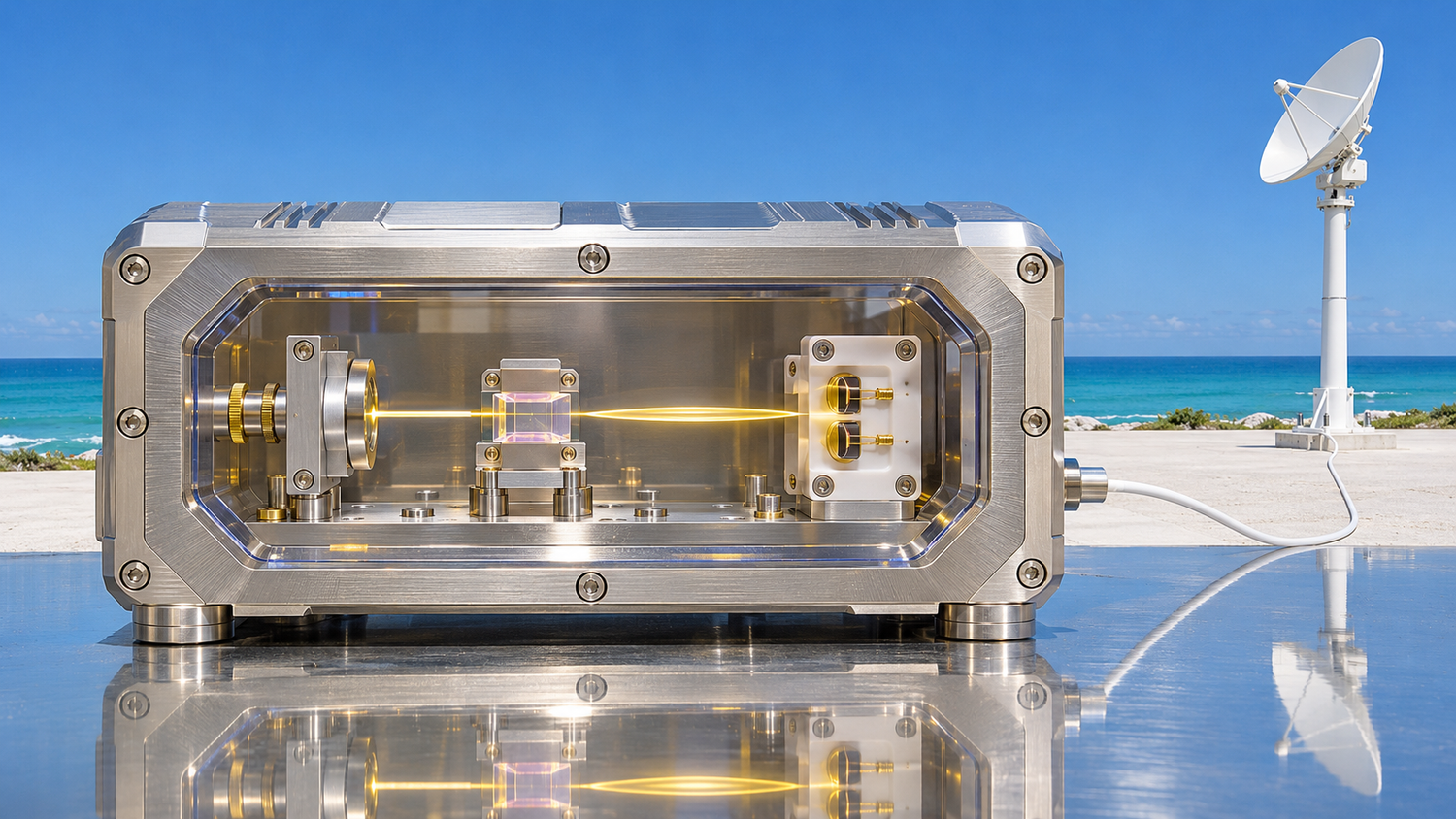
A radio-frequency photonic receiver puts no amplifier at the antenna. The antenna voltage drives an electro-optic modulator, the light travels over fiber to wherever the electronics sit, and a photodetector recovers the signal. Engineers accept that arrangement for wideband antenna remoting because fiber carries tens of gigahertz over kilometers with little loss and the antenna node needs no power, cooling or maintenance. The price is sensitivity: at the optical power a modulator tolerates, the shot noise of the light sets the floor, which optics calls the standard quantum limit. A preprint submitted to arXiv on 15 November 2026 by Visuttha Manthamkarn, Shuaifeng Guo and Zheshen Zhang of the University of Michigan, Haowei Shi and Quntao Zhuang of the University of Southern California and Christopher M. Jones of Halliburton Technology in Houston shows experimentally that squeezed light lowers that floor for imaging. With 3.05 dB of phase squeezing on the optical carrier, their emulated 24-receiver array gained up to 5.9 dB of peak signal-to-noise ratio in a passive radio image and up to 6 dB in a synthetic-aperture image, and a model with no free parameters predicted every gain within a quarter of a decibel.
The antennas, the aperture and the targets were emulated with replayed waveforms, so this is a proof of concept on real optics, and the paper says so. It still earns a defense reader's attention because it attacks the one weakness that keeps RF photonic front ends out of the most sensitive receiving jobs, with a quantum resource that stays inside the optical readout.
What Manthamkarn, Shi, Guo, Jones, Zhuang and Zhang built: a 1550 nm squeezer, a free-space modulator and 24 emulated receivers across 5 to 20 MHz
The optical chain is a squeezed-light source of the kind built for interferometry: a 1550 nm laser, a frequency-doubled 775 nm pump and a periodically poled potassium titanyl phosphate crystal run as a sub-threshold optical parametric amplifier, whose output carrier fluctuates in phase less than the vacuum allows. Averaged over 102 paired acquisitions the squeezing measured 3.05 dB, close to the 3 dB design value, with optical loss between amplifier and detector the main reason it was not higher. A free-space Thorlabs phase modulator carrying about 20 microwatts of carrier wrote the radio signal onto the light, and a 40 milliwatt local oscillator with balanced photodiodes read it back by homodyne detection.
The radio side was synthetic by design. An arbitrary waveform generator replayed signals directly in the 5 to 20 MHz band, and 24 receivers across a 1.6 km aperture were emulated by running one receiver 24 times with the geometric delays each position would have seen, which the authors state leaves out the channel calibration and correlated environmental noise of a physical array. Two imaging modes ran through the same hardware. The passive mode is radiometric interferometry: two synthesized point sources with a power ratio of 1 to 0.6 on a faint diffuse ridge, imaged from correlated visibilities into an 81 by 81 pixel map over a 24 degree field at 0.54 degrees of resolution. The active mode is stripmap synthetic-aperture radar: 20 microsecond chirps, 250 pulses at 30 Hz from a platform at 3 km altitude and 120 meters per second along a 1 km synthetic aperture, and an M-shaped target 1.7 by 1.15 km at 4 km ground range imaged with 20 m by 6 m pixels.
How 3 dB of squeezing becomes 6 dB of image gain: readout noise, scene noise and the crossover near −5.6 dB
The arithmetic is the paper's central contribution, and it is simple enough to check. Phase squeezing reduces the variance of the additive readout noise by a factor g, here 0.495. In passive imaging, multiplying receiver samples to estimate visibilities produces scene, signal-noise and noise-noise contributions to the pixel error. Equations (6) and (7) give their sum as α₀ + α₁ + α₂ with coherent readout and α₀ + gα₁ + g²α₂ with squeezed readout. When the noise-noise contribution dominates, the mean squared error falls by g², giving a peak signal-to-noise gain of 10 log₁₀(1/g²), about 6.1 dB or 2G. Where scene noise dominates, the unchanged α₀ term makes the gain approach zero. In active imaging, the reconstructed intensity is |z₀ + n|², and equation (16) gives its mean squared error as γ₁ + 2γ₂, becoming gγ₁ + 2g²γ₂ with squeezing. Here γ₁ comes from signal-noise mixing and γ₂ from noise power; the factor 2 includes noise-power variance and squared bias. For deterministic echoes with negligible classical noise, the gain therefore moves from 2G toward G as the signal-noise contribution grows. These are the noise-propagation relations in sections III.3 and III.5 of the paper.
The measurements follow that curve. In the passive image the whole-image gain was 5.9 dB with scene power 20 dB below readout noise, 0.8 dB when the two were equal and 0.2 dB with scene power 5 dB above; the predicted crossover, where the gain equals G, falls near −5.6 dB, and the measured gains agree with the model within 0.08 dB from −10 dB upward. Source brightness agreed between squeezed and coherent images within 0.6 percent, so squeezing lowered the noise without altering the scene. In the synthetic-aperture image at an echo signal-to-noise ratio of −15 dB, the whole image rose from 20.8 to 24.7 dB of peak signal-to-noise, the target from 16.2 to 19.4 dB and the background from 24.3 to 30.2 dB, against predictions of 4.05, 3.32 and 5.92 dB of gain. The target gain fell from 6.08 dB at the weakest echo to 3.06 dB at the strongest, approaching G as the theory requires, while the background held near 2G throughout.
Quantum pillar: sensing (quantum radar and lidar). Use posture: dual-use. Technology readiness: TRL 3 of 9. The squeezed optical readout ran on real hardware, while the antennas, the 1.6 km aperture and the radar target were emulated with replayed waveforms through one receiver, so a buyer should read the 6 dB as a laboratory proof of concept that no assembled imager has yet reproduced.
What a quieter photonic readout would let a force do: unpowered antenna nodes, passive HF imaging and synthetic-aperture radar
The capability at stake is receiver sensitivity in places where an amplifier cannot go. The paper's own list of uses is civil: radio pickups in accelerator halls with restricted access, permanent receivers in hot geothermal boreholes, and what the authors call the unpowered antenna nodes of fiber-distributed arrays. Each has a military counterpart. A ship's topside antennas, a hardened receive site and a distributed direction-finding array along a coastline all gain from an antenna node with no electronics to power, cool, shield or repair, and all pay for it in sensitivity today. DARPA's Quantum Apertures program sought receivers with greater sensitivity, bandwidth and dynamic range than any classical receiver for spectrum operations, radar and communications, and this paper addresses the same demand at the optical end of a fiber.
Where the gain appears is the question a program office should ask first, and the paper answers it with a noise temperature. The free-space modulator in this experiment, with a half-wave voltage near 267 volts and 20 microwatts of carrier, has an equivalent readout noise temperature of about 37 billion kelvin, which is why readout noise dominated and the full 2G gain was available. An integrated thin-film lithium niobate modulator with a half-wave voltage of a few volts and a milliwatt of carrier would bring that to about 130,000 kelvin, against a median galactic sky of about 140,000 kelvin at 12.5 MHz. At HF, then, a well-built photonic receiver with no electronic gain sits at the crossover and squeezing buys a few decibels; at microwave frequencies, where the sky is cold and a low-noise amplifier ahead of the modulator is routine, the gain shrinks toward nothing. The authors say this plainly: squeezing is most valuable for unpowered photonic front ends.
The posture is dual-use in the ordinary sense. The same squeezer, modulator and homodyne detector serve a geothermal operator, a radio observatory and an electronic-support receiver; passive wide-aperture imaging at HF is emitter location, which protects a force that uses it and finds an adversary who radiates. The work is also distinct from the quantum radar this Monitor read in October, when Big Bang Boom Solutions announced a quantum illumination program at IEEE MILCOM. Quantum illumination entangles the transmitted microwave field with a stored idler and needs a cryogenic source and memory. Here, in the authors' words, the RF field remains classical and all quantum resources are localized at the optical readout stage, a smaller promise and a far nearer one.
What stands between the bench and a program office: a physical array, an integrated modulator and squeezing that survives the field
The first gap is the emulated array. Twenty-four receivers were one receiver run 24 times, so the squeezed light never had to reach physically separate nodes, and the calibration errors, phase drift and correlated interference of a real array were absent. The group has built distributed quantum RF sensing before: Xia, Li, Clark, Hart, Zhuang and Zhang demonstrated a three-node entangled RF photonic sensor network in Physical Review Letters in April 2020, and Shi, Jones, Yu, Zhang and Zhuang proposed squeezed readout for synthetic-aperture imaging in a numerical study of March 2025, arXiv 2503.03075. The present paper is the first experiment on that claim, and a physically distributed version is listed as future work.
The second gap is the modulator. The 6 dB gain was large because the free-space modulator was poor, and the integrated modulator that would make the receiver competitive also moves it toward the regime where squeezing matters less, so a buyer should ask for the gain measured with the modulator the fielded receiver would carry. The third gap is stability. Carrier transduction drifted by up to 9.1 percent in power within one squeezed acquisition, against 2.4 percent for the coherent reference, costing up to 0.25 dB of target gain, and a squeezer on a ship or in a shelter will see temperature, vibration and fiber loss that the bench did not.
Against those gaps stands one precedent. The LIGO observatories have run squeezed light in their readout since 2019, and since May 2023 a frequency-dependent version that the laboratory says lets the detectors find about 60 percent more mergers. Squeezing has therefore already become an instrument that runs around the clock in a fixed, well-controlled facility, which is the environment of a hardened receive site. The paper's own ceiling is higher: with the 15 dB of squeezing published in 2016, the readout-dominated passive gain would approach 30 dB, provided the optics are nearly lossless and the electronics nearly silent. The evidence a program office should request is concrete: a physically separated two- or three-node version with real antennas in the HF band, the measured gain with an integrated modulator at a milliwatt of carrier, and a week of unattended squeezing stability. If those hold, the readiness reading moves from 3 to 4. Until then the paper establishes the physics, the arithmetic and a bench result that matched the arithmetic.
Sources
Primary source: Visuttha Manthamkarn, Shuaifeng Guo and Zheshen Zhang (University of Michigan, Ann Arbor), Haowei Shi and Quntao Zhuang (University of Southern California, Los Angeles) and Christopher M. Jones (Halliburton Technology, Houston), "Quantum-Enhanced Passive and Active Radio-Frequency Photonic Imaging," arXiv 2611.20194, submitted 15 November 2026. Other material: Xia, Li, Clark, Hart, Zhuang and Zhang, "Demonstration of a Reconfigurable Entangled Radio-Frequency Photonic Sensor Network," Physical Review Letters 124, 150502, 17 April 2020; Shi, Jones, Yu, Zhang and Zhuang, "Quantum-enhanced radio-frequency photonic distributed imaging," arXiv 2503.03075, 5 March 2025; LIGO Laboratory, Caltech, "LIGO Surpasses the Quantum Limit," 23 October 2023; DARPA, Quantum Apertures program page, read 17 November 2026. The capability reading, the posture argument, the readiness placement and the buyer items are Quentir analysis.