Big Bang Boom Solutions Puts Its Quantum Illumination Radar at TRL 3 at QuantEW 2026, IEEE MILCOM, 12 October 2026: What the 6 dB Theory and a 15 mK Experiment Leave Open
Quentir Defense Monitor
Evidence-based insights for quantum defense and security. Published by Quentir Systems LLC · October 16, 2026.
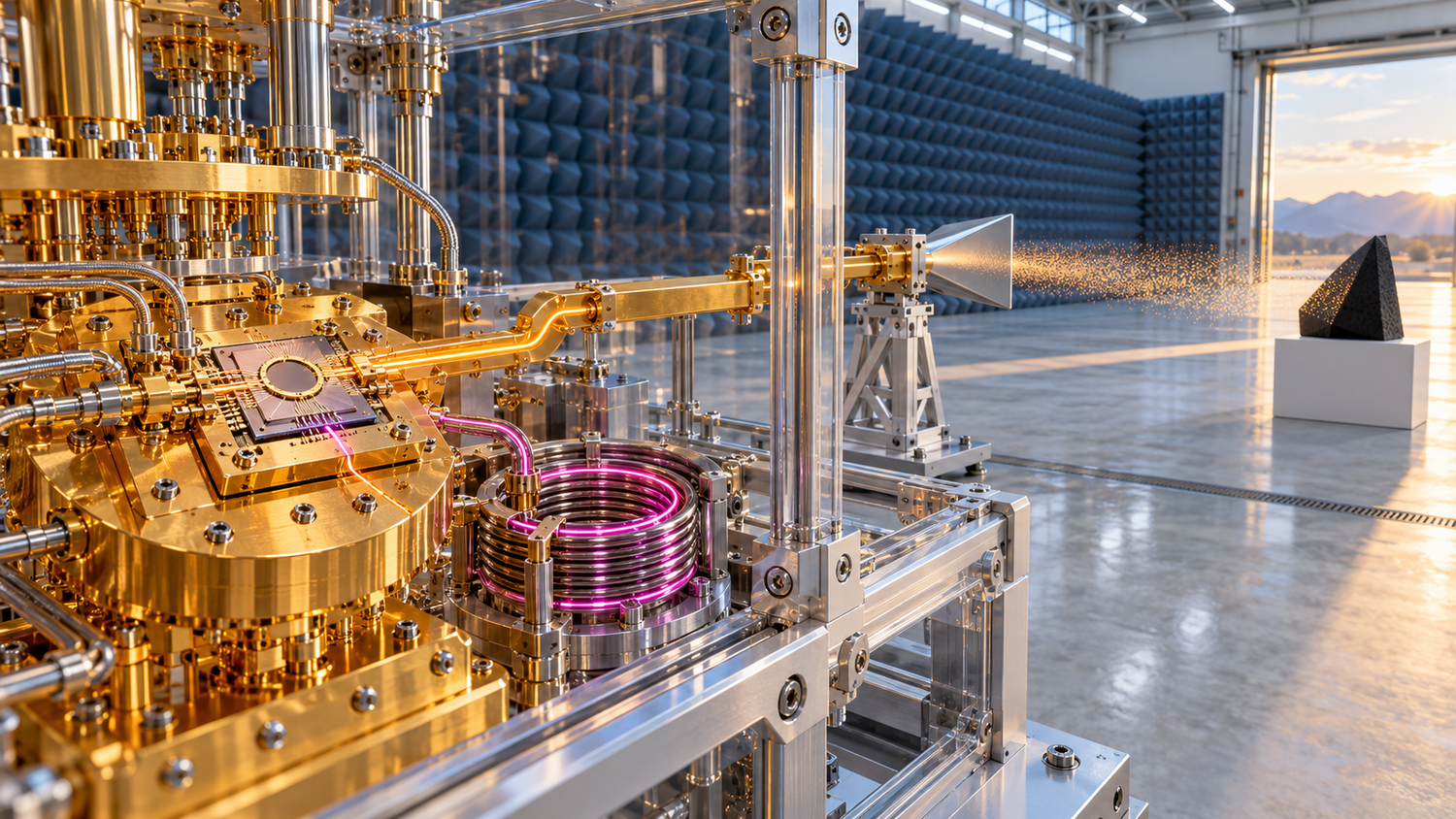
On October 15, 2026, Big Bang Boom Solutions (BBBS), a Chennai defense company founded in 2018, issued a release through NewsVoir stating that its co-founder and chief technology officer Shivaraman Ramaswamy had used the opening keynote of QuantEW 2026, a workshop the company organized inside IEEE MILCOM 2026, to announce a plan to build a quantum illumination radar. The release places the program at technology readiness level 3, targets TRL 4 to 5 in about 24 months, and lists platform-mounted demonstrators and an operational prototype as longer-term goals. It says the work is supported by India's National Quantum Mission.
Counter-stealth radar is the oldest promise attached to quantum sensing and the one with the thinnest hardware trail behind it. A defense reader therefore has two questions. What does the physics allow, and what has anyone built. The published literature answers both with numbers, and those numbers measure the distance between the keynote and a program office.
What BBBS announced at QuantEW 2026 on 12 October 2026, and who stood behind the workshop
The primary source is the company's release carried by ANI on October 15. It states that the keynote addressed quantum illumination, a technique that uses entangled signal and idler photons to detect low-observable targets against strong background noise, where conventional radar is limited by stealth shaping, thermal noise and spoofing from digital radio frequency memory jammers. It says theory shows "up to a significant advantage in the detection error exponent" over any classical scheme with the same transmitted energy, that the advantage applies in the low-signal, high-noise regime, that no field-deployable quantum radar exists today, and that cryogenic requirements remain a critical barrier. Ramaswamy is quoted as saying quantum radar "is moving from the laboratory toward engineering reality."
The workshop itself is verifiable on the conference site. The IEEE MILCOM 2026 page for WS16 lists QuantEW 2026: Quantum-Enhanced Electronic Warfare and Secure Military Communications as a half-day workshop on Monday, October 12, from 12:45 to 17:00, during a conference that ran from October 12 to 16 in the Washington, DC area. The page names G. Subrahmanya VRK Rao, a consultant and distinguished engineer at BBBS, as workshop chair, Major General Krishnamoorthy Shankar (retired), a former chief information security officer of the Indian Army, as senior advisor, Colonel Vivek Vaidyanathan, head of Agnishodh, the Indian Army's research and innovation cell at IIT Madras, as co-organizer, and Ramaswamy as technical program committee chair. Its first topic of interest is quantum radar and lidar for low-observable target detection in contested environments. Papers went through double-blind review by at least three reviewers with an acceptance target near 50 percent, and accepted papers go to IEEE Xplore. The page describes BBBS as a startup awarded a 200 crore rupee contract by India's Ministry of Defense through iDEX, the ministry's innovation scheme, and the release counts eight iDEX projects. The company's own site lists counter-drone detection and jamming systems as its main product line, which is the electronic warfare footing the keynote stands on.
What the release does not contain matters as much. There is no measurement, no frequency band, no range figure, no photograph of apparatus and no paper. The TRL 3 figure is the company's self-assessment, and the keynote's own framing, a technology assessment and a roadmap, is the language of a plan.
What the physics allows: Tan et al.'s 6 dB, Shapiro's limits and the 15 mK Lyon experiment
The theoretical prize is precise and small. In 2008 Seth Lloyd proposed quantum illumination and Si-Hui Tan and co-authors showed that an entangled transmitter gives a factor-of-four improvement, 6 dB, in the error-probability exponent over an optimal classical radar of the same transmitted energy. Jeffrey Shapiro's 2019 review, The Quantum Illumination Story, later published in IEEE Aerospace and Electronic Systems Magazine, sets out the conditions. The advantage exists only when the signal carries far less than one photon per mode, the background carries many, and the target returns a small fraction of what hits it. The practical receiver proposed by Saikat Guha and Baris Erkmen, an optical parametric amplifier, realizes 3 dB of the 6. The retained idler must be stored for the full round trip, and Shapiro's bound shows that 3 dB of idler loss erases the advantage for that receiver class and 6 dB erases it for the ideal one. His own conclusion is that a realistic assessment of the improvement's utility "shows that its value is severely limited," and that the lasting lesson is scientific: entanglement can be useful on a channel that destroys it.
The strongest hardware result sits in Lyon. Réouven Assouly, Rémy Dassonneville, Théau Peronnin, Audrey Bienfait and Benjamin Huard reported a measured quantum advantage in microwave quantum radar in Nature Physics in June 2023. Using a Josephson ring modulator as the entangled source and a joint measurement of probe and idler, they beat every classical strategy by a factor of about 1.2 in error exponent. The whole experiment ran inside a dilution refrigerator at 15 millikelvin, and the authors write that it exhibits the inherent difficulties of quantum radar, including the limited range of parameters where any advantage appears and the requirement for very low probe and idler temperatures. That is the cryogenic barrier the BBBS keynote acknowledges.
Quentir's arithmetic puts those figures in radar terms. Shapiro notes that the 6 dB advantage is equivalent to a 6 dB rise in effective signal-to-noise ratio. Under the standard radar range equation, a fourfold gain in effective power lengthens detection range by the fourth root of four, about 41 percent, in the ideal case, and by about 19 percent with the 3 dB receiver. Against a target whose shaping has cut its return by 20 or 30 dB, that is a modest recovery, and it arrives only in a regime where the transmitter emits less than one photon per mode.
Quantum pillar: sensing (quantum radar and lidar). Use posture: offensive. Technology readiness: TRL 3 of 9, according to the company's unverified self-assessment. The keynote is a program announcement and roadmap whose readiness figure is the company's own rating with no published BBBS experiment behind it, so it does not independently verify a device's place on the ladder; the strongest published hardware result in the field, the Lyon experiment, is a laboratory proof of concept inside a dilution refrigerator.
Why a counter-stealth radar reads as offensive capability, and what India's National Quantum Mission does and does not say
The lane's capability map puts a development in the offensive posture when the value described lies in acting against an adversary's systems, including finding platforms the adversary intends to keep concealed. That is the stated purpose here. The release defines the problem as stealth shaping and jamming, two design choices made by the other side, and the proposed radar's value is to defeat them. The same radar on an air defense site protects the force behind it, and a reader should hold both facts. The Monitor's reading follows the capability as described, and as described it is a sensor aimed at an adversary's low-observable aircraft and drones.
What such a sensor would let a force do is bounded by the physics above. Quantum illumination helps where the return is weak and the background is loud, which at microwave frequencies is the natural state of the channel, and it helps by a fixed factor that no amount of integration time enlarges. Shapiro's reading is that the low-brightness requirement that creates the advantage also confines it to short ranges and to receivers that exist only as cryogenic laboratory circuits. A program office should read the keynote's promise of "measurable advantage in the contested, noise-dominated environments where it matters most" against that ceiling.
The funding claim deserves the same care. India's National Quantum Mission is documented by the Press Information Bureau: the Union Cabinet approved the mission on April 19, 2023, with 6,003.65 crore rupees for 2023-24 to 2030-31 and four thematic hubs, including a Quantum Sensing and Metrology hub at IIT Bombay. Its published sensing targets are magnetometers at 1 femtotesla per root hertz, gravity sensors better than 100 nanometers per second squared, and clocks at a fractional instability of 10 to the minus 19. Quantum radar is not among them, and the mission's public material does not name BBBS. The statement that the program is supported by the mission is the company's, and a buyer should ask which hub, call or grant carries it and for how much.
One route around the cryogenic barrier already exists in the literature, at a cost. Quentir read MIT's August 2026 Nature Electronics device, a room-temperature cavity-magnonic source of correlated microwaves, as a TRL 4 bench prototype whose paired outputs are classically correlated rather than entangled. It sidesteps the refrigerator by giving up the quantum advantage the BBBS keynote is built on. That classical source provides a comparison with BBBS's proposed quantum illumination approach using entangled photons; the release leaves the implementation details undisclosed.
What stands between the keynote and a program office: idler storage, a receiver, a frequency band and a published number
The gaps are the ones the literature has listed for a decade. First, an entangled microwave signal-idler source that works outside a dilution refrigerator has not been published. Second, the idler must be held for the full two-way flight time, which at a few kilometers of range is tens of microseconds. Preserving an advantage requires less than 3 dB of idler loss for the practical receiver class discussed above, or less than 6 dB for the ideal receiver; BBBS has not specified its receiver, and no microwave memory with those loss budgets and duration has been shown. Third, the receiver must measure the return jointly with the idler. The Lyon team did this with Josephson circuits at 15 millikelvin, and a fielded radar front end would have to do it at a platform's ambient temperature or carry its own cryostat. Fourth, the regime itself: a transmitter emitting less than one photon per mode is a very weak transmitter, and the published assessments place its useful range far short of a surveillance radar's.
Against those gaps, the roadmap is ambitious. Our ladder treats TRL 3 as a run on hardware that exists, TRL 4 as a bench assembly tested in the laboratory, and TRL 5 as trials with realistic targets. The announced target of TRL 4 to 5 in about 24 months spans laboratory bench testing at its lower end and realistic-target trials at its upper end, so it does not establish a commitment to target testing by late 2028. An integrated BBBS-built entangled source, idler store and joint receiver is an analytical expectation for that roadmap. The Lyon group, with a mature superconducting-circuit laboratory, took years to reach a factor of 1.2 inside a refrigerator with no moving target at all. Nothing in the sources shows the company's starting point, and the workshop proceedings in IEEE Xplore are one place to watch for a published BBBS result.
For a buyer the questions are concrete. Which frequency band. What source, what idler store and at what loss. What receiver, and at what temperature. What range and what target class the 24-month trials will use. Which National Quantum Mission instrument funds the work. Until those have published answers, the sources establish a workshop that took place inside a serious conference, an organizer with real electronic warfare contracts and a plan whose physics caps the prize at 6 dB under conditions nobody has met outside a laboratory. That is a reasonable thing to watch and, today, nothing to buy.
Sources
Primary source: Big Bang Boom Solutions Private Limited, NewsVoir release of October 15, 2026 (Chennai), carried by ANI, with statements by co-founder and CTO Shivaraman Ramaswamy. Other material: IEEE MILCOM 2026 WS16 QuantEW 2026 workshop page; Jeffrey H. Shapiro, The Quantum Illumination Story, arXiv:1910.12277 (IEEE AESM 2020); Assouly et al., Quantum advantage in microwave quantum radar, Nature Physics 19, 1418-1422 (2023); Press Information Bureau of India, National Quantum Mission explainer, March 17, 2025. Range arithmetic, posture reading and buyer questions are Quentir analysis.