Multi-Chirp Waveforms Give Rydberg Receivers a Moving-Target Test
Quentir Defense Monitor
Evidence-based insights for quantum defense and security. Published by Quentir Systems LLC · July 31, 2026.
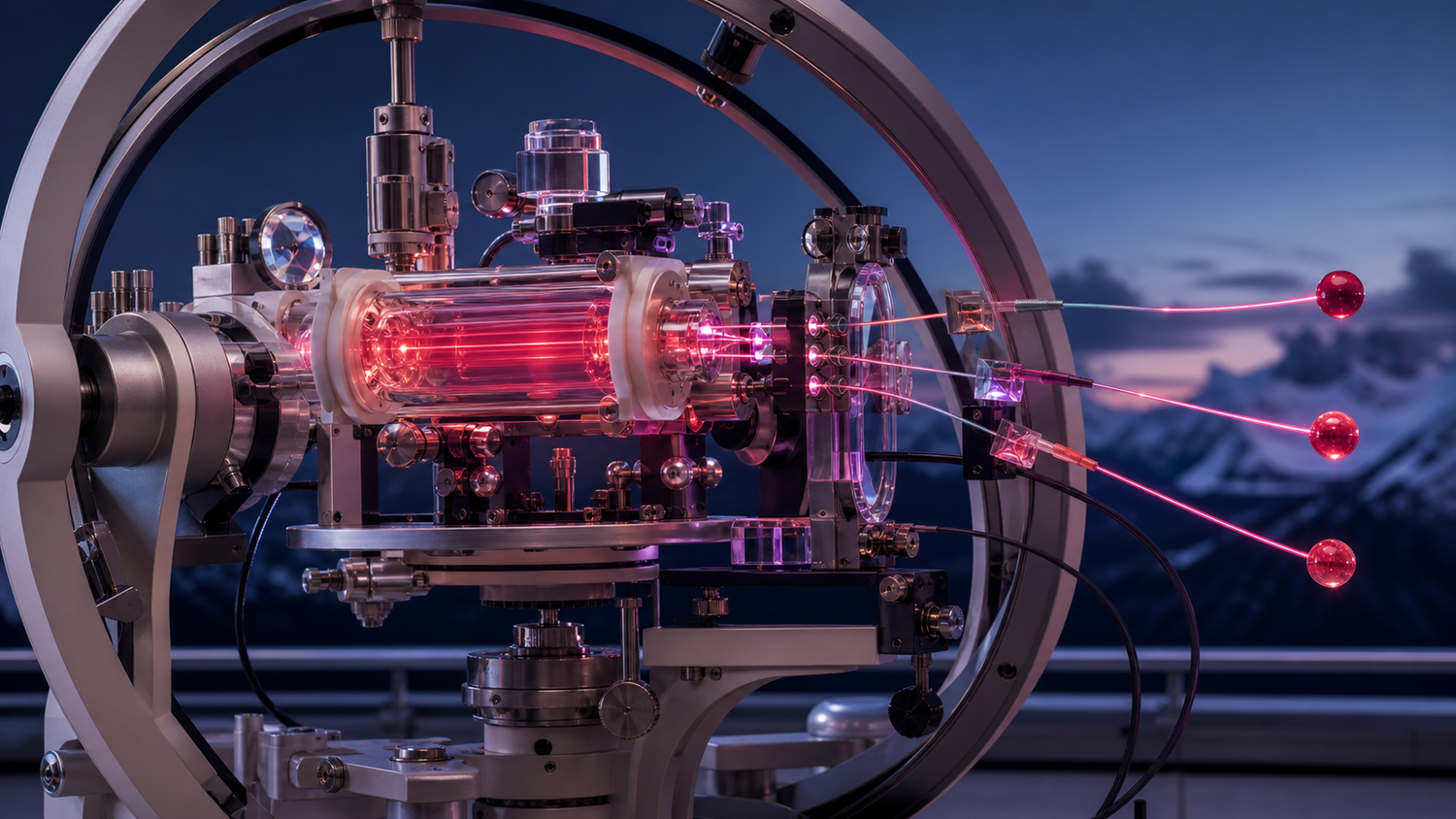
A quantum radio receiver can be exquisitely sensitive and still struggle with a basic sensing question: which return came from which moving object? A new paper tackles that problem at the waveform and signal-processing level. Its authors propose sending several related chirps through a modeled Rydberg atomic receiver so that range and velocity can be separated across multiple targets.
The primary paper by Hanvit Kim and colleagues reports numerical results for multi-chirp affine frequency division multiplexing, or MC-AFDM. In the authors' simulations, the method improves range and velocity estimation accuracy by as much as two orders of magnitude over the single-chirp comparison. That is a checkable result inside a defined model. No physical receiver, target scene, or field trial appears in the study.
This distinction matters for a defense buyer. The paper addresses a real mathematical obstacle in a promising sensor architecture, while leaving the apparatus and operating environment for later work. Its value today is a sharper test hypothesis: a Rydberg receiver intended to observe moving emitters or reflections needs waveforms that produce enough independent measurements to recover delay and Doppler without ambiguity.
The receiver sees an ambiguous optical trace
Rydberg receivers use atoms excited to high-energy states as electric-field sensors. An incoming radio-frequency field changes the atomic response, which can be read optically. That creates an unusual receiver chain: the RF signal interacts with atoms while lasers prepare and interrogate them. Photodetectors then turn the optical response into data for conventional processing.
The architecture has already moved beyond idealized laboratory tones. NIST researchers demonstrated reception of a consumer UHF handheld radio, including simultaneous detection of accessible channels and reception of two neighboring channels with at least 53 dB of isolation. That experiment shows that an atomic sensor can receive a real modulated transmission. It does not answer the new paper's question about jointly estimating the range and velocity of multiple moving targets.
Kim and colleagues focus on a doubly dispersive channel, where propagation delay and Doppler shift both shape the received signal. In their model, the optical readout of a conventional single-chirp AFDM waveform collapses the unknown delay and Doppler into an underdetermined measurement. Several combinations can explain the same observation. A sensitive measurement therefore remains an ambiguous one.
Their proposed multi-chirp waveform changes the post-chirp parameter from frame to frame. Each frame produces a different optical measurement of the same underlying target parameters. Taken together, the frames convert the recovery problem from underdetermined to overdetermined. The design is physical in its consequences, yet the contribution in this paper is mathematical. It provides waveform criteria, a receiver model and a recovery algorithm.
The algorithm first uses orthogonal matching pursuit to estimate fluctuation frequencies, then applies least squares to recover delay and Doppler. The authors also derive Cramér-Rao lower bounds for the attainable estimation error. Their simulations compare multi-chirp, dual-chirp and single-chirp cases. Spreading the chirp parameters toward their allowed edges reduces the condition number and improves the modeled estimates.
This is the useful core of the result. Delay-Doppler estimation depends on measurement diversity as well as atomic sensitivity. A program office evaluating a quantum RF receiver should care about both. Receiver sensitivity describes how faint a field the apparatus can register. Estimation performance describes whether the resulting measurements resolve the quantities a sensing application actually needs.
The reported improvement needs its full qualifier every time: up to two orders of magnitude in numerical experiments against the paper's single-chirp baseline. It is neither a measured range extension nor a fielded detection advantage. The model assumes a defined receiver response and channel, and the paper says its manuscript has been submitted to an IEEE journal. Independent review and replication remain ahead. Hardware data does too.
Quantum pillar: sensing (RF spectrum sensing). Use posture: dual-use. Technology readiness: TRL 2 of 9. The authors report numerical experiments on a modeled receiver, without a bench implementation or measured target returns.
The defense capability is spectrum understanding
The defense-specific capability is broader than receiving a message. A compact sensor that can estimate signal direction and delay, together with Doppler, phase and strength across a wide band, could contribute to spectrum awareness in crowded environments. The new paper isolates one piece of that prospect: separating range and motion information when multiple returns are present.
DEVCOM Army Research Laboratory recently described a separate laboratory Rydberg sensor that measures the three-dimensional direction of RF fields. That work concerns field direction rather than the multi-chirp method. Read together, the sources show why atomic RF sensing is becoming a systems problem. Different experiments are filling in distinct functions that a useful receiver would eventually need to combine.
For a defensive force, better RF spectrum sensing could support situational awareness and interference recognition. It could also contribute to communications monitoring and protection of spectrum-dependent systems. For organizations developing offensive electronic capabilities, the same measurement primitive could inform emitter characterization and electronic-support research. Civilian communications and integrated sensing systems also face delay-Doppler channels. Those users gain from the same waveform and estimation work, which makes the development dual-use.
That posture describes who can benefit from the published result. It does not turn a simulation into an employment concept. The paper supplies no evidence about detection against a particular platform, performance under adversarial interference, covert operation, or a deployed military system. A buyer should resist filling those gaps with the receiver's theoretical appeal.
DARPA's MANTRAS program description makes the transition problem concrete. It calls for co-integrating Rydberg photonics with low-latency control and signal processing in a manufacturable receiver. The stated goals include laboratory comparison with conventional receivers and a package below 10 liters and 50 watts. Environmental testing precedes later field evaluation in a realistic environment. Those requirements show the distance between an algorithm paper and a dependable capability.
They also explain why waveform design belongs in acquisition analysis. A receiver may achieve strong atomic sensitivity while its lasers and optical alignment make it large or fragile. Photodetection and the processing chain add their own demands. A mathematically accurate estimator may require more frames, time or computation than a real-time application can tolerate. Increasing chirp diversity can improve identifiability while also creating trade-offs in dwell time and bandwidth, followed by synchronization and processing load.
The relevant comparison is therefore an end-to-end one. Conventional antennas and RF front ends have known size and bandwidth constraints, along with calibration and integration demands. Atomic receivers offer a different set of constraints and possible advantages. Program evidence must hold both systems to the same target scene and latency requirements. False-alarm and dynamic-range tests should use matched conditions, as should the power, volume and environmental assessments.
What a buyer still needs to see
The first missing layer is experimental reproduction. A bench setup would need to generate the proposed waveforms and pass them through an actual Rydberg receiver. It would then recover known delay and Doppler values from controlled signals. Results should report estimation error across signal strength and target count. Separate runs should vary velocity and multipath, followed by the relevant parameter choices. Classical receiver data collected under matching conditions would make the comparison meaningful.
The second layer is model fidelity. Atomic sensors have optical shot noise and laser-frequency noise. Finite coherence and calibration drift add further error, as can nonlinear response. Hardware also has bandwidth limits and timing errors. The paper's contribution can survive those effects in principle while losing much of its simulated margin in practice. Measured residuals would reveal whether the assumed optical response captures the behavior that drives the estimator.
The third layer is integration. A credible Rydberg atomic receiver needs stable lasers and a vapor cell, supported by optical routing and detectors. Control electronics must deliver real-time processing in a package that tolerates movement and temperature change. It needs startup and recalibration behavior that operators can predict. Supply and maintenance matter alongside component lifetime and sensitivity. These are program risks rather than footnotes to the physics.
The fourth layer is operationally representative testing. A trial should introduce realistic RF traffic and clutter, followed by competing emitters and changing geometry. Environmental stress belongs in the same plan, with ground truth preserved for range and velocity. Its purpose would be to measure where the method works and where it fails, then determine whether its added frames and computation earn their cost. Published evidence at that stage could support a higher readiness judgment.
Procurement teams can use today's result without pretending that those layers exist. They can ask vendors whether delay and Doppler are jointly observable in the proposed architecture, which measurements make the recovery full rank, and how many frames the estimator requires. They can request latency and error budgets that include optical and digital processing. They can also require comparisons against a conventional receiver under the same conditions.
The practical insight is that quantum sensitivity alone is an incomplete specification. The sensing chain must convert an atomic response into stable information about a dynamic scene. This paper gives that chain a candidate waveform and estimator for one hard case. Its next decisive evidence will come from real atoms and measured returns, followed by a comparison that a buyer can audit.
Sources
Primary source: Hanvit Kim, Hyeon Seok Rou, Kihong Min, Giuseppe Thadeu Freitas de Abreu, and Sunwoo Kim; other material from NIST, DEVCOM Army Research Laboratory, and DARPA.