NATO's Quantum Technology Roadmap, Published 29 September 2026: QUESTOR Sea Trials for GNSS-Denied PNT in 2026 and 2027 and a Quantum Zero Beacon Pilot Between Brussels and Mons by Q4 2027
Quentir Defense Monitor
Evidence-based insights for quantum defense and security. Published by Quentir Systems LLC · October 2, 2026.
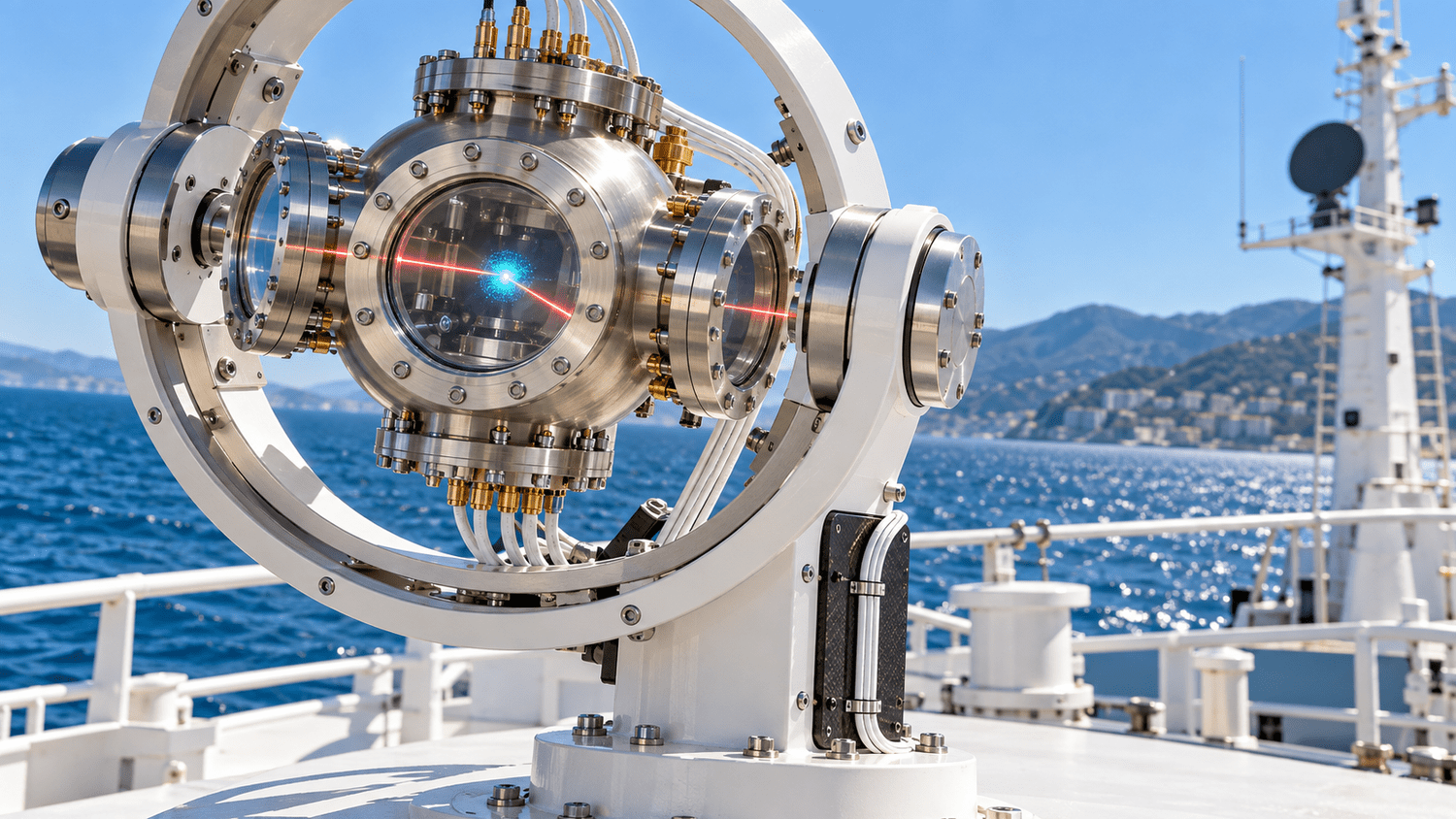
On Tuesday, September 29, 2026, NATO released the public summary of its Quantum Technology Roadmap, the implementation plan behind the Quantum Technology Strategy the Alliance adopted in November 2023. Allies approved the roadmap itself on July 30, 2026, and the summary now on nato.int is the first official text that attaches calendar dates to NATO's quantum work: sea trials of quantum sensors in 2026 and 2027, a first pilot report in the first quarter of 2027, a quantum-resilient communications pilot between NATO Headquarters in Brussels and SHAPE in Mons by the fourth quarter of 2027, and an Alliance standards roadmap in the third quarter of 2029.
This post reads the roadmap summary as what it is, a schedule of experiments and governance steps, and asks the question a program office asks of any such document: which of these dates produce evidence about a capability, and which produce paperwork about a capability. The answer is that two items on the list produce measurable results a buyer can use, the QUESTOR sea trials on quantum sensing for positioning, navigation and timing, and the Quantum Zero Beacon pilot on quantum-resilient communications. The rest of the roadmap is the scaffolding that decides whether those results ever reach an Allied force.
What NATO published on 29 September 2026: a public summary of a roadmap Allies approved on 30 July, five lines of effort and a table of dates
The summary runs to fifteen numbered paragraphs. It restates the 2023 Strategy's premise that quantum technology can change sensing, imaging, precise positioning, navigation and timing, communications, computing, modeling and simulation, and it states that potential adversaries and strategic competitors are investing substantially in quantum research, which the Alliance treats as an element of strategic competition. The scope is the same three areas as the Strategy: quantum computing, quantum communication and quantum sensing, each with its own readiness level, standards, test centers and protection needs. The interplay with AI, space, next-generation communication networks and biotechnology is to be addressed across all lines of effort and expanded in later iterations.
Five lines of effort organize the work, and only selected activities within each were cleared for public release. The first, identifying use cases, promises annual horizon-scanning reports, a structured repository of military and industry use cases within 12 months, and an initial version of NATO's Quantum Assessment Criteria by the second quarter of 2027. The second, testing and adopting quantum-enabled solutions, carries the two experimental commitments: pilot evaluations through Allied Command Transformation's Innovation Continuum, with the first pilot report expected in the first quarter of 2027 and initial comparative assessments in the fourth quarter, the QUESTOR sea trials with the STO Centre for Maritime Research and Experimentation in 2026 and 2027, and an Allied Quantum Computing Access Network concept by the fourth quarter of 2027.
The third line, standardization and interoperability, sets up an STO Quantum Standardisation Specialist Team by the third quarter of 2027, an STO-led Alliance Quantum Standards Roadmap by the third quarter of 2029, the ongoing adoption of post-quantum cryptography standards, and the Quantum Zero Beacon Project pilot between NATO HQ and SHAPE by the fourth quarter of 2027. The fourth line, safeguarding against quantum risks, schedules the next update of NATO's Action Plan on the quantum threat to cryptography for the third quarter of 2027 and a NATO Industrial Advisory Group study on industry readiness for quantum-resistant cryptographic solutions for the second quarter of 2027. The fifth line, training and education, promises initial training modules within 12 months.
Governance sits with the Digital Policy Committee, with the Cyber and Digital Transformation Division at NATO HQ responsible for quantum policy and for overseeing implementation. The implementers are listed by name: the Transatlantic Quantum Community and its Industry Network, Allied Command Transformation for use cases and pilots, Allied Command Operations for operational requirements, the NATO Communications and Information Agency with its Digital Foundry as the experimentation environment, the Science and Technology Organization including CMRE, the Cryptographic Services Capability Team for the cryptographic elements, and the innovation entities DIANA, the NATO Innovation Fund and the NATO Innovation Ranges. The summary says plainly that the phases will remain adaptive and opportunity-driven, because the three technology areas mature at different speeds, and that later iterations will depend on the outcomes of this first one.
QUESTOR sea trials with STO-CMRE in 2026 and 2027: quantum sensing for PNT where GNSS is denied, and what Questor 26 in La Spezia already ran
The roadmap describes QUESTOR as sea trials that deploy and test quantum sensing in realistic operational environments to assess performance for positioning, navigation and timing, particularly in GNSS-denied scenarios. The NATO news release that accompanied the summary, reproduced by GlobalSecurity.org, adds that a Questor 26 experimentation campaign was already conducted by CMRE and the TQC Industry Network in La Spezia, Italy, early in September 2026, and that the Transatlantic Quantum Community discussed its implications when it met in Washington on September 24 and 25. The same release says Belgium and Bulgaria have joined the community alongside 22 other Allies and six partner nations, and that the Netherlands took the chair on May 12, 2026, with Canada as vice-chair.
What the public text does not say matters as much as what it does. It does not identify the sensors carried: a quantum PNT suite can mean cold-atom accelerometers and gyroscopes, a cold-atom gravimeter or gravity gradiometer for map-matching against a gravity database, an optical or microwave atomic clock holding time while satellite timing is gone, or a magnetometer matched against magnetic anomaly maps. It does not say which vendors took part, what the vessel was, how long the GNSS-denied legs ran, or what position error accumulated. The only quantitative framing any Allied buyer can bring to QUESTOR today comes from outside NATO. When Q-CTRL sailed 83 kilometers of the Coral Sea without GNSS fixes and reported its position error against a conventional inertial unit, it set the shape of the number a sea trial must produce: distance run, time without fixes, error at the end, and the classical baseline on the same leg. Questor 26 ran; whether it produced a figure of that kind is not in the summary, and the first place one could appear is the pilot report due in the first quarter of 2027.
Quantum pillar: sensing (inertial navigation and PNT). Use posture: dual-use. Technology readiness: not applicable. The roadmap is a policy instrument with a schedule of trials, pilots and studies rather than a tested system, so the readiness ladder applies to the individual sensors QUESTOR carries, which the public summary does not identify, and no rung can honestly be assigned to the document itself today.
What GNSS-denied quantum PNT would let a force do, who gains from it, and why the posture reads dual-use
Positioning, navigation and timing is the capability the roadmap puts first in its own list, and the reason is operational rather than scientific. Every Allied platform that fires, flies, sails or synchronizes a network depends on satellite PNT, and every recent theater has shown that signal being jammed or spoofed at scale. A sensor suite that holds position to within a nautical mile over a day of sailing without a fix, or holds time to within microseconds across a week, lets a ship keep station in a denied littoral, lets a submarine shorten the exposures it needs to update its inertial fix, lets a long-range munition navigate by gravity or magnetic map when its receiver is blinded, and lets a tactical network keep its time slots aligned when GPS timing drops out. GNSS-denied navigation is therefore a force-wide enabler rather than a niche instrument.
That is also why the posture reads dual-use. The same cold-atom gravimeter that keeps a frigate on station keeps a strike platform on course to a target; the same holdover clock that protects a defensive radar network timing protects an offensive electronic-attack network. The roadmap itself frames the gain in both directions, speaking of harnessing quantum-enabled capabilities to maintain NATO's technological edge and of protecting the Alliance from quantum risks in the same paragraph. On the defensive side the benefit is resilience: a force that does not lose its position when the sky goes quiet cannot be degraded by an adversary's jammer. On the offensive side the benefit is reach: a weapon or platform that does not need the sky can go where jamming was supposed to keep it out. Neither reading is a recommendation; both follow from what the sensors do.
Who gains commercially is a narrower question. The TQC Industry Network ran Questor 26 with CMRE, so the firms whose instruments were on the water already hold the one dataset that will matter when Allied Command Transformation writes its first pilot report. The roadmap's use-case repository and Quantum Assessment Criteria, both due within roughly a year, will become the filter through which later vendors are judged, and a company that is not in the repository by then is competing against criteria written around someone else's sensor.
Quantum Zero Beacon between Brussels and Mons by Q4 2027, the Allied Quantum Computing Access Network concept, and what still stands between the roadmap and a program office relying on it
The second concrete item is the Quantum Zero Beacon Project. The roadmap describes it as a pilot deployment between NATO HQ in Brussels and SHAPE in Mons to demonstrate and validate a practical pathway for NATO's transition to quantum-resilient communications, due in the fourth quarter of 2027. The procurement is already visible: on September 8, 2026, Orange Slices reported that Headquarters Supreme Allied Commander Transformation was preparing a request for proposals, notice RFP-ACT-SACT-26-90, for a 12-month effort to pilot the deployment of post-quantum cryptography between the two headquarters, with deliverables covering systems engineering, integration and testing, cryptographic engineering, vulnerability assessment, security accreditation, operational validation, interoperability assessment and migration planning, in support of broader adoption across NATO before 2030. Read together with the roadmap, the Beacon is a PQC migration pilot on a live inter-headquarters link, and the fourth-quarter 2027 date is when its lessons are due, with the NIAG industry-readiness study of the second quarter of 2027 and the Action Plan update of the third quarter feeding the same decision.
The third item, the Allied Quantum Computing Access Network concept due in the fourth quarter of 2027, is a design milestone and nothing more. As The Quantum Insider noted in its reading of the summary, the date is about the network's design rather than a commitment to have an operational network running by then. The comparison that makes the modesty visible is the US Department of Energy's quantum computing roadmap of September 25, 2026, which set a target of 50 to 100 or more logical qubits for 2028 and a user facility around it. NATO's document promises no machine and no qubit count; it promises a concept for how Allies would share access to machines others build.
So what stands between this roadmap and a program office relying on it. First, the roadmap carries no budget line and no deployment date for any sensor or system; the summary says operational adoption will depend on technical progress and trial outcomes. Second, the only capability evidence it schedules, the QUESTOR results and the ACT pilot report, is due in the first quarter of 2027 and may well remain restricted; a program office outside the trial will know of it only through the comparative assessments promised for the fourth quarter. Third, the standards that would make an Allied quantum PNT or quantum-resilient communications buy interoperable do not exist yet, and the roadmap places the Alliance Quantum Standards Roadmap in the third quarter of 2029, two years after the trials. Fourth, the public text identifies no sensor, no vendor and no performance threshold, so there is no number against which a competing offer can be scored. What the summary does establish is that NATO has moved from a strategy with aspirations to a schedule with owners, that two of its dates will generate measurable evidence, and that the first of those dates is now six months away.
Sources
Primary source: North Atlantic Treaty Organization, "Quantum Technology Roadmap," official text published September 29, 2026 (public summary of the roadmap approved by Allies on July 30, 2026). Other material: NATO news release of September 29, 2026, "NATO releases Quantum Technology roadmap," as reproduced by GlobalSecurity.org; Orange Slices, "NATO Prepares Procurement for Quantum-Resilient Communications Pilot," September 8, 2026; The Quantum Insider, "NATO Sets Quantum Roadmap for Military Trials and Secure Communications," September 30, 2026.