NEC and IBM Japan Combine QKD Keys With ML-KEM-768 Under HKDF-SHA256 in One TLS Proxy Over an ETSI GS QKD 014 API, Validated July to September 2026 and Announced 17 November 2026: TRL 4
Quentir Defense Monitor
Evidence-based insights for quantum defense and security. Published by Quentir Systems LLC · November 18, 2026.
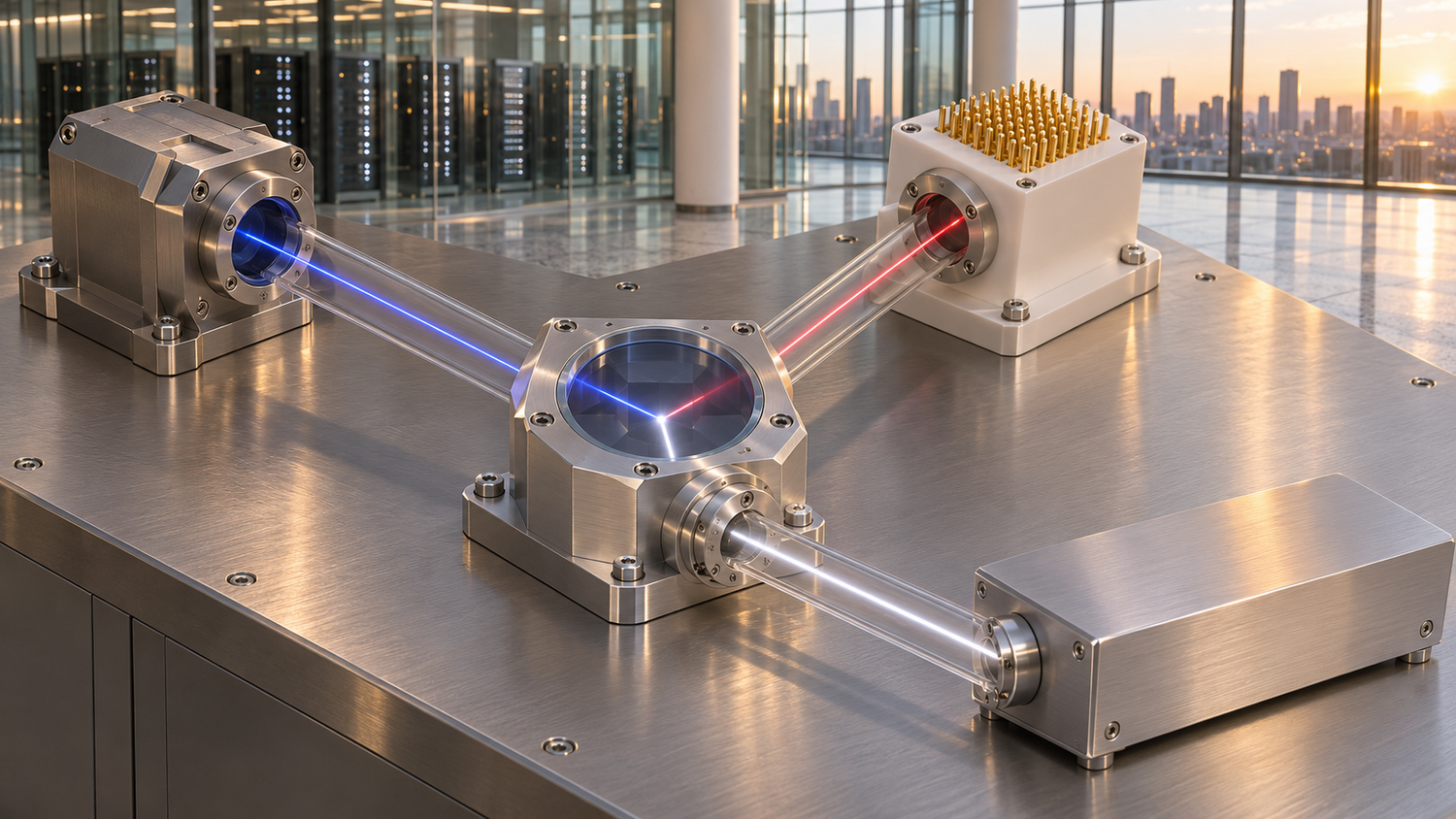
On 17 November 2026 NEC Corporation and IBM Japan announced what they call Japan's first demonstration of a hybrid quantum-resistant communication method, in which a key delivered by NEC's quantum key distribution equipment and a key established with the lattice-based ML-KEM-768 algorithm are combined inside one TLS connection. The NEC press release states that the two companies ran the validation from July to September 2026, that the QKD equipment was reached through a REST-based key delivery API based on ETSI GS QKD 014, and that the combination happened inside a custom-built version of IBM Quantum Safe Proxy deployed as a proxy layer in front of applications that were left unmodified.
For a defense reader the interesting part is the arithmetic of the key. Secret material obtained through QKD and secret material established through ML-KEM-768 were combined with HKDF-SHA256 to derive the secret that protects the traffic, so QKD was used together with post-quantum cryptography and never as an alternative to it. Peer authentication stayed certificate-based and used ML-DSA-44 signatures. The companies also say what they did not test: the demonstration did not evaluate QKD as a replacement for certificate-based authentication or as an independent fallback channel. This post reads the result as hybrid key establishment in the networking pillar, defensive in posture, and places it at the laboratory-testing rung of the readiness ladder.
What NEC and IBM Japan tested between July and September 2026: one TLS handshake fed by a QKD key store and an ML-KEM-768 exchange
The release describes an architecture of three parts. The first is NEC's QKD equipment, which produces shared secret keys between two endpoints over an optical fiber and holds them in a key management system. The second is the delivery interface between that key store and the application side. ETSI GS QKD 014, published in February 2019 by the ETSI Industry Specification Group on QKD, specifies the protocol and data format of a REST-based key delivery API with three methods: a status call, a request for new keys, and a request for keys by identifier, each addressed to a key management entity on behalf of a secure application entity. The third part is the proxy, a custom build of IBM's Quantum Safe Proxy, which terminates TLS for the application, pulls a QKD key through that API, runs an ML-KEM-768 key encapsulation with its peer, and feeds both secrets into HKDF-SHA256.
The algorithm choices tell a buyer which standards the proxy implements. ML-KEM is the key-encapsulation mechanism NIST standardized in FIPS 203 on 13 August 2024, with its security resting on the Module Learning With Errors problem; the standard defines ML-KEM-512, ML-KEM-768 and ML-KEM-1024 in order of increasing security strength and decreasing performance, so the demonstration used the middle set. ML-DSA-44 is the smallest of the three parameter sets of the companion signature standard, FIPS 204, and it carried the certificate signatures that authenticated the two ends. The release lists three results: combined key establishment within a single TLS architecture, interoperability between the products of two vendors over a standard API, and a deployment path that required no major change to the existing TLS environment.
Why the companies combined the two keys and kept ML-DSA-44 certificates for authentication: the NCSC position of 5 August 2025 on QKD
The design reflects a position that the NCSC, the United Kingdom's national cyber security authority, set out in its paper on quantum networking technologies of 5 August 2025. The NCSC writes that QKD does not provide authentication, nor does any other quantum technique, so QKD must be combined with other cryptographic services and should not be relied on as a mechanism that provides substantial security value on its own. The same paper says the NCSC will not support the use of QKD for government or military applications and recommends post-quantum cryptography as the primary mitigation against the quantum threat to cryptography. The NEC and IBM Japan architecture follows that logic. The lattice algorithm carries the authentication through ML-DSA-44 certificates, the lattice key encapsulation still yields a post-quantum key when the QKD link is unavailable, and the QKD secret enters the derivation as additional material.
What the QKD input adds is a key whose secrecy rests on physics and on the correct engineering of the hardware, with no dependence on the hardness of a lattice problem. If a future cryptanalytic result weakened ML-KEM-768, a session whose traffic key was derived from both inputs would still contain the QKD contribution, and the HKDF output would keep its secrecy as long as either input did, which is the design intent of a hybrid combiner. The release publishes no security proof for the combiner and no formal analysis of the proxy, so that intent remains the vendors' statement until an evaluation report confirms it.
Quantum pillar: networking (quantum key distribution links). Use posture: defensive. Technology readiness: TRL 4 of 9. For the reader this means real QKD hardware and a working proxy were assembled and tested together in a validation environment over three months, with no published key rate, latency, outage behavior or trial on an operator's live traffic, so the result sits at laboratory testing and below a field trial.
What a hybrid QKD and ML-KEM link would let a force do, and who gains from it
A fixed fiber link between two sites that a force controls is the setting in which this architecture makes sense: a headquarters and a data center, or a ministry and its backup site. On such a link the hybrid gives the operator a traffic key that an adversary would have to defeat twice, once against the lattice problem and once against the physical key exchange, while the applications behind the proxy keep speaking ordinary TLS. The deployment model counts as much as the cryptography for a program office, because a proxy layer in front of existing software can be introduced on a maintenance window and rolled back. The vendors point first at core banking and transaction systems and at links between financial institutions and data centers, and they list defense beside finance and critical infrastructure as sectors where long-lived secrets are at risk.
The posture is defensive. The value described in the release lies in protecting one's own communications against an adversary who collects ciphertext now and expects to decrypt it with a future quantum computer, which is the threat the United States set out in Executive Order 14412 of 22 June 2026, Securing the Nation Against Advanced Cryptographic Attacks. That order requires federal agencies to move their high value assets and high impact systems to post-quantum key establishment by 31 December 2030 and to post-quantum digital signatures by 31 December 2031, and it excludes National Security Systems from that particular directive. The order does not mention QKD. A proxy that already uses ML-KEM-768 and ML-DSA-44 meets the order's cryptographic direction on its own; the QKD input is a second layer that a national program in Japan or Korea may want for links it already owns, as the Korean science ministry's plan for a nationwide QKD network by 2028 shows.
The civil side of the dual-use question is also visible: financial regulators in Singapore and the United Kingdom have put QKD beside post-quantum cryptography in their joint statement of 20 October 2026, and the NEC and IBM Japan outlook lists bank core systems as the first commercial target. The reading in this post stays defensive because the release describes protection of the operator's own traffic and nothing that acts against an adversary's systems.
What stands between the September 2026 validation and a program office relying on it: numbers, outage behavior, evaluation and the QKD policy line
Several things are missing from the public evidence, and a buyer should ask for each of them before writing the architecture into a requirement. The first is measurement. The release gives neither a key rate from the QKD equipment, nor the handshake latency added by the proxy, nor a distance for the fiber link, so the reader cannot judge whether the key store keeps up with the connection rate of a core banking system or a command network. The second is behavior under failure. The test did not evaluate QKD as an independent fallback channel, and the release is silent on what the proxy does when the QKD key store is empty, the fiber is cut, or the key delivery API is unreachable; a program office needs to know whether the connection falls back to ML-KEM-768 alone, stalls, or refuses to open.
The third is assurance. The proxy was a custom-built version, the release describes a validation environment with no production deployment, and it cites no independent evaluation, cryptographic module validation or protocol analysis. The ETSI specification also leaves the installation and upgrade of the certificates on each key management entity and each secure application entity outside its scope, so the security of the API depends on how those certificates are managed, and the release does not say whether that mutual authentication used post-quantum certificates. The fourth is policy. The NCSC will not support QKD for government or military use, and Executive Order 14412 directs agencies toward post-quantum algorithms without mentioning QKD, so a defense buyer in either country would deploy this hybrid as an addition to a post-quantum baseline it must have anyway, and the question becomes whether the second layer earns its cost on a given link.
What the sources support is this. NEC and IBM Japan connected real quantum key distribution equipment to a post-quantum TLS proxy over the standard ETSI key delivery API, derived one traffic key from a QKD secret and an ML-KEM-768 secret with HKDF-SHA256, authenticated with ML-DSA-44 certificates, and showed that existing applications needed no change. What the sources do not support is any performance figure, any failure-mode result, or any independent assessment of the proxy. For a defense reader the demonstration is a laboratory-tested design for a fixed fiber link, and the test report with numbers and outage behavior is the evidence to wait for.
Sources
Primary source: NEC Corporation and IBM Japan, Ltd., press release of 17 November 2026 announcing Japan's first PQC and QKD integrated method for quantum-resistant communication. Other material: ETSI GS QKD 014 V1.1.1, February 2019; NIST FIPS 203, 13 August 2024; the NCSC, "Quantum networking technologies," 5 August 2025; the White House, Executive Order 14412, 22 June 2026. The capability reading, the posture argument, the readiness placement and the buyer items are Quentir analysis.