PsiQuantum's Jennings, Korzekwa, Lostaglio and Vaszary Map Where Quantum Elastic-Media Simulation Keeps a Quartic Speedup, arXiv 2611.06975, 4 November 2026: TRL 2
Quentir Defense Monitor
Evidence-based insights for quantum defense and security. Published by Quentir Systems LLC · November 6, 2026.
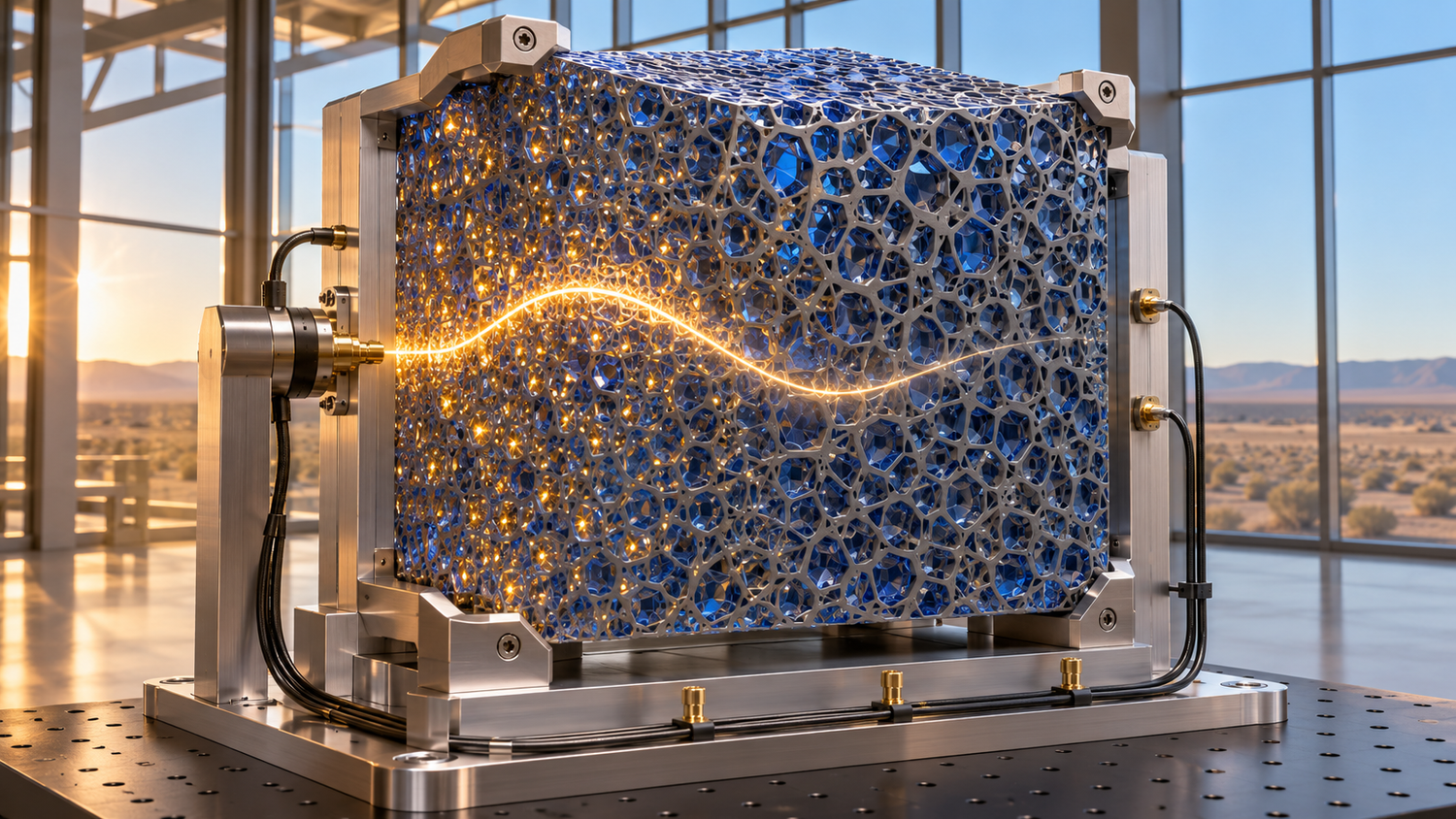
Four theorists at PsiQuantum in Palo Alto, David Jennings, Kamil Korzekwa, Matteo Lostaglio and Tamás Vaszary, posted a 46-page paper to arXiv on 4 November 2026 that asks a narrow question with a wide audience: when does a quantum computer simulating elastic waves through a heterogeneous solid beat a classical supercomputer by the quartic margin that earlier papers promised? Their answer is conditional. For a continuum model at fixed volume the advantage shrinks as the material gets smoother, and at high enough discretization order the quantum algorithm loses on accuracy. The quartic separation survives only where the material has to be resolved at the lattice scale and where the quantity asked for lives in that fine structure.
Elastic-wave simulation is the computational core of seismic monitoring, armor and composite design, and nondestructive testing of airframes and hulls. This post reads the paper as quantum simulation of structural materials in the simulation pillar, dual-use in posture, and sets out what separates an advantage-regime analysis from a code a program office could schedule time on.
What the arXiv paper of 4 November 2026 establishes: a speedup of (m+4)/(m+1) in time and 4/(m+1) in accuracy, set by the convergence order the material allows
The paper builds a quantum algorithm for linear elasticity with spatially varying density and Lamé parameters. The continuum equations are discretized onto a lattice of coupled oscillators, the equations of motion are embedded into a Schrödinger evolution under a sparse Hamiltonian, and the material coefficients enter through an explicit block-encoding. The authors then account for every cost end to end: discretization error, initial-state preparation, Hamiltonian simulation, and the amplitude estimation needed to read one classical number, the fraction of elastic energy in a chosen region, out of the final quantum state.
The headline result is a pair of exponents. With an attained spatial convergence order m, the quantum cost scales as roughly (t/ε) to the power 1 + 1/m, against a classical finite-difference cost of t times (t/ε) to the power 4/m, where t is the simulation time and ε the target accuracy. The speedup is therefore of order (m+4)/(m+1) in simulation time and 4/(m+1) in accuracy. For second-order convergence, the common case for sharp interfaces and rough coefficient profiles, that is a quadratic gain in time and a gain of order four thirds in accuracy. For first-order convergence, which interface and boundary effects can force, the time speedup rises to 2.5. For fourth-order convergence the accuracy dependence becomes worse than classical, because the amplitude-estimation step adds its own inverse-ε cost. Smooth materials that admit high-order classical stencils give the quantum algorithm the least room.
The authors say plainly that this is less optimistic than the quartic figure in earlier work on quantum wave-equation simulation. Those papers counted a speedup in N, the number of degrees of freedom, from N to the four thirds classically to N to the one third on a quantum machine. At fixed physical volume, the PsiQuantum team notes, N is set by the accuracy you want and cannot be scaled up as an independent parameter.
Where the quartic speedup survives: lattice-scale materials, microscopically resolved bulk observables and the quantum cheese encoding
The second half of the paper moves to the regime where continuum elasticity breaks down: crystalline solids excited near the unit-cell spacing, glasses, granular materials, phononic crystals and elastic metamaterials, disordered alloys and nanocomposites. There N is the physical size of the lattice, and the comparison is between quantum and classical simulation of the same discrete system. For a three-dimensional local lattice evolved over a fixed number of traversal times, the quantum cost is of order N to the one third against N to the four thirds for explicit classical time stepping: the quartic separation.
Two conditions are attached. First, the quantity read out must be what the authors call a microscopically resolved bulk observable, a bulk quantity that no known continuum model with fewer degrees of freedom than the lattice can reproduce, yet one that can be extracted from the quantum state with a signal that does not shrink as N grows. Their worked example is a binary-disorder lattice, two isotropic phases assigned at random with probability p, driven by a long-wavelength displacement. Multiplying a smooth strain by the random stiffness pushes an order-one fraction of the elastic energy into lattice-scale Fourier components, and the share of energy in those microscopic modes is the observable. Second, the material itself must be loadable. Storing N coefficients explicitly would cost N and erase the advantage, so the authors use a quantum cheese encoding: a reversible pseudorandom permutation marks a set of centers, a fixed local kernel smooths them, and a threshold assigns one of two phases. The geometry at any site is then computed coherently by a circuit polynomial in log N.
Quantum pillar: simulation (materials and energetics). Use posture: dual-use. Technology readiness: TRL 2 of 9. For the reader this means the work is an asymptotic complexity analysis with a worked lattice model and small numerical illustrations, with no circuit compiled, no qubit count and no run on hardware, so the speedup regime is a paper result awaiting a resource estimate.
Why the panel reads simulation (materials and energetics), dual-use and TRL 2
The pillar is simulation because a quantum processor is used to model a classical physical system, a heterogeneous elastic solid, rather than to run a general computation. The sub-branch is materials and energetics, which Quentir's capability map defines as propellants, explosives, armor and structural materials: the paper's own application list is structural mechanics, fracture diagnostics, nondestructive testing and engineered media for wave damping, and its lattice regime is the composite and metamaterial microstructure that armor and airframe designers simulate. The posture is dual-use because the same solver serves a civil seismologist, a bridge inspector and a weapons laboratory without modification.
The readiness level is 2. The shared ladder places theory, resource estimates and advantage-boundary analysis at levels 1 to 2, and this paper is an advantage-boundary analysis: a specific application worked out on paper with its exponents. The authors state that quantifying fault-tolerant resource requirements is a next step, so the number that would move the result to a comparison with a real machine does not yet exist.
What it would let a force do: LLNL's 60,000 ground-motion simulations for explosion monitoring, SW4 on 100,000 cores, and the composite microstructures a lattice model resolves
The classical baseline the paper competes with is already a national-laboratory workload. SW4, the seismic wave code from Lawrence Livermore and Lawrence Berkeley National Laboratories, solves the three-dimensional elastic and visco-elastic wave equations in heterogeneous earth models with realistic topography and runs on supercomputers with on the order of 100,000 cores. In August 2022 Livermore reported that building its WUS256 model of the western United States took more than 60,000 high-performance-computing simulations on the Lassen machine across 256 model iterations, and said that nuclear explosion monitoring benefits from 3D models that reproduce short-period waveforms shaped by crustal structure. Elastic-wave simulation in heterogeneous media is how a monitoring agency turns a seismogram into a judgment about what happened underground and where.
For a force the capability on offer is twofold. On the defensive side, faster or larger elastic simulations improve the models behind treaty monitoring and nuclear forensics, and they shorten the design loop for protective structures, blast-resistant composites and the engineered lattices that damp vibration in sensors and platforms. On the other side of the ledger, the same solvers characterize the response of an adversary's structures and materials from public data. The paper's lattice regime is the one that matters for materials: nanocomposites and metamaterials whose band gaps and local resonances a homogenized continuum model cannot capture, and the observable it defines, the share of energy a slow wave dumps into microscopic modes, measures how a structured material absorbs an impulse.
Whether any of that arrives depends on the error-correction economics that Ryan Babbush and colleagues at Google set out in PRX Quantum in March 2021: quadratic speedups will not deliver advantage on early fault-tolerant machines without a large improvement in error-correction overhead, while quartic speedups look considerably more practical. That paper is the reason a quartic exponent is worth 46 pages. The PsiQuantum authors have narrowed where the exponent is real, the same discipline the daily blog applied when it read Alice & Bob's cat-qubit estimate for RSA-2048: the assumptions, rather than the headline exponent, decide the date.
What stands between the paper and a program office relying on it: no qubit count, no classical lower bound, a data-loading bottleneck and a classical algorithm nobody has tried to beat
Five items separate this result from a requirement. The first is a resource estimate. The paper gives exponents, and a program office needs logical qubits, T-gate counts and a wall-clock estimate for one seismic or composite problem at a stated accuracy, the kind of count Quentir discussed when fault tolerance was shown to cost an unavoidable logarithm. The second is the classical side of the comparison. The quartic figure is measured against standard explicit lattice evolution, and the authors say it is no lower bound against all classical methods; a specialized classical algorithm for the chosen observable could close the gap. The third is the observable. The advantage is lost if the output can be recovered to the required accuracy from a coarser continuum model, or if the precision needed tightens with system size. The fourth is data loading. The quantum cheese encoding handles synthetic pseudorandom materials; efficient encoding of a measured microstructure from a tomograph, or a real crustal velocity model, has not been demonstrated here, and the authors flag that complex lattice data may itself become the bottleneck. The fifth is hardware. No photonic or other fault-tolerant machine today runs a Hamiltonian simulation at the scale where N to the one third beats N to the four thirds.
What the sources support is this. A PsiQuantum team has published an end-to-end complexity analysis showing that quartic quantum advantage in elastic-media simulation is confined to lattice-scale materials, efficiently encodable geometries and bulk observables that depend on microscopic structure, while continuum problems at fixed volume yield at most a quadratic gain in time for convergence orders m ≥ 2. A qubit and gate count for one specific materials or seismic problem, a specialized classical competitor for the same observable, and a measured-microstructure encoding are the next three pieces of evidence to wait for.
Sources
Primary source: David Jennings, Kamil Korzekwa, Matteo Lostaglio and Tamás Vaszary (PsiQuantum, Palo Alto; Vaszary also at the Mathematical Institute, University of Oxford), "Physical regimes of quartic quantum advantage in elastic media simulation," arXiv 2611.06975, submitted 4 November 2026, 46 pages. Other material: the Computational Infrastructure for Geodynamics page for SW4 by Petersson, Sjögreen, Tang and Pankajakshan; the Lawrence Livermore National Laboratory news release of 10 August 2022 on the WUS256 model by Rodgers, Doody, Chiang and Simmons; Babbush, McClean, Newman, Gidney, Boixo and Neven, PRX Quantum 2, 010103, 29 March 2021. The capability reading, the posture argument, the readiness placement and the buyer items are Quentir analysis.