QodeX Quantum, NSWC Panama City, NVIDIA and RTX BBN Forecast a 33,824-Cell Cylinder Flow on 26 Qubits and Gray-Scott on 52 Qubits, arXiv 2611.10351, 7 November 2026: TRL 3
Quentir Defense Monitor
Evidence-based insights for quantum defense and security. Published by Quentir Systems LLC · November 10, 2026.
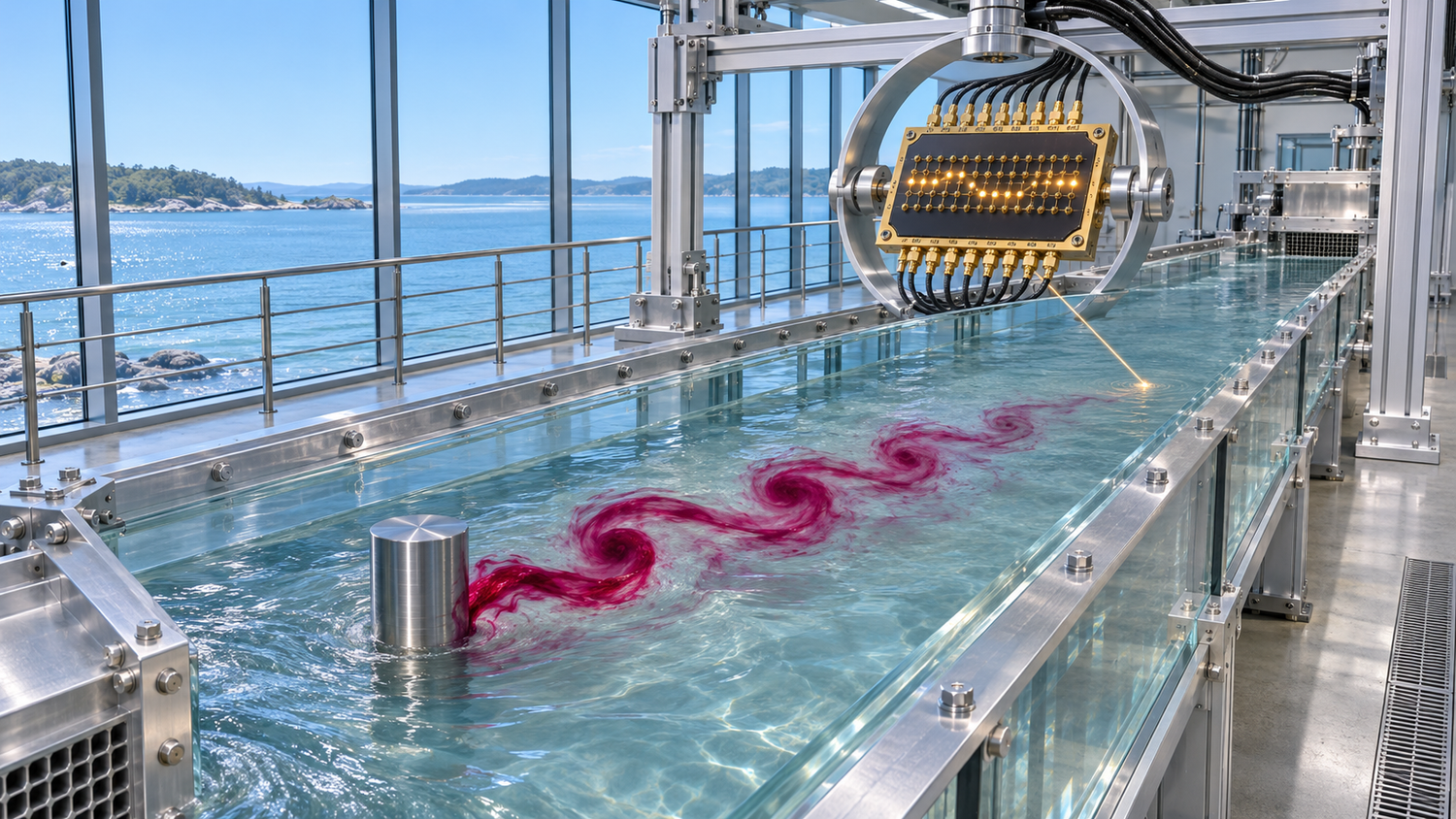
Five authors from a Chicago quantum startup, a Navy warfare center, NVIDIA and RTX's research arm have run cylinder-flow forecasting on 26 superconducting qubits and Gray-Scott forecasting on up to 52 qubits of an IBM processor and reported that the quantum features cut one-step prediction error by 21 to 43 percent against a linear readout. Erik Connerty, Jonathan Eastridge, Taylor Patti, Gerasimos Angelatos and Ethan N. Evans posted the 27-page paper to arXiv on 7 November 2026, with the fluid test case a two-dimensional cylinder wake at Reynolds number 1000 on an unstructured mesh of 33,824 cells. The method is a quantum reservoir network, a fixed quantum circuit whose measured outputs feed a cheap linear regression, so nothing on the quantum side is trained.
The defense interest is plain from the author list and from the problem. Forecasting the pressure and velocity around a body in a flow is the daily work of hull, propulsor, vehicle and munition design offices, and the Naval Surface Warfare Center Panama City Division sits on the paper as a co-author's affiliation. This post reads the result as quantum reservoir computing for fluid dynamics in the simulation pillar, dual-use in posture, and sets out what the ibm_boston run shows, what the authors themselves say it does not show, and what a program office should wait for.
What the paper of 7 November 2026 establishes: a 52-qubit reservoir on ibm_boston, a cylinder wake from OpenFOAM and a 21 to 43 percent error cut over a linear readout
The paper works on two problems. The first is the classical benchmark of flow past a circular cylinder, computed with the pisoFoam solver in OpenFOAM v2512 at a fixed time step of one millisecond and saved as 300 snapshots a tenth of a second apart. The second is the Gray-Scott reaction-diffusion system on a 128 by 128 grid, with 1,001 snapshots. Neither simulation enters the quantum processor directly. A graph autoencoder with four residual GraphSAGE layers first compresses each snapshot into a small latent vector: 13 numbers for the cylinder velocity field, 48 for a pressure field the authors infer from velocity, and 26 for Gray-Scott. The quantum circuit reads that latent vector, and a ridge regression maps the measured observables, concatenated with the latent vector itself, onto the next snapshot.
The improvement is measured as normalized root mean square error on held-out snapshots, with the baseline the same ridge readout fed the latent state alone. For one-step cylinder velocity prediction the error falls from 0.121 to 0.069 in noiseless simulation and to 0.081 on 26 qubits of ibm_boston, reductions of 42.8 and 33.2 percent. For the harder task of observing pressure from velocity it falls from 0.374 to 0.223 in simulation and 0.295 on hardware, a 21.2 percent gain on the processor. For Gray-Scott the paper reports the error dropping from 0.225 to about 0.133, a 41 percent cut, in simulation and on both the 26-qubit and 52-qubit hardware runs. The test sets are small, 30 snapshots for the cylinder and 150 for Gray-Scott, and every forecast is one step ahead.
Two hardware facts frame those numbers. The processor is the one IBM lists as ibm_boston, a Heron r3 device with 156 programmable qubits whose layered two-qubit error stood at 2.5 in a thousand on the day of writing. And the comparison the authors stress is execution accounting against exact classical simulation of their own circuits on an NVIDIA H100 through CUDA-Q: normalized to 30,000 shots, a one-step cylinder circuit took 75 seconds of QPU execution excluding queueing, against about 250,000 seconds of GPU statevector sampling with parallel shot jobs summed, rather than measured as elapsed wall-clock time. The 52-qubit circuits sit beyond exact statevector simulation altogether. That is a statement about simulating the quantum circuit. It says nothing about beating OpenFOAM, and the authors say so themselves.
How the quantum reservoir network works: memory and readout registers, partial swaps and circuits that run 24 times longer than the qubits stay coherent
A reservoir computer uses a fixed dynamical system as a feature generator and trains only the final linear layer. The quantum version here splits the qubits into two equal registers, 13 and 13 for the 26-qubit runs and 26 and 26 for 52. Each latent vector is uploaded into the memory register through input-dependent rotations and an entangling layer with fixed angles, in two or three reuploading blocks, and a partial swap of strength 0.75 or 0.9 leaks part of each memory qubit's state into its readout partner. The circuit parameters are untrained; the encoding rotations depend on the current latent vector. The readout qubits are then measured and reset while the memory register keeps running. Because the memory qubits are never measured, the circuit can run far longer than any single qubit stays coherent: the paper reports total runtimes up to about 28 times the median T1 and 24 times the median T2 of the device, so qubit lifetime no longer sets the forecast length. The same group showed the trick on ibm_marrakesh in a Communications Physics paper of 5 May 2026, where a quantum reservoir reconstructed hidden variables of the Lorenz system with memory persisting more than 100 times the qubits' T1 and T2.
Each circuit is sampled 30,000 times for the cylinder cases, and the observables are built after measurement: single-qubit Z expectations first, then higher correlations added from the same bitstrings as the shot budget and the hardware noise allow. For closed-loop forecasting, where each prediction feeds the next, the authors replay a window of 40 latent states to reinitialize the reservoir, keep only first-order observables, and run ten steps. In those rollouts the error went down as noise went up, which the authors read as hardware noise acting as a regularizer. One-step accuracy still degrades with noise, as the gap between simulation and hardware numbers shows.
Quantum pillar: simulation (hypersonics and aerodynamics). Use posture: dual-use. Technology readiness: TRL 3 of 9. For the reader this means a quantum circuit has run on real hardware and improved a flow forecast made from simulation data, while the flow itself is a slow two-dimensional benchmark, the comparison is a linear readout and no classical solver was outperformed.
Why the panel reads simulation (hypersonics and aerodynamics), dual-use and TRL 3
The pillar is simulation because the quantum device is used to model another physical system, a fluid in motion, and the sub-branch is the one Quentir's capability map reserves for flow, heating and control, which is where aerodynamic and hydrodynamic forecasting belongs. The qualification comes next: a cylinder at Reynolds number 1000 is a low-speed incompressible benchmark, and nothing in the paper touches compressibility, shock layers or the heating that defines the high-Mach end of that sub-branch. The method only ever sees the autoencoder's latent vector, so the same pipeline could in principle be pointed at a hypersonic or an undersea dataset. No such run exists.
The posture is dual-use. A faster surrogate for wake and pressure prediction serves a ship designer, a torpedo designer and a wind-turbine designer with the same code, and the funding on the page reflects it: IBM Quantum credits through the IBM startup program, supercomputer time at Pittsburgh, National Science Foundation grants and a Department of War SMART scholarship for the first author. The readiness level is 3. The shared ladder places a run on real hardware, or working software exercised on stand-in data, at that level, and this is both: a real processor, fed data from a classical simulation rather than from a towing tank. It stands one rung above the quantum lattice Boltzmann solver with solid walls that Peking University published on 5 September 2026, which handled flows at Reynolds numbers 6 to 71 in noiseless emulation only. The two papers mark the two ends of quantum fluid work today: exact algorithms that cannot yet run, and heuristic feature generators that run now.
What it would let a force do: faster wake and pressure surrogates for hull, vehicle and weapon design, once the horizon grows
Design offices already lean on reduced-order models and machine-learned surrogates because full computational fluid dynamics is too slow for the thousands of cases a trade study or a control loop needs. The capability on offer here is a surrogate whose nonlinear feature space is a quantum circuit, with the attraction that 52 qubits generate features from a space of 2 to the 52nd dimensions that a classical machine cannot reproduce exactly. If that feature space holds up at scale, the payoffs a force would care about are the ones the authors sketch: forecasting a wake or a pressure field a few steps ahead faster than the solver, inferring an unmeasured field such as pressure from a measured one such as velocity, and warm-starting a classical solver so it converges in fewer iterations. The pressure-from-velocity task is the one closest to a sensing problem, since velocity is what a particle-image system can see and pressure is what a hull feels.
Ten closed-loop steps on a 13-dimensional latent of a two-dimensional benchmark is a method demonstration. A control or design application wants hundreds of steps on three-dimensional, higher-Reynolds-number flow, and whether the quantum features keep their edge as the latent grows is the question the authors leave for future work. The hardware footing matters too: the team rented time on IBM's cloud through startup credits, a different position from an institution that installs its own machine, as Yonsei University did with a 120-qubit Nighthawk r2 on 4 November 2026. Queue times, credit budgets and the 75 to 465 seconds of QPU execution per experiment, excluding queueing and normalized to 30,000 shots, enter a program's calculation before any speedup does.
What stands between the ibm_boston run and a program office relying on it: a fair classical baseline, longer rollouts, a 3D flow and a third-party rerun
Five items separate this paper from a requirement. The first is the baseline. A 21 to 43 percent error reduction over a linear ridge readout is the right internal control for a reservoir paper. A buyer needs a stronger comparison: a classical echo-state network or a small recurrent network trained on the same latent vectors, at matched compute cost, would show whether the quantum circuit earns its place. The authors are direct that the method offers no speedup over classical PDE solvers, which they expect to be faster and more accurate on these problems. The second is the horizon: ten autoregressive steps is where the demonstration stops, and the noise-as-regularizer finding should be tested at 50 and 100 steps before anyone builds on it. The third is the problem: a three-dimensional flow at a Reynolds number in the tens of thousands, with a body shape the evaluator picks. The fourth is an ablation that swaps the quantum reservoir for random classical features of the same dimension, which would settle how much the qubits contribute once the autoencoder and the ridge readout have done their work. The fifth is replication by a group outside the author list on a processor of its own choosing, since every hardware number here comes from one device over one campaign.
What the sources support is this. A five-author team spanning QodeX Quantum, NSWC Panama City Division, NVIDIA and RTX BBN has run a quantum reservoir network on up to 52 qubits of IBM's ibm_boston, kept circuits running some 24 times longer than the qubits' coherence through measure-and-reset, and cut one-step forecast error on a 33,824-cell cylinder wake and a Gray-Scott system by 21 to 43 percent against a linear readout. The flow is a low-speed benchmark, the forecasts are short, and the authors state plainly that no classical solver has been beaten. A matched classical surrogate comparison, a longer rollout and a 3D flow forecast on a buyer-chosen geometry are the next three pieces of evidence to wait for.
Sources
Primary source: Erik Connerty (QodeX Quantum, Chicago, and the AI Institute, University of South Carolina), Jonathan Eastridge (Naval Surface Warfare Center Panama City Division), Taylor Patti (NVIDIA, Santa Clara), Gerasimos Angelatos (RTX BBN, Cambridge, Massachusetts) and Ethan N. Evans (QodeX Quantum), "Realizing Unstructured PDE Forecasting on Superconducting Quantum Processors," arXiv 2611.10351, submitted 7 November 2026, 27 pages, 26 figures. Other material: Connerty, Evans, Angelatos and Narayanan, "Predicting chaotic dynamics on NISQ hardware with quantum reservoir networks," Communications Physics, 5 May 2026; the IBM Quantum compute resources listing for ibm_boston, read on 10 November 2026; the NVIDIA CUDA-Q platform page; the OpenFOAM v2512 release page of December 2025. The capability reading, the posture argument, the readiness placement and the buyer items are Quentir analysis.