Peking University Puts Solid Walls Into a Quantum Fluid Solver: the Quantum Lattice Boltzmann Paper of 5 September 2026 and Its Emulated Flows at Reynolds 6 to 71
Quentir Defense Monitor
Evidence-based insights for quantum defense and security. Published by Quentir Systems LLC · September 9, 2026.
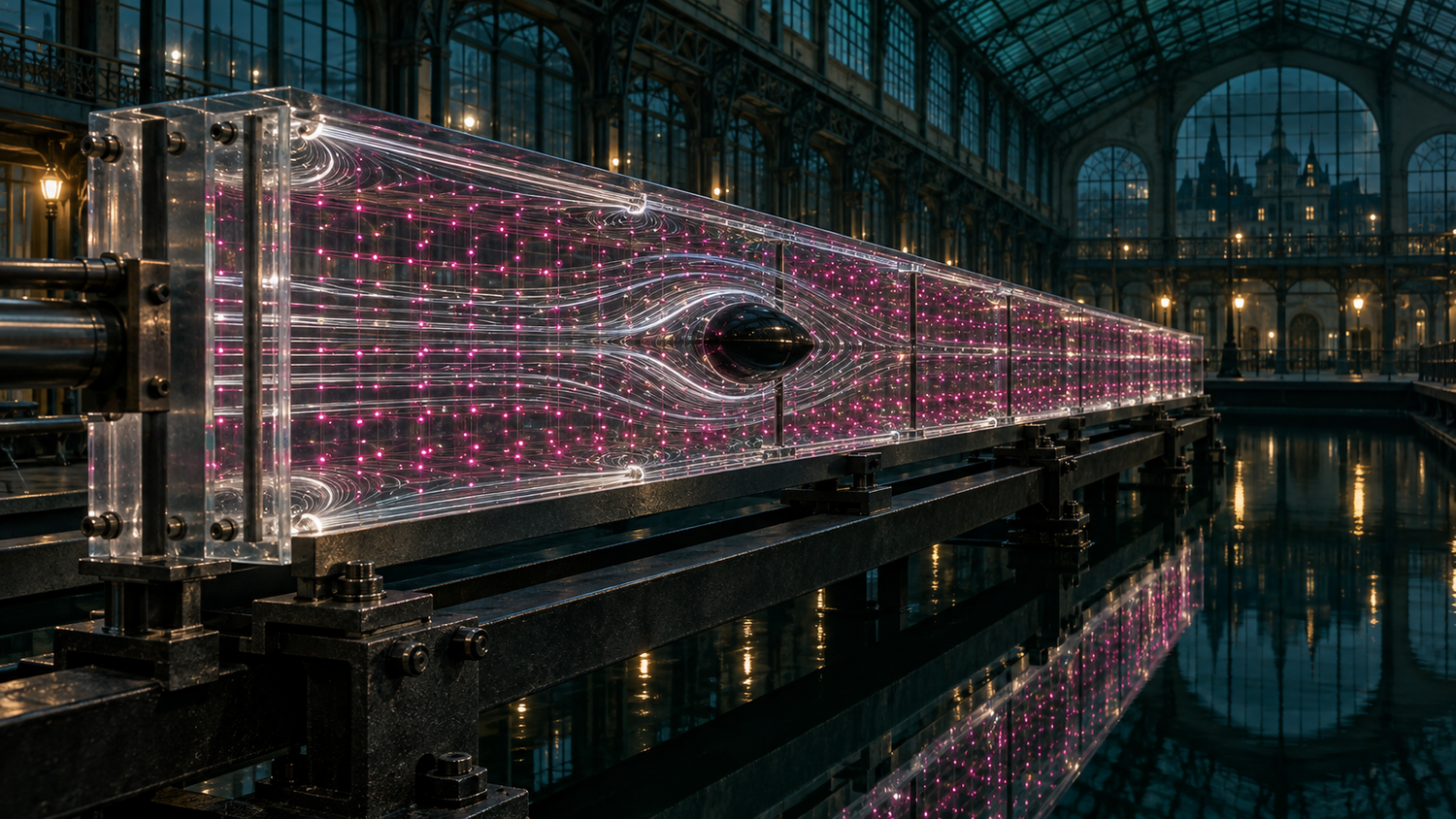
On September 5, 2026, three researchers at Peking University's State Key Laboratory for Turbulence and Complex Systems posted an algorithm that teaches a quantum fluid solver something every wind tunnel takes for granted: how flow behaves when it meets a solid wall. Hao Su, Boyuan Wang and Yue Yang describe a quantum lattice Boltzmann method that carries walls, inlets and outlets inside the quantum computation itself, then exercise it on channel flow, a backward-facing step, a cylinder wake and an obstacle shaped like the letters of their university's initials. Their arXiv preprint calls the treatment of solid walls with arbitrary geometry "a critical open challenge" for the field, and the claim is fair: quantum flow demonstrations to date have mostly lived in periodic boxes, the fluid equivalent of a world with no objects in it.
A defense reader should care about walls for a plain reason. Computational fluid dynamics is the workhorse discipline behind every vehicle that moves through air or water, and its appetite for computing has been an acknowledged ceiling on aerodynamic design for over a decade. NASA's CFD Vision 2030 study, written with authors from Boeing, Stanford, MIT and Pratt & Whitney, set the problem out in 2014: routine physics-based prediction of turbulent and reacting flows across the full Mach range demands computing beyond what even the largest machines deliver, and high-speed design work leans on that prediction hardest because wind tunnels that reproduce sustained hypersonic conditions are scarce. Any computing technology that might someday move that ceiling gets read as a defense technology whatever its authors intend. A flow solver with no walls can never be that technology; an airframe, an inlet duct, a control surface and a submarine hull are all, to the solver, walls.
This briefing reads the paper as a capability document: what the Peking University team actually built, what their numbers show and withhold, and how far an emulated two-dimensional flow at Reynolds number 71 sits from the design regimes a program office pays for.
What Su, Wang and Yang built: bounce-back walls and Kraus operators inside a density-matrix solver
The lattice Boltzmann method, the classical algorithm underneath this work, describes a fluid as populations of fictitious particles that stream between the sites of a regular lattice and collide there, relaxing toward local equilibrium. Averaged over the lattice, those simple rules reproduce the Navier-Stokes equations that govern real flows. Classical engineers prize the method precisely for its handling of complicated geometry, which is why it appears in aerodynamic and acoustic work where meshing an intricate shape defeats other solvers. A quantum version is attractive because the populations across the whole lattice can in principle live in the amplitudes of a modest register of qubits, with each additional address qubit doubling the register's address capacity.
The obstacle has been broader than the static half-way bounce-back rule itself. For a static wall, the rule exchanges particle populations at lattice links that cross the solid surface, and the paper implements those component permutations with SWAP gates. The harder problem is representing the broader stochastic evolution together with inlet and outlet replacement, while the paper specifically identifies the moving-wall correction as violating the unitary and positive-semidefinite requirements.
The Peking University team's answer is to change what the qubits encode. Instead of holding the flow state as a pure quantum state vector, their solver holds it as a density matrix, the more general object quantum mechanics uses for open systems. That representation admits operations built from Kraus operators, the mathematical form of quantum evolution that need not be unitary, and the paper spends its technical weight there: the static bounce-back rule becomes a component exchange applied ahead of the streaming step, which enforces the no-slip condition at every solid surface, while inlets and outlets are absorbed and refreshed through controlled-SWAP gates acting on ancilla registers. Geometry is compiled into the circuit from precomputed boundary-adjacent points and bounce directions. The authors demonstrate the point by running flow past an obstacle spelling "PKU" on a 2,048 by 512 lattice. Their predecessor algorithm supported only periodic boundaries; this construction adds obstacle boundaries while retaining cyclic streaming.
Quantum pillar: simulation (hypersonics and aerodynamics). Use posture: dual-use. Technology readiness: TRL 2 of 9. Every quantum circuit in the paper ran as a mathematical emulation on a conventional computer, so the method stands as a concept worked out with numbers, awaiting its first execution on quantum hardware that physically exists.
The numbers behind the claim: 23 qubits for a 128 by 128 grid, Reynolds 6.37 to 71, and no quantum processor anywhere
The validation cases are honest laboratory exercises in two dimensions. A decaying Poiseuille channel flow at Reynolds number 6.37 ran on a 128 by 128 grid using 23 encoding qubits, 14 carrying position and 9 carrying the particle velocities. That count excludes working ancillas and the repeated state preparations required by the H-step. The backward-facing step, a canonical test of flow separation and reattachment, ran on a 512 by 128 grid, which requires more position qubits, at Reynolds numbers 17.8, 35.5 and 71. Flow past a cylinder ran on grids up to 1,024 by 256 at Reynolds numbers 6.6 and 43, and the PKU-shaped obstacle case reached Reynolds 64.8. The Poiseuille and obstacle results provide comparisons with classical references. Across the backward-facing-step and cylinder benchmarks, reported relative errors range from 10.3 to 17.34 percent, and the authors identify imperfect inlet and wall-boundary accuracy. The PKU-letter case presents QLBM streamlines without a classical reference comparison.
Every one of those circuits, though, was executed by what the authors call a quantum emulator with in-house code on a classical computer. No quantum processor appears anywhere in the study, and the emulation is noiseless, so the results say nothing about how the algorithm survives the error rates of physical hardware. That is why the readiness panel above places this work at level 2 on the nine-rung ladder: a concept fully formulated with numbers, demonstrated by simulating a machine that has not been used. The authors are also direct about their own cost accounting. They express the per-step controlled-gate cost as O(2^q n²), where n represents position-register width rather than a number of grid sites per side; the spatial grid is represented logarithmically. The full algorithm additionally requires q^(T/Δt) repeated state preparations obtained through repeated circuit execution for the H-step, beyond the encoding qubits and working ancillas. The step handling their nonlinear collision term "introduces considerable complexity, which may undermine the quantum speedup for moderate-sized problems." Moving boundaries, meaning any object that rotates, deflects or vibrates, remain untreated.
The distance from these flows to engineering regimes deserves plain statement. Reynolds number 71 places these particular combinations of geometry, velocity and viscosity in a viscous-dominated laminar regime; the airflow over a fighter wing or a reentry body sits in the millions, fully turbulent, three-dimensional, and at high Mach coupled to shock waves and heating chemistry. A recent Nature Reviews Physics survey of quantum computing for nonlinear flow problems by Tennie, Laizet, Lloyd and Magri identifies exactly this nonlinearity as the field's central unsolved difficulty and judges practical advantage to lie beyond the near term, after progress in both algorithms and hardware.
Who gains from a quantum route to aerodynamic simulation, and what a program office would still need
Read as capability, the paper is one brick in a specific structure: a future in which the design simulation for a high-speed vehicle runs on a quantum machine at grid resolutions classical computers cannot reach. What that would let a force do is concrete. Aerodynamic and hydrodynamic design cycles are gated by simulation throughput, so the owner of a superior solver iterates airframes, inlets, propellers and hulls faster and trusts computation where test facilities are scarce, which for hypersonic heating and for quiet submarine hydrodynamics is most of the time. The posture is squarely dual-use: the same wall boundary conditions serve an airliner and an interceptor, and this work was funded by three grants from the National Natural Science Foundation of China at a laboratory whose classical turbulence research already serves China's aerospace sector. The benefit, if the method ever pays off, accrues to whoever fields large fault-tolerant quantum machines, a race in which DARPA's Quantum Benchmarking Initiative is currently auditing company roadmaps against the test of an industrially useful computer by 2033.
Between this preprint and any program office lie steps the paper does not claim to have taken. The algorithm needs a run on physical hardware, then noise studies, then some answer to the measurement problem that shadows all quantum flow schemes: a design engineer wants the whole flow field, and reading a full field out of a quantum state costs enough repetition to erode the advantage the encoding bought. The gate, copy and ancilla requirements the authors report must come down, and the method must reach turbulence. Readers weighing the field's trajectory can set this algorithmic advance beside the hybrid solver from Oak Ridge that got an exascale reality check in August: two research communities, one working from variational linear solvers and one from lattice Boltzmann physics, are now independently doing the unglamorous engineering that decides whether quantum computing for aerodynamics ever leaves the emulator.
For a capability planner, the honest summary is that quantum flow simulation gained a working wall this month, in emulation, in two dimensions, within viscous-dominated laminar cases defined by the selected geometries, velocities and viscosities. The reason to keep watching is that walls were the ingredient standing between quantum flow demonstrations and geometry that means something, and geometry that means something is where defense engineering begins.
Sources
Primary source: Hao Su, Boyuan Wang and Yue Yang (Peking University), 'Quantum lattice Boltzmann method via density-matrix encoding for fluid simulation with wall boundary conditions,' arXiv:2609.06179, September 5, 2026. Other material: NASA's CFD Vision 2030 study (CR-2014-218178); Tennie, Laizet, Lloyd and Magri, Nature Reviews Physics 7 (2025); DARPA's Quantum Benchmarking Initiative program page.