Quantum X Labs Runs a 16-Qubit Photon-Transport Circuit for 140 keV Photons Through a Tungsten Collimator on IBM's Fez Processor, 20 November 2026, With No Amplitude Estimation Yet: TRL 3
Quentir Defense Monitor
Evidence-based insights for quantum defense and security. Published by Quentir Systems LLC · November 20, 2026.
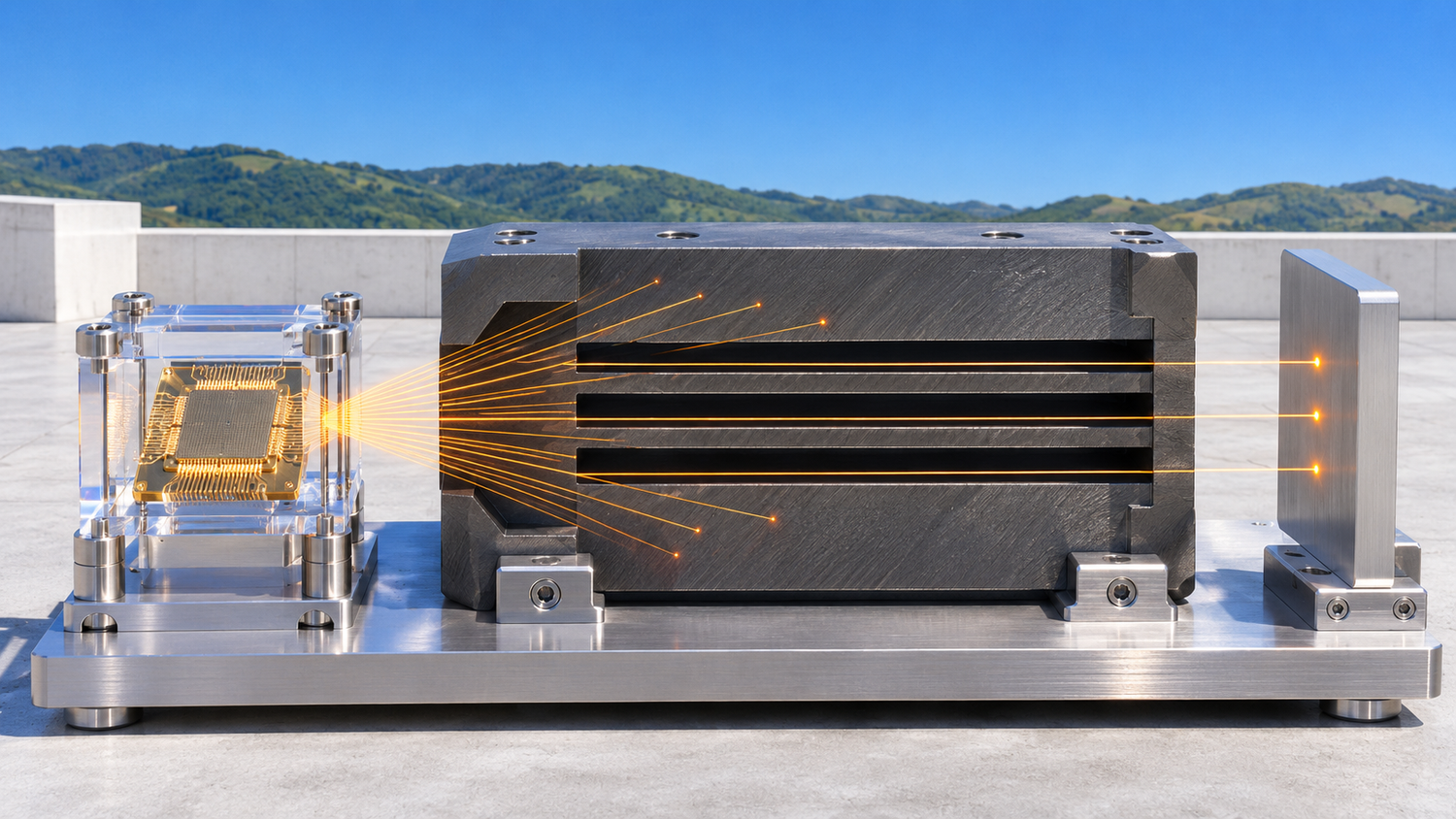
On 20 November 2026 Quantum X Labs of Tel Aviv announced that its Nuclear Simulation Team had executed a 16-qubit quantum algorithm on IBM's Fez superconducting processor to simulate the passage of 140 keV photons through a two-dimensional tungsten collimator. The company reports that, after hardware-noise mitigation, the processor's output deviated from an exact classical statevector simulation of the same circuit by a root-mean-square figure of about 0.03 to 0.04, with 4,096 shots per measurement point. The release, issued through GlobeNewswire, states in its own words that the experiment did not implement amplitude estimation and did not establish an efficiency advantage over GPU-based methods.
This post takes that sentence at face value. Radiation transport is the physics of how photons, neutrons and charged particles move through matter, and the codes that compute it decide how thick a shield must be, how a detector sees through a collimator, how an electronic component survives a radiation environment, and what a nuclear device or reactor does to the material around it. The classical tools are mature and fast, so a quantum method would have to reduce total computational cost through fewer sampling operations, cheaper sample generation or both. Quantum amplitude estimation offers an asymptotic sampling advantage, which the company has not yet tested. This post reads the development as a simulation-pillar item in the nuclear and radiation effects sub-branch, dual-use in posture, at the proof-of-concept rung of the readiness ladder.
What Quantum X Labs ran on IBM's Fez on 20 November 2026: a 16-qubit transport circuit, 140 keV photons, a tungsten collimator in two dimensions and 4,096 shots per point
The release describes the algorithm as using quantum-state preparation and reversible quantum operations to encode particle transport probabilities and to evaluate detection outcomes. In plain terms, the circuit prepares a quantum state whose amplitudes stand for the probabilities that a photon entering the collimator is absorbed in the tungsten, scatters, passes through a channel, and deposits enough energy in the detector to clear its threshold, and measuring the circuit many times recovers those probabilities as frequencies. The company varied the tungsten attenuation, the channel width and the detector energy threshold, and says the circuit reproduced the resulting changes in detection probability in agreement with analytical calculations and classical simulations.
Fez appears on IBM's list of available quantum computers as a Heron r2 processor with 156 qubits, so the experiment used 16 of those qubits through ordinary cloud access; the release names no partnership with IBM, no funding and no co-author outside the company. The comparison baseline is an exact statevector simulation, meaning a classical computer ran the identical 16-qubit circuit without noise and the two sets of output probabilities were compared point by point. The reported root-mean-square deviation of 0.03 to 0.04 measures agreement between the mitigated output probabilities and the noiseless reference; mitigation effectiveness remains unverified without a comparison with unmitigated results. It says nothing about how well the circuit models tungsten, because the reference it was compared against is the circuit itself.
A photon energy of 140 keV is the gamma line of technetium-99m, the isotope behind most nuclear-medicine scans, and a tungsten or lead collimator in front of a gamma camera is the geometry a medical physicist models for such a scan. The test case is therefore a textbook shielding-and-detection problem with known analytical answers, which is the right way to validate a new method and also the reason the result carries no claim about a defense geometry.
Where a speedup would come from and why it has not been shown: quantum amplitude estimation, 4,096 shots and the quadratic bound
Classical Monte Carlo transport codes follow one random particle history at a time and average over millions of them. The statistical error of such an estimate falls as one over the square root of the number of histories, so halving the error requires four times as many histories. Ashley Montanaro showed in 2015, in Quantum speedup of Monte Carlo methods, that a quantum algorithm can estimate the expected output of a randomized subroutine with bounded variance using a number of oracle calls that grows approximately inversely with the target error, with additional logarithmic factors. This near-quadratic sampling advantage does not determine total computational cost, which also depends on the cost of each oracle call. The mechanism is quantum amplitude estimation, which runs the state-preparation circuit coherently many times inside a phase-estimation routine instead of measuring it once per sample.
Quantum X Labs ran the state-preparation circuit and measured it. Each measurement point used 4,096 shots, which is a Monte Carlo estimate executed on a quantum processor with the same square-root scaling as a classical one. The release is explicit that the quadratic gain was not attempted; David Shnaiderov, the company's Head of Nuclear Quantum, is quoted as saying the team demonstrated a coherent and efficient oracle that can serve as a foundation for amplitude estimation, and that the next objective is to integrate it and test whether it delivers comparable accuracy with fewer sampling operations. The amplitude-estimation step is where the difficulty lies, because it multiplies the circuit depth by the number of coherent repetitions, and on hardware without error correction each repetition adds noise. The Samsung Medical Center preprint on protons slowing in tissue, which Quentir's Medicine Monitor read on 10 November 2026, found a clinical-scale amplitude-estimation circuit 160 times over the gate budget of present devices.
Related work includes Noé Olivier and Michel Nowak's October 2024 proposal, in arXiv 2410.19489, for a particle-transport scheme built on discrete-time quantum walks combined with amplitude amplification. The release provides no circuit documentation establishing that Quantum X Labs implemented this scheme.
Quantum pillar: simulation (nuclear and radiation effects). Use posture: dual-use. Technology readiness: TRL 3 of 9. A 16-qubit circuit ran on a real processor and reproduced its own noiseless statistics for a two-dimensional textbook geometry, so the result is an experimental proof of concept, with no amplitude estimation, no three-dimensional problem and no comparison against a production transport code yet performed.
What a quantum radiation-transport solver would let a force do or stop: shield design, hardening, detection and the nuclear-effects codes it would have to displace
The release lists nuclear energy, aerospace, defense, medical imaging and radiation shielding as the industries that depend on transport simulation, and for a defense buyer the problems are concrete. Shield mass on a satellite, an aircraft or a vehicle is traded against payload and range, electronics on missiles and satellites are hardened against a radiation environment specified through transport calculations, and detector collimators for finding shielded radioactive material are designed the same way. The stockpile-adjacent modeling of weapon effects is the most consequential case and the one with the deepest classical investment: the National Nuclear Security Administration's Advanced Simulation and Computing program at Lawrence Livermore exists to certify the stockpile through simulation in the absence of testing, on the largest classical machines in the country.
The classical state of the art sets the bar. Geant4, the CERN-led toolkit for simulating the passage of particles through matter, covers high-energy, nuclear and accelerator physics as well as medical and space science, and Los Alamos's MCNP code is the reference for nuclear applications, with decades of validated cross-section libraries behind these tools. A quantum solver earns a place only when the quadratic gain in sampling survives the overhead of error correction on a problem large enough for the classical code to be slow, and no published experiment has reached that point.
The posture is dual-use in the ordinary sense of the capability map. A better tungsten collimator model serves a gamma camera in a hospital and a radiation portal monitor at a border; a better shielding calculation protects a satellite's electronics and sizes the shield around a reactor or a weapon, and nothing in the release points the method at one side of that line. The company's earlier announcement on Rydberg radio-frequency sensing and its atomic clock, which this Monitor read on 3 October 2026, showed the same pattern of a laboratory component presented with defense and aerospace context that the company did not itself generate.
What stands between the 20 November release and a program office: no paper, no circuit details, no production-code comparison and a company whose other subsidiaries sell advertising software
The first gap is documentation. The release cites no preprint, technical report or repository, and it gives no circuit depth, no two-qubit gate count, no transpilation details, no name for the noise-mitigation method, no number of measurement points, no collimator dimensions and no attenuation values. A reader cannot reproduce the result or judge how far the mitigation carried it, and until a write-up appears the headline deviation figure stands alone.
The second gap is the baseline. Agreement with a statevector simulation of the same circuit measures agreement in the selected output probabilities and cannot establish correct circuit execution. It does not show that the circuit models photon transport correctly in any case where the answer is not already known analytically. A convincing next release would compare detection probabilities against MCNP or Geant4 on the same geometry and state the discrepancy, and would then move to a three-dimensional geometry with scattering that an analytical formula cannot handle.
The third gap is the speedup, which the company itself identifies as the next objective. Integrating quantum amplitude estimation with the demonstrated oracle and benchmarking sampling requirements against GPU Monte Carlo is the stated plan. A program office should expect that result to come with an error analysis showing how many coherent repetitions the hardware sustained before noise erased the gain, because that number decides whether the method has a path to relevance.
The fourth gap concerns the supplier. Quantum X Labs Inc. is a Nasdaq-listed holding company whose release describes its subsidiaries as focused on quantum technology, digital advertising and computing, and enterprise artificial intelligence; two of them sell internet campaign and grammar-correction software, while Quantum X Labs Ltd. works on quantum algorithms for transportation, drug discovery and security alongside a GPS replacement and an atomic clock. The release names no national laboratory, university or defense partner, and a buyer evaluating a radiation-transport method would want the institutional anchors it gets from the laboratories that maintain the classical codes. When the amplitude-estimation result arrives, the same buyer should ask for the preprint, the gate counts, the comparison with a production code and the three-dimensional geometry that this release does not contain.
Sources
Primary source: Quantum X Labs Inc., GlobeNewswire release of 20 November 2026 as carried by The Manila Times. Other material: IBM Quantum Platform computers list (Fez, Heron r2, 156 qubits); Montanaro, arXiv 1504.06987 (2015); Olivier and Nowak, arXiv 2410.19489 (2024), cited without a link; Geant4 project page; LLNL Advanced Simulation and Computing page. The capability reading, the posture argument, the readiness placement and the buyer items are Quentir analysis.