Quantum X Labs Pairs Rydberg Atom RF Sensing With Its Ramsey-CPT Atomic Clock, Announced 28 September 2026: What Is Shown, What DARPA and the Airbus RydRa Study Measured, and Why It Sits at TRL 2
Quentir Defense Monitor
Evidence-based insights for quantum defense and security. Published by Quentir Systems LLC · October 3, 2026.
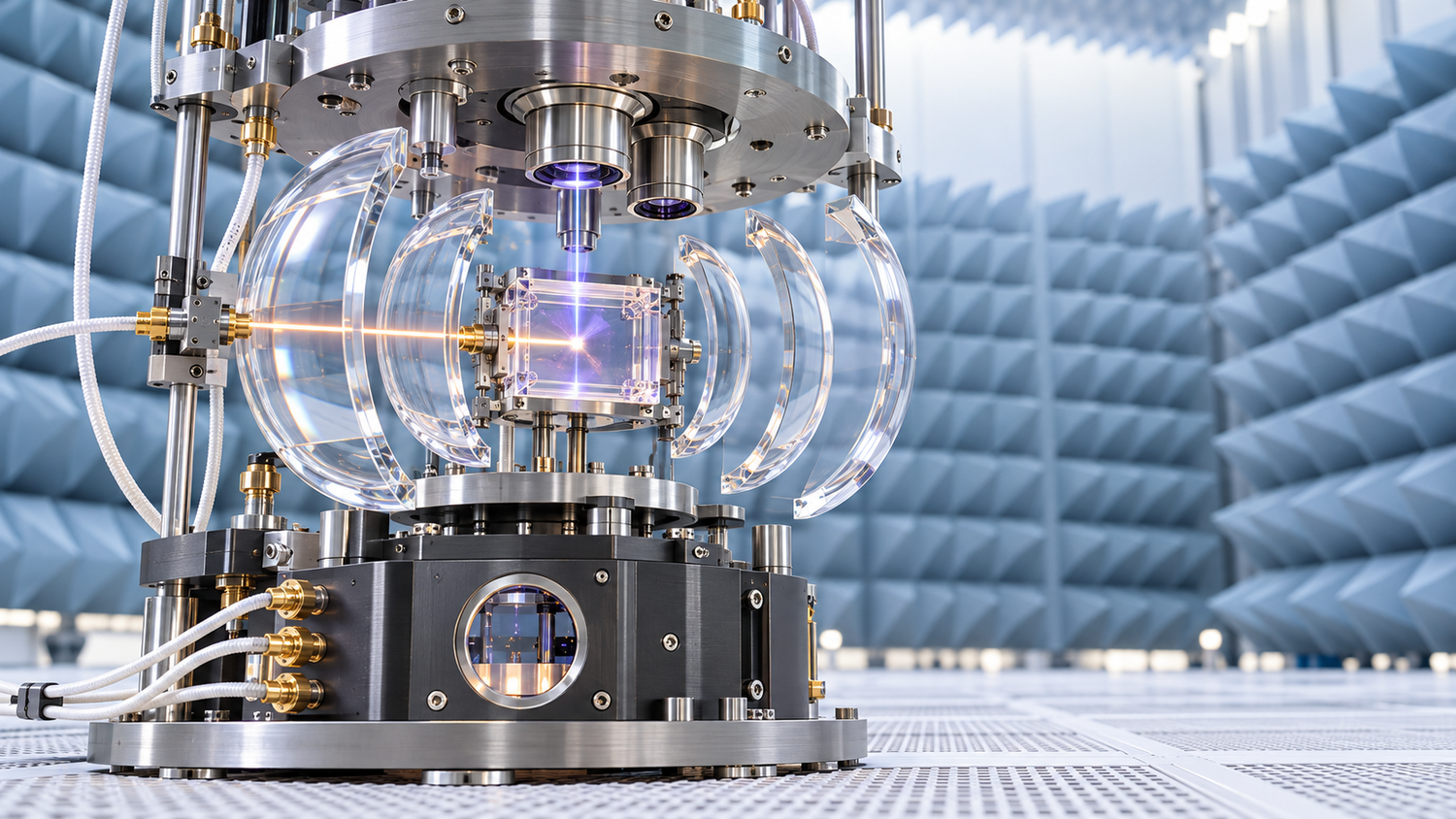
On Monday, September 28, 2026, Quantum X Labs Inc., a Nasdaq-listed company based in Tel Aviv, said its wholly owned subsidiary Quantum X Labs Ltd. is developing Rydberg atom radio-frequency sensing and working to integrate it with the company's patent-pending atomic clock. The clock rests on a Ramsey coherent population trapping scheme, Ramsey-CPT, which the company reported in July at a short-term fractional frequency stability of 1 × 10⁻13 at one second. The stated goal is one atomic sensor architecture that supplies a time reference, a frequency reference and a picture of the surrounding radio environment from the same physics.
This post reads the GlobeNewswire release for what it establishes and what it leaves open, and then does the work the release does not: it puts the idea of Rydberg RF sensing on the same page as the public measurements that exist for it, from NIST's atom-based field probes to the Airbus, Quantum Valley Ideas Laboratories and DLR feasibility study of a Rydberg receiver for spaceborne radar, and from DARPA's Quantum Apertures program to its Robust Optical Clock Network. The company has demonstrated one component in the laboratory, is building a second, and has not shown the two together. That is a concept with laboratory components, and a program office reading the announcement needs to know which of the surrounding numbers belong to Quantum X Labs and which belong to other people's instruments.
What the 28 September 2026 release establishes and what it withholds: one clock result from July, Rydberg sensing in the lab, no integrated system
The release carries three statements of fact and a long list of intentions. The first fact is the clock. On July 7, 2026, the company announced that its Ramsey-CPT platform had reached a fractional frequency stability of 1 × 10⁻13 at one second, a figure The Quantum Insider reported at the time with the company's stated aim of compact timing for resilient positioning, navigation and timing. That July text named optimization, miniaturization and integration as future work, so the result is a laboratory clock, with no public size, power, holdover or environmental figure attached to it. The second fact is a patent application covering the clock, which the company describes as pending. The third is a statement of scope: the new Rydberg RF sensing work and the planned integration are, in the company's words, separate development activities that the existing clock patent application does not cover.
Everything else is prospective. The release says the Rydberg sensing is under laboratory development, that the company is working to integrate it with the clock, that its target is a demonstration of the combined architecture, and that a fully integrated system has not been demonstrated. It gives no sensitivity, frequency range, bandwidth or form factor for the Rydberg sensor, no date for the demonstration, no customer and no funded program. Prof. Nir Sharon, the company's chief quantum scientist, frames the rationale as integration rather than isolation: the clock provides timing and a frequency reference, the Rydberg sensor provides information about the surrounding RF environment, and the architecture is meant to deliver both. The release also places the work in context the company did not generate, citing DARPA's investment in Rydberg receivers and precision clocks and a 2026 study by Airbus Defence and Space, QVIL and the German Aerospace Center on spaceborne Rydberg radar sensors. Those references are accurate, and they are also the only performance evidence in the vicinity of the announcement, which is why the rest of this post is about them.
One further piece of context belongs here. The German-language investor coverage that carried the story on October 1 was paid promotional material under an investor-relations contract with the company, as its own disclosure states, so this post rests on the wire release and the third-party sources linked below.
Why one atom can be both a clock and an antenna: the physics NIST and DARPA's Quantum Apertures program established
A Rydberg receiver is a glass cell of alkali vapor, usually cesium or rubidium, with two laser beams passing through it. One laser pumps the outer electron of the atoms into a Rydberg state, an orbit so far from the nucleus that the atom responds to faint electric fields the way a large antenna would. The second laser reads the atoms optically: a radio-frequency field arriving at the cell shifts the atomic levels, the transparency of the vapor to the probe laser changes, and the radio signal appears directly as a modulation of the light. NIST's Communications Technology Laboratory, whose Rydberg atom RF field probe project under Christopher Holloway, Matt Simons and colleagues is the reference body of work, describes the result as self-calibrated electric-field measurement traceable to fundamental constants across a range from DC into the terahertz region, with fiber-coupled cells for portable use and weak-field detection at sub-hertz resolution.
Two properties follow that matter for a military buyer. The sensing cell is dielectric and can reduce disturbance of the field it is measuring compared with a metal probe; that does not imply zero scattering or establish the radar detectability of the whole instrument. And its frequency response is set by which atomic transition the lasers select rather than by the geometry of a metal element, so one cell can in principle cover bands that would otherwise need several antennas. DARPA's Quantum Apertures program, now complete and maintained on the agency's site for reference, was built on exactly that premise: a new way of receiving RF waveforms with greater sensitivity and frequency agility for electromagnetic spectrum operations, radar and communications.
The connection to a clock is physical rather than marketing. A Ramsey-CPT clock interrogates the same kind of alkali vapor with laser light, in a different configuration, to lock a microwave oscillator to a hyperfine transition. Both instruments are vapor cells, lasers, photodetectors and frequency control electronics. The engineering claim Quantum X Labs is making is that a single platform of those parts can host both functions, with the clock supplying the stable local oscillator that a Rydberg receiver needs to measure phase and frequency rather than amplitude alone. That claim is reasonable on paper and has not been shown by this company in hardware, which is the gap the readiness panel reflects.
Quantum pillar: sensing (RF spectrum sensing). Use posture: dual-use. Technology readiness: TRL 2 of 9. The combined clock and Rydberg sensing architecture is a formulated concept whose two components are at different stages, a laboratory clock with one published stability figure and a Rydberg sensor still in development with no reported measurement, and nothing has yet been run as one system, so the integration itself has not reached the experimental proof of concept that would place it on rung three.
What a combined timing and RF-sensing head would let a force do, who gains from it, and why the posture reads dual-use
Start with what each half does alone, because that is where the operational value is already visible. A holdover clock is what a platform runs on when satellite timing is jammed or spoofed. DARPA's Robust Optical Clock Network program, in a March 2026 update, described a shoebox-sized optical clock that holds GPS-level sub-nanosecond timing for up to two weeks without intervention, a washing-machine-sized master clock meant to hold a regional network for more than six months, and prototypes already tested on a fixed-wing aircraft, on ground vehicles and on a naval ship during a three-week deployment in the tropical Pacific. The agency's next step is a field exercise campaign aimed at next-generation PNT, electronic warfare and ISR. Those are the capability targets a timing reference serves: a radar network stays coherent, a frequency-hopping link stays synchronized, and a passive sensor can time-stamp an emitter with a precision that fixes its position. Quantum X Labs' clock is far earlier than that, but the use case it names is the same.
A Rydberg receiver on its own addresses a different problem. Wideband spectrum sensing today is done with banks of antennas and receivers, each tuned to a slice of the band, each with its own calibration, and each a visible metal aperture. An atomic receiver that covers the band by changing a laser frequency, calibrates itself against a physical constant and uses a sensing cell that can reduce disturbance of the measured field is attractive for electronic support measures, for passive detection of emitters and for signals-of-opportunity sensing. Whether the whole instrument is less detectable by radar requires separate evidence. The earlier work this Monitor read on MIMO coding for Rydberg atomic receivers from Tampere University and Nokia Bell Labs showed how much receiver-side processing still separates a working atomic sensor from a working link; the same gap applies to any emitter-detection use.
Put the two together and the proposition becomes a single head intended to provide timing and information about what is on the air across a wide band, without a satellite and without a metal antenna. Nanosecond absolute timing could be an application requirement, but meeting it would require initialization, synchronization and a specified holdover interval with characterized drift; the reported one-second fractional frequency stability does not establish that capability. Who gains is the question the posture field answers. The defensive case is resilience: a force whose timing and spectrum awareness survive GPS denial and jamming is harder to degrade. The offensive case is equally direct: precise timing plus wideband passive reception is the front end of electronic warfare and emitter geolocation, while any claim that the receiver could be placed covertly because of low radar detectability would need evidence for the whole instrument. Neither reading is a recommendation; both follow from the proposed functions, and the company itself describes the market as defense and aerospace. The posture reads dual-use, and in this case the two uses are inseparable at the component level.
Commercially, the gain today goes to whoever can show a measurement, and the company is entering a field where NIST, the Army Research Laboratory, QVIL and several European groups have published sensitivities, bandwidths and receiver architectures for years. Those numbers are the subject of the final section.
What the Airbus, QVIL and DLR RydRa study and DARPA's clocks show about the distance between this announcement and a program office
The Airbus Defence and Space, Quantum Valley Ideas Laboratories and DLR feasibility study the release cites is public. Its closeout report, Rydberg RF Sensors for Spaceborne Radar Applications, by James P. Shaffer of QVIL and Piotr Kozakowski of Airbus, was published on January 15, 2026 under DLR grant 50WM2349 and summarizes fourteen months of work completed at the end of 2024. It is the most concrete public statement of what a Rydberg receiver can and cannot do against a real radar requirement, and it is worth reading in detail because it sets the bar any newcomer has to meet.
The study asked whether a Rydberg receiver could replace the conventional receive subsystem of a C-band spaceborne radar at 5.52 GHz. The answer was a qualified yes on paper. A bare cesium vapor cell with a two-photon readout reached a sensitivity of about 2.4 nanovolts per meter per root hertz, a three-photon scheme that cancels Doppler broadening improved that to about 0.5, and QVIL's photonic-crystal receiver, which slows and concentrates the RF field around the cell, added roughly 30 dB. Against a mission requirement of minus 150 dBm per hertz, the proposed design reached better than minus 170. The costs are equally specific. Each photonic-crystal cell is limited to 10 MHz of bandwidth, so the 100 MHz system requirement needs eleven cells read out in parallel. A bare receiver has a directivity of about 13.5 dBi against a requirement of 53, so the concept needs either a 63 by 63 array of cells about seven meters on a side or five three-meter parabolic dishes with a receiver panel at each focus. The proposed system came in under 75 kilograms and 300 liters before the dishes, at about 750 watts, against a conventional allocation of 400 kilograms, 1,323 liters and up to 3 kilowatts. The authors call the work exploratory, say the three-photon packaging is less mature than the two-photon version, and describe the result as groundwork for raising the technology readiness level rather than a system.
That report is the measuring stick. It shows that a Rydberg receiver's sensitivity is real and already competitive, that bandwidth and directivity are the engineering problems, and that a credible concept comes with a mass, volume and power budget. Quantum X Labs has published none of those quantities for its sensor. On the timing side, DARPA's ROCkN clocks have ridden on aircraft, vehicles and a ship with stated holdover figures; the company's Ramsey-CPT clock has one laboratory stability number and no holdover, size or environmental data. The release's own caution, that no fully integrated system has been demonstrated and that there is no assurance the program will reach its intended performance or a viable product, is the accurate summary.
So what stands between the September 28 announcement and a program office relying on it. First, a measurement of the Rydberg sensor itself: sensitivity, band, bandwidth and dynamic range, in the units the RydRa authors and NIST use, so it can be compared. Second, a demonstration that the clock and the receiver run as one head, with evidence that sharing the platform improves the receiver's phase and frequency measurement rather than merely co-locating two instruments. Third, the engineering figures that turn a laboratory result into quantum sensing for defense that a prime can integrate: size, power, temperature range, vibration tolerance and holdover for the clock, and a bandwidth and directivity plan for the receiver. Fourth, a funded program or a trial partner, since the announcement names neither. Until a laboratory result for the receiver and a combined-system run appear, the development sits at the concept rung, with the measured work of other laboratories defining what a credible result would have to look like.
Sources
Primary source: Quantum X Labs Inc., "Quantum X Labs Enhances Its Quantum Platform for Defense and Aerospace with Unique Combination of Atomic Clock and Rydberg RF Sensing Technologies," GlobeNewswire, Tel Aviv, September 28, 2026, with the statement of Prof. Nir Sharon. Other material: The Quantum Insider, July 7, 2026, on the Ramsey-CPT clock stability result; NIST Communications Technology Laboratory, "Rydberg Atom-based Quantum RF Field Probes," project page; DARPA, "ROCkN enables GPS-free operations," March 2, 2026; James P. Shaffer and Piotr Kozakowski, "Rydberg RF Sensors for Spaceborne Radar Applications (RydRa 50WM2349)," Airbus Defence and Space, Quantum Valley Ideas Laboratories and DLR, closeout report, January 15, 2026.