Saarland University and UCL Generate a 10-Tooth Microwave Frequency Comb From a Room-Temperature Diamond Maser at 9.23 GHz, arXiv 19 August 2026
Quentir Defense Monitor
Evidence-based insights for quantum defense and security. Published by Quentir Systems LLC · September 20, 2026.
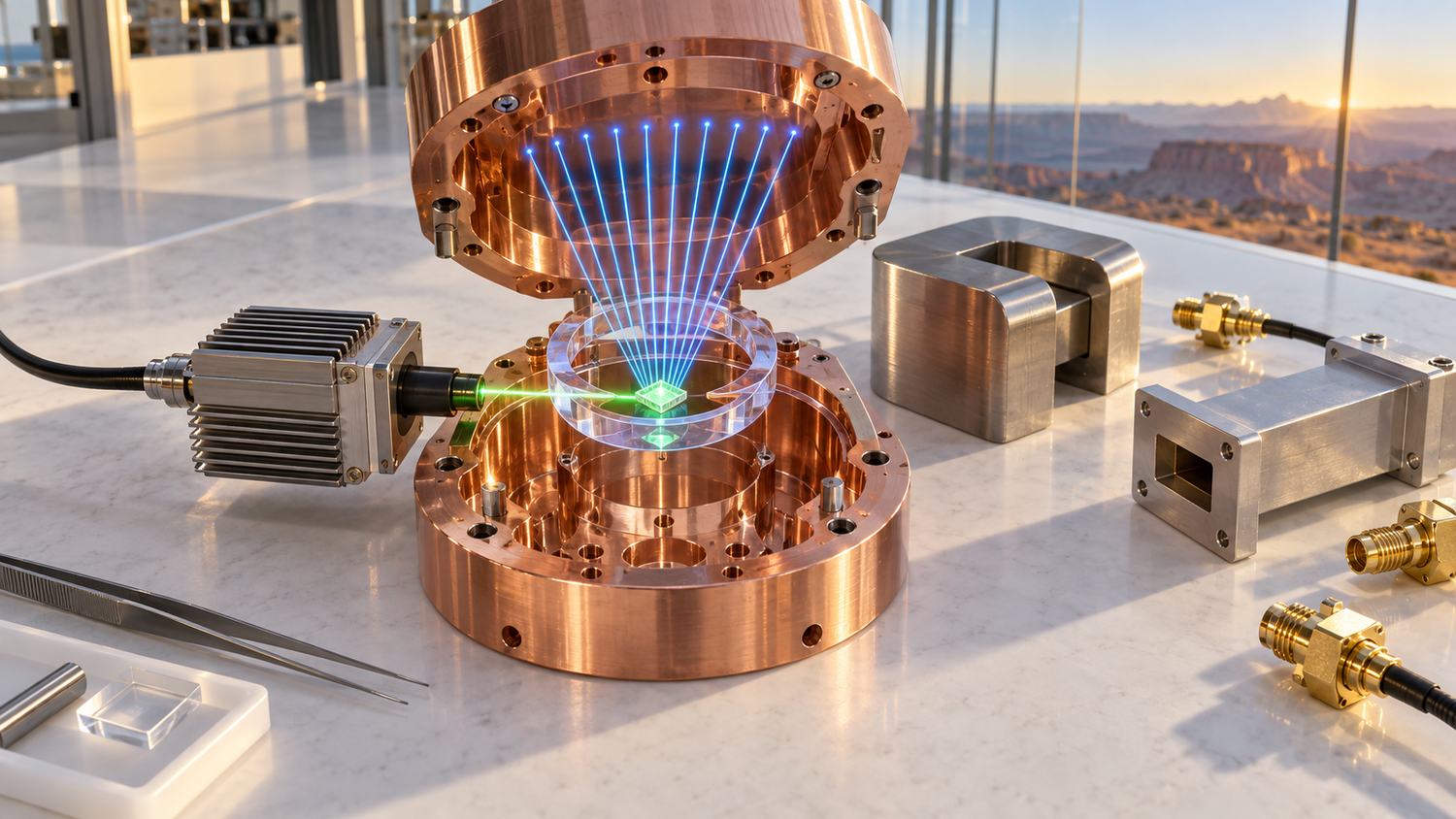
On August 19, 2026, four physicists from Saarland University and University College London posted a paper to arXiv on what a diamond maser does when it is pumped harder than it needs to be. The answer, measured on a bench in Saarbrücken, is that the device stops emitting one narrow microwave line and starts emitting a periodic train of pulses whose spectrum is a microwave frequency comb of up to 10 evenly spaced teeth at 9.23 gigahertz, at room temperature and without a cryostat or a vacuum chamber. Christoph W. Zollitsch, Jonas N. Bach and Christopher W. M. Kay write from the Department of Chemistry at Saarland University, Kay also from University College London, and Jonathan D. Breeze from the Department of Physics and Astronomy at University College London. Breeze led the team that put the first continuous-wave room-temperature diamond maser into Nature in 2018, and the new work runs on a descendant of that bench. The Royal Society, the UK Engineering and Physical Sciences Research Council, the German Research Foundation and Saarland University funded it. Trade coverage on September 16 by Quantum Zeitgeist put the paper in front of a wider readership, which is how it reached the Defense Monitor pool.
The reason a defense reader should care sits in one sentence of the authors' introduction: conventional masers rank among metrology's steadiest frequency standards, and frequency combs are the other established kind. Hydrogen masers keep time in navigation-satellite ground segments and aboard the satellites themselves. Combs connect one frequency to another with a fixed ratio. A device that is both, and needs neither liquid helium nor a vacuum pump, is a candidate component for compact timing hardware.
What sits on the Saarbrücken bench: a 0.34 ppm nitrogen-vacancy diamond inside a sapphire ring, pumped by a 520 nanometer laser diode
The gain medium is a synthetic diamond with natural carbon abundance and a nitrogen-vacancy concentration of 0.34 parts per million, spread evenly across the four possible defect orientations. A magnetic field aligned to one orientation tunes the spin transition by the Zeeman effect, and after the crystallographic and hyperfine bookkeeping about 4 times 10 to the 13th spins contribute to masing. The diamond sits inside a sapphire ring resonator at 9.23 gigahertz, mounted in a copper cavity that suppresses radiation loss and couples the ring to a readout waveguide through an iris. Ring holders 3D-printed in cyclic olefin copolymer replaced machined PTFE, and the loaded quality factor rose to 42,772. A 520 nanometer multimode laser diode pumps the spins, and a spectrum analyzer reads the output.
The arXiv paper then walks the optical pump rate through three values, 6, 7.8 and 12.5 per second, and finds three regimes. At the first, the maser does what a maser is supposed to do: it emits a single narrow line with a Gaussian width of 69 hertz and a Lorentzian width of 51 hertz. At the second, the emission becomes a periodic train of microwave pulses, and the spectrum of that train is a comb of up to 10 teeth spaced 3.8 kilohertz apart, each tooth about as narrow as the original line. At the third, the pulses acquire an oscillatory, frequency-chirped decay. Peak power rises to minus 60 dBm and each pulse lasts about 150 microseconds. Those figures imply an energy ceiling of approximately 0.15 picojoules, calculated as 1 nanowatt times 150 microseconds, although the paper reports 33 picojoules, which conflicts with the stated peak power and duration. Only the tips of 7 teeth remain visible above a broad background about 40 kilohertz wide. Time-resolved measurements tie the comb directly to the self-pulsing. The single-burst Fourier transform establishes a frequency distribution, while a fitted chirp model produces the sweep endpoints. Figure 4's caption gives a fitted sweep from 11.2 to 27.4 kilohertz, while the paper's accompanying prose gives 11.2 to 22.4 kilohertz. The authors attribute the sequence to the inhomogeneously broadened spin ensemble: the resonator and the spins exchange excitations in Rabi cycles, and the continuous pump keeps recruiting off-center parts of the spin distribution, so each cycle runs a little faster than the last.
Why a maser counts as timing hardware: hydrogen masers on Galileo satellites and the 2018 Nature result this bench descends from
A maser is the microwave ancestor of the laser, and its two established jobs are amplifying very weak signals and holding a very stable frequency. The 2018 paper by Breeze and colleagues in Nature put the constraint plainly: masers had been confined to deep-space communications and radio astronomy because they needed cryogenic refrigeration and high-vacuum systems, and the diamond device removed both requirements while running continuously. The timing side of the same story is visible in the European navigation constellation. The European Space Agency's description of Galileo's clocks states that each satellite carries a passive hydrogen maser accurate to within 0.45 nanoseconds over 12 hours and a rubidium clock accurate to within 1.8 nanoseconds over the same period, and that both drift if left alone, so they are synchronized regularly to a network of even more stable ground-based reference clocks.
That is the standard against which any new microwave frequency source is eventually measured, and the diamond comb is far from it today. The comb matters for a different reason first. A comb's teeth are equally spaced, so it can transfer a frequency reference from one part of the spectrum to another and serve as a ruler for spectroscopy. Combs are mature in the optical domain and are the reason optical clocks can be read out at all. Microwave combs are of growing interest because they sit at the frequencies communication and radar hardware already use. The authors note that their maser gets its comb from moderate laser power where combs usually need high pump power. The same defect in the same crystal is also the basis of the Army Research Laboratory and UC Berkeley diamond clock that ran ten days at room temperature, which pairs two spin transitions so their temperature drifts cancel. The two results are complementary: one shows a diamond can hold a frequency, the other shows a diamond can emit a comb of them.
Quantum pillar: sensing (clocks and timing). Use posture: dual-use. Technology readiness: The Monitor's assessment is TRL 3 of 9. A working maser on a laboratory bench produced the comb for real, so the effect is demonstrated on hardware that exists, while nothing was measured against a reference clock and no timing or amplification function was tested end to end.
What a room-temperature microwave comb would let a force do, and who gains from it
The defense reading of this paper runs through timing and through receivers, and both directions are open. On timing, the Defense Advanced Research Projects Agency's Robust Optical Clock Network program describes what the buyer wants: GPS-independent timing with month-long holdover of GPS-quality precise time, small portable clocks for airborne and spaceborne platforms, and distributed coherent sensing in which several platforms share one time base. Every one of those needs a chain of frequency references and the links between them, and a solid-state microwave oscillator that runs at room temperature, needs no vacuum and self-generates a comb of teeth is a plausible link in such a chain. On receivers, the maser's older job is low-noise amplification: a radar warning receiver, a satellite ground station or a passive signals collector is limited by the noise its first amplifier adds, and a cryogen-free maser front end is the application the diamond-maser community has pursued since 2018. The comb regime adds nothing to that application directly, though a device that switches between a single line and a comb by pump power alone is the more flexible instrument.
Who gains is the reason the posture reads dual-use. A room-temperature diamond maser serves a navigation-satellite operator, a radio astronomer, a telecom vendor and a hospital in exactly the way it serves a force, and the same nitrogen-vacancy physics already reads the human heart in a clinical setting, as in the Mainz, Stuttgart, Freiburg and Q.ANT magnetocardiogram taken with room-temperature diamond sensors. Inside the military reading, timing holdover when satellite signals are jammed protects one's own forces, while a quieter receiver front end helps whoever is listening. The funding is academic on both sides of the Channel, the paper is open access, and nothing in it is controlled. A program office should therefore treat it as a component-physics result that an ally or an adversary can read equally well.
What stands between a 10-tooth comb in Saarbrücken and a program office: stability, coherence, heat and a missing reference measurement
The paper is candid about its own gaps, and they are the gaps a timing buyer cares about. First, stability. The fitted Voigt emission profile has a Lorentzian component of about 50 hertz, but including the Gaussian contribution gives an overall full width at half maximum of approximately 191 hertz in the first regime and 150 hertz in the second. On a 9.23 gigahertz carrier, those combined widths are roughly 21 and 16 parts in a billion, respectively. The Galileo passive hydrogen maser's 0.45 nanoseconds over 12 hours corresponds to about 1 part in 100 trillion. Linewidth and long-term stability are different quantities, and no Allan deviation, no comparison against a hydrogen maser or a cesium standard, and no drift measurement appear anywhere in the paper. Second, the comb spacing is unlocked. The authors write that tooth spacing and maximum tooth count show no clear dependence on optical pump rate and require further study, and the pulse period in the third regime wanders between about 270 and 300 microseconds. A frequency reference whose tick interval varies by 10 percent is a physics result and not yet a clock. Third, heat. Laser heating shifts the resonator and the spin transition, and the authors state that diamond heat management is what currently prevents them from pumping harder. Fourth, the mechanism is unmodeled; the group intends to extend its own maser-dynamics theory to include time evolution before it can say which parameters set the comb.
None of this is a weakness of the work. It is a bench demonstration that a room-temperature solid-state device can produce a microwave comb at all, and that is where the readiness ladder places it. What would move it up is specific: a stabilized comb spacing, an Allan deviation curve against a known reference, a thermal design that holds the resonator frequency under sustained pumping, and then a packaged unit that a navigation or receiver team could put on a platform. Until those measurements exist, the honest description for a buyer is that Saarland and UCL have opened a new operating regime for the diamond maser, and that the timing and receiver applications it points toward remain to be earned.
Sources
Primary source: Christoph W. Zollitsch, Jonas N. Bach, Christopher W. M. Kay and Jonathan D. Breeze, "Nonlinear collective dynamics and microwave comb generation in a diamond maser," arXiv 2608.18692, posted August 19, 2026. Other material: Breeze, Salvadori, Sathian, Alford and Kay, "Continuous-wave room-temperature diamond maser," Nature 555, 493, March 2018; the European Space Agency's page on Galileo's atomic clocks; DARPA's Robust Optical Clock Network program page; Quantum Zeitgeist's September 16, 2026 coverage.