Mainz, Stuttgart, Freiburg and Q.ANT Recorded a Human Magnetocardiogram With Room-Temperature Diamond Sensors: What the 16 September 2026 Science Advances Paper Shows
Quentir Medicine Monitor
Evidence-based insights for quantum medicine. Published by Quentir Systems LLC · September 18, 2026.
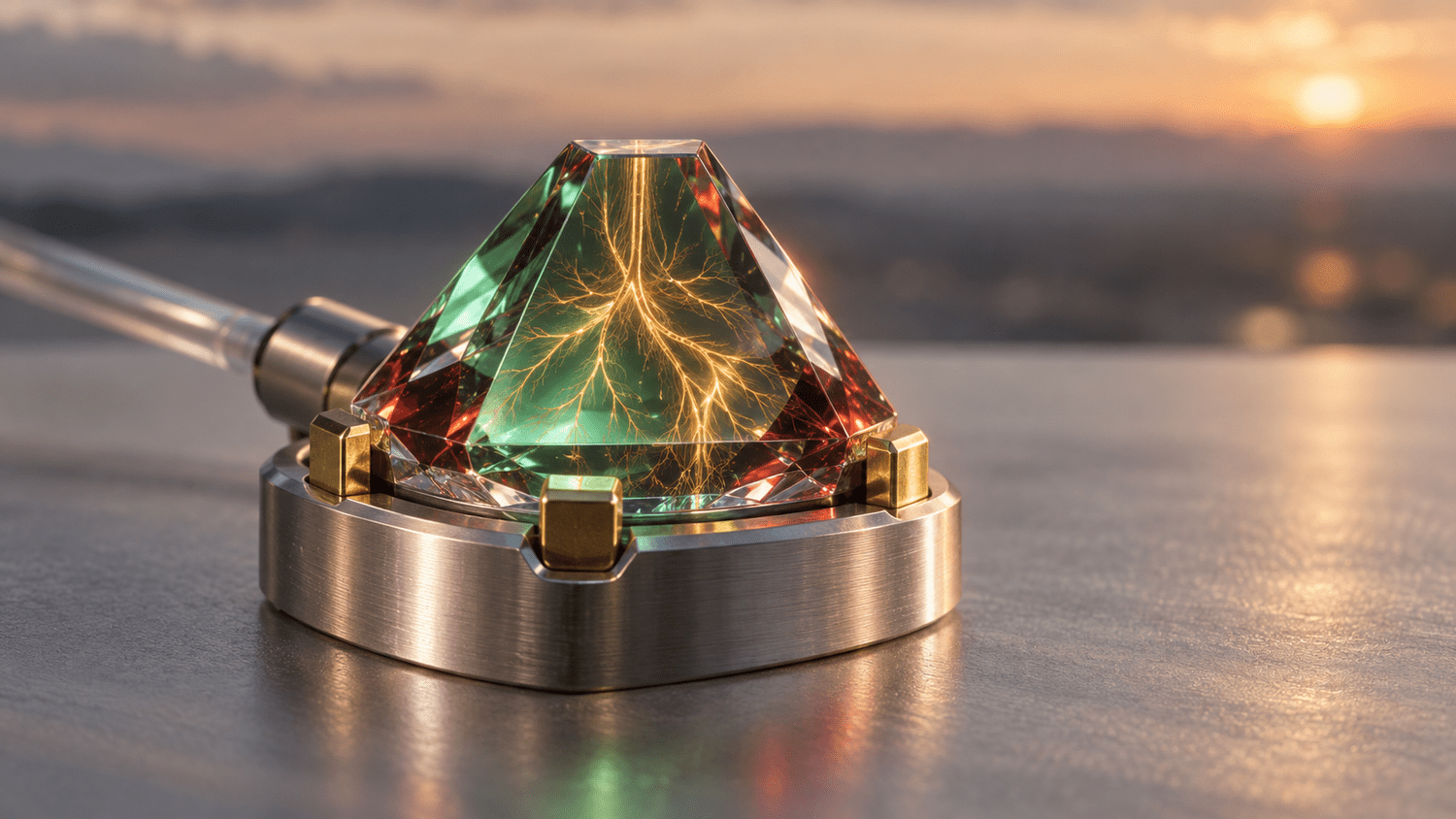
Three research groups in Germany have measured the magnetic field of a beating human heart with diamond sensing crystals smaller than half a cubic millimeter, at room temperature and without touching the skin. The paper appeared in Science Advances on 16 September 2026 under the coordination of Muhib Omar and Arne Wickenbrock of Johannes Gutenberg University Mainz, with Dmitry Budker and Jörg Wrachtrup among its 30 authors.
The instruments are diamond nitrogen-vacancy magnetometers: a nitrogen atom sitting beside a missing carbon atom in the diamond lattice, whose electron spin shifts its energy in proportion to the surrounding magnetic field. The three systems, built independently at Mainz, at the University of Stuttgart and by the Stuttgart startup Q.ANT GmbH, each produced a human magnetocardiogram in proof-of-concept self-experiments on members of the research groups, with sensitivities between 6 and 26 picotesla per square-root hertz. The result is a laboratory measurement on a handful of volunteers from the teams themselves, with no patient involved. It establishes that room-temperature diamond sensors can read the heart's field at all, after averaging, which is the step a cryogenic SQUID cleared decades ago and an optically pumped magnetometer clears with a heated vapor cell. The half-cubic-millimeter figure describes the sensing crystal, not the complete instrument with its fiber, optics and electronics, and the diamond heads recorded without touching the skin while a conventional electrocardiogram supplied the timing reference for the averaging, so the experiments did not show an electrode-free workflow.
The heart's magnetic signal is faint. The paper puts the average R-peak, the sharpest feature of each beat, at about 25 picotesla, roughly two million times weaker than the field of the Earth. That is why magnetocardiography has stayed inside hospitals that could afford superconducting detectors and the shielding around them, and why a SQUID magnetocardiograph still counts as deployable news when a Chinese manufacturer places one. The Mainz group's own line of work reached a related milestone on 6 August 2026 with a levitated-magnet sensor at 32 femtotesla per square-root hertz, a sensitivity reached only in a narrow resonance near 305 hertz, on a benchtop device that is far less suited than a diamond to sitting near a chest.
What the three sensors measured, in a shielded room, a lighter shield, and no shield at all
The paper, submitted to arXiv on 26 January 2026 and published in Science Advances as article aeg5281, describes three configurations rather than one device. The Mainz sensor is a fiber-coupled probe with a truncated diamond pyramid on a 0.5 by 0.5 millimeter base and 0.18 millimeters high. It runs with no magnetic bias field, a design the authors chose because a zero-field shielded environment is easy to build and removes the drift that a bias magnet brings. It reached 13 picotesla per square-root hertz inside a multilayer magnetically shielded room and produced its magnetocardiogram by averaging 12,000 heartbeats.
The Stuttgart sensor, from Wrachtrup's ZAQuant center, uses a 0.5 millimeter diamond cube under a bias field of about one millitesla. It reached 7 picotesla per square-root hertz in a single-layer shielded room and needed 300 averaged heartbeats. Q.ANT's sensor, a 1 by 1 by 0.5 millimeter diamond with about 1.7 parts per million of nitrogen-vacancy centers, worked in an unshielded environment at 26 picotesla per square-root hertz and averaged 2,000 beats. The Stuttgart team also ran two sensors 78 millimeters apart as a gradiometer, which suppressed deliberately applied interference by almost two orders of magnitude inside a single-layer shielded room, mainly at low frequencies; unshielded clinical operation on that principle remains a prospective application.
At the Fraunhofer Institute for Physical Measurement Techniques in Freiburg the Mainz probe was cross-checked against a commercial array of optically pumped magnetometers. The QRS complex, the spike that marks ventricular contraction, had matching amplitude on both instruments. The T-wave, the slower recovery signal that follows it, differed in shape. The authors attribute the difference to sensor positioning and to the very different sensing volumes of the two instruments, and they report it rather than smoothing it away; it is the detail a cardiologist would want settled before trusting the diamond trace for anything beyond rhythm.
Quantum pillar: sensing. Technology readiness: TRL 4 of 9. The three diamond magnetometers were validated in the laboratory in self-experiments on the researchers, with signals averaged over hundreds to thousands of heartbeats, several steps before any patient study, single-beat readout or routine bedside use.
Why room temperature and no skin contact matter for burns, fetal monitoring and surgery
Electrocardiography reads the heart's electrical activity through electrodes on the skin. It is cheap, universal and sensitive to the varying conductivity of the tissue between heart and electrode. Magnetocardiography reads the magnetic field that the same currents produce; tissue barely alters it, so the signal keeps more of its spatial information and can be taken without contact. The Mainz press office lists the clinical situations where that difference counts: a patient with burns on whom electrodes cannot be placed (a use these experiments did not yet reach, since they still relied on a reference electrocardiogram for timing), a fetus whose faint heart signal must be separated from the mother's, and a more precise three-dimensional map of the heart's conduction system than the release expects a surface electrode array to give.
The obstacle has been the detector. A conventional SQUID is cooled with liquid helium, which usually confines it to a shielded room and holds it centimeters from the chest inside a dewar. Optically pumped magnetometers work warm but carry a heated vapor cell and, in the paper's description, can suffer a dead zone at certain field orientations and a heading error when the field direction changes. A diamond sensor needs no cryogen and no heated cell: the crystal itself is inert, biocompatible and stable over a wide temperature range, which is what would let a future instrument rest on the skin at any point a clinician chooses. Its orientation behavior depends on the configuration, since the Stuttgart and Q.ANT sensors run under a bias field with a defined sensitivity axis while the Mainz probe runs at zero field, and whether a complete powered probe is safe and comfortable on a patient is a separate question the paper does not address. Wickenbrock's summary in the university release of 17 September 2026 is that nitrogen-vacancy magnetometers offer fast initialization, excellent biocompatibility and stable operation across temperatures, which is what makes them attractive for biomedical use.
The same physics reaches beyond the heart. The DIAQNOS project that funded this work, a five-year program started in October 2022 with almost EUR 11 million from the German research ministry under project number 13N16455, stands for diamond-based quantum sensing for neurosurgery. Its neurosurgical partners in Freiburg want a gradiometer that monitors nerves during an operation in an unshielded theater, and a room-temperature magnetoencephalography cap that would open the brain's magnetic activity to clinics that cannot house a helium-cooled system. Earlier diamond-magnetometer papers in this Monitor's reading stopped at phantoms; the Mainz paper is the first to record human cardiac magnetic signals without contact using nitrogen-vacancy diamond sensors.
Where the sensitivity gap stands, and what flux concentrators and single-shot readout would change
The honest comparison in the paper is with the instruments it hopes to displace. Optically pumped magnetometers reach sub-picotesla sensitivity; the lowest-noise diamond sensor here reached 7 picotesla per square-root hertz, and the authors say practical deployment needs roughly an order of magnitude more, putting the target near 1 picotesla per square-root hertz for an R-peak signal-to-noise ratio of five. Every trace in the paper is an average of hundreds or thousands of beats. A clinical magnetocardiogram must catch a single arrhythmic beat as it happens, so the authors state a goal of single-shot readout and give the arithmetic: with sensitivities around 10 picotesla per square-root hertz, a bandwidth of about 30 hertz and a single-shot noise floor of 50 picotesla, the average 25-picotesla R-peak could be detected reliably beat by beat once that tenfold gap closes.
Two routes are on the bench. Pulsed magnetometry schemes have already reached 490 femtotesla per square-root hertz in other diamond experiments. Magnetic flux concentrators, ferromagnetic structures that funnel field lines into the tiny crystal, can multiply the signal by more than two orders of magnitude at the cost of spatial resolution, since the concentrator gathers field from a wider area than the crystal alone; Omar's doctoral work centers on making them work at room temperature. Either route could carry the diamond trace from averaged demonstration to something a cardiology department might evaluate against its existing electrocardiograph.
The paper reports no regulatory milestone and claims none. The measurements are non-invasive self-experiments by the researchers, for which the University of Freiburg ethics committee advised that no approval was required. No sensitivity, specificity or diagnostic outcome is reported, because the study set out to prove signal detection rather than clinical value. A hospital buyer reading the release should file the result under sensor physics with a credible clinical direction, in the same drawer as Korea's health-ministry call for a quantum nanosensor to detect cancer-drug heart damage: a funded direction, a working prototype, and years of validation between the two.
How Quentir Reads It
The significance of the Mainz paper lies in the combination it demonstrates rather than in any single figure. A magnetometer that works warm, whose sensing crystal occupies less than half a cubic millimeter, and that reads a real human heart without contact had not been shown before with nitrogen-vacancy diamond; placing such a sensor on the skin remains the prospect the authors describe, not the measurement they made. Three independent builds converging on the same signal, one of them with no shielding, make the result harder to dismiss as a single laboratory's tuning. The price of that convergence is visible in the averaging counts, and the authors do not hide it.
For the quantum-medicine field the paper also supplies a useful measuring stick. Claims of quantum sensing for cardiology can now be checked against a published human magnetocardiogram with stated sensitivity, stated averaging and a stated gap to the incumbents. A vendor whose diamond device promises bedside diagnostics will have to say where its sensitivity sits relative to 7 picotesla per square-root hertz and how many averaged heartbeats its trace needs. Germany's quantum program has spent a decade on this line of work through Budker's and Wrachtrup's groups. The 16 September paper sets the benchmark that human cardiac signals can be detected with these sensors; single-beat performance and any clinical validation remain outstanding, and the next paper to watch is the first single-shot trace on a patient.
Sources
Primary source: Muhib Omar, Magnus Benke, Shaowen Zhang and 27 co-authors including Dmitry Budker, Jörg Wrachtrup and Arne Wickenbrock, "Human Cardiac Measurements with Diamond Magnetometers," Science Advances, 16 September 2026, DOI 10.1126/sciadv.aeg5281, with the arXiv preprint 2601.18843 of 26 January 2026. Also drawn on: the Johannes Gutenberg University Mainz press release as distributed by EurekAlert on 17 September 2026; the French-language summary in ma-clinique.fr of 17 September 2026; and the DIAQNOS project description. The readiness placement and the comparison with earlier Quentir coverage are this Monitor's own.