Surrey, Queen Mary and Southeast University Model a Single-Local-Oscillator Rydberg Receiver for 10 MHz OFDM at 16 GHz, arXiv 2611.06181, 4 November 2026: TRL 2
Quentir Defense Monitor
Evidence-based insights for quantum defense and security. Published by Quentir Systems LLC · November 5, 2026.
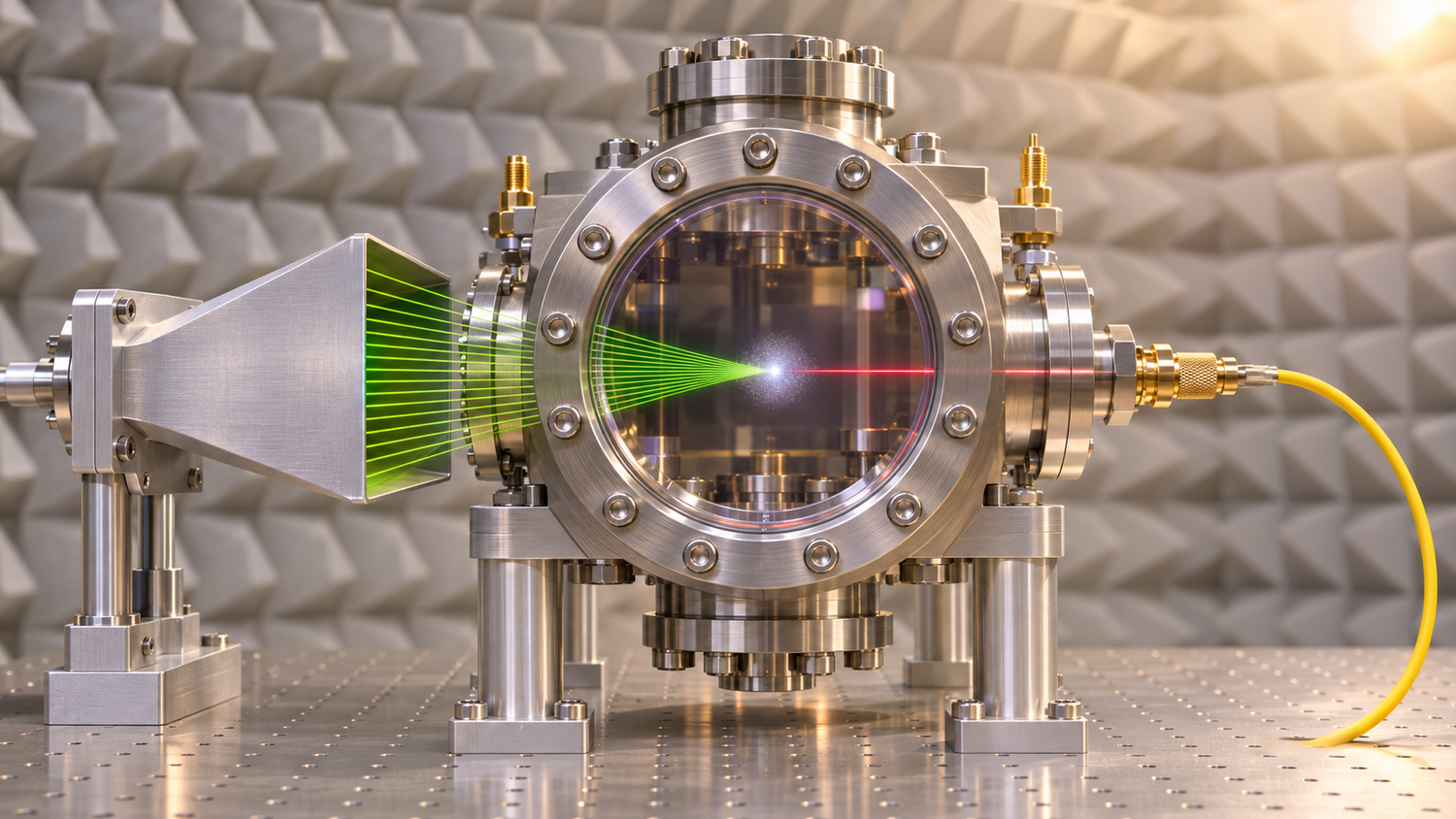
Eight researchers from the University of Surrey, Queen Mary University of London, Southeast University in Nanjing, the Aristotle University of Thessaloniki, Memorial University of Newfoundland and Queen's University Belfast have worked out, on paper and in simulation, how a Rydberg atomic receiver could take in a 10 MHz multicarrier signal at 16 GHz with one microwave local oscillator and no frequency comb. Qihao Peng, Qu Luo, Maged Elkashlan, Cunhua Pan, Pei Xiao, George K. Karagiannidis, Trung Q. Duong and Jiangzhou Wang posted the paper to arXiv on 4 November 2026. Their model treats the atoms as a frequency-selective front end and shows that an equalizer built around it recovers an orthogonal frequency-division multiplexing waveform the atoms would otherwise distort subcarrier by subcarrier.
The receiver described is the kind of Rydberg atomic receiver the US Defense Advanced Research Projects Agency spent a program trying to build: a radio front end made of atoms, sensitive across a wide band, with no metal antenna or amplifier chain in front of it. This post reads the paper as RF spectrum sensing capability in the sensing pillar, dual-use in posture, and sets out what separates a simulated cold-atom receiver from an instrument a signals or electronic warfare unit could carry.
What the arXiv paper of 4 November 2026 establishes: one microwave local oscillator, a Floquet model, and about 11 MHz of usable band on each side of the carrier
A Rydberg receiver reads a radio field optically. A probe laser and a coupling laser hold rubidium atoms in a state of electromagnetically induced transparency, and an incoming microwave field at the right frequency splits that transparency window in proportion to its amplitude. To recover phase as well, the atoms are also bathed in a microwave local oscillator a little way off the signal frequency, so the beat between the two appears on the probe light. The difficulty that the paper addresses is bandwidth. The atomic response is sharply peaked around the local oscillator, so a wide signal arrives with its edges weakened and its phase bent, and earlier proposals for continuous wideband reception needed a comb of local oscillators, one per sub-band.
The authors keep a single local oscillator and add a far-detuned auxiliary microwave field, a five-level rubidium-87 scheme the paper cites from a 44.6 MHz instantaneous-bandwidth demonstration by Yan and colleagues. Their contribution is the model. They use Floquet theory to compute the response at finite offsets from the carrier and derive closed-form conversion expressions from the Lindblad master equation under weak-probe and weak-signal approximations. From those they build an equivalent multicarrier channel in which the atoms appear as a filter with their own amplitude and phase shape, and they design a zero-forcing equalizer that compensates the wireless channel and the atomic filter jointly. Under the stated parameters the one-sided bandwidth, from the local oscillator to the half-power point, comes out at about 11 MHz.
The gain-bandwidth tradeoff in numbers: 12.6 to 15.7 MHz for 13.5 dB, 18 dB per doubling, and 2.57 times a conventional receiver's rate at 23 dBm
The paper's second contribution is a quantified cost for every extra megahertz. Raising the local-oscillator drive pushes the two bright resonances outward and widens the band, and the simulation shows the one-sided bandwidth growing from 12.6 to 15.7 MHz while the center conversion gain falls by about 13.5 dB. The auxiliary field works in the opposite direction: it raises the center response and narrows the contiguous passband. Without the auxiliary field and with strong local-oscillator drive, the authors derive an upper bound on the bandwidth and a scaling law in which doubling the bandwidth costs roughly 18 dB of center-response power, which they describe as an equivalent sensitivity penalty under fixed readout noise.
The communication test is a simulation of a laser-cooled rubidium-87 ensemble at 100 microkelvin, chosen so that Doppler broadening can be neglected, in a 6.5 centimeter cell with a 780.241 nanometer probe and a 3 watt coupling beam. The local oscillator sits near 16.03 GHz. The waveform has 1,024 subcarriers at 10 kHz spacing, 10.24 MHz in all, sent at 23 dBm from a 0 dBi antenna over 1,500 meters. Against a conventional radio-frequency receiver with a 7 dB noise figure, the atomic receiver with the atom-aware equalizer reaches 2.57 times the achievable data rate at that transmit power. A receiver calibrated as if the atoms were flat across the band saturates in rate instead, which is the paper's practical point: the atoms are a filter, and a modem that ignores the filter leaves most of the gain on the table.
Quantum pillar: sensing (RF spectrum sensing). Use posture: dual-use. Technology readiness: TRL 2 of 9. For the reader this means the receiver exists as an analytical model and a numerical simulation of a laser-cooled atom cloud that the authors have not assembled, so the bandwidth, the gain penalty and the rate advantage are predictions awaiting a bench.
Why the panel reads sensing (RF spectrum sensing), dual-use and TRL 2
The pillar is sensing because the device senses an electric field with atoms, and the sub-branch is RF spectrum sensing, which Quentir's capability map defines as Rydberg and atomic receivers for wideband signal detection. The paper frames its receiver for sixth-generation mobile networks, and the same front end serves a spectrum-monitoring or signals-collection role without change, which is why the posture is dual-use. A receiver that takes in 10 MHz of modulated traffic at 16 GHz and equalizes it correctly can carry a friendly link, and it can also demodulate someone else's. The readiness level is 2. The shared ladder places simulation of hardware that does not exist at level 2, and this paper simulates a laser-cooled ensemble while the five-level scheme it borrows has only been shown in thermal vapor. The closed-form expressions are checked against a full numerical solution of the master equation, which is the internal check level 2 work should carry, and there is no measurement.
What it would let a force do: the DARPA Quantum Apertures goal, NIST's handheld-radio reception and a 100 kHz to 20 GHz frequency-hopping receiver in Nature Communications
The DARPA Quantum Apertures program, now listed as complete, states the military interest plainly. Its aim was portable and directional RF receivers with greater sensitivity, bandwidth and dynamic range than any classical receiver, for electromagnetic spectrum operations, radar and communications, built on Rydberg states near principal quantum number 100. Bandwidth is the item on that list where the physics has pushed back hardest, and the Surrey paper tells a designer how much center sensitivity a given instantaneous band will cost and how to run a modem behind the atoms once the band is chosen.
Two measured results show what real atoms have already done. Noah Schlossberger, Tate McDonald, Nikunjkumar Prajapati and Christopher Holloway at the US National Institute of Standards and Technology reported in Physical Review Applied the reception of a consumer handheld UHF two-way radio by a Rydberg vapor, demodulating speech, detecting all consumer-accessible channels at once and separating two neighboring channels with at least 53 dB of isolation. A group led from the University of Science and Technology of China published in Nature Communications on 11 August 2026 a waveguide-coupled Rydberg receiver running frequency-hopping spread spectrum across 100 kHz to 20 GHz at up to 100,000 hops per second, with more than 150,000 channels available and a 51 dB improvement in tolerance of narrowband interference over a single-frequency link. That paper is the clearest published statement of the defensive case: a link that can hop across 17 octaves without changing its optics is hard to jam and hard to find. The Surrey model addresses the next requirement, which is to pass a wide modern waveform through the atoms at any one hop. Its receiver-side signal processing belongs to the same body of work as the space-time coding Tampere University and Nokia Bell Labs adapted to Rydberg receivers, which treated a different distortion of the same front end.
For a force, the capability on offer is a receiver that covers a very wide band from one small atomic cell, with sensitivity set by atomic physics rather than by antenna size, able in principle to receive wideband traffic, monitor spectrum and resist interference with the same hardware. Whether the 2.57 times rate figure survives contact with a real cell is the open question.
What stands between the simulation and a program office relying on it: a cold-atom receiver nobody has built, thermal-vapor physics, dynamic range, and an outside measurement
Five items separate this paper from a requirement. The first is the receiver itself. A cold-atom receiver means a magneto-optical trap, a vacuum system and cooling lasers in the field; the five-level scheme the authors borrow was shown in a room-temperature vapor cell, and the paper does not report what its bandwidth and gain become once Doppler broadening is restored. The second is the gain penalty. Without the auxiliary field and with strong local-oscillator drive, an 18 dB loss per doubling of bandwidth is steep. The third is dynamic range and strong-signal behavior, which the weak-signal approximation sets aside and which decide whether a receiver survives a crowded or hostile band. The fourth is the 3 watt coupling laser and the stability the authors themselves flag: fluctuations in laser detuning and power change the conversion gain, so the equalizer has to be re-estimated as the atoms drift. The fifth is measurement by someone other than the authors, on hardware, against a conventional receiver chosen by the evaluator.
What the sources support is this. A Surrey-led team has published a closed-form, simulation-checked model of a single-local-oscillator wideband Rydberg receiver with about 11 MHz of usable band on each side of a 16 GHz carrier, an explicit gain-bandwidth tradeoff of roughly 18 dB per doubling without the auxiliary field and with strong local-oscillator drive, and an atom-aware equalizer that in simulation yields 2.57 times the data rate of a conventional receiver at 23 dBm. NIST has received a handheld radio with atoms, and a Chinese group has hopped across 20 GHz with 51 dB of added interference tolerance. A build of the Surrey design, a bandwidth and sensitivity measurement on it, and an independent comparison are the next three pieces of evidence to wait for.
Sources
Primary source: Qihao Peng, Qu Luo and Pei Xiao (Institute for Communication Systems, University of Surrey), Maged Elkashlan (Queen Mary University of London), Cunhua Pan and Jiangzhou Wang (National Mobile Communications Research Laboratory, Southeast University, Nanjing), George K. Karagiannidis (Aristotle University of Thessaloniki) and Trung Q. Duong (Memorial University of Newfoundland and Queen's University Belfast), "Continuous Wideband Multicarrier Rydberg Atomic Quantum Receiver," arXiv 2611.06181, submitted 4 November 2026. Other material: the DARPA Quantum Apertures program page; the NIST publication page for Schlossberger, McDonald, Prajapati and Holloway, Physical Review Applied 25(2), 2026; Nan et al., Nature Communications, 11 August 2026, DOI 10.1038/s41467-026-76592-3. The 44.6 MHz five-level scheme by Yan et al., arXiv 2606.25555, is cited in the text. The capability reading, the posture argument, the readiness placement and the buyer items are Quentir analysis.