The Raw Material of Quantum Radar Arrives at Room Temperature
Quentir Defense Monitor
Evidence-based insights for quantum defense and security. Published by Quentir Systems LLC · August 20, 2026.
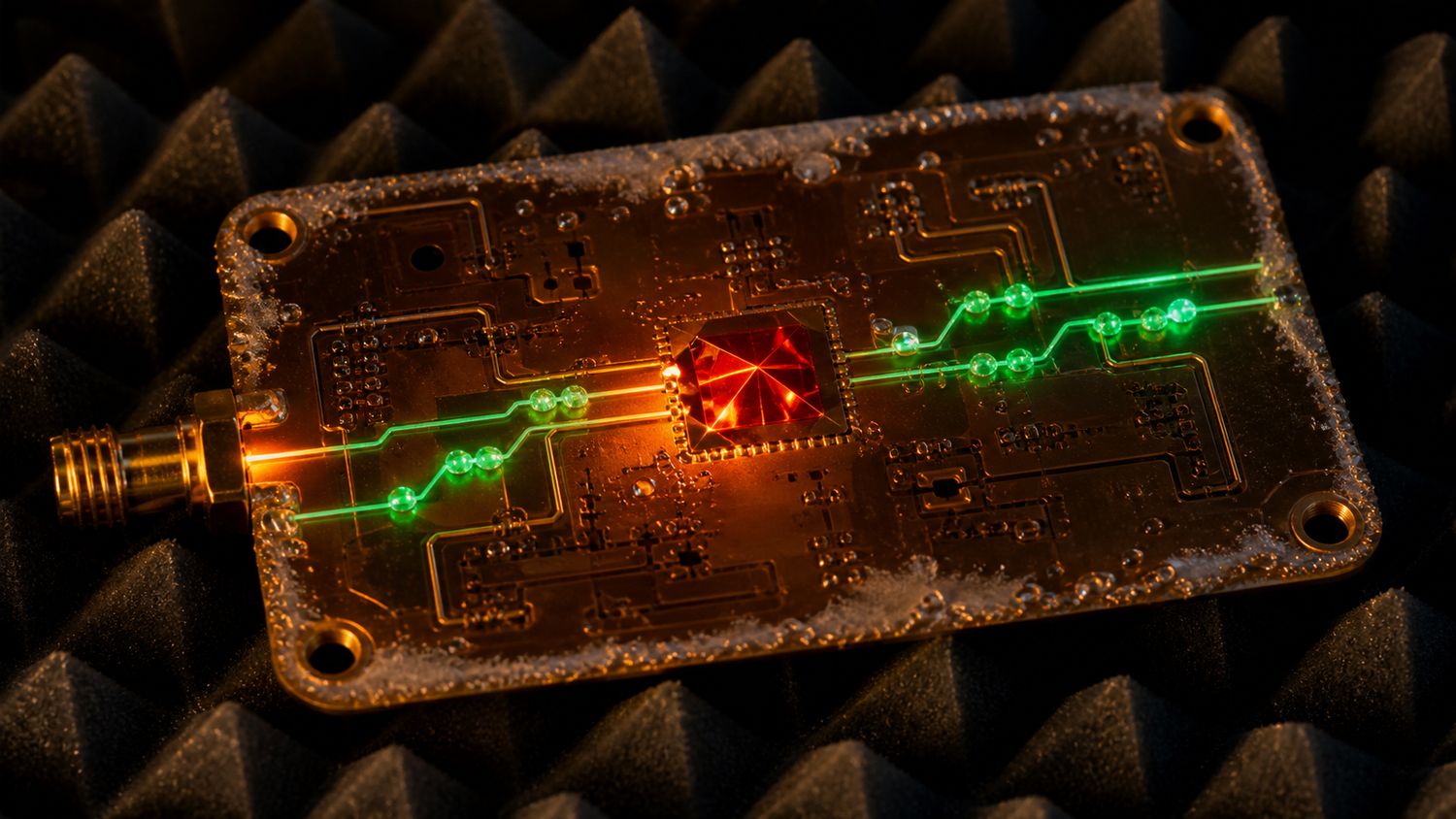
Superconducting sources of the correlated microwave pairs used in quantum sensing and communications share an unglamorous dependency: a refrigerator the size of a wardrobe, holding their circuits within a few thousandths of a degree of absolute zero. A team at MIT has now produced correlated microwave signals from a magnetic device sitting on an ordinary circuit board at room temperature. The result reads like a component-catalog entry rather than a physics milestone, and that is exactly its significance for a defense reader. Components that shed their refrigerators are components that can leave the laboratory.
In a paper published August 19 in Nature Electronics, graduate student Qiuyuan Wang, together with Aravind Karthigeyan of the University of Illinois, MIT postdoc Chung-Tao Chou and senior author Prof. Luqiao Liu, describes a cavity-magnonic source that splits one input microwave photon into a pair of output signals at distinct frequencies with a strongly correlated phase relationship. The hardware is deliberately modest: a film of yttrium iron garnet, a magnetic crystal the radar industry has machined into filters and oscillators for decades, mounted on a microstrip resonator etched into a printed circuit board. As MIT News reports, the team demonstrated the pairing directly, encoding a small image into the frequency of one signal and recovering it only with the help of its partner. The research was funded by the U.S. National Science Foundation and the Department of Energy.
Correlated microwave pairs are relevant to two capability families this publication tracks closely. One is quantum illumination radar, which ultimately requires entanglement to obtain its quantum advantage but can use correlated signals in classical noise-radar experiments. The other is correlation-assisted radio communication, in which a partner signal helps decode a message sent through noisy channels. Until this week, correlated microwave sources of this kind were typically superconducting circuits inside dilution refrigerators. The MIT device is instead a room-temperature, non-degenerate correlated source and a possible precursor to an entangled source.
What the magnet actually does
The quantum particle at the center of the device is the magnon, a packet of collective spin motion rippling through a magnetic material. Pump enough microwave energy into a magnetic film and a single pump photon will down-convert into a pair of magnons, a process long understood and long frustrating: the two magnons emerge at the same frequency, which makes them impossible to separate into two usable channels. A pair you cannot split is a pair you cannot route to a transmitter and a receiver.
The MIT team's contribution is the splitting. By placing the garnet film inside a microwave cavity, they coupled the magnons to two distinct photon modes of the resonator. The coupling produces hybrid waves, magnon polaritons, and a physical effect called level repulsion pushes the two members of each pair apart in frequency. "By using the level repulsion arising from coupling between magnons and microwave photons, we were able to separate the two magnons in frequency," Liu told MIT News. Out of the device come two correlated signals at different frequencies. Each looks random on its own; measured together, their phase relationship stays strongly correlated.
That combination, individual randomness with joint order, is what the demonstrated application exploits. The paper reports that the pairs show true randomness alongside robust correlations across channels, and it demonstrates reliable transmission of a message through two noisy channels, as coverage at Tech Xplore summarizes alongside the image-recovery experiment. A receiver using only the message-bearing signal sees a random-looking transmission; using the correlated partner assists message recovery through the noisy channels. The experiment demonstrates correlation-assisted decoding and noise resilience, not cryptographic security, key distribution, authentication or resistance to an interceptor collecting both frequencies.
Quantum pillar: sensing (quantum radar and lidar). Use posture: dual-use. Technology readiness: TRL 4 of 9. The source exists as a bench-built circuit-board device whose paired outputs were validated in laboratory tests, while the radar or communication system that would field those outputs remains unbuilt.
What paired microwaves would let a force do
The radar application works by division of labor between the two signals. A transmitter fires one member of the pair, the signal beam, toward a suspected target and retains the other, the idler, at home. Whatever returns from the scene is compared against the retained idler. A genuine echo betrays itself through its correlation with the twin, while correlation processing can improve discrimination against thermal background and hostile jamming that share no history with the idler. It does not eliminate sufficiently strong interference or counter correlated or spoofing jammers. The theoretical promise demonstrated so far is narrower: detecting faint targets of low reflectivity in bright thermal noise.
The experimental benchmark for the microwave version is a 2020 demonstration by Shabir Barzanjeh and colleagues, published in Science Advances and available as a preprint on arXiv, which used a Josephson parametric converter to generate entangled microwave fields and detect a room-temperature object one meter away. Its digital phase-conjugate receiver experimentally outperformed a symmetric classical noise radar; advantage over the relevant ideal classical benchmark was obtained only in a simulation assuming perfect idler photon-number detection. The instructive detail is the plumbing: the source of those fields lived at millikelvin temperature inside a dilution refrigerator. That refrigerator, with its compressors and helium lines and kilowatt appetite, is a major reason quantum radar has remained an argument between laboratories rather than a line in an air-defense budget.
A source that works warm rewrites the logistics side of that argument. The magnonic device needs a modest magnetic bias field and a microwave pump, on a circuit board, in a material family that microwave engineers already integrate into fielded radar and electronic warfare front ends. The communication reading of the result follows the same logic. A correlation that assists decoding through two noisy channels is attractive wherever jamming is the expected condition, although the experiment does not establish confidentiality or resistance to an adversary able to collect both frequencies. These gains flow to both sides of any conflict and to civilian users of congested spectrum alike, which is why the posture field above reads dual-use: the beneficiary is whoever engineers the transmitter first.
What stands between a bench and a program office
The distance is real and worth stating carefully, because the words correlated and entangled do different work in this field. The Nature Electronics paper claims strong correlations between the paired outputs and stops there; it makes no claim of entanglement, the strictly quantum resource on which quantum illumination's advantage over an ideal classical radar is built. A correlated-only pair source enables what radar engineers call a noise radar, a genuinely useful class of hard-to-intercept systems, and it may enable elegant new ones. By itself, though, it does not deliver the full quantum advantage sought by the Barzanjeh experiment; that experiment demonstrated an advantage over a symmetric classical noise radar, while its advantage over the relevant ideal classical benchmark came from simulation with perfect idler photon-number detection. Whether parametric down-conversion in warm magnetic films can be pushed into the entangled regime is the exact question this result now puts on the table, and the answer will decide which shelf the component belongs on.
The engineering gaps are the familiar ones for a component at this readiness level. Ranging remains undemonstrated: the new source has yet to be pointed at a target, and the retained-idler storage that quantum illumination requires is an unsolved system problem at any temperature. Output power, bandwidth and the fidelity of the correlations under real amplifier chains are characterized so far only on the bench. The 2020 cryogenic benchmark itself carries a caution as well, since its advantage appeared against a target one meter away under favorable detection assumptions in a laboratory. Skepticism about near-term quantum radar is well earned, and a room-temperature source removes one obstacle among several.
What the development changes today is who can afford to try. A millikelvin pair source confines experimentation to the small set of laboratories that own dilution refrigerators. A circuit-board source built on the radar industry's own garnet puts correlated-signal experiments within reach of any capable microwave group, including those inside defense primes and their government customers. Buyers tracking quantum sensing for defense should log this as the week the correlated microwave pair source became an accessible laboratory platform, and should watch for three follow-ons, each of which would move the readiness needle: a demonstration of entanglement, rather than correlation alone, from a magnonic source; a ranging experiment against a real target with a retained idler; and an appearance of correlated-pair waveforms in electronic-protection or covert-sensing programs, where the noise-like character of the signals holds value on classical grounds alone.
Sources
Primary source: Qiuyuan Wang, Aravind Karthigeyan, Chung-Tao Chou, and Luqiao Liu of MIT and the University of Illinois, "A room-temperature cavity-magnonic source of correlated microwave magnon polariton pairs," Nature Electronics, August 19, 2026. Other material from Adam Zewe's report for MIT News, the Barzanjeh group's microwave quantum illumination experiment (Science Advances 2020, arXiv:1908.03058), and Tech Xplore's coverage of the device.