Tsinghua Reports 546 Hz Atom-to-Atom Entanglement Over 20 km of Fiber From Two 15 by 15 Rubidium Memory Arrays Without Active Phase Stabilization, arXiv 2611.30150, 23 November 2026: TRL 4
Quentir Defense Monitor
Evidence-based insights for quantum defense and security. Published by Quentir Systems LLC · November 24, 2026.
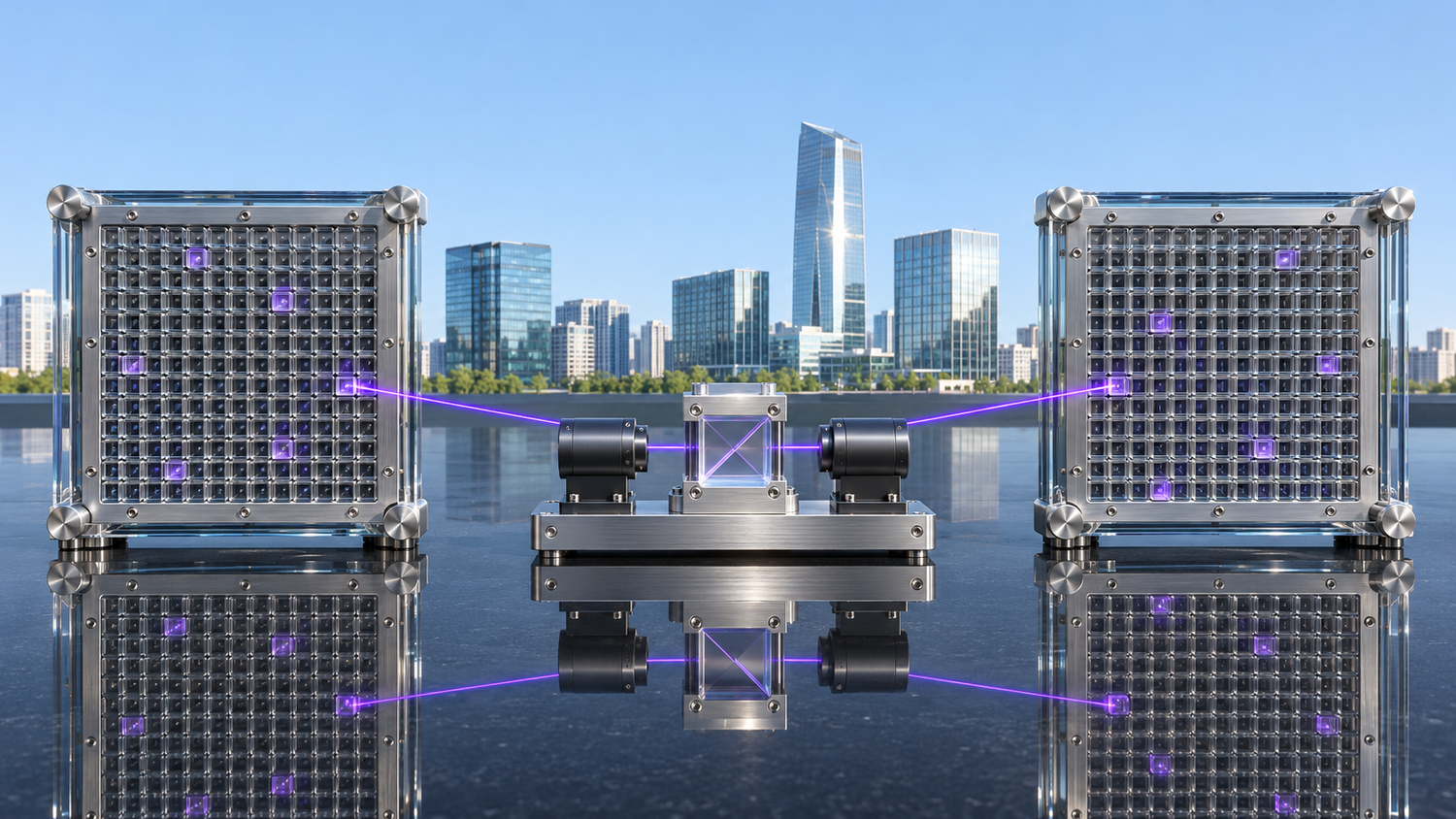
On 23 November 2026 a team at Tsinghua University's Center for Quantum Information, supervised by Luming Duan and Yunfei Pu, posted a preprint reporting entanglement between two rubidium quantum memory arrays at 546 pairs per second across 20 kilometers of telecom fiber, with no active stabilization of the fiber's optical phase. Each node holds a 15 by 15 array of 225 micro-ensembles of rubidium-87 atoms, addressed one cell at a time at a 1 MHz clock rate, and both nodes reach a middle measurement station through 10 kilometer spools of fiber. The preprint, arXiv 2611.30150 by Jixuan Shi, Yuedong Sun, Yibo Liang, Sheng Zhang, Pingyuan Liu, Zhaibin Cui, Luming Duan and Yunfei Pu, puts the rate at 75,932 times that of single-mode two-photon schemes and 23 times that of single-mode single-photon schemes in an analysis that matches experimental conditions and rescales rates by duration, with simulated alternatives included in Figure 4. The team reached the reported rate on a fiber the authors had shaken until its phase noise matched that of a buried cable more than 250 kilometers long.
This post reads the result as a laboratory building block for the quantum repeater, the device that would let entanglement, and the keys and synchronized measurements built on it, cross distances that a single run of fiber cannot. The work sits at the laboratory rung of the readiness ladder, since the nodes and the fiber spools share one room, and its posture reads dual-use, since the same elementary link serves a civil quantum internet, a government key supply and a network of synchronized sensors.
Why a repeater link needs both speed and phase stability, and how the Tsinghua scheme of 23 November 2026 fuses two single-photon heralds to obtain both
A photon carrying a quantum state cannot be copied or amplified without destroying the state, so fiber loss, which grows exponentially with length, caps how far quantum information travels in one hop. A quantum repeater divides the route into elementary links: memories at the two ends of each link emit photons toward a station in the middle, a detection there heralds that the memories are entangled, and later operations join neighboring links. The preprint sets out the two established ways to herald that entanglement. Single-photon interference needs only one photon to arrive, so it succeeds often, and in exchange the two fiber paths must stay locked to a fraction of an optical wavelength, which means active phase stabilization along the route. Two-photon interference tolerates phase drift about ten million times larger, by the authors' figure, because both photons must register in the same instant, and that requirement makes success rare. The authors cite current single-mode repeater links at about 1 Hz over 10 kilometers and note that direct key distribution over hundreds of kilometers already runs at tens of hertz, so a 1 Hz repeater adds nothing a buyer would pay for.
The Tsinghua scheme keeps the efficiency of the single-photon route without a locked phase. Each node excites its 225 cells in sequence, one per microsecond, and a click at the middle station heralds a pair between one cell in node A and one in node B that carries an unknown phase from the fiber. A second click shortly after heralds a second pair. Because the interval between the two heralds is far shorter than the time over which the fiber's phase drifts, the two phases are nearly equal, and when the pairs are fused into one polarization-entangled pair, following the protocol of Duan, Lukin, Cirac and Zoller, the phases cancel. The random-access quantum memory makes the fusion possible, because any cell can be read at a chosen moment within its lifetime, so the first pair waits for the second. With all cells in use the authors report 1.6 kHz for the raw heralded states and 546 Hz for fused pairs, and with two excitation rounds the probability of obtaining a fused pair reached 30.02 percent, which they call semi-deterministic.
Quantum pillar: networking (entanglement distribution and repeaters). Use posture: dual-use. Technology readiness: TRL 4 of 9. For the reader this means two complete repeater nodes and a middle measurement station have been assembled and characterized in one laboratory over 20 kilometers of spooled fiber, with rate, fidelity and memory lifetime measured, and no link between separate sites, no entanglement swapping and no run on deployed fiber has yet been reported.
What arXiv 2611.30150 establishes and what it leaves open: 69 to 71 percent fidelity, 683 and 503 microsecond memories, and fiber on spools in one laboratory
The fidelity of the fused state, measured with one excitation round, is 69 percent with an uncertainty of 6 points for one Bell state and 71 percent with an uncertainty of 6 points for the other. These fidelities alone do not determine the key-basis error rate or establish secure entanglement-based key distribution, which depends on the state, measurement bases, protocol and post-processing; the preprint reports no secure-key result. The preprint lists purification, which trades several weak pairs for one better pair, among the operations its stored pairs would make possible, and it reports no purification result.
Memory coherence times, averaged over the 225 cells, are 683 microseconds at node A and 503 at node B. Light in fiber covers a kilometer in about five microseconds, so photon travel to the middle station 10 kilometers away plus the herald's return takes roughly 100 microseconds. For an elementary link of 50 to 100 kilometers, the spacing a chain across a country would use, this herald latency is 250 to 500 microseconds, below both reported coherence times. Coherence time describes decay, so assessing whether these memories can support a repeater also requires the stochastic waiting time for successful entanglement on neighboring links and the time needed for processing and swapping. The authors expect optical lattice arrays, faster acousto-optic deflectors and further multiplexing to reach deterministic distribution over hundreds of kilometers; the preprint gives no measured step in that direction.
The fiber is the third open point. The authors measured the phase noise of 22 kilometers of fiber buried under the Tsinghua campus and of the 20 kilometer spool at rest, found the induced infidelity negligible in both, then shook the spool until its noise matched, by their cited comparison, a deployed fiber of 250.2 kilometers, and generated the fused pairs under that condition with an induced infidelity of 2 percent. The test establishes robustness to phase noise; operation between separate buildings remains unshown. Entanglement across a real city has been reached by other means: in May 2024 Jian-Long Liu, Xi-Yu Luo and colleagues reported in Nature memory-memory entanglement among three atomic-ensemble nodes up to 12.5 kilometers apart, with a photonic server heralding success, and that network actively stabilized the phase of its fiber links and control lasers, the burden the Tsinghua scheme is designed to drop. The preprint is version 1, with no journal reference, and its data are to be released at publication.
What a 546 Hz entanglement link would let a force do, who gains from it, and why the posture reads dual-use
The defense value of entanglement distribution lies in the three uses the preprint lists as the motivation for repeaters: long-distance quantum communication, networked quantum sensing and distributed quantum computing. For a force the first means a key supply between two headquarters, or between a headquarters and a port or airfield, in which the key arises from entangled pairs and an interception disturbs the correlations the two ends measure. The second means separated clocks, magnetometers or receivers that share entanglement and measure against a common phase reference, which gives an array of sensors a precision no single sensor reaches. The third is civil in every example the authors give. A repeater built from such links would carry those uses past the few hundred kilometers that direct fiber transmission allows. The Defense Monitor covered the other end of that chain in September 2026, when Haldar, Guha, Towsley and Rozpędek simulated encoded repeater chains over 960 kilometers; such a simulation assumes an elementary link rate, and the Tsinghua result is a measured value for that input.
The United States has a program office working at this scale. DARPA's Quantum-Augmented Network program, QuANET, under program manager Allyson O'Brien, asks whether classical and quantum communications can be blended into a more secure networking infrastructure, states that today's quantum implementations lack cohesion, and aims at security capabilities relevant to national security with solutions that scale to a metropolitan area network. The Tsinghua group's funding line, China's National Key Research and Development Program for quantum science and technology, shows the same interest on the other side.
The counterweight comes from the United Kingdom's National Cyber Security Centre, whose paper on quantum networking technologies of 5 August 2025 states that the NCSC will not support the use of quantum key distribution for government or military applications and recommends post-quantum cryptography as the primary mitigation. The reasoning applies to entanglement-based keys as much as to prepare-and-measure QKD: no quantum technique provides authentication, so a force using keys drawn from entangled pairs still needs quantum-resistant authentication through post-quantum signatures or symmetric authentication with pre-shared keys to establish who holds the other end, and the specialized hardware adds complexity and attack surface. The same paper counts quantum memories and repeaters among the components a future networked quantum capability would need. A program office should therefore read a repeater link as a second layer beside lattice-based key establishment.
The posture reads dual-use because the owners the sources describe are mixed: a civil quantum internet, a national research program, a defense research agency and, in Quentir's medicine lane, hospitals, as when Stony Brook aimed its quantum network at hospital patient data. The link that would carry a hospital's keys would carry a ministry's, and the networked-sensing use serves geodesy and the detection of concealed platforms with the same hardware.
What stands between the preprint of 23 November 2026 and a program office relying on a repeater link: deployed fiber, entanglement swapping, purification and peer review
The preprint establishes a laboratory elementary link with a rate about two orders of magnitude above earlier multiplexed schemes in the authors' analysis under matched experimental conditions with rates rescaled by duration and simulated alternatives included in Figure 4, and robust against phase noise far stronger than a buried cable produces. It does not establish a repeater. No entanglement swapping between two elementary links appears, so the step that joins two 20 kilometer links into one 40 kilometer link remains undemonstrated with this hardware. No purification or secure-key result appears. The 250 to 500 microsecond herald latency for a 50 to 100 kilometer link is below the reported memory coherence times, but repeater operation also requires time for stochastic entanglement generation, processing and swapping as coherence decays. The middle-station detectors are superconducting nanowire devices that need cryogenic cooling wherever a station stands, and the work has not been peer reviewed.
The questions a program office would put to the authors, or to any vendor who builds on the method, follow from those gaps. The rate and fidelity on deployed fiber between two separate sites, with the middle station in a third, would show whether the passive phase cancellation holds outside the laboratory. The fidelity after one swapping operation would show how error compounds across hops. The memory lifetime reachable with the optical lattice arrays the authors propose, together with entanglement-generation rates and processing and swapping times, would constrain the link spacing a chain could use. The footprint, power and cooling of a node built around 225 laser-addressed atomic ensembles and a frequency-conversion module would decide whether such a node belongs in a telecom exchange, on a ship or only in a laboratory. Until those answers exist, the 546 Hz figure is a measured input for the repeater designs that others simulate, and the preprint describes itself in the same terms: a building block for practical quantum repeaters, with deterministic distribution over hundreds of kilometers as the expected next stage.
Sources
Primary source: Shi, Sun, Liang, Zhang, Liu, Cui, Duan and Pu, arXiv 2611.30150 v1, 23 November 2026, on 546 Hz atom-atom entanglement distribution over 20 km of fiber without active phase stabilization. Other material: Liu, Luo and colleagues, Nature 629, 579–585 (2024); DARPA QuANET program page; the NCSC, "Quantum networking technologies," 5 August 2025. The capability reading, the posture argument, the readiness placement, the round-trip arithmetic and the buyer questions are Quentir analysis.