Stony Brook Aims Its Quantum Network at University Hospital Patient Data: What the 21 August Link to Brookhaven Actually Carried
Quentir Medicine Monitor
Evidence-based insights for quantum medicine. Published by Quentir Systems LLC · August 29, 2026.
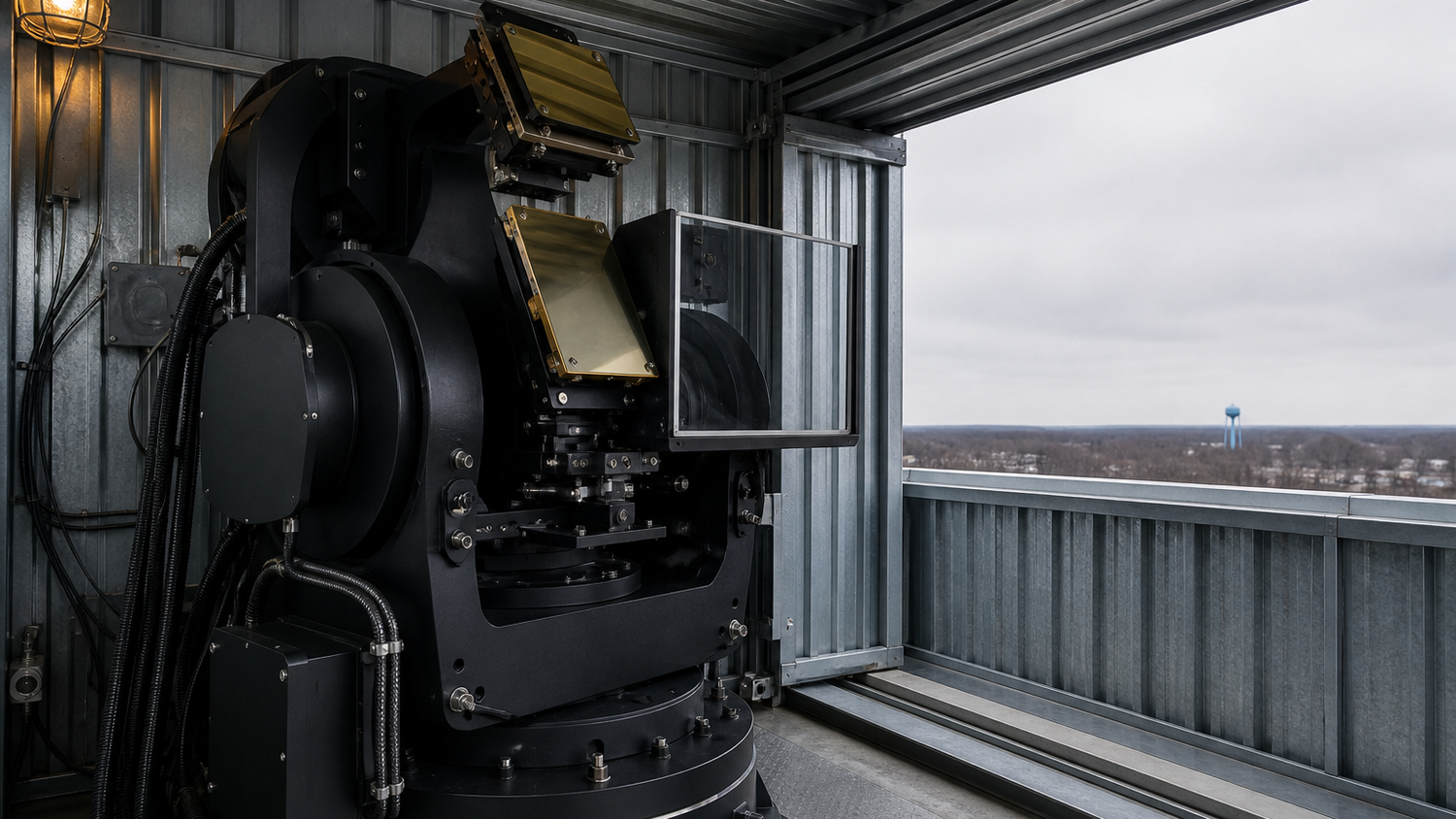
A 375-square-foot galvanized steel chamber now sits on the roof of Stony Brook University's Health Sciences Center, fourteen floors above the medical campus and reached by two final flights of stairs. Its builders call it the Quantum Watchtower, and they say the instruments inside will one day protect Stony Brook University Hospital patient data against cyberattack by teleporting quantum information.
That sentence was published on 28 August 2026 by Jess Stallone in Stony Brook Matters, the university's news site for alumni. One week earlier, on 21 August, Stony Brook and the Department of Energy's Brookhaven National Laboratory announced the demonstration behind it: a working free-space optical link carrying quantum information across 13 miles of open Long Island air. For a hospital reader the useful exercise is to hold the two statements next to each other, because they describe different stages of the same project.
Practical takeaway. A US academic medical center now has quantum communications hardware on one of its own buildings, and the people running it have said in public what they eventually want it to carry. What crossed the air on 21 August was faint states of light holding a few photons each. Entangled pairs crossed the same route in separate night-time testing. No clinical data has moved on this network, and the slice of a hospital's exposure that a link like this reaches is narrow enough to be worth stating precisely.
What crossed the 13 miles between Stony Brook and Upton on 21 August 2026
The Watchtower is one end of a pair. The other is the Quantum Lighthouse, a nearly identical steel structure built by Brookhaven Lab at Upton, New York, 13 miles east, positioned for a clear line of sight back to campus. At the "First Light" event on 21 August, researchers generated quantum states of light at the Stony Brook rooftop and sent them across the open air to the Lighthouse. The university describes what was transmitted as "quantum states of light, each containing just a few individual photons," which is a weak coherent source rather than a true single-photon emitter. That daytime run demonstrated that the optical path could be aimed and held steady.
The entanglement work happened separately, at night, when the sky's background light drops far enough for faint signals to be picked out. Entangled photon pairs were generated in a Stony Brook physics laboratory, carried by fiber to the Watchtower, launched across the 13 miles, and measured at the Lighthouse. Justine Haupt, the Brookhaven engineer leading the link, came to it from astronomical instrumentation. "It's exciting to take capabilities we've spent years refining for astronomy and adapt them for a completely different scientific problem," she said.
The physics is what makes this hard. A quantum state cannot be copied, which is the property that lets quantum key distribution reveal an eavesdropper and which also removes the engineer's usual repair tool. An optical amplifier partway along the path would destroy the thing being sent, so the states have to arrive intact over the whole 21 kilometers. Across open air that puts the burden on aiming two telescopes at each other precisely enough, and on getting the light through ground-layer atmospheric turbulence, which is why the entanglement measurements were made at night when background light is lowest. Fiber routes avoid the turbulence and the aiming problem, at the cost of digging a path. Open air is what lets a network reach a site with no trench between the two ends, and eventually reach a satellite.
SCY-QNet: four million dollars from the NSF, ten nodes, and 350 kilometers of fiber into Manhattan
The wireless hop attaches to something already built. Stony Brook and Brookhaven operate a fiber quantum network spanning 161 miles and eight nodes across Long Island and the New York metropolitan area. Eden Figueroa, who directs Stony Brook's Quantum Institute and holds a joint appointment at Brookhaven, is lead principal investigator on the expansion, called SCY-QNet. In September 2025 it drew a four million dollar National Science Foundation grant under the National Quantum Virtual Laboratory testbed program, a two-year Phase II design award for a ten-node network running more than 350 kilometers from eastern Long Island into New York City, with Columbia, Yale, Brookhaven, and commercial data centers at Commack and Westbury among the sites.
The grant announcement names the intended applications. Secret-key sharing protocols come first, aimed at critical infrastructure such as power systems. Teleportation-based communication for the health and financial sectors follows. Synchronized atomic clock networks come third. The health sector therefore appears in the funded scope from the start, which is the thread the Watchtower feature picked up a year later and pointed at a specific hospital.
Quantum pillar: networking. Technology readiness: TRL 5 of 9. The hardware works over a real 13-mile path in real weather between two operating sites, which is well past a laboratory bench, and it is still a research testbed in its design phase with two of three telescopes standing, no clinical system attached to it and no patient information ever sent across it.
Which part of a hospital's exposure a quantum link reaches
A hospital's data risk sits mostly in places this technology does not go. Ransomware arrives through phishing mail and unpatched remote access. Breaches come from misconfigured storage buckets or from credentials stolen at a supplier. Clinical material then sits at rest for decades inside electronic health record systems and imaging archives. A quantum link secures the exchange of encryption keys between two endpoints on a network. It does nothing about any of the rest.
What it does address is real and specific. Encrypted traffic captured today can be stored and decrypted later, once a cryptographically relevant quantum computer exists. Clinical material has an unusually long shelf life against that threat: a genome sequenced in 2026 identifies the same person and their relatives in 2050, and neural signals from an implanted interface cannot be reissued the way a password or a certificate can. Health data is a plausible early target for harvest-now-decrypt-later collection precisely because it stays sensitive longer than almost anything else an attacker could take.
The answer most health systems will actually deploy against that is post-quantum cryptography, which is a software change to existing key exchange and signatures and requires no rooftop telescope. Quantum key distribution is a hardware answer to the same question with a different trust model, and it is expensive and distance-limited. Where a link is extended by relaying keys through trusted intermediate nodes, as most deployed metropolitan networks are, its security also depends on the security of each of those nodes. A hospital chief information security officer reading the Watchtower story should register that Stony Brook is building a testbed for the second approach, not procuring a product.
Germany ran a simulated teleconsultation over a quantum-keyed link at 12.7 bits a second
There is a useful benchmark for how far ahead of clinical practice this sits. This Monitor covered the German Q-net-Q consortium on 20 August 2026, which ran a fifteen-minute simulated teleconsultation between a village health kiosk in Sundhausen and Jena University Hospital over an entanglement-based quantum key distribution link using the BBM92 protocol. Roughly 140 kilometers of installed fiber, a 70-kilometer measured segment that was mostly aerial, vital signs monitored through the session, and a key rate of 12.7 bits per second on the aerial-heavy path against 22.2 on the buried one. Real clinical traffic was left as future work.
Two things stand out. The first is the key rate. At 12.7 bits per second, quantum key distribution supplies keys for conventional symmetric encryption; it does not carry the consultation itself. The second is where the security in that deployment actually came from: post-quantum algorithms running in ordinary Linux tunnels. Four European cybersecurity agencies, Germany's BSI, France's ANSSI, the Netherlands National Communications Security Agency and the Swedish National Communications Security Authority, have stated jointly that end-to-end security cannot be achieved over long distances using fiber-based quantum key distribution. That judgment belongs to those agencies rather than to the German project. A European deployment that reached a hospital and a working link still stopped short of carrying a patient, and Stony Brook sits several stages behind that point.
How Quentir Reads It
The interesting fact here is where the building is. Quantum network testbeds in the United States have generally been sited at physics departments, national laboratories, and telecommunications facilities. Stony Brook put its optical terminal on the Health Sciences Center, the building that houses the university's medical, nursing, dental and health professions schools alongside its hospital campus, and its own communications office wrote hospital patient data into the description of what the network is for. That is a siting decision and a positioning decision arriving together. It is the first case this Monitor has covered in which a specific named US hospital, rather than the health sector in the abstract, is presented as the beneficiary of a quantum network still under construction.
The gap between that identification and any clinical reality remains wide, and Stony Brook's own materials are reasonably clear about it. Two of three telescopes are standing. The Yale terminal, roughly 30 miles across Long Island Sound, is still under development. The network sits in a two-year design phase awarded in September 2025. Nothing in the announcements claims a hospital deployment, and the phrasing throughout is about what the technology will one day do.
For a hospital that wants to act on this in 2026, the work is on the software side and it is already specified. Inventory where long-lived clinical data crosses a network and where it sits encrypted at rest. Ask your electronic health record and imaging archive suppliers for their post-quantum migration timelines against NIST's transition guidance in IR 8547, where those requirements apply to your organization, ask the same of any genomics or connected-device vendor, and put the answers in the contract rather than the sales deck. Genomic and neural data deserve first priority in that inventory for the reason above: those payloads cannot be reissued after a future decryption. A rooftop telescope is not on that list, and will not be for years. What Stony Brook has done is worth watching for a different reason, which is that it changes who the customer for a quantum network is assumed to be, and hospital procurement tends to follow the assumption before it follows the hardware.
Sources
Primary source: Jess Stallone, "The Quantum Watchtower: Stony Brook Sets Cybersecurity Sights on Quantum Wireless Networking and Teleportation," Stony Brook Matters, 28 August 2026, from which the 375-square-foot galvanized steel chamber on the Health Sciences Center roof, the fourteen-story ascent, the statement that the devices will one day protect Stony Brook University Hospital patient data by teleporting quantum information, the second-of-three-telescopes status, and the quotation from Brookhaven engineer Justine Haupt are taken. The Stony Brook University news office release of 21 August 2026 covering the "First Light" demonstration with Brookhaven National Laboratory supplies the 13 miles and 21 kilometers of the free-space optical link, the description of the daytime transmission as "quantum states of light, each containing just a few individual photons," the separate night-time entangled-pair testing, the 161-mile eight-node fiber network, the roles of Eden Figueroa and university president Andrea Goldsmith, and the planned 30-mile Yale link across Long Island Sound. The Stony Brook newsroom announcement of 4 September 2025 supplies the four million dollar National Science Foundation award under the National Quantum Virtual Laboratory Quantum Testbeds program, the two-year Phase II design scope, the ten nodes and 350-plus kilometers, the partner institutions and data center sites, and the stated application areas including the health sector. The German comparison, including the BBM92 protocol, the 12.7 and 22.2 bits per second key rates, the 70-kilometer segment, and the fact that the fifteen-minute teleconsultation was a simulation with real clinical traffic left as future work, is drawn from this Monitor's post of 20 August 2026 on the Sundhausen health kiosk and Jena University Hospital. The conclusion that end-to-end security cannot be achieved over long distances using fiber-based quantum key distribution is not the Q-net-Q consortium's; it is the joint position of four European cybersecurity agencies, Germany's BSI, France's ANSSI, the Netherlands National Communications Security Agency and the Swedish National Communications Security Authority, as carried in that same post, and it is attributed to them above. The characterization of ransomware, credential theft and data at rest as the larger share of hospital exposure, and of post-quantum cryptography as the software answer most health systems will deploy, is this Monitor's assessment and is not attributed to Stony Brook. The transition guidance linked in the closing section is NIST Internal Report 8547, "Transition to Post-Quantum Cryptography Standards," initial public draft of 12 November 2024, cited as the authority a supplier timeline can be measured against where it applies to the organization asking.