Two Thorium-229 Nuclear Clocks in Nature, 7 October 2026: TU Wien and PTB Run One Unattended for a Day, a Tsinghua-Led Team Reaches 5e-13 Instability, for GNSS-Denied Timing, TRL 4
Quentir Defense Monitor
Evidence-based insights for quantum defense and security. Published by Quentir Systems LLC · October 8, 2026.
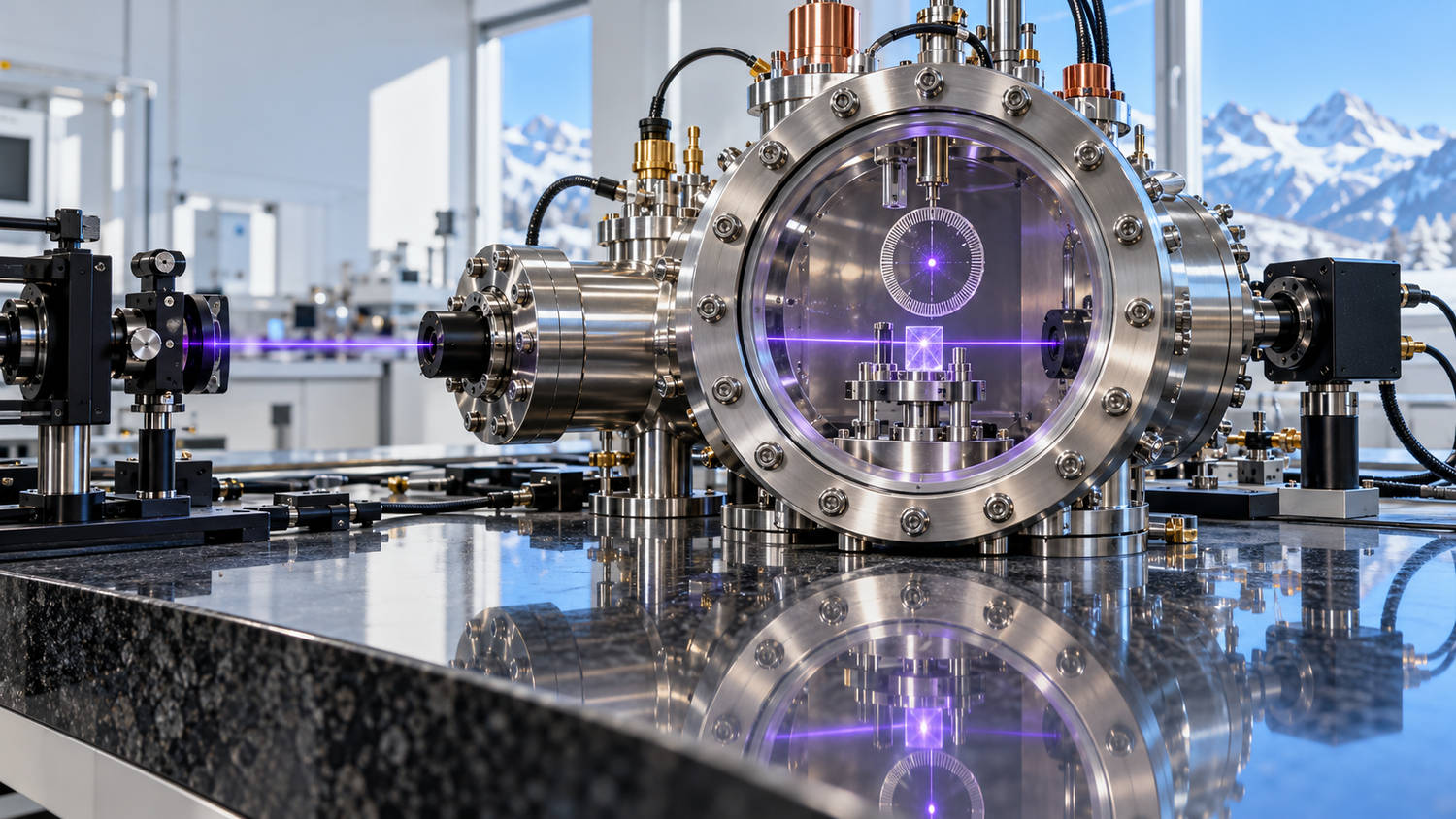
On October 7, 2026 Nature published two papers from two independent teams, each describing a working clock whose frequency reference is a transition inside the thorium-229 nucleus rather than in the electron shell of an atom. The Vienna and Braunschweig team around Luca Toscani De Col, Ekkehard Peik and Thorsten Schumm locked a 148-nanometer laser to thorium nuclei in a room-temperature calcium fluoride crystal, compared it continuously with a ytterbium single-ion clock, and ran it for a day without anyone touching it. A 40-author team led from Tsinghua University and the Beijing Academy of Quantum Information Sciences did the same with a stronger vacuum-ultraviolet source and two crystals grown in their own laboratory, and reached a fractional frequency instability of 5e-13 divided by the square root of the averaging time in seconds.
This post reads both results as a clocks and timing capability. The sentence to hold onto is Peik's own, in the PTB press release: the stability does not yet exceed that of leading atomic clocks, and the team can now clearly identify where the technical limits lie. For a program office that cares about timing when satellite signals are jammed, that sentence is worth more than the headline.
What Toscani De Col, Peik and Schumm built in Vienna: a 148-nanometer laser locked to thorium nuclei in a 3.1-millimeter calcium fluoride crystal
The Vienna paper, with 27 authors from TU Wien, the Austrian Federal Office of Metrology and Surveying, PTB in Braunschweig, the Max Born Institute in Berlin, Leibniz University Hannover and the Institute of Scientific Instruments in Brno, describes a stand-alone clock. A 1,187-nanometer laser is frequency-quadrupled and then doubled in a strontium tetraborate crystal to reach the 148-nanometer nuclear transition, while a separate cavity-stabilized clock laser supplies the short-term stability. The thorium-doped calcium fluoride crystal, 3.1 millimeters across and held at room temperature, supplies the long-term reference: a photomultiplier behind the crystal measures how much ultraviolet light the nuclei absorb, the interrogation frequency is stepped from side to side of the absorption line, and the difference becomes an error signal that pulls the laser back onto the nuclear resonance. Schumm's summary in the TU Wien announcement is the plain version: the laser changes the energy state of the thorium nuclei, and the thorium nuclei are used to stabilize the frequency of the laser.
The numbers are modest and precisely stated. Only 65 picowatts of ultraviolet light reach the detector, 0.75 percent of it is absorbed on the clock transition, and the signal-to-noise ratio after one second is about 17. The measured linewidth is roughly 100 kilohertz against a transition frequency of 2.02e15 hertz. From those figures the authors derive a shot-noise-limited instability of 3e-12 divided by the square root of the averaging time in seconds. That scaling projects 1.02e-14 after one day and would require 9,000,000 seconds, approximately 104 days, to reach 1e-15; these are shot-noise projections, not measured performance. The clock was compared throughout with the ytterbium single-ion clock of the Austrian metrology office through a fiber link and a frequency comb, and the power stability of the ultraviolet source now allows operation without intervention for one day. A tenth of a kelvin of crystal temperature drift during the run did not disturb the lock.
The authors then report the limit they found. Within a single run the clock reaches instabilities in the low 1e-14 range. Between runs on different days the reproducibility was limited to about 5e-13, and the team traced the cause to realignment: each restart sends the half-millimeter beam through a slightly different region of the crystal, and measurements at four positions showed line centers that differed by up to 1.7 kilohertz, far above the 0.13 kilohertz expected from statistics, while measuring twice at the same position gave the same frequency. Local strain from structural inhomogeneity in the crystal is the authors' conjecture, and the remedies they propose are a reproducible optical path through the crystal, more homogeneous doping and growth conditions that minimize strain.
What Huang, Ding and 38 co-authors ran in Beijing: 10 microwatts of vacuum-ultraviolet light, two home-grown crystals and 5e-13 instability
The Tsinghua-led paper, with 40 authors from Tsinghua University, the Beijing Academy of Quantum Information Sciences, three Shanghai institutes of the Chinese Academy of Sciences, Peking University, the National Institute of Metrology and three further Chinese laboratories, attacks the same problem with more light. Its vacuum-ultraviolet source is four-wave mixing in cadmium vapor at 600 degrees Celsius, driven by a 375-nanometer beam and 10 watts of 710-nanometer light, producing 10 microwatts of continuous-wave 148.4-nanometer radiation with an estimated sub-hertz linewidth. About 5 microwatts arrive at the crystal, roughly five orders of magnitude more than the 65 picowatts that reached the Vienna detector. The crystals are home-grown, one of them in a single growth run from a solution containing only 1.4 micrograms of thorium-229, and they are shaped as elongated cylinders, the first 1.44 millimeters wide and 9.8 millimeters long, so that the beam sees enough nuclei along its path for absorption readout.
Across four readout configurations the instability improved from 1e-11 to 6e-12 to 2e-12 and finally, with 350 nanowatts of transmitted power and an 85 percent measurement duty cycle, to 5e-13 divided by the square root of the averaging time, within a factor of two of the photon shot-noise limit. The crystal sits at 301.4 kelvin with 3 millikelvin of temperature jitter, which the authors convert to a fractional frequency fluctuation of about 3e-15. The reproducibility test is the part a buyer should underline: the clock-transition frequencies measured in the two independently fabricated crystals agree at the 1e-13 level and are consistent with earlier frequency-comb measurements on other thorium-doped calcium fluoride crystals at JILA. That is evidence that two solid-state nuclear references built separately tell the same time to that precision.
Quantum pillar: sensing (clocks and timing). Use posture: dual-use. Technology readiness: TRL 4 of 9. Both clocks are complete laboratory assemblies that close a feedback loop on real thorium nuclei and are measured against reference clocks on an optical bench, with no transportable package, no environmental qualification and no field trial, which is the fourth rung of the shared ladder.
Why a solid-state clock matters to forces without satellite timing: holdover, DARPA's ROCkN targets and the dual-use reading
Every modern force runs on time from satellites. Radar networks, encrypted radios and frequency-hopping links assume that distant platforms agree on the clock to nanoseconds, and the cheap way to get that agreement is a GNSS receiver. When the signal is jammed or spoofed, each platform falls back on a local oscillator and the question becomes holdover: how long the local clock can run before its drift breaks the network. DARPA's Robust Optical Clock Network program states the requirement directly: optical timing in low size, weight and power that works outside the laboratory, with one technical area for small portable clocks on aircraft and satellites and another for transportable clocks that keep GPS-quality time for a month without the satellites.
A nuclear clock is interesting to that program for a reason that has nothing to do with today's stability figures. The thorium reference is a solid. There is no trapped ion, no atomic fountain, no laser-cooled cloud in ultra-high vacuum, no cryogenic stage. The nucleus couples only weakly to stray electric and magnetic fields, which is why a clock can be built from microgram quantities of thorium in a millimeter-scale crystal at room temperature. The Tsinghua-led authors say the aim plainly: compact, field-deployable nuclear frequency references. A robust solid-state reference is the shape of clock that eventually fits a vehicle, a ship or a satellite, and the Monitor's earlier reading of the Italian strontium lattice clock work showed how much engineering a trapped-atom clock needs before it can leave a vault.
The posture is dual-use in the plainest sense. Timing is infrastructure. The same reference that lets a radar network hold coherence without satellites lets a civil telecom network or a power grid do the same, and whichever side fields a better clock gains the same resilience. Both papers are written as fundamental physics: the Vienna group uses its clock to constrain ultralight dark matter over 23 hours of data, and both teams list tests of fundamental constants ahead of any application. Nothing in either paper is a weapons program, and nothing in this post infers one. What a defense buyer takes from the physics is that quantum timing has a new candidate reference with properties the trapped-atom clocks lack, and that the candidate is at the start of its engineering.
What stands between a laboratory nuclear clock and a program office: 5e-13 day-to-day reproducibility, crystal strain, laser power and the atomic clocks it must beat
The distance is measured in the papers themselves. Leading optical lattice and single-ion clocks reach instabilities well below 1e-15 after a single second and systematic uncertainties around 1e-18. The Vienna clock's derived shot-noise scaling projects 1.02e-14 after one day and 1e-15 after approximately 104 days, rather than demonstrating those averaging results; its measured within-run instability is in the low 1e-14 range. The Tsinghua-led clock would need about 250,000 seconds of averaging, roughly three days, to reach 1e-15 from its 5e-13 starting point. For holdover the number that matters is a different one. A sustained fractional frequency offset of 5e-13 would accumulate about 43 nanoseconds of timing error per day. That is a conditional illustration: the Vienna authors' measured day-to-day reproducibility of 5e-13 does not establish a sustained offset, absolute accuracy or continuous holdover performance. The figure came from a bench where the beam had to be realigned every morning, and realignment was itself the cause. A fieldable device has to fix the optical path through the crystal mechanically and prove that the fix survives vibration and temperature cycling.
The second barrier is light. The Vienna clock worked with 65 picowatts at the detector, which is why its one-second signal-to-noise ratio is 17 and its derived shot-noise-limited instability starts at 3e-12. The Beijing route produces 10 microwatts from a cadmium oven at 600 degrees Celsius fed by a 10-watt laser and a comb tied to a cryogenic silicon cavity, which is a laboratory, not a payload. Schumm's own list of next steps in the TU Wien announcement is stronger lasers and better thorium crystals. The third barrier is the crystal itself: strain and doping inhomogeneity shift the line center by kilohertz across a few millimeters, and crystals that agree at the 1e-13 level, as the two Beijing crystals did, have to become routine before anyone can specify a nuclear clock the way a program specifies a rubidium standard today.
A program office should therefore place these papers where the authors do. They are the proof that a nuclear transition can serve as an operational clock reference, demonstrated twice and independently in the same week, on hardware that runs unattended for a day and agrees between crystals to one part in ten trillion. They are also two bench instruments in two metrology laboratories with no transportable version and no field data, which is why the readiness panel above says four. The questions to put to any vendor who proposes nuclear timing for a GNSS-denied platform are the ones these papers leave open: how the beam path through the crystal is held fixed, how much ultraviolet power the package generates at what size, weight and power, and what the clock's reproducibility is after it has been switched off, moved and switched on again.
Sources
Primary source: Luca Toscani De Col, Thomas Riebner, Ira Morawetz, Felix Schneider, Fabian Schaden, Sebastian Lahs, Johannes Tiedau, Maksim V. Okhapkin, Ekkehard Peik, Thorsten Schumm and co-authors (TU Wien, BEV, PTB, Max Born Institute, Leibniz University Hannover, ISI Brno), "A thorium-229 optical nuclear clock with feedback loop," Nature, October 7, 2026, https://www.nature.com/articles/s41586-026-11084-4. Also read in full: Beichen Huang, Gaowei Yan, Qi Xiao, Shiqian Ding and co-authors (Tsinghua University, BAQIS, CAS Shanghai institutes, Peking University, NIM, Hefei National Laboratory, ECNU), "A nuclear clock synchronized to 229Th," Nature, October 7, 2026, https://www.nature.com/articles/s41586-026-11122-1. Other material: PTB press release of October 6, 2026; TU Wien announcement of October 8, 2026; DARPA ROCkN program page.