
USTC's Wang, Jiang and Peng Field-Test a 7 cm³ Rubidium Magnetometer at 10 pT/√Hz and 25,200 nT/s Slew: Subway Trains, a G4 Storm and a Buried Magnet, Acta Physica Sinica, September 2026
Defense Henry Quentir Defense Henry Quentir

USTC's Wang, Jiang and Peng Field-Test a 7 cm³ Rubidium Magnetometer at 10 pT/√Hz and 25,200 nT/s Slew: Subway Trains, a G4 Storm and a Buried Magnet, Acta Physica Sinica, September 2026

Wang Xin, Jiang Min and Peng Xinhua of the University of Science and Technology of China, with a China State Shipbuilding navigation laboratory as co-author, report in Acta Physica Sinica a rubidium quantum magnetometer whose 7 cubic centimeter probe reaches 10 pT/√Hz, tracks field changes of 25,200 nT/s and relocks by itself in under a second. We read its three field tests, the June 1, 2025 G4 storm against INTERMAGNET's Cheongyang station, two subway trains above a station and a magnet buried half a meter deep, as defense-specific capability: what a motion-tolerant palm-sized sensor changes for magnetic anomaly detection and magnetic navigation, who gains under the dual-use reading, and the moving-platform trial that still stands between the paper and a program office.
Read More
Peking University and Mainz Demonstrate a Levitated Magnet Magnetometer at 32 Femtotesla per √Hz and Room Temperature in Science, the Signal Class of Undersea Magnetic Anomaly Detection
Defense Henry Quentir Defense Henry Quentir

Peking University and Mainz Demonstrate a Levitated Magnet Magnetometer at 32 Femtotesla per √Hz and Room Temperature in Science, the Signal Class of Undersea Magnetic Anomaly Detection

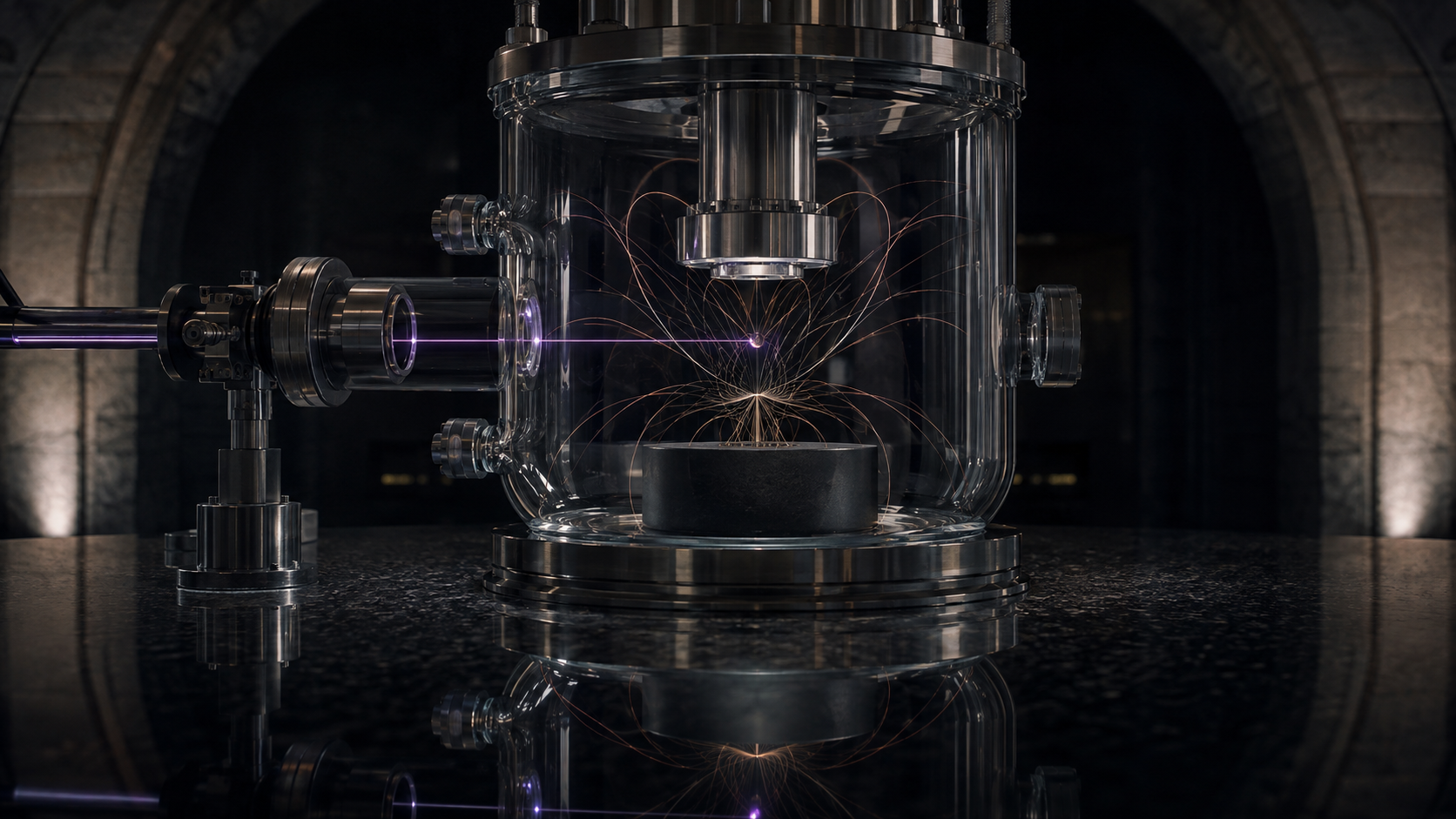
Physicists at Peking University and Johannes Gutenberg University Mainz published a levitated magnet magnetometer in Science whose preprint reports 32 ± 3 femtotesla per root hertz at approximately 305 Hz, at room temperature inside a four-layer cylindrical magnetic enclosure, without cryogenics. Earth-strength background-field tolerance does not establish unshielded sensitivity. The response FWHM is approximately 0.025 Hz, with sensitivity of approximately 1 nT/√Hz below 15 Hz. We read the physics against magnetic anomaly detection of submarines, from the P-3 tail stinger to the Strategic Capabilities Office's throwaway sensor drone, and set out what stands between a quiet optical bench and a sonobuoy-launched sensor, including suitable low-frequency performance or demonstrated signal modulation.

Read More