USTC's Wang, Jiang and Peng Field-Test a 7 cm³ Rubidium Magnetometer at 10 pT/√Hz and 25,200 nT/s Slew: Subway Trains, a G4 Storm and a Buried Magnet, Acta Physica Sinica, September 2026
Quentir Defense Monitor
Evidence-based insights for quantum defense and security. Published by Quentir Systems LLC · September 27, 2026.
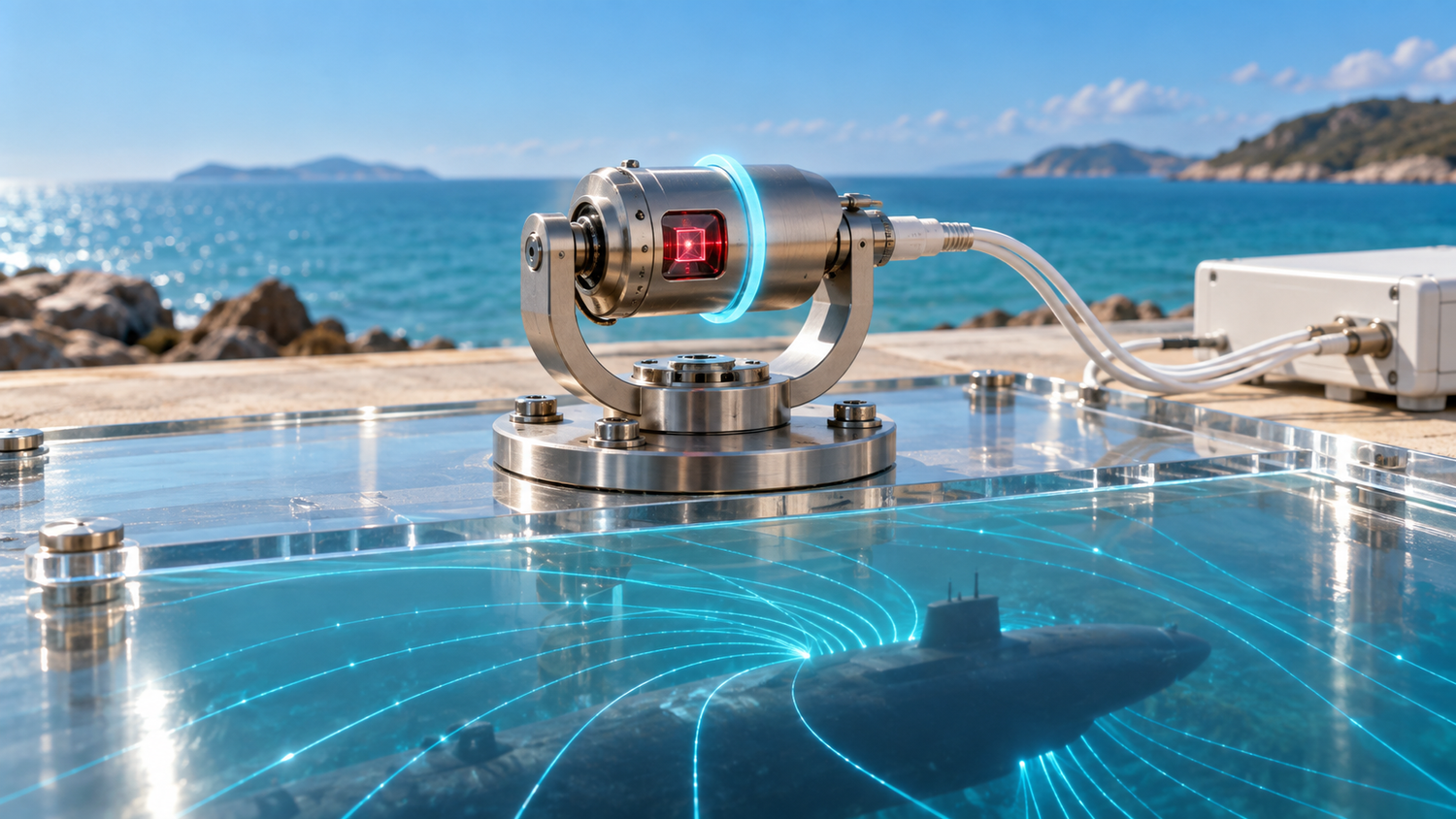
A paper that Acta Physica Sinica lists as online since September 8, 2026, describes a rubidium quantum magnetometer whose sensing probe measures 3 by 1.5 by 1.5 centimeters, draws less than 5 watts for the whole system and keeps working while the magnetic field around it changes at more than 25,000 nanotesla per second. Wang Xin, Jiang Min and Peng Xinhua of the University of Science and Technology of China wrote it, and the paper opens by listing anti-submarine warfare among the fields in which weak-field magnetometry plays a role. The South China Morning Post carried it on September 25 under the headline of a handheld submarine detector that tracked a subway train underground. The paper tested no submarine, and it reports no detection range against one.
What it does report is more useful to a defense reader than the headline. The three authors set out to close a gap that sits between every laboratory sensitivity figure and a sensor on a moving platform: an atomic magnetometer that is small and sensitive tends to lose its measurement the moment the field changes faster than its electronics can follow, and it then needs a human or a long reset to find the signal again. This paper is about that failure mode, how to detect it in real time and how to recover from it in under a second, and then about whether the result survives outdoors. That is the step the Monitor flagged as missing when it covered the levitated magnet magnetometer from Peking University and Mainz earlier this month: motion, bandwidth and recovery, the unglamorous engineering between a bench result and a sonobuoy.
What the paper establishes: a 7 cubic centimeter rubidium-87 probe, 10 pT/√Hz in shielding, 41.4 Hz of bandwidth and a 25,200 nT/s slew rate with sub-second relock
The instrument is an optically pumped magnetometer of the Mz type. A vertical-cavity surface-emitting laser shines through a cubic vapor cell of rubidium-87 that measures 4 millimeters on a side, a thin-film radio-frequency coil drives the atoms at their Larmor frequency, and a photodiode reads the transmitted light. The resonance frequency is proportional to the total magnetic field, so a servo loop that holds the radio frequency on resonance reads the field continuously. The authors packed the laser, the micro-optics, the cell, its heaters, the coil and the detector into a probe of about 7 cubic centimeters, with a separate controller board of 8 by 2.5 centimeters. Total power stays under 5 watts.
Two design choices carry the performance claims. First, the radio-frequency amplitude is tuned to maximize the ratio of the resonance's height to its width, which gives the steepest frequency discriminator and therefore the lowest noise for a given photon budget. Second, the feedback gain is pushed as high as the intrinsic hardware delays allow without adding baseline noise. The result is a noise floor of about 10 picotesla per root hertz, measured between 1 and 10 hertz inside magnetic shielding against a controlled background field, and a bandwidth of 41.4 hertz at the minus 3 decibel point. The paper is candid that comparable instruments reach around 100 hertz by giving up sensitivity, and that the intended applications mostly live below 1 hertz.
The figure the authors emphasize is the slew rate. They drove the probe with a triangular field of 8,400 nanotesla amplitude at 1.5 hertz and showed distortion-free tracking, which works out to 25,200 nanotesla per second. They place typical commercial Mz devices at 1,000 to 10,000 nanotesla per second and cite a QuSpin Mz sensor at about 10,000. A high slew rate is what keeps a sensor locked on a platform that turns, pitches or passes a ferrous structure.
When the loop does lose lock, the paper adds a detector for it. The transmitted light is demodulated at twice the modulation frequency, which yields a signal proportional to the second derivative of the absorption profile, a quantity that collapses when the resonance is gone. Once that amplitude falls below a threshold, the controller abandons normal tracking, sweeps the whole frequency band, finds the resonance and resumes. In the published test the authors pushed a permanent magnet toward the probe until it lost lock and then withdrew it; the instrument was back on the field within a second. The readings during the disturbance itself are invalid, and the paper does not claim otherwise.
Three field tests: the June 1, 2025 G4 storm against INTERMAGNET's Cheongyang station, two subway trains at more than 2,000 nT/s, and a magnet half a meter down in a 40 by 25 meter plot
The outdoor work is what separates this paper from most miniaturization reports. The first test was long-duration geomagnetic monitoring at a suburban site. During the severe geomagnetic storm of June 1, 2025, classed G4, the probe followed the total-field excursion from start to finish without a data gap, and the authors plot their trace beside the same interval from the Cheongyang observatory in South Korea, one of the stations of the INTERMAGNET network. The two curves show the same shape. That is a demonstration of stability over hours in an unshielded environment.
The second test is the one the newspapers noticed. The probe sat at street level above a subway station and recorded the field as two trains arrived and left. The total field, near 50,000 nanotesla in that city, swung by thousands of nanotesla with transients the paper puts at more than 2,000 nanotesla per second, and the traces resolve three phases of each train's visit: braking into the station, the stop with doors open and departure under traction. The authors' own description is surface remote sensing of the dynamic magnetic signature of a concealed moving target in an urban environment. The traction currents of an electric train are enormous compared with any naval target, so the test speaks to robustness against fast disturbance, and it says nothing about faint signals at long range.
The third test is the most defense-adjacent. A cylindrical magnet was buried about half a meter deep in a 40 by 25 meter plot, and an operator walked a serpentine path with the handheld probe 5 to 10 centimeters above the ground. The fitted contour map shows the paired high and low lobes of a dipole, roughly 50,530 and 48,750 nanotesla against a background of about 50,100 nanotesla, and the inferred position agrees with where the magnet was placed. The instrument held lock through the vibration and attitude changes of a walking operator, and this is the geometry of unexploded-ordnance search and of some demining work.
Quantum pillar: sensing (gravimetry and magnetometry). Use posture: dual-use. Technology readiness: TRL 5 of 9. The complete instrument ran outdoors on realistic targets for its handheld and monitoring uses, a buried magnet and moving trains, while its stated undersea application has faced no moving platform, no sea trial and no measured range against a hull.
Who gains from a robust palm-sized magnetometer: the China State Shipbuilding navigation laboratory on the author list, the anti-submarine line in the abstract, and the dual-use reading
The affiliations tell the defense reader where to look. Wang Xin lists, alongside USTC and the Hefei National Laboratory, the Laboratory of Science and Technology on Marine Navigation and Control of the China State Shipbuilding Corporation in Tianjin, and the funding statement includes an open grant from the China Ship Navigation Support Technology Laboratory. The abstract's first sentence names anti-submarine warfare as one of four application areas, next to mineral exploration, geomagnetic monitoring and navigation. The Quantum Insider's report of September 25 is careful on this point, noting that the study itself did not test submarine detection and does not seem to establish military detection ranges. The Monitor reads the paper the same way.
Under the capability map this lane uses, the offensive value of a magnetometer lies in finding a platform an adversary intends to keep concealed. Magnetic anomaly detection has been part of maritime patrol since the 1940s, and the constraint has always been range: a hull's anomaly falls with the cube of distance, so a tenfold gain in sensitivity buys only a little more than a doubling of detection distance. A 10 picotesla instrument does not change that arithmetic, and the paper does not pretend to. What a 7 cubic centimeter, 5 watt probe that survives motion does change is where a magnetometer can be carried: on a small drone, a towed body, an unmanned surface vessel or a disposable buoy, in numbers. That is the shape of the drone-mounted magnetometer prototypes Japan's Defense Ministry asked to fund this summer, and of the Australian debate on whether sensor proliferation makes the oceans transparent by the 2050s, a claim the Australian National University team put at 75 percent probability in its ASPI Strategist essay of March 2023. This paper is one data point on the sensor side of that argument, and a modest one.
The defensive and civil readings are at least as strong, which is why the panel says dual-use. A scalar magnetometer that holds lock on a moving vehicle is the front end of magnetic navigation, the technique that matches measured crustal anomalies to a map when satellite positioning is denied. The same probe, walked over a field, locates buried ferrous objects for ordnance disposal. Nothing in the hardware distinguishes these uses; the software and the platform do. A program office in any of these lines gains the same thing from this paper: evidence that a Chinese university and shipbuilding laboratory can package an atomic magnetometer at this size and make it recover on its own.
What stands between a handheld field test and a program office relying on it: no moving-platform trial, scalar-only output, 41 hertz and a sensitivity two orders below the femtotesla instruments
The distance from this paper to a procurement decision is measurable, and the authors point at most of it. The first gap is the platform. Every field test used a stationary or walking sensor. Nothing here shows the probe on an aircraft, a boat or a drone, where heading changes rotate the sensor through the Earth's field, where the vehicle's own electrical systems add noise and where the compensation of the platform's magnetic signature becomes the dominant engineering problem. The slew-rate figure is an argument that the probe could survive such a platform; it is not yet a trial on one.
The second gap is sensitivity. Ten picotesla per root hertz is respectable for a device this small and this cheap to power, and it is two to three orders of magnitude away from the femtotesla-class instruments that set the laboratory frontier, including the 32 femtotesla levitated magnet the Monitor covered on September 5. For long-range undersea search, sensitivity and noise rejection together set the detection distance, and this design trades sensitivity for size and robustness deliberately. The third gap is the output. The device measures the total field only. A vector reading, which the authors list as future work through applied fields along three axes, is what navigation and target-classification algorithms generally want. The fourth is bandwidth. The paper's own discussion says the target applications live below 1 hertz, so 41.4 hertz is adequate for them, and it also says hundreds of hertz would need a free-induction-decay scheme the team has not built.
A buyer should also weigh what the field tests measured against how they were reported. The storm test compares a trace to a reference observatory and shows agreement in shape. The subway test shows a very large signal at short range. The buried-magnet test locates a strong dipole from a few centimeters away. Each is a valid engineering check; none is a detection-range experiment. The pattern is familiar to readers of the Monitor's Medicine lane, where a September broadcast claim of a scanner 100,000 times sharper rested on a diamond magnetometer whose published numbers said something narrower. Here the paper itself is careful; the headline about a submarine detector came from the newspaper.
The next public evidence that would move this paper up the ladder is a flight or sea trial with the probe on a moving vehicle and a published noise figure in that setting. Until then its relevance to submarine detection rests on the authors' stated intent and on the platform argument, and on no measured result.
Sources
Primary source: Wang Xin, Jiang Min and Peng Xinhua, "Development of a Highly Robust Miniaturized Quantum Magnetometer and Its Applications in Geomagnetic Environments," Acta Physica Sinica, DOI 10.7498/aps.76.20260845, listed online September 8, 2026. Other material: Zhang Tong, South China Morning Post, September 25, 2026; Matt Swayne, The Quantum Insider, September 25, 2026; Bradbury, Grisogono, Williams and Vella, The Strategist (ASPI), March 15, 2023.