Peking University and Mainz Demonstrate a Levitated Magnet Magnetometer at 32 Femtotesla per √Hz and Room Temperature in Science, the Signal Class of Undersea Magnetic Anomaly Detection
Quentir Defense Monitor
Evidence-based insights for quantum defense and security. Published by Quentir Systems LLC · September 5, 2026.
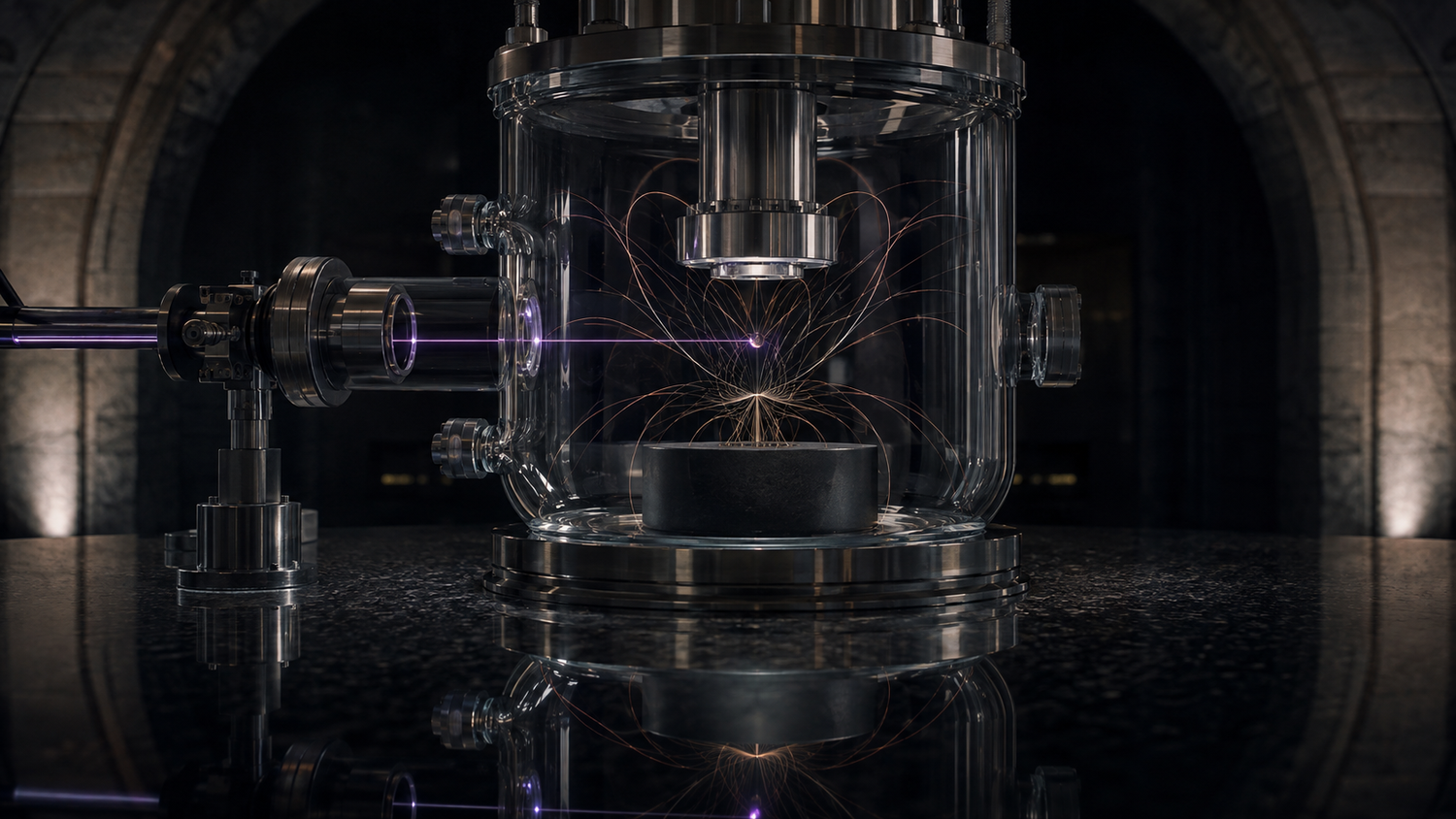
A magnet smaller than a millimeter, floating without contact inside a small vacuum chamber, has measured magnetic fields at the femtotesla scale while sitting at room temperature inside a four-layer cylindrical magnetic enclosure. Physicists at Peking University and Johannes Gutenberg University Mainz published the result in Science on August 6, 2026, demonstrating this sensitivity class on a benchtop instrument without liquid helium, but with magnetic shielding to suppress environmental alternating-field noise. The team of Wei Ji, Changhao Xu, Guofeng Qu and Dmitry Budker calls the device LeMaMa, short for levitated magnet magnetometer, and reports a sensitivity of 32 ± 3 femtotesla per root hertz at approximately 305 Hz in the preprint that preceded the journal paper. A femtotesla is a quadrillionth of a tesla; Earth's own field is roughly a billion times stronger. Instruments that read at that depth have belonged, for decades, to two families with heavy logistical anchors, and one potential application, subject to compatible signal-band performance, is the search for submarines.
The Quentir Defense Monitor covers the sensing pillar of quantum technology precisely for developments like this one. The capability in question, sensing a large ferromagnetic object by the faint distortion it presses into Earth's magnetic field, is the oldest quantum-adjacent sensing mission in any navy's inventory, and its limiting instrument has always been the magnetometer riding on the aircraft.
How a floating millimeter magnet reaches 32 femtotesla: diamagnetic levitation, spin-lattice coupling and a laser watching the wobble
The design reads like a compass rebuilt for a physics laboratory. A hard magnetic particle, under a millimeter across, levitates between a lifting magnet above it and a diamagnetic surface below it, which pushes back against the lifting field and holds the particle stable with no wires, no bearings and no mechanical contact of any kind. An external magnetic field tilts the floating particle the way a passing ship's hull tilts a compass needle, and a laser reads the tilt optically. Because nothing touches the sensor, almost nothing adds friction noise to its motion. Because the particle is ferromagnetic, its billions of electron spins are locked to the crystal lattice, a property the authors use to suppress the quantum projection noise that limits atomic vapor sensors. The remaining enemies are stray fields and vibration, which the team beats down with magnetic shielding, compensation coils and damping until the femtotesla floor emerges.
Two established instrument families already reach that floor, each with a burden attached. Superconducting quantum interference devices, the SQUIDs that anchor magnetoencephalography suites in hospitals, need cryogenic cooling near absolute zero and a supply chain of liquid helium. Optically pumped atomic magnetometers reach comparable depths without cryogenic cooling, but with heated vapor cells, yet do their best work inside magnetically shielded rooms, away from Earth's field. The Peking and Mainz instrument runs at room temperature and tolerates an Earth-strength background field, in a package Nature's news coverage describes as simpler than the alternatives it rivals. Its reported sensitivity was measured inside a four-layer cylindrical magnetic enclosure; background-field tolerance does not establish the same sensitivity without shielding. Ji Wei told Guangming Daily, in remarks carried by the South China Morning Post, that the combination of room-temperature operation, tiny components and high sensitivity makes the device promising for fundamental physics experiments. The applications the authors put forward are civilian science: dark matter searches, where an axion-like particle would announce itself as a faint oscillating field, and brain measurement, where neural currents produce fields in exactly this femtotesla range.
Why a defense reader should care: the P-3 tail stinger, the P-8A altitude gap and a Strategic Capabilities Office call for a throwaway magnetometer drone
Magnetic anomaly detection is the military mission that has paid for magnetometer development since the Second World War. A submarine is thousands of tons of ferromagnetic steel, and however quiet its machinery becomes, it cannot stop distorting the geomagnetic field around it. Maritime patrol aircraft have exploited that fact since 1944. The P-3 Orion carried its magnetometer in the tail boom that gave the aircraft its silhouette, flying low over the ocean to bring the sensor inside detection range. Its successor, the P-8A Poseidon, patrols higher and faster, and the United States Navy accepted the loss of the onboard instrument in the base design. The gap this opened is documented in public acquisition traffic: in June 2019 the Strategic Capabilities Office asked industry for a small expendable drone carrying a magnetic anomaly detector, light enough to launch from the P-8A's sonobuoy tubes, cheap enough to throw away at under 12,500 dollars a unit. India's P-8I variant, by contrast, kept an integrated detection system.
That solicitation defines the platform class a new magnetometer physics must eventually fit: tens of pounds, battery power, salt air, constant motion. It also explains why room-temperature femtotesla sensing draws a defense reading the moment it appears in a physics journal. A helium-cooled SQUID will never ride a throwaway sonobuoy drone. An instrument that reaches that floor from a benchtop vacuum chamber without cryogenics removes one logistical burden, but the experiment's four-layer magnetic enclosure leaves its fit within that weight and power envelope unproven. The pattern has a recent precedent in the same pillar: quantum sensors of gravity, cousins of this one in the capability map, went from laboratory towers to an 83-kilometer GPS-free maritime navigation trial once an engineering team took platform motion seriously.
Quantum pillar: sensing (gravimetry and magnetometry). Use posture: dual-use. Technology readiness: assessed by Quentir at TRL 4 of 9. The magnetometer exists as a complete bench instrument whose reported sensitivity was measured in a laboratory inside a four-layer cylindrical magnetic enclosure; tolerance of an Earth-strength background does not demonstrate unshielded sensitivity, and it has faced no moving platform, no ocean environment and no realistic search trial.
What stands between a vibration-isolated bench and a sonobuoy tube: motion, bandwidth and the cube law of detection range
The honest capability arithmetic starts with the physics of the target. The field of a magnetic dipole falls with the cube of distance, so improvements in sensor depth buy detection range slowly: a tenfold gain in sensitivity extends range by only a bit more than a factor of two. That comparison requires sensitivity in the target's signal band. The preprint reports 32 ± 3 fT/√Hz at approximately 305 Hz, a response full width at half maximum of approximately 0.025 Hz, and approximately 1 nT/√Hz below 15 Hz. Applying its resonant sensitivity to submarine detection therefore depends on suitable low-frequency performance or demonstrated signal modulation into the sensor's resonant band. Nobody should read this instrument as a claim that the ocean becomes transparent. What better magnetometers actually change is the economics of coverage. Detection range per sensor grows modestly, and the cost, weight and cooling burden per sensor can collapse, which is the variable that decides whether a force fields one exquisite instrument on a patrol aircraft or scatters dozens of adequate ones across a barrier of drifting buoys and drones. The 2019 solicitation already described the second architecture; this result does not yet establish a sensor cheap and light enough, with suitable signal-band performance, to serve it at depth.
The posture is dual-use in the plainest sense. The publication is open science by a Chinese and German academic collaboration, its stated applications are dark matter and the human brain, and every hospital that wants helium-free brain measurement gains from it. The same physical package, matured and with suitable low-frequency performance or demonstrated signal modulation, could serve whoever hunts submarines and equally whoever needs to know their own boats' magnetic hygiene, the defensive discipline of degaussing ranges that measure a hull's signature before it sails. Neither side of the undersea game gets an exclusive advantage from a paper both can read.
What the published result does not yet address is everything a program office would ask next. A levitated particle held by field gradients must survive engine vibration, aerodynamic buffet and platform maneuvers without losing lock; the laboratory result stands on a quiet optical bench. Quantum sensing instruments in motion also fight their own platform, whose electrical systems and structure are magnetically loud, which is why fielded magnetic anomaly detectors live on tail booms and towed birds as far from the airframe as possible. The reported narrow resonant response and poorer low-frequency sensitivity leave mission-band compatibility unestablished; dynamic range against the full geomagnetic background during a turn and long-duration stability outside a climate-controlled room are unreported. Those are the ordinary contents of the gap between TRL 4 and TRL 7, and they took atomic clocks and cold-atom gravimeters a decade or more to cross. A buyer watching this capability should look for three specific signals in the open literature: replication of the femtotesla floor by a second group, a gradiometer configuration that subtracts platform and geomagnetic noise between two levitated sensors, and any demonstration on a moving vehicle, however humble. Until those appear, the correct reading of the Science paper is a genuine physics advance that invites reassessment of the size, cost and logistics assumptions behind femtotesla magnetometry, with shielding requirements and mission-band performance still to be established for deployment, published openly by a collaboration spanning two countries whose navies both care about the answer.
Sources
Primary source: Wei Ji, Changhao Xu, Guofeng Qu and Dmitry Budker (Peking University and Johannes Gutenberg University Mainz), 'Levitated sensor for magnetometry in ambient environment,' Science 393, 607-610, August 6, 2026, DOI 10.1126/science.adx1707 (open arXiv version cited in the body). Other material: Nature news coverage of the instrument; the South China Morning Post report carrying Ji Wei's remarks to Guangming Daily; Military and Aerospace Electronics on the June 2019 Strategic Capabilities Office solicitation for a MAD-equipped expendable UAV.