Basque Health Department Funds an Alzheimer's Drug-Target Search on IBM's Quantum System Two in San Sebastián, With Brain-Organoid Validation Planned at BioBizkaia
Quentir Medicine Monitor
Evidence-based insights for quantum medicine. Published by Quentir Systems LLC · October 21, 2026.
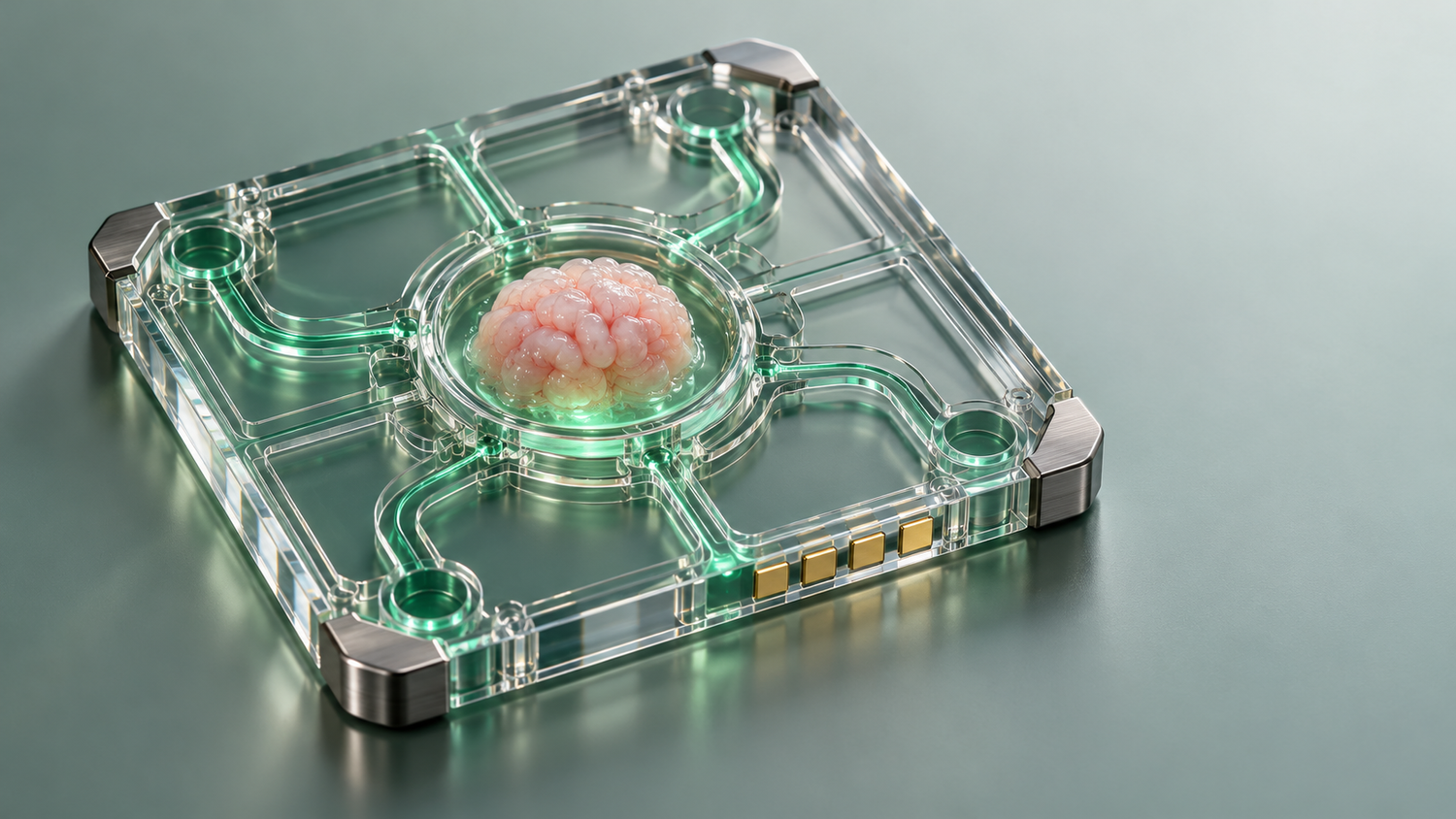
Alzheimer's disease involves thousands of genes and biological processes acting on one another, and a drug developer has to pick one place to intervene. In the Basque Country, a small team of brain-imaging researchers is now trying to make that choice with help from a quantum computer in San Sebastián.
The machine is the IBM Quantum System Two that IBM and the Basque Government inaugurated on 14 October 2025 at the Ikerbasque building in Donostia-San Sebastián. On its first anniversary, the regional newspaper elDiario.es reported on 18 October 2026 that the system had supported 64 scientific projects, with 444 researchers holding access and average use at about half its capacity. Ten international publications have drawn on it so far.
One of those projects belongs to medicine. The Basque Department of Health is backing a study called Quantum-Enhanced Drug Target Discovery for Alzheimer's Disease, or ADQ, run by the Computational Neuroimaging Group of the BioBizkaia Health Research Institute near Bilbao. According to elDiario.es, the project has €70,000 for 2026 and 2027. It combines reinforcement-learning models with hybrid quantum-classical algorithms to analyze gene-expression networks, and its stated goal is a short list of three to five possible therapeutic targets against the disease.
That is a modest budget and a precise aim. A hospital research institute is asking whether a quantum processor can help sort a large biological network into a handful of candidates worth testing, and then checking those candidates in brain organoids grown from patients' own cells.
The project matters to clinicians for a plain reason. Figures cited by the regional broadcaster Onda Vasca put the number of people living with Alzheimer's in the Basque Country at 43,300, and few new Alzheimer's medicines have reached patients in recent decades. Any method that narrows the list before expensive laboratory work begins is worth watching, even at this early stage.
What BioBizkaia, Osakidetza and IBM announced on 9 April 2026
The project first appeared in April. On 9 April 2026 the Basque news agency Orain orain.eus described it as the first health research project in the Basque Country to apply quantum computing to the search for therapeutic targets. The partners listed were the Basque Department of Health working through BioBizkaia, the public health service Osakidetza, the regional quantum program Basque Quantum (BasQ), and the quantum health partnership of IBM and Cleveland Clinic. The Basque Government's own announcement on Irekia carried the same description.
The Government announcement and Onda Vasca gave the names of the researchers in the Computational Neuroimaging group: Ibai Diez, Asier Erramuzpe, Ivan Carcamo and Jesús M. Cortés. Their group works on computational neuroimaging, which explains the starting point. Brain imaging and gene-expression data both describe networks, and the team designs its own algorithms to run on the Donostia machine.
The method has three steps in the April description. The algorithms propose where to act against the disease. Those proposals are to be tested in brain organoids, small tissue models grown in the laboratory from patients' cells. The laboratory results are then meant to retrain the algorithms, so the computational and wet-lab sides correct each other over time. The partners also said they intend to apply the same approach to other diseases and to personalized treatment later.
Quantum pillar: computing. Technology readiness: TRL 2 of 9. TRL 2 is the Monitor's editorial assessment. The cited reports describe planned organoid validation but provide no target-validation results or evidence of clinical testing.
How a gene-expression network becomes a list of three to five Alzheimer's drug targets
A gene-expression network maps which genes switch on together in a tissue, and how strongly. In Alzheimer's research such networks are built from brain samples and compared between people with and without the disease. The difficulty is size. Thousands of genes produce millions of possible interactions, and the clinically interesting question is which small group of nodes, if pushed by a drug, would move the whole network toward a healthier state.
That question has the shape of a combinatorial search, which is why it attracts quantum algorithm designers. Hybrid methods split the work: a classical computer handles most of the data, and the quantum processor is given a reduced subproblem, such as choosing among a limited set of candidate nodes. The reinforcement-learning component described by elDiario.es suggests the team treats target selection as a sequence of decisions scored against the network's response.
Nothing published so far shows that the quantum step finds better targets than a strong classical method would. That comparison is the result to look for when the group reports. The Monitor has followed a similar search elsewhere: Quantum Computing Inc. and INmune Bio announced on 14 October 2026 that a Dirac-3 machine would help search for new indications for INmune's Alzheimer's candidate XPro. Both projects sit at the stage where the method is defined and the evidence is still to come.
Why patient-derived brain organoids are the test that counts
The organoid step is the part of ADQ a clinician should weigh most heavily. A target proposed by any algorithm, quantum or classical, is a hypothesis. Brain organoids grown from patients' cells let researchers check whether changing that target alters disease-related behavior in human neural tissue, and they can show differences between patients that animal models miss.
Organoids have limits of their own. They are small, lack blood vessels and immune cells in most forms, and model early development better than an aging brain. A positive result in organoids would justify further preclinical work. It would still sit years away from a clinical trial, and the sources do not say which organoid readouts the team will use.
What the first year of IBM's Quantum System Two in Donostia shows about access
The anniversary figures say as much about the infrastructure as about medicine. Juan Ignacio Pérez Iglesias, the Basque minister for science, universities and innovation, told Estrategia Empresarial on 14 October 2026 that use averaged 50% of capacity and peaked at 80% in March. Most projects came from the University of the Basque Country (EHU), Tecnalia and the Donostia International Physics Center, working on quantum systems, new states of matter and algorithms.
The system has also opened to companies. Under an access protocol approved in July, an evaluation committee accepted eight of eleven applications: Global Data Quantum, LKS Next, Multiverse Computing, Akshar Innovation, Iberdrola, Amadeus, Moeve and Gertek. None of the eight is a pharmaceutical firm, and the stated focus is materials, chemistry and industrial optimization. The BasQ training program Road to Practitioner has prepared 178 people, 121 of them in the past year.
For a health researcher the useful fact is that a public hospital institute can get time on an IBM Quantum System Two through a regional program. Other countries pay for these machines in other ways: Switzerland's first System Two, at CSCS in Lugano, is funded through an F-35A offset agreement with Lockheed Martin. The Basque model relies on regional public money and IBM's partnership, and ADQ is a test of whether that access produces medical results a hospital can use.
The next step for the Donostia site is the Atenea supercomputer, due in late 2027 to replace Atlas and work alongside the Hyperion system and the IBM processor. For ADQ, the next step is smaller and more decisive: a published list of candidate targets, with a classical baseline beside it and the first organoid results.
Sources
Primary source: elDiario.es (Euskadi edition), report of 18 October 2026 on the first year of the IBM Quantum System Two in Donostia and the ADQ project of the BioBizkaia Computational Neuroimaging Group (Ibai Diez, Asier Erramuzpe, Ivan Carcamo, Jesús M. Cortés). Also drawn on: the Basque Government's Irekia announcement and the orain.eus and Onda Vasca reports of 9 April 2026, Estrategia Empresarial's report of 14 October 2026, and earlier Quentir coverage. The readiness rating is the Monitor's editorial assessment.