Phasecraft's 3,000-Emulation VQE Molecular Dataset With NVIDIA Was Computed on GPUs Under Wellcome Leap's Q4Bio: What the 14 September 2026 Announcement Shows
Quentir Medicine Monitor
Evidence-based insights for quantum medicine. Published by Quentir Systems LLC · September 17, 2026.
Phasecraft and NVIDIA announced on 14 September 2026 what Phasecraft calls the largest known database of Variational Quantum Eigensolver results for molecules, more than 3,000 emulations across thirteen molecular systems, computed on NVIDIA Hopper GPUs at the University of Nottingham. No quantum computer ran any of it, and the announcement says so in its own description of the method.
The dataset is an emulated VQE molecular dataset: for each of the 13 molecular systems, a classical GPU cluster worked out what a quantum processor of 4 to 32 qubits would return when asked for the lowest-energy state of the molecule, with most of the circuits in the 24-to-28-qubit range. Its purpose is to train Phasecraft's quantum-enhanced density functional theory method, a way of improving the standard workhorse of computational chemistry with data a quantum computer would produce. The Wellcome Leap Q4Bio program that paid for it asks whether new algorithms can deliver quantum advantage for health, and its prizes require a demonstration on a real quantum computer with more than 50 qubits. For a hospital buyer or a clinical pharmacologist the announcement describes training data for a chemistry method, produced on conventional hardware, with no named molecular systems, quantitative accuracy benchmarks or clinical results disclosed.
What the 14 September 2026 release states, and what its 15x figure rests on
The Phasecraft release, datelined London and Toronto, gives four numbers: over 3,000 unique emulations, 13 molecular systems, a qubit range of 4 to 32 with "the vast majority in the 24–28 qubit regime", and "a 15x simulation speedup over prior results when modeling physical, many-body systems integral to biology and health applications". The GPUs were NVIDIA Hopper hardware hosted at the University of Nottingham, driven through NVIDIA's cuQuantum software kit. Ashley Montanaro, Phasecraft's co-founder and chief executive, is quoted on the need "to push the limits of today's most capable hardware, both conventional and quantum"; Sam Stanwyck, NVIDIA's director of quantum product, on shortening "the timeline" to useful quantum computing. The release describes the dataset as "a training foundation for quantum-enhanced molecular modeling, which could accelerate drug discovery at a scale previously out of reach, as quantum hardware develops". The conditional clause at the end carries the weight of the sentence.
Read as a scientific claim, the release leaves its two headline numbers without the information a reader needs to weigh them. The 15x speedup has no cited paper, preprint or named baseline; The Next Web made the same observation the same day. Without the baseline, a reader cannot tell whether the comparison is with Phasecraft's own earlier emulation code, with a general-purpose simulator, or with a CPU implementation, and each would mean something different. Either way the speedup measures how fast a classical machine imitates a quantum circuit; it measures nothing about a quantum computer, since none was used. The "over 3,000 unique emulations" figure is a count of emulation runs as Phasecraft reports it, and the release gives no accuracy figure for the energies those circuits produced against any reference, which for a training set is the number that decides its worth. For a clinical reader the shortest summary is that the release describes a computational asset and reports no medical or pharmaceutical result of any kind.
How a GPU emulation differs from a quantum-computer run, and what 4 to 32 qubits means
VQE is a hybrid algorithm: a short quantum circuit prepares a trial state of the molecule's electrons, the energy of that state is measured, and a classical optimizer adjusts the circuit and tries again until the energy stops falling. On a quantum processor the trial state lives in the qubits and is never written out. In an emulation a classical computer imitates the circuit. The release says the emulations ran through NVIDIA's cuQuantum kit and gives no further detail of the method, so the following is an illustration of the most common approach, state-vector emulation, and no description of what Phasecraft did. In a state-vector emulation the full quantum state is stored as a list of complex numbers, one for every possible configuration of the qubits, and the list doubles with every qubit added. At 32 qubits it has 232 entries, about 4.3 billion; at 16 bytes each that is roughly 69 gigabytes, at 8 bytes each about 34, so one such state fits on a single 80-gigabyte Hopper card. That arithmetic is ours and gives a sense of scale, no more: 32 qubits is the upper limit the release reports, and the release does not say why the range stops there. cuQuantum can also spread a state vector across many GPUs and nodes, so larger emulations are possible at a cost that grows with every added qubit. The relevant point for the reader is that the whole 4-to-32-qubit range sits comfortably inside what classical computers reproduce today, so the dataset by construction contains nothing a classical machine could not compute, and it can make no claim about quantum advantage.
A second distinction matters as much. An emulation's output can differ from the ideal circuit result in three separate ways, and the release specifies none of them: finite-sampling uncertainty, if measurement outcomes were sampled rather than computed in full; modeled hardware noise, if a noise model was applied, which can be propagated deterministically or by sampling; and numerical approximation in the emulator itself. Those are emulation questions. Separate from all of them, circuit output is a different thing from the true lowest energy of the molecule. VQE returns the lowest energy its optimizer managed to find within the chosen circuit template and the chosen model of the molecule, and the optimizer can stall short of the lowest energy that template allows, while the template and the model can each fall short of the true ground state. How close the dataset's energies come to the molecules' real ground states is a question only a comparison with reference energies from established methods can settle, and the release reports no such comparison.
The Monitor's general-blog colleagues covered a related case two weeks ago, when an author of D-Wave's 2025 advantage paper reproduced all four of its graph topologies classically and reported the GPU hours it took. The lesson carries over. GPU emulation is now good enough that the interesting question about any small quantum-chemistry result is whether a GPU could have produced it, and here the answer is given in advance: a GPU did.
Quantum pillar: simulation. Technology readiness: TRL 3 of 9. This level is Quentir's provisional assessment. Phasecraft states that its quantum-enhanced density functional theory method is being trained on classically emulated circuit data for thirteen molecular systems, and the 2024 paper applied the method to data from a real quantum processor for a model lattice; the announcement discloses no named molecular systems, no quantitative accuracy benchmarks and no clinical results, and the method belongs to the computational, target-and-lead stage of drug discovery, before any laboratory assay, animal study or clinical trial.
What the 2024 QEDFT paper claimed, and what the new dataset trains
The method the dataset feeds was set out on 28 February 2024 by Evan Sheridan, Lana Mineh, Raul A. Santos and Toby Cubitt of Phasecraft in "Enhancing density functional theory using the variational quantum eigensolver". Density functional theory is the method chemists and materials scientists use most to compute the electronic structure of molecules; its weak point is that the exact "universal functional" that maps electron density to energy is unknown and has to be approximated. The paper's proposal, quantum-enhanced DFT or QEDFT, constructs approximations of that functional from data obtained on a quantum computer. The authors benchmarked it on the Fermi-Hubbard model, a standard lattice model of interacting electrons, both numerically and on data from Google's quantum processor, and reported that QEDFT gave better ground-state results than Hartree-Fock DFT and than a direct VQE calculation alone, and that it worked even when only noisy, low-depth quantum computation was available. They also showed that functionals learned on small systems captured the physics of much larger ones.
The 2024 paper used a model lattice. The 2026 dataset moves the training data to thirteen molecular systems, which the release does not name, and replaces the Google processor with GPU emulation. For a training set that is a defensible choice: an emulation can supply circuit outputs in the quantity a training set needs, subject to the caveat above about circuit output and true ground-state energy. It also means the 2026 result is one step further from quantum hardware than the 2024 one, in return for being much larger. The company's own news page shows the same algorithm-first pattern in its ARPA-E catalyst-discovery award of 15 June 2026: algorithms and reference data are built now, on the expectation that hardware able to run them at useful scale arrives later.
What Wellcome Leap's Q4Bio pays for, and where a 32-qubit emulation sits against its prize rules
Wellcome Leap's Quantum for Bio program is a $40 million research program plus $10 million in challenge prizes, aimed at health applications for "the quantum computers expected to emerge in the next 3-5 years", under program director Shihan Sajeed. Its prize rules ask for a demonstration on a quantum computer with more than 50 qubits, a circuit depth of the order of a thousand to ten thousand operations and a clear path to scaling, with $2 million per qualifying team and a $5 million grand prize for an execution inside the program's target resource box; the Monitor covered why that prize money comes in two sizes in July. Those rules describe hardware resources, and meeting them would not by itself show that the task lies beyond classical reach. Measured against them, the 14 September announcement is a research-phase result: 32 emulated qubits, no hardware run. Other Q4Bio teams have published their intermediate positions in the same spirit; Shah, Teo, Harrow, Tomesh and colleagues set out in September 2025 a biomarker-discovery pipeline for precision oncology in which classical methods are pushed as far as they go before a quantum feature-selection subroutine is added, and defined "empirical quantum advantage" as a measurable gain on real hardware over the strongest classical method on the same task. Phasecraft's dataset is groundwork such a demonstration would need, and the demonstration itself remains to be made, on hardware and against the strongest classical comparison.
How Quentir Reads It
For a reader who buys or runs clinical technology, the useful reading is about where in the pipeline this sits and what would have to happen next. Better density functionals would improve the accuracy of molecular simulation at the target-and-lead stage of drug discovery, the computational work that precedes a laboratory assay, let alone a patient. A dataset that trains those functionals sits one step before that. Nothing in the announcement changes what a clinician does, and nothing in it should appear in a procurement conversation as a quantum capability, because the capability demonstrated is a classical one: GPU-based emulation of quantum circuits.
Three things would move this up the ladder. A paper or preprint that names the thirteen molecular systems, the emulation baseline the 15x figure improved on, and the accuracy the trained functionals reach against known reference energies. A new run of the trained method on a quantum processor, compared with the strongest classical methods available for the same molecules at matched accuracy and matched computing cost; a calculation too large for one GPU is no evidence of quantum advantage on its own. The 2024 paper used experimental data from Google's processor to build its functionals for a model lattice, which is a different thing from a fresh hardware run on molecules, so that step is still open. And a comparison on a molecule that matters to medicine, against the DFT functionals a pharmaceutical chemistry team uses today. Until the first of those appears, the honest description of the 14 September release is the one Phasecraft gives in its own text: a training foundation, built on conventional hardware, for a method whose quantum step is still to come.
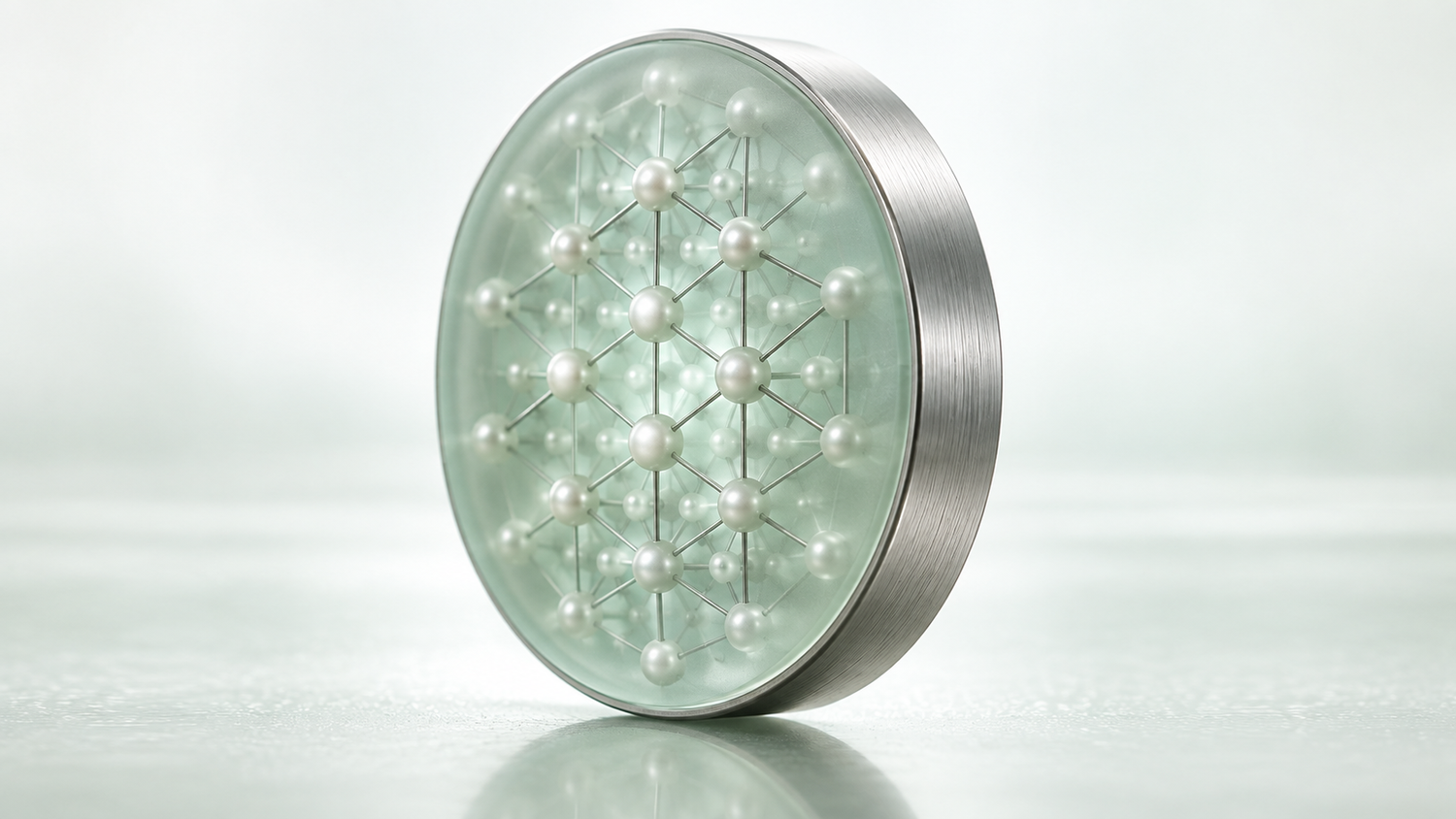
Image: an AI-generated conceptual illustration of a round tablet of frosted glass with a titanium rim, with a regular lattice of small spheres and struts visible inside it. It depicts no real product, drug or laboratory and no clinical use; it stands for the idea of a computed electronic structure inside a medicine, and the lattice shown is generic rather than any of the thirteen molecular systems in the dataset.
Sources
Primary source: Phasecraft, "Phasecraft utilizes accelerated computing to develop Quantum Computing Applications for Real World Impact," company announcement with NVIDIA, London and Toronto, 14 September 2026. Also drawn on: Evan Sheridan, Lana Mineh, Raul A. Santos and Toby Cubitt, "Enhancing density functional theory using the variational quantum eigensolver," arXiv 2402.18534, 28 February 2024; Wellcome Leap's Q4Bio program page; Ana-Maria Stanciuc in The Next Web, 14 September 2026; and Shah and colleagues, arXiv 2509.25904, 30 September 2025. The memory arithmetic and the readiness placement are this Monitor's own.