A Quantum Clinical-Data Claim Stops Before the Benchmark
Quentir Medicine Monitor
Evidence-based insights for quantum medicine. Published by Quentir Systems LLC · July 29, 2026.
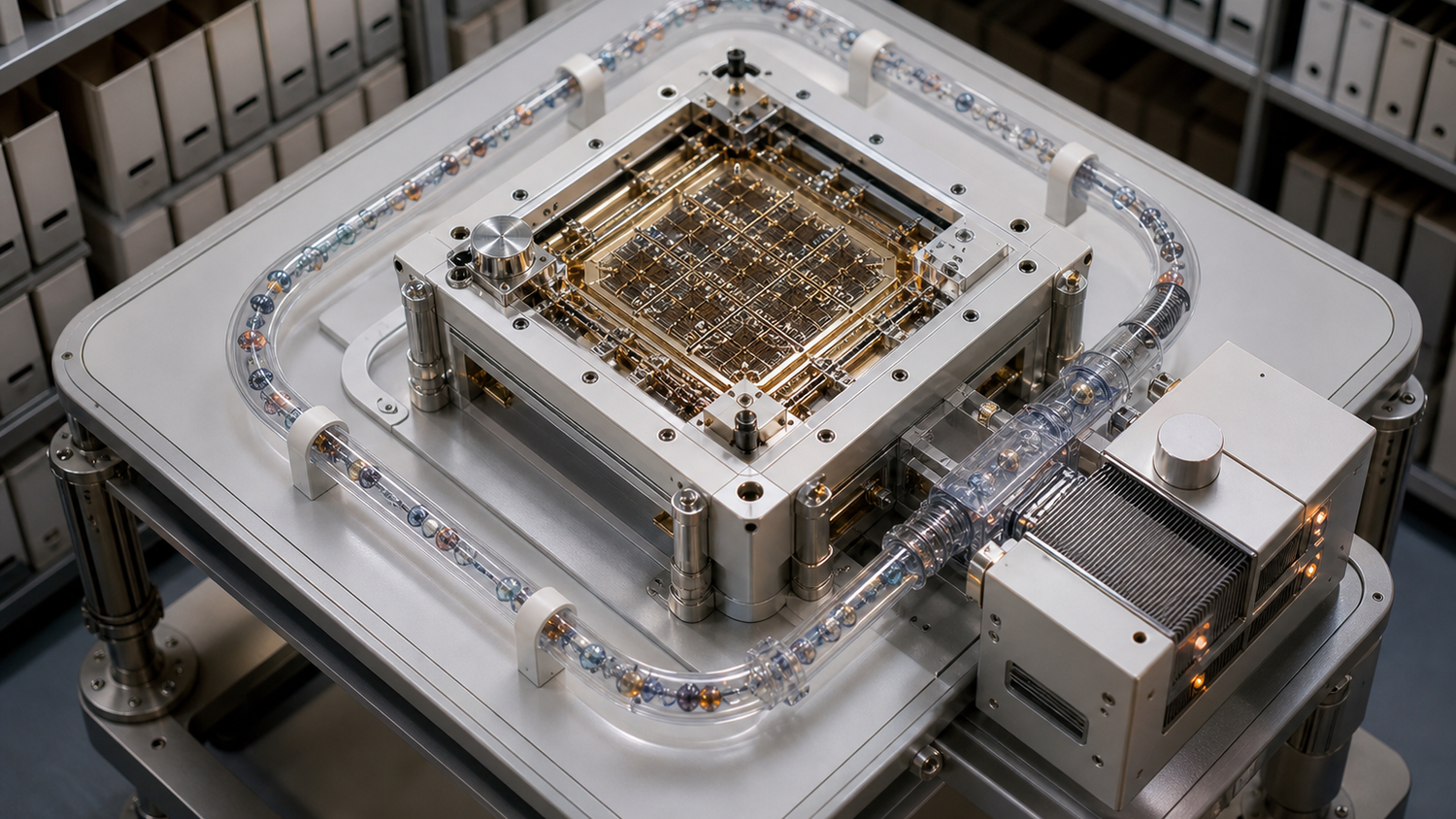
A clinical data analysis can end in a single estimate: a treatment effect, a subgroup signal, a probability of harm. Reaching that estimate often requires a sampler to travel through a complicated probability distribution. If the sampler lingers in one region or fails to discover another, a polished final number can conceal a poor journey.
NeuroThera Labs said on July 29 that it had completed internal validation of a proprietary quantum sampling workflow for continuous clinical and biomedical data. The release describes a hybrid design in which quantum dynamics propose samples and a classical acceptance step preserves the intended distribution. That is a coherent computational architecture. The public account also leaves a clear benchmark gap: it reports no dataset, system size, circuit depth, comparator, runtime, convergence diagnostic, error bar, or result from an independent team.
Practical takeaway. The announcement establishes an internally tested workflow for representing continuous distributions in a hybrid quantum-classical process. It does not establish faster, more accurate, or more clinically useful analysis than a classical method.
What the company says it validated
The July 29 company release distributed through TheNewswire describes a method for converting continuous datasets into what it calls quantum-operable energy-landscape representations. Quantum dynamics generate proposed moves through that representation. A classical acceptance mechanism then accepts or rejects each proposal so that the chain retains the target probability distribution.
This hybrid pattern has a recognizable statistical lineage. Markov chain Monte Carlo constructs a sequence of samples whose long-run distribution matches the quantity being studied. In Bayesian clinical analysis, that quantity might be a posterior distribution over a treatment effect or model parameter. The acceptance rule guards the destination. The proposal mechanism influences how efficiently the chain moves through the terrain on its way there.
NeuroThera says its implementation was developed and evaluated on an unnamed S&P 500 company's hybrid quantum-classical platform. The release calls the work an internal validation of a component in the platform's computational architecture. It does not identify the hardware, number of qubits, circuit family, dataset, clinical question, or validation protocol. No technical paper, code, or benchmark table accompanies the announcement.
Correct destination, unknown travel time
The distinction between correctness and efficiency is central here. A classical acceptance step can establish target-distribution correctness under the assumptions of the method. It cannot by itself show that the chain mixes quickly, that successive samples carry enough new information, or that a quantum proposal outperforms a strong classical proposal.
Imagine two couriers working from the same street map. Both eventually deliver to the right addresses. One takes direct routes and the other circles the same blocks. Delivery correctness says little about travel time. Samplers have analogous measures: autocorrelation, effective sample size, mixing time, wall-clock cost, sensitivity to initialization, and stability across repeated runs. Those measures become especially important when quantum execution adds queueing, calibration, noise, or data-encoding overhead.
The company's own cautionary language is unusually explicit. It says the validation was preliminary, internal, unreviewed, and not independently verified. It may fail to replicate or predict performance at commercial scale. The release also says there is no assurance of a quantum advantage over classical methods. These qualifications do useful work. They separate a functioning research component from a comparative performance claim.
The published record sets a higher comparator
A 2023 Nature paper by David Layden and colleagues gives a more complete example of quantum-enhanced Markov chain Monte Carlo. Their algorithm used a quantum processor to propose moves for sampling Boltzmann distributions of classical Ising models, while a classical computer accepted or rejected those moves. The authors reported convergence in fewer iterations than common classical MCMC alternatives on the tested instances. Simulations suggested a polynomial speedup between cubic and quartic, with the careful condition that it would need to persist at larger scales.
That paper matters here because it shows the layers a performance claim must connect. The authors named the distribution and problem instances, defined the algorithm, ran hardware experiments, compared classical alternatives, and analyzed convergence. They then used simulations to study changes across size. Even with that record, they framed the larger-scale speedup as conditional.
The literature also contains limits. In a 2024 analysis by Alev Orfi and Dries Sels, the authors found no speedup for a worst-case unstructured sampling problem under the class of unital quantum proposals they studied. Their result does not decide NeuroThera's method, whose implementation has not been disclosed. It does show why mixing efficiency depends on problem structure and proposal design. “Quantum” does not settle the comparison before the benchmark is run.
Clinical data add another validation layer
Suppose a hybrid sampler eventually beats a classical alternative on a computational test. A clinical-data claim would still need a second bridge. The representation must preserve missingness and censoring, along with correlated variables and treatment interactions. Rare subgroups and uncertainty need separate scrutiny. An efficient route through a distorted distribution would answer the wrong question quickly.
That is why the most revealing public comparison would have several columns. It would name the dataset and statistical task; report encoding and preprocessing; compare against well-tuned classical samplers; show effective sample size per unit of wall-clock time; and disclose convergence and calibration. The comparison would repeat across multiple seeds and hardware runs, with patient-subgroup results reported separately. Resource accounting would include classical preparation and post-processing as well as quantum execution.
Such a table could expose several valid outcomes. The quantum proposal might improve movement between separated modes while losing time to execution overhead. It might match classical quality without a speed gain. It might work only on a structured synthetic distribution. Any of those results would teach the field more than the word “validated” can carry by itself.
The medical boundary is already stated
NeuroThera says the platform is a research and analytics tool. The release states that it is neither a medical device nor a diagnostic, has not been reviewed or approved by Health Canada or the US Food and Drug Administration, and is not offered for clinical use. Those boundaries should remain attached to every account of the announcement.
The humane stake sits further down the development path. Clinical datasets contain the traces of real patients, including people whose conditions or demographic groups may be rare. If a future analytic tool influences trial interpretation, a failure to explore a low-probability region could contribute to a missed safety signal or an unstable subgroup estimate. Clinical validity therefore depends on the full chain from data representation to statistical output and, eventually, decision context.
Nothing in the July 29 release indicates that the platform has reached that stage. Its achievement is narrower: an internally tested method for making continuous distributions operable within a hybrid quantum-classical workflow. That is an engineering checkpoint with a public boundary, not a clinical result.
How Quentir Reads It
Quentir reads this announcement as a claim about architecture whose value now depends on comparative measurement. The hybrid form is technically legible. Quantum dynamics propose movement; a classical rule protects the target distribution. The open issue is whether that pairing produces better samples at a lower total cost on a named clinical-data problem.
The next credible disclosure would connect three records that are usually kept apart: the quantum circuit and hardware run, the statistical diagnostics of the chain, and the clinical meaning of the represented variables. A result can be sound at one layer and weak at another. Hardware novelty cannot repair a poorly mixed chain, and statistical convergence cannot repair a clinically distorted encoding.
For now, the credible comparison remains absent. NeuroThera has disclosed the mechanism at a high level and published unusually direct cautions about its limits. A benchmark with named data, classical baselines, end-to-end cost, and reproducible diagnostics would turn that mechanism into a claim other researchers can test. Until then, the announcement belongs at the architecture stage of quantum medicine.
Sources
Primary source: NeuroThera Labs Inc., company release distributed through TheNewswire, July 29, 2026. Technical context: David Layden and colleagues in Nature, July 12, 2023, and Alev Orfi and Dries Sels, arXiv, March 5, 2024.