A Surgical Simulator Enters the Real-Time Loop
Quentir Medicine Monitor
Evidence-based insights for quantum medicine. Published by Quentir Systems LLC · July 28, 2026.
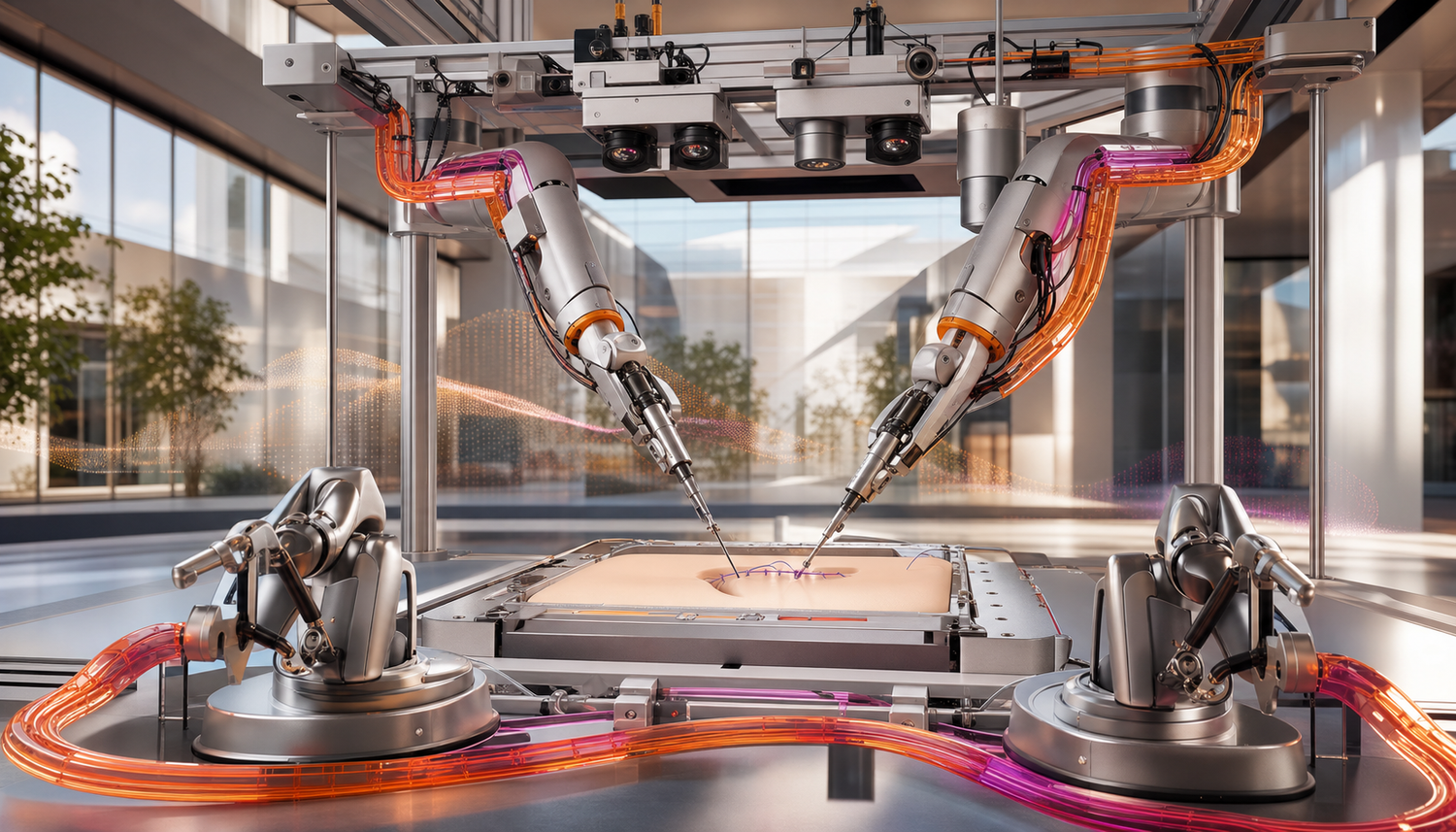
A training simulator can produce a convincing scene and still teach the wrong lesson. The decisive moment comes when an operator moves a control: does the simulated world answer with the right motion and delay while representing the deformation and failure that the physical machine would produce?
NVIDIA's newly released Cosmos-H-Dreams moves that question into real-time surgical simulation. The system accepts a live stream of robotic actions and generates the next video frames fast enough for a human or a learned policy to remain inside the loop. Its authors report roughly 160 frames per second on one RTX PRO 6000 GPU. That speed makes closed-loop evaluation possible. It leaves a harder issue open: whether the generated response is faithful enough to support conclusions about an actual surgical robot.
Practical takeaway. Cosmos-H-Dreams is an interactive research platform for tabletop suturing and rehearsal. It also supports synthetic data and robotic-policy testing. The public release does not establish clinical performance, diagnostic value, or transfer of results to a physical procedure.
A video generator begins to answer the controls
The distinction between a surgical video model and a simulator is temporal. An offline model can receive a starting frame and a planned robot trajectory, then render a possible sequence for later inspection. An interactive simulator has to accept the next action while the scene is unfolding. The July 27 technical account by Lukas Zbinden, Javier Gamazo, Mostafa Toloui, and Sean Huver describes Cosmos-H-Dreams as a causal, action-conditioned student model built for that second task.
The released checkpoint specializes in tabletop suturing with the da Vinci Research Kit. It starts with an RGB frame and a live stream of robot kinematics. Those actions are represented within a unified 44-dimensional format. The model generates 12-frame blocks and rolls them forward autoregressively, so each new block depends on the scene the system has already created. A keyboard, a Meta Quest controller, or a learned robotic policy can supply the action stream through the serving layer.
This architecture turns a recorded demonstration into an exchange. The operator moves; the model predicts the visual consequence; the next action arrives against that generated state. For surgical robotics, that loop matters because tissue and instruments change alongside sutures, smoke, reflections, or occlusion. A static clip may look credible while hiding whether the world model responds correctly to an intervention.
The speedup came from compression and streaming
The project begins with Cosmos-H-Surgical-Simulator, a bidirectional action-conditioned model trained on synchronized surgical video and robot motion. Its teacher sees a fuller temporal context. Cosmos-H-Dreams distills that teacher into a causal student that can operate from past and present information during a live rollout.
The training process first exposes the teacher to progressively longer horizons, moving from 12 to 72 frames. The student's causal warmup imitates cached teacher trajectories. Self-forcing distillation then makes the student condition on its own generated history, where small errors can accumulate. Distribution matching from the frozen teacher pulls those rollouts back toward the learned surgical-video distribution. The final student can use as few as two denoising steps per latent frame.
FlashDreams supplies the serving side: a streaming key-value cache, model compilation, CUDA Graph capture, and a lightweight decoding path. NVIDIA reports that the combined stack raises throughput from roughly 10 frames per second for standard Cosmos-H-Surgical-Simulator inference to about 160 frames per second on one RTX PRO 6000. The claim comes from the developers' own release, and the public materials do not include an independent throughput comparison. Still, the difference changes the class of experiment. A researcher can perturb the system during a rollout instead of waiting for each complete video.
Failure episodes belong inside the simulator
A simulator trained only on clean demonstrations would offer a dangerously polished world. The Cosmos-H-Dreams model card says the post-training data include successful suturing and knot tying alongside needle drops, missed throws, unsuccessful knots, and out-of-distribution episodes. It describes the dVRK material as roughly one million frames at an effective 10 Hz, with about 95 percent used for training and validation and 5 percent held out for testing.
That choice links machine learning to the older logic of professional simulation. Practice gains value when the environment can expose failure and recovery under surprise. In robotic surgery, a world model that erases a dropped needle or smooths over a missed throw could reward a policy for behavior that fails on hardware. Retaining imperfect episodes gives the model a chance to render adverse consequences, though inclusion in a dataset does not prove that each failure is reproduced accurately.
The release also gives developers access to the code, configurations, and serving workflow. That supports inspection of the pipeline and adaptation to other embodiments. Reproducible code helps researchers ask sharper questions about inputs and latency, along with model behavior. It does not supply the missing comparison between simulated and physical outcomes.
Visual realism and physical fidelity part company
A fast simulator can fail in ways that remain invisible in a short clip. A tool tip may drift a few millimeters. A gripper cycle may lag. Tissue may deform attractively while violating the response produced by the robot and material. Long rollouts may preserve local texture while gradually moving instruments into impossible positions. These errors matter because a learned policy can exploit regularities in the simulated world that disappear on the real platform.
The authors therefore call for tests that reach beyond visual quality: tool-tip reach and pose accuracy, gripper-cycle fidelity, idle stability, response to counterfactual actions, long-horizon drift, and agreement between simulated and physical policy outcomes. This proposed benchmark set is the most important part of the release. It defines model fidelity as action-response consistency across time, not a pleasing frame.
The public model card also fixes useful boundaries around the current system. Recommended image resolution is 288 by 512 pixels. The released dVRK checkpoint targets tabletop suturing. Its output is generated RGB video in 12-frame blocks. Those specifications are appropriate for research and interactive demonstration. They say little about anatomical diversity, bleeding, camera contamination, unusual patient geometry, hardware wear, or the full sequence of decisions within an operation. Each additional use would create a new transfer gap between the training environment and the intended setting.
The clinical boundary is explicit
The developers describe Cosmos-H-Dreams as a research and development platform, with interactive rehearsal among its intended uses. They reserve procedure planning, latency-aware telesurgery, and intraoperative decision support for later exploration. The current release is outside the role of a diagnostic system, intraoperative imaging replacement, or controller for a physical surgical robot.
That boundary protects the distinction between a useful engineering instrument and a clinical claim. Real-time generation can reduce dependence on scarce robotic hardware during early policy experiments. It may help teams create rare failure scenarios and compare control strategies. A surgeon's trust, a patient's safety, and a hospital's accountability depend on records that this release does not yet contain: independent physical-robot comparisons, representative procedural variation, human-factors study, and prospective clinical evaluation.
The humane stake is easy to miss because the public demo is a stream of pixels. A simulator may shape how trainees practice and how autonomous policies are selected long before it appears near a patient. Errors learned in that quieter development phase can travel forward. So can good habits of explicit scope and failure retention. Disciplined benchmark design can travel with them.
How Quentir Reads It
Quentir reads Cosmos-H-Dreams as a meaningful infrastructure release with a well-stated boundary. Its engineering contribution is latency: a distilled surgical world model can now take actions while it generates frames and accepts the next action in an interactive loop. Its medical contribution remains conditional on validation that connects generated motion to physical behavior.
The right unit of scrutiny is the simulation contract: initial scene, action representation, generated response, time horizon, and the physical outcome used as comparator. A strong benchmark should reveal where that contract holds and where it breaks. The developers' own proposed tests point in that direction, especially counterfactual action diversity and agreement between simulated and real policy outcomes.
Real time is therefore a beginning with practical consequences. It allows the simulator to be interrupted or challenged while a person or policy drives it. The next record will show whether a particular action inside that responsive world predicts what the surgical robot actually does. Until then, the most valuable fact is precise: the loop is fast enough to test, and its fidelity is still a research question.
Sources
Primary source: Lukas Zbinden, Javier Gamazo, Mostafa Toloui, and Sean Huver, Hugging Face and NVIDIA, July 27, 2026. Technical context: the NVIDIA Cosmos-H-Dreams model card and public GitHub repository, released July 23, 2026.