The Liver Biopsy’s Unmeasured Chemistry
Quentir Medicine Monitor
Evidence-based insights for quantum medicine. Published by Quentir Systems LLC · July 30, 2026.
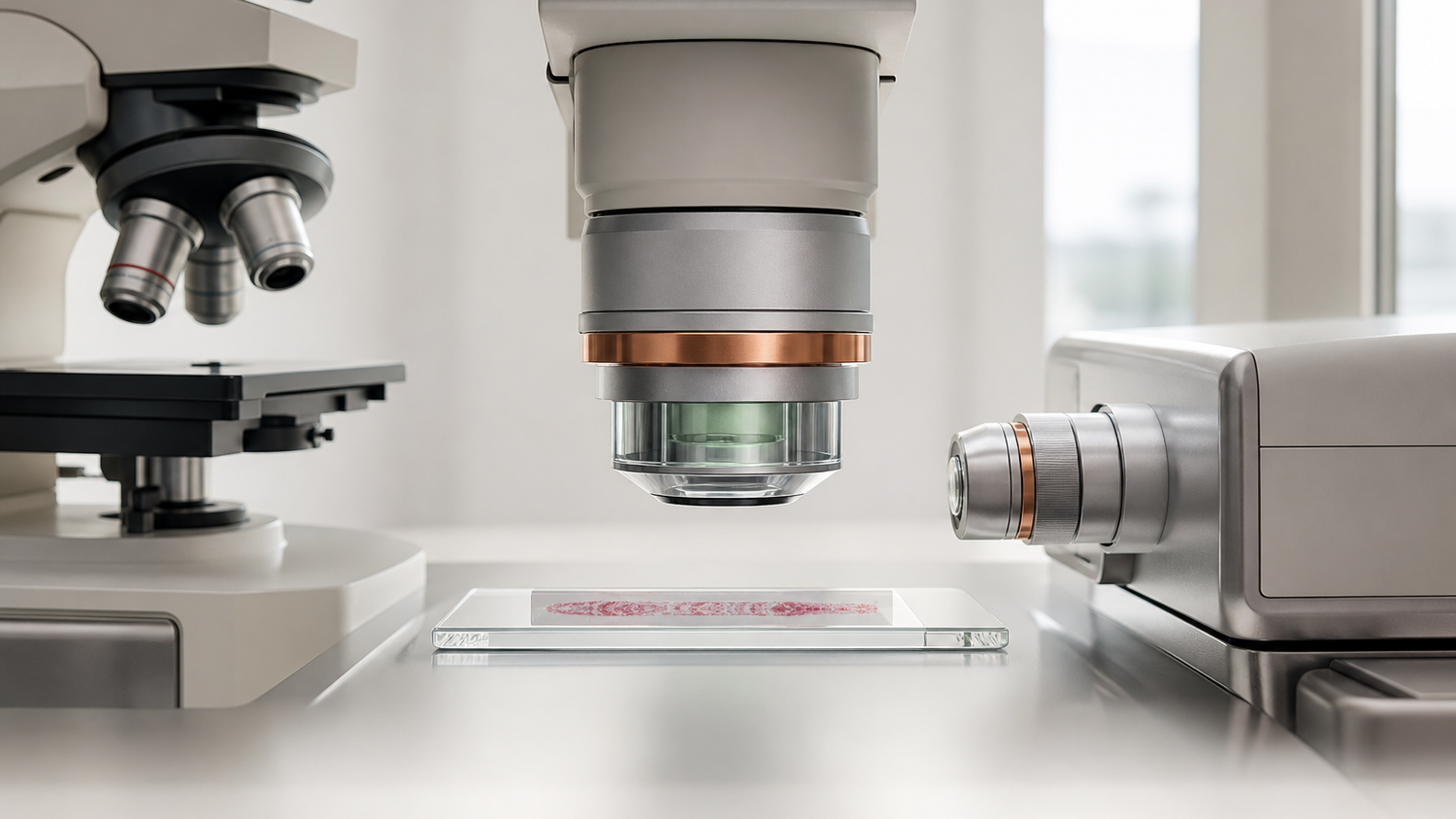
A liver biopsy can show fibrosis, inflammation and tissue architecture. It still leaves a harder question for the years ahead: which person’s disease will accelerate? A University of Nottingham team now plans to look inside the same type of specimen for a different layer of information: the magnetic signatures associated with reactive oxygen species, measured through defects in microscopic diamond particles.
The university’s July 30 announcement says the NIHR-funded project will aim to measure reactive oxygen species in routine liver biopsy samples. The proposed sensors are nitrogen-vacancy centers in diamond. The clinical ambition is to learn whether this chemical readout can become a progression signal for chronic liver disease. The release establishes a funded translational project and names its specimen, biological target and intended decision. It reports no patient cohort, completed sensor result, accuracy estimate or prospective outcome test.
Practical takeaway. The credible claim today is narrow: a multidisciplinary team will test a quantum-sensing route on routine biopsy tissue. Any claim that it predicts deterioration must wait for analytical validation and patient-linked results.
The project starts with a real clinical gap
Chronic liver disease often progresses through fibrosis toward cirrhosis, liver failure or cancer, yet the trajectory differs greatly between patients. Fibrosis staging describes damage already visible in the tissue. It does not, by itself, give every patient a reliable forecast. That gap creates a plausible place for an additional tissue measurement, provided that the added signal is reproducible and improves prediction beyond the information clinicians already possess.
The Nottingham project is led by Professor Lisa Chakrabarti, with Professor Melissa Mather, Professor Mark Fromhold and Dr Aloysious Aravinthan. It is one of 17 projects supported through the NIHR Invention for Innovation Funding At Speed of Translation opportunity. The announcement says the team will use microscopic diamond particles containing nitrogen-vacancy centers to detect tiny magnetic signals produced by free radicals in liver tissue.
A nitrogen-vacancy center is a defect in diamond where a nitrogen atom sits beside a missing carbon atom. Its spin state can be prepared and read optically, while nearby magnetic noise changes that state’s relaxation. In biological sensing, that gives researchers a route to infer fluctuating paramagnetic species close to a nanodiamond. The instrument therefore measures a physical interaction around the sensor. Turning that interaction into a specific concentration of reactive oxygen species inside prepared liver tissue requires a defined assay, calibration and controls.
Quantum pillar: sensing. Technology readiness: not applicable. The funding announcement describes a planned liver-biopsy test and reports no completed instrument result.
Earlier biopsies make the biological question concrete
The project’s biological premise has a relevant clinical history. In a 2013 Journal of Hepatology study, Aravinthan and colleagues examined 105 biopsies from 70 patients with what the paper then called non-alcohol-related fatty liver disease, alongside 60 controls. Hepatocyte expression of the cell-cycle inhibitor p21 correlated with fibrosis stage and with adverse liver-related outcome. In paired biopsies, changes in p21 expression and nuclear area moved with changes in fibrosis stage.
Those data linked features consistent with hepatocyte senescence to disease course. They did not test a diamond sensor or establish reactive oxygen species as a clinical prognostic assay. A 2024 review of ageing, reactive oxygen species and liver fibrosis describes the mechanistic connection: oxidative stress can activate senescence pathways, while senescent cells and hepatic stellate-cell responses can contribute to fibrogenesis. That literature makes the target biologically defensible. It cannot supply the missing performance data for the planned sensor.
This distinction matters because “senescence” is a cellular state inferred through a combination of features, rather than a single molecule. Reactive oxygen species are diverse and often short-lived. A signal near a diamond particle could reflect several paramagnetic contributors, specimen handling or local tissue conditions. A useful assay needs to show what physical quantity it measures and how that quantity maps to the biological construct of interest.
The measurement needs its own proof chain
The first step is quantum ROS measurement under controlled conditions. Investigators need to specify the diamond particle, microwave and optical sequence, sensing volume, acquisition time and calibration standard. Blinded repeats across sensors, operators and days would show whether the readout is stable. Orthogonal chemistry and appropriate radical-scavenger controls would help establish specificity. Limits of detection and quantification should be reported with uncertainty, rather than reduced to a positive-or-negative label.
Routine pathology material introduces a second layer. Fixation, processing, storage time, section thickness, autofluorescence and the placement of particles can all alter the measurement environment. A development set can reveal these effects. An independently handled validation set is needed to show that a signal survives real variation in specimen preparation. The comparison should include current histology and established senescence markers so that the quantum readout’s incremental contribution is visible.
The clinical claim sits further downstream. Clinical validation would link a prespecified sensor measurement to a prespecified patient outcome over time. The analysis should account for fibrosis stage, age, metabolic disease, alcohol exposure, treatment and other relevant covariates. Calibration, discrimination and decision-curve analysis would show whether adding the measurement changes risk classification in a useful way. External validation would test whether the relationship travels to another center and patient mix.
Even a statistically predictive marker has a final question to answer: does acting on it improve care? A higher-risk result might justify closer monitoring or specialist review; a lower-risk result might support a longer interval. Those pathways require prospective evaluation, because a new measurement can also create false reassurance, unnecessary follow-up and uncertain thresholds. The funded project has yet to reach that stage in the public record.
How Quentir Reads It
Quentir classifies today’s item as a project announcement with a checkable technical proposition: nitrogen-vacancy sensing will be tested on routine liver-biopsy tissue for reactive-oxygen-species signals associated with disease progression. The proposition is more specific than a generic quantum-health ambition. It names the sensor class, specimen, analyte family and proposed clinical use.
The readiness line remains “not applicable” because the shared ladder assigns that value to a plan without a result of its own. A completed laboratory assay would enter the ladder only when the team reports the setup, samples, controls and measurements. Realistic biopsy testing, reproducible analytical performance, external patient validation and clinical utility are separate advances. The central question for the next public result is simple: what did the diamond measurement add beyond the biopsy information already in hand?
Sources
Primary source: University of Nottingham, ‘Nottingham scientists awarded funding to develop quantum sensing technology that could predict liver disease severity,’ July 30, 2026. Technical context: Aravinthan et al., Journal of Hepatology, March 2013, and Almalki and Almujri, Biogerontology, November 15, 2024.