The Quiet Defect Inside a Noisy Diamond
Quentir Medicine Monitor
Evidence-based insights for quantum medicine. Published by Quentir Systems LLC · August 2, 2026.
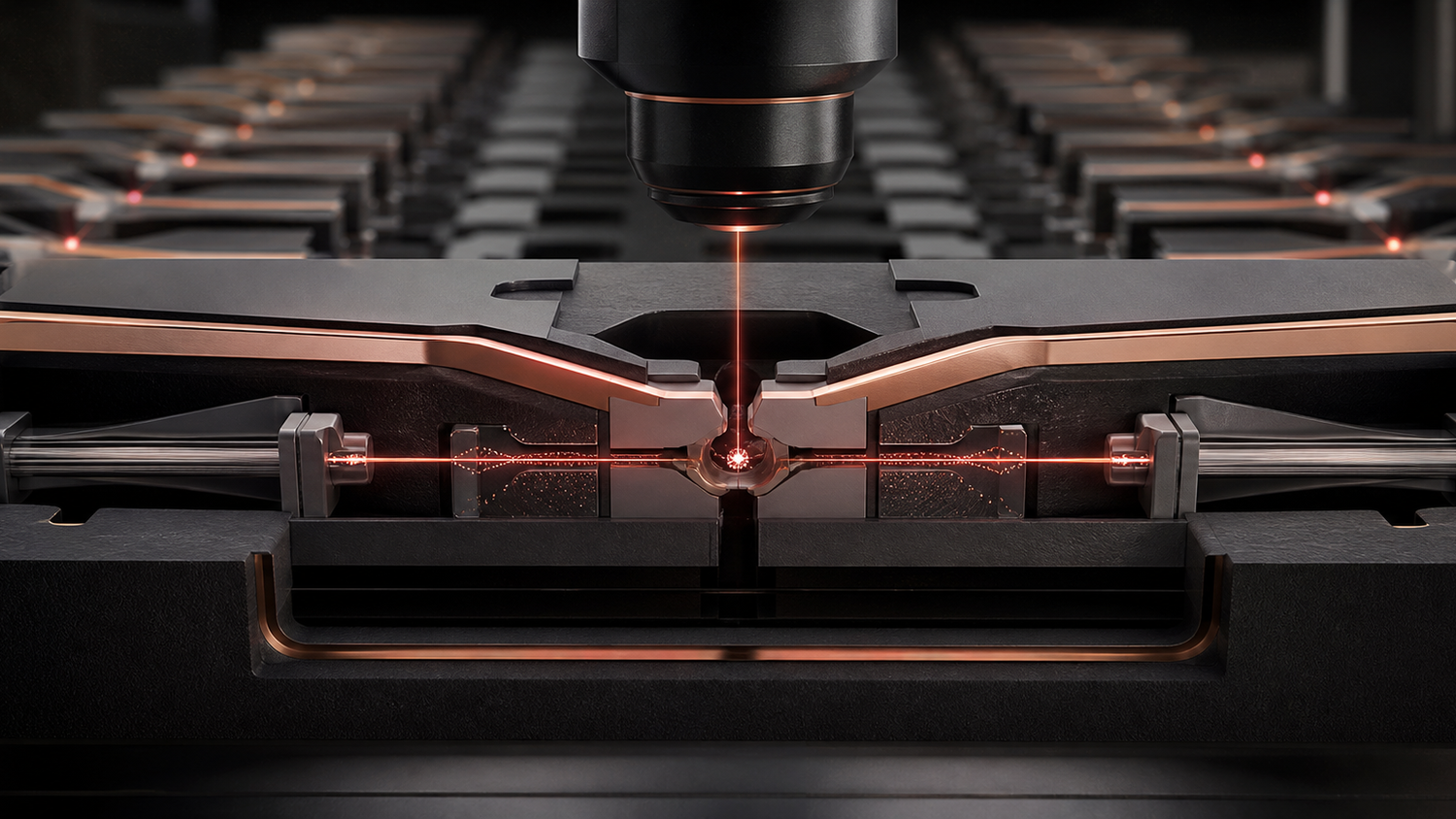
At room temperature, a diamond is not still. Its lattice vibrates, and those vibrations can smear the frequency of light from an atom-sized defect that researchers want to use as a quantum emitter. A team led from the University of Illinois has now measured a defect that remains unusually quiet inside that motion.
The researchers call it the IL1 color center. In nanodiamonds, it produced bright, narrow single-photon light while coupling only weakly to the broad vibration spectrum of the surrounding crystal. The result gives solid-state quantum sensing a promising materials candidate. It does not yet give medicine a sensor.
That distinction matters. The paper concerns the behavior of a light-emitting defect under laboratory measurement. No biological sample, analyte, patient, diagnostic task, or clinical workflow appears in the experiment. The medical interest lies in an engineering constraint the work may ease: whether a quantum optical component can retain a clean signal at ordinary temperature.
Practical takeaway. IL1 is a room-temperature materials result with a plausible sensing path. A medical claim must wait for an integrated device tested in realistic samples, with a defined biological target and comparative performance.
A defect with an unusually clean optical voice
A color center is a local irregularity in a crystal. It can behave like an artificial atom, absorbing and emitting light at characteristic frequencies. Some color centers can generate single photons, a useful property for quantum networks and extremely small-scale measurements. Their optical behavior is often disturbed by phonons, the quantized vibrations of the solid around them.
In the Nature Communications paper published June 26, Swetapadma Sahoo and colleagues report room-temperature emission with linewidths down to 0.3 nanometers. At saturation, the observed brightness exceeded 10 million counts per second. The broad phonon sideband that commonly accompanies a solid-state emitter was almost entirely suppressed. A narrow line and high count rate can improve optical readout. They do not establish field sensitivity or biological selectivity.
The remaining interaction had a different shape. IL1 coupled strongly to a single localized vibration whose energy sat outside the ordinary diamond phonon band. The authors' measurements and simulations point to a radiative orbital transition that is largely decoupled from the bulk crystal while retaining this one local mode. That combination explains the title of the finding more accurately than a generic claim about a better diamond: the defect does not silence the lattice; it avoids listening to most of it.
Quantum pillar: sensing. Technology readiness: TRL 3 of 9. The emitter was observed on real nanodiamonds under laboratory measurement, while no integrated sensor, biological specimen, or clinical task was tested.
The room-temperature result changes the engineering problem
Temperature is part of every quantum-device architecture. Cooling can add bulk and power demand, together with cryogenic hardware and specialized maintenance. A phenomenon that survives at room temperature does not erase those costs across a whole system. It can remove them from one component and change which system designs deserve further work.
The IL1 measurement is useful because it combines several traits in the same defect: narrow optical output, high brightness, single-photon behavior, and broad decoupling from lattice vibrations. The team did not merely infer the emitter from a calculated structure. It observed individual centers in nanodiamonds and measured their spectra under ordinary laboratory temperature.
The University of Illinois account published July 8 places the finding in a wider program of quantum networks and nanoscale sensing. It also records the open questions. The researchers still need to establish control over the defect's spin and charge, test whether it can support a useful quantum memory, and test whether similar defects can be engineered in other materials. Those are central functions for a device. Bright light alone cannot substitute for them.
A medical sensor still needs a target
Medicine enters this story through the temperature budget. Living samples and pathology benches operate far from the cryogenic settings used by many quantum experiments. The same is true of surgical instruments and bedside devices. A defect that retains a clean optical signature while warm could make packaging easier and bring sensing hardware closer to conventional laboratory equipment.
The path remains long because medical sensing asks different questions from emitter physics. What quantity will the device measure: magnetic field, temperature, electric field, molecular binding, or another local change? How selective is that quantity for the biological process of interest? Can the nanodiamond be positioned reproducibly, and can its surface be made compatible with the sample? Does the signal remain stable across fabrication batches and ordinary instrument drift?
None of those questions weakens the physics result. They define the additional result medicine needs. An optical emitter can be excellent on its own terms and still fail as a clinical component because the surrounding chemistry, packaging, or readout introduces more variation than the signal can bear. The humane stake appears at that boundary: a smaller sensor has value only when its measurement can be tied to a decision about a specimen, a disease process, or care.
How Quentir Reads It
Quentir reads IL1 as a credible experimental proof of concept for a new diamond quantum emitter. The claim is unusually inspectable. The authors report a peer-reviewed material, room-temperature spectra, linewidth, brightness, sideband suppression, and a physical model for the localized vibrational mode. They do not report a medical assay or a finished sensing platform.
The original connection is architectural. Much of quantum medicine is discussed as an algorithm problem, yet the distance to practice can be set by thermal hardware. A component that relaxes cooling requirements may matter before a dramatic gain in raw sensitivity, because it changes where a device can be built, who can maintain it, and which samples can reach it without an elaborate interface.
The next decisive record will pair the emitter with a controlled degree of freedom and a defined sensing task. Comparative testing against established diamond color centers should then show whether IL1's optical cleanliness survives fabrication and surface treatment. Repeated calibration with realistic samples can test whether the gain holds. Until that work exists, the quiet defect is a materials discovery with medical potential held in reserve.
Sources
Primary source: Sahoo et al., Nature Communications, June 26, 2026. Institutional context: University of Illinois ECE, July 8, 2026.