The Sleep Study Still Has More to Say
Quentir Medicine Monitor
Evidence-based insights for quantum medicine. Published by Quentir Systems LLC · August 3, 2026.
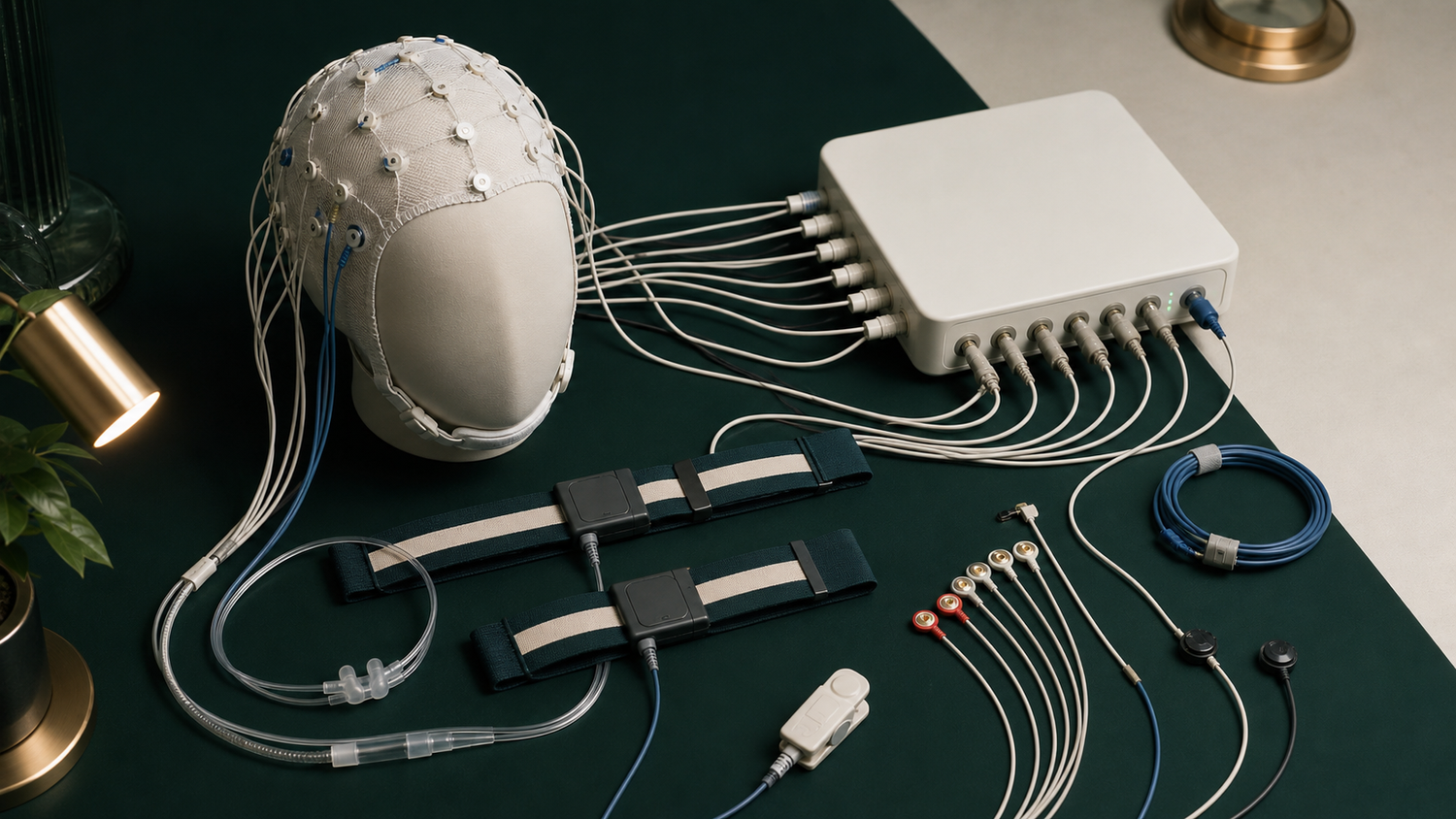
An overnight sleep study records a body in motion while the patient lies still. Brain waves, eye movements, muscle tone, breathing, oxygen levels, heart rhythm and body position produce hours of dense sleep physiology. Clinical interpretation often compresses that night into a few summary measures.
A new foundation model suggests that the compression leaves useful structure behind. The source registry began with 10,000 clinical sleep recordings linked to electronic medical records. After preprocessing and data splits, 9,203 studies formed the model's training set. The model identified five risk groups with different trajectories for mortality, cardiovascular disease, and neurological disease. The highest-risk group had more than twice the mortality risk of the lowest group.
The study is a serious result in medical artificial intelligence, published in Nature Communications on August 3. It also offers a useful boundary for quantum medicine. The team came together through the Cleveland Clinic–IBM Discovery Accelerator, a program spanning AI and quantum computing, yet this particular work used classical AI. The partnership label and the technology in the experiment are different facts.
Practical takeaway. The model found prognostic structure in data that sleep laboratories already collect. Prospective testing must show whether those risk groups improve a clinical decision before hospitals treat them as a new use for polysomnography.
A whole night becomes a handful of measures
Polysomnography is the standard laboratory test for sleep disorders. It combines several physiological channels across an entire night. For sleep apnea, one familiar output is the apnea–hypopnea index, or AHI, which counts breathing interruptions per hour and sorts them into severity bands.
AHI is clinically established, but it describes one part of a complex recording. Two patients with similar counts can differ in oxygen burden and autonomic response. Sleep-stage disruption, heart rhythm and long-term health may differ too. A single index can be useful while remaining incomplete.
In the peer-reviewed study, Erhan Bilal and colleagues trained a transformer-based foundation model on the Cleveland Clinic STARLIT registry. The model converted full-night time series into high-dimensional representations, then clustering revealed five groups. Risk rose across those groups in a monotonic pattern for several outcomes. Conventional AHI severity categories showed limited prognostic value in the same analysis.
The cohort accounting matters. STARLIT originally held 10,000 polysomnograms from 9,661 patients. After preprocessing, 9,608 studies remained for clustering. The authors used 9,203 studies to train the foundation model, while reserving separate validation and test sets.
This is a better comparison than a headline contest between AI and a clinician. The model and AHI answer different questions. AHI helps characterize sleep-disordered breathing. The learned representation searches across many channels for patterns associated with future outcomes. The study asks whether the recording contains more prognostic information than the familiar summary preserves.
Quantum pillar: not applicable. Technology readiness: not applicable. This monitored study uses classical artificial intelligence on existing sleep recordings and contains no quantum computation, quantum sensor, simulation, or network.
Five clusters are associations, not care pathways
The strongest finding is the separation between groups. The highest-risk group showed more than double the mortality risk of the lowest group. The groups also differed in cardiovascular, neurological, and psychiatric outcomes after adjustment for age, gender, body mass index, and outcome-specific comorbidities. The paper reports confidence intervals and statistical tests for these associations.
Several limitations remain material. The outcome models did not receive a multiple-comparison adjustment. Objective positive-airway-pressure adherence was unavailable, medication use was not recorded systematically, and ICD-10-based outcomes can be misclassified despite clinician review. Residual confounding remains possible. These qualifications narrow the result to retrospective risk stratification.
External validation matters here. The researchers applied the framework to the independent Sleep Heart Health Study, a population-based cohort collected with lower-resolution data. The model still distinguished higher- and lower-risk patients. That reduces the chance that the clusters merely encode one hospital's equipment or documentation habits.
It does not settle generalizability. The UW Medicine account published the same day points to prospective studies, while the paper calls for replication in additional cohorts and prospective clinical trials. The current analysis is retrospective. It links recorded physiology to later outcomes; it does not show that giving a clinician the risk group changes treatment, referral, monitoring, or survival.
Clustering also creates a translation problem. A group can be statistically stable and clinically awkward. A physician needs to know which signals drive placement, whether modifiable conditions explain them, how often a patient changes groups, and what action follows. If the answer is simply “closer follow-up,” the benefit must still be weighed against false alarms and workload. Anxiety and unequal access to specialty care belong in that assessment too.
The hidden asset is data already collected
The operational appeal lies in reuse. UW Medicine estimates that American sleep laboratories perform between one million and four million studies each year. These records already contain synchronized signals from the brain and heart, together with the lungs and muscles. A new analysis layer could extract additional information without adding another night in the laboratory.
That prospect changes the hospital-buyer question. Acquisition cost is only one part of adoption. Older recordings vary by sensor set and sampling frequency. Montage and scoring practice vary as well, and storage formats add another source of difference. A model trained on one registry must remain reliable across those conditions. Data retention rules and consent language may also limit retrospective reuse, especially when a test ordered for apnea becomes a tool for broader mortality or neurological risk stratification.
There is a humane reason to be exact. A sleep study is burdensome for many patients. It can involve unfamiliar sensors, a strange room, disrupted rest, and a long wait for interpretation. Finding more value in the same night could reduce repeated testing and surface risk earlier. A poorly calibrated secondary analysis could also give a person an alarming label whose clinical meaning remains uncertain.
The model therefore sits at an unusual point in medical innovation. Its raw material is routine care, its output is a research-defined risk group, and its proposed value depends on a decision pathway that has not yet been tested. The distance from retrospective association to bedside use is organizational as well as statistical.
The quantum label needs its own accounting
The Discovery Accelerator is a ten-year Cleveland Clinic–IBM partnership that explicitly covers AI and quantum computing in life sciences. That institutional context explains why this study belongs on a quantum-medicine watch surface. It does not turn a transformer model into a quantum method.
The support relationship is part of the record. IBM Research scientists are among the authors, and several authors disclosed support from the Cleveland Clinic–IBM Discovery Accelerator. The National Heart, Lung, and Blood Institute supported other members of the team and the external Sleep Heart Health Study infrastructure. Institutional participation does not weaken the findings by itself; it should remain visible when the same partnership supplies the public quantum-and-AI frame.
This distinction protects both fields. Classical AI can produce a clinically interesting result without quantum hardware. Quantum medicine gains credibility when each monitored claim names the actual pillar in use. The honest classification today is “not applicable,” even though the sponsoring program includes quantum research elsewhere.
The separation also reveals where quantum technology could enter later. Quantum sensors might change what physiology a sleep study can measure. Quantum computing or simulation might eventually support a different analytic method. Neither appears in this paper. The current contribution comes from learning a richer representation of conventional physiological signals.
How Quentir Reads It
Quentir reads the study as a well-specified retrospective demonstration with a meaningful external validation. The authors disclose the cohort and model architecture, along with the clustering approach and outcomes. They also report adjustments and limits. The result deserves attention because it recovers a clinically relevant pattern from an established test rather than inventing a new data source.
The more interesting connection is institutional. Health systems often speak about advanced AI as a procurement of new capability. This paper points toward a second route: old clinical instruments may already produce richer records than current workflows use. The innovation challenge then moves into data quality, interpretation, consent, validation, and the design of a decision pathway.
The next decisive study will be prospective. It will assign the risk output a defined place in care, measure how clinicians respond, and test whether patients benefit across hospitals and populations. Until then, the sleep study has more to say, and medicine still has to decide how much of that message it can safely use.
Sources
Primary source: Bilal et al., Nature Communications, August 3, 2026. Clinical and institutional context: UW Medicine, August 3, 2026.