The Quiet Defect Inside a Noisy Diamond
A diamond defect can have a cleaner optical voice
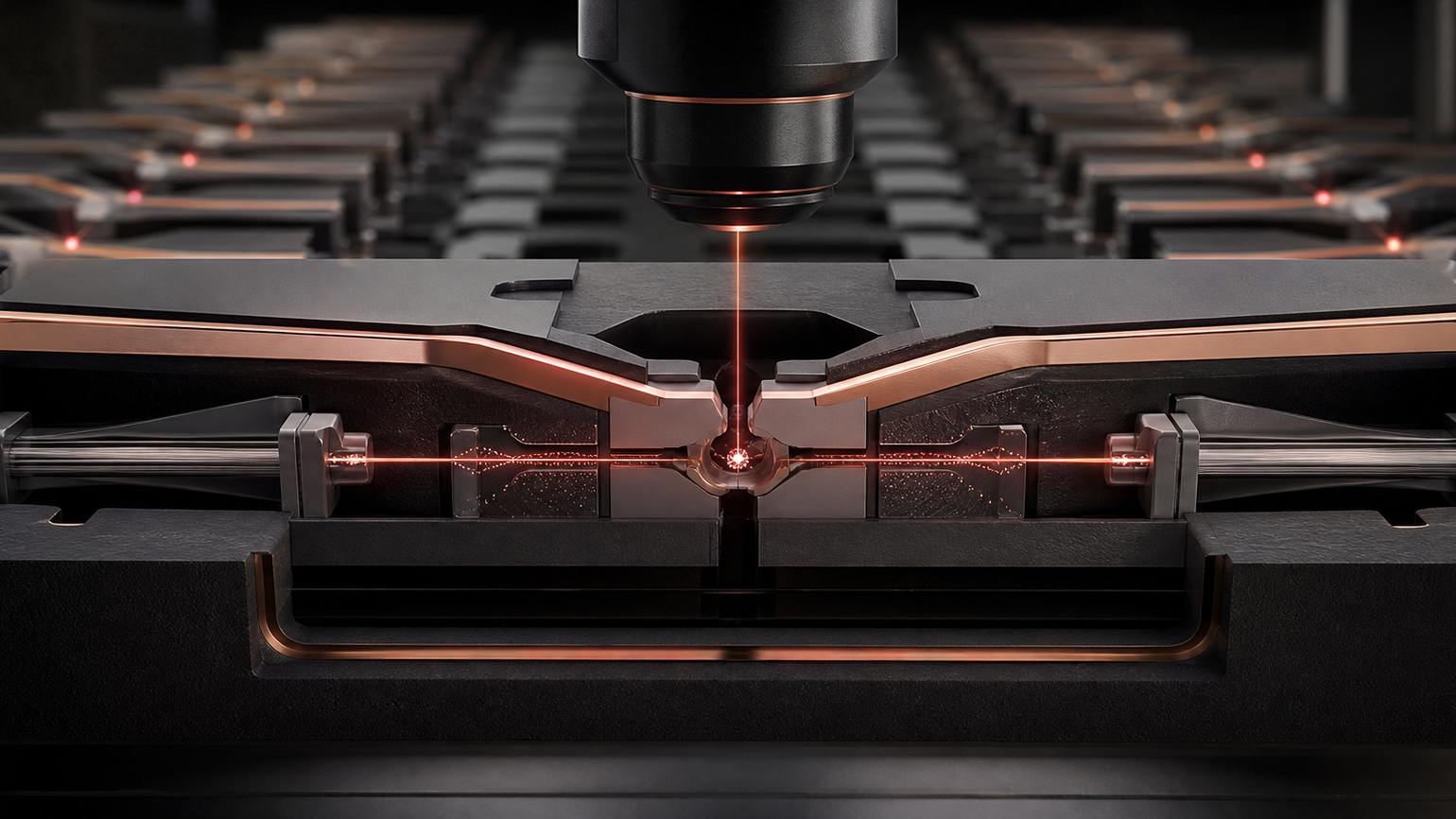
At room temperature, vibrations in a diamond lattice usually disturb the light emitted by an atom-sized defect. A research team led from the University of Illinois has reported a newly identified IL1 color center in nanodiamonds that behaves differently. The peer-reviewed paper describes single-photon emission with linewidths down to 0.3 nanometers at room temperature and brightness above 10 million counts per second at saturation. The usual broad phonon sideband was almost entirely suppressed. Instead, the emitter coupled mainly to one localized vibrational mode outside the diamond phonon band.
The result changes one engineering constraint
That combination matters because many solid-state quantum emitters pay a heavy thermal price for optical coherence. The IL1 result shows room-temperature emission from a real material under laboratory measurement. It does not yet show a complete sensor. The paper reports no controlled spin state, stable charge protocol, integrated readout package, biological sample, analyte, patient cohort, or clinical task. The authors themselves identify spin and charge control, quantum memory, and engineered versions of the defect as future questions.
Medicine enters through the temperature budget
Medical sensing often has to meet living tissue, routine laboratory workflows, or compact instruments at ordinary temperatures. A quantum component that preserves a narrow optical signal without deep cooling could eventually reduce one obstacle between materials physics and a usable device. Sensitivity, selectivity, calibration, biocompatibility, fabrication yield, and reproducibility remain separate problems.
Quentir reads IL1 as an experimental materials result with a credible sensing path and a still-open medical case. Its value today is precise: the team found an unusual way for an emitter to remain optically clean while the surrounding crystal vibrates. The next useful milestones are an integrated sensor, a defined target, comparison with existing diamond defects, and testing in the kind of sample the intended medical job actually involves.