SpinQ and DIVBIO Add a Five-Qubit Circuit to GLP-1 Receptor Potency Prediction: What the arXiv Study of 9 October 2026 Shows
Quentir Medicine Monitor
Evidence-based insights for quantum medicine. Published by Quentir Systems LLC · October 14, 2026.
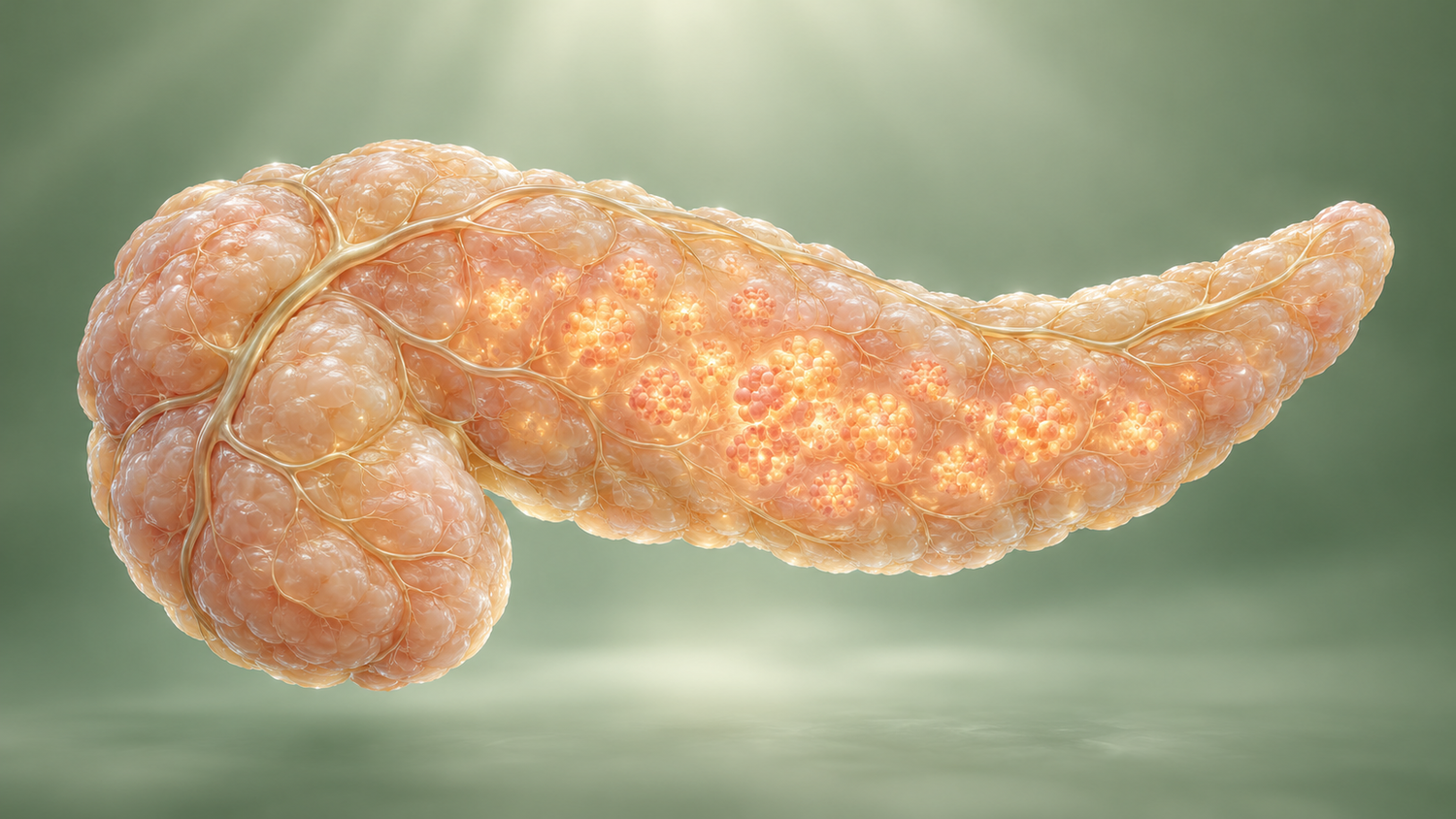
Researchers at the Shenzhen quantum computing company SpinQ Technology and the Shenzhen drug developer DIVBIO Pharmaceutical report that a small simulated quantum circuit, bolted onto a conventional neural network, makes slightly better predictions of how strongly candidate molecules switch on the GLP-1 receptor. That receptor is the target of the drug class now used widely for type 2 diabetes and weight management, so even modest gains in early compound triage attract attention.
The preprint, posted to arXiv on 9 October 2026 by Chenyan Jia, Yaping Ma, Yuen Wang and Cong Guo, tests what the authors call a quantum-circuit residual head: a five-qubit circuit that adds a correction on top of an ordinary linear prediction. Its subject is potency prediction, the task of estimating from a molecule's structure the concentration at which it produces half of its maximal effect in a laboratory assay. The study also includes a careful classical control, and that control shapes how the result should be read.
The full paper, its 19 pages of supporting information and the abstract are open on arXiv under identifier 2610.13037. It has not yet been peer reviewed.
Which data SpinQ and DIVBIO used: 1,052 GLP-1 receptor compounds from ChEMBL 37
The team drew its measurements from release 37 of ChEMBL, the open bioactivity database run by EMBL's European Bioinformatics Institute. They kept only records for the human receptor that measured cAMP, the signalling molecule a cell produces when the GLP-1 receptor is activated, and that reported an exact EC50 value. After removing flagged and duplicate entries and merging repeat measurements of the same structure by their median, the GLP-1 receptor set held 1,052 compounds, of which 472 were small molecules and 580 were peptides under the authors' grouping rule, which counts amide bonds.
Two further receptors served as checks. The beta-2 adrenergic receptor (ADRB2) set held 829 compounds, 711 of them small molecules, and the melanocortin-4 receptor (MC4R) set held 767. Both receptors are established drug targets, the first in asthma and the second in rare genetic forms of obesity.
The authors point out a limitation of public potency data. A single cAMP potency value merges measurements taken in different laboratories under different assay conditions, so part of the error any model shows reflects noise in the labels themselves.
How the five-qubit residual head works, and how it was tested
Each model has three parts trained together. A classical encoder, either a multilayer perceptron reading molecular fingerprints or a graph neural network reading the molecule's atom-and-bond structure, turns a compound into a compact numerical description. A simple linear head makes the base prediction from that description. The quantum head then reads the same description, loads it into five qubits, applies two layers of trainable rotations linked by a ring of CNOT gates, and measures each qubit. A weighted sum of those five readings is added to the base prediction. The quantum head has 36 trainable parameters.
No quantum computer was used. The circuit was computed exactly by state-vector simulation in PyTorch on ordinary hardware, which is practical at five qubits.
Quantum pillar: computing. Technology readiness: TRL 2 of 9. The quantum circuit exists only as a computer simulation trained on historical laboratory measurements; it has not run on quantum hardware, and no new compound has been made or tested on the strength of its predictions.
What the GLP-1 receptor results show under random and structure-group splits
The team tested every model in two ways. A random split scatters compounds across training and test sets, so close chemical relatives of a test molecule are usually in training. A structure-group split keeps clusters of closely related molecules together, so any two compounds with a structural similarity of 0.90 or more on the standard Tanimoto measure land on the same side. The second test is harder. The authors still list validation on independent chemical series as future work.
Under the structure-group split, adding the quantum head lowered the mean absolute error from 0.677 to 0.639 log units with the fingerprint encoder and from 0.680 to 0.641 with the graph encoder, averaged over five training runs. The quantum head beat its own base model in every training run in all four encoder and split combinations. It also beat a classical residual head built as a small neural network with 69 parameters. Both base models were already more accurate than a tuned version of Chemprop, the widely used open-source molecular property package from MIT, which the authors included as a domain reference.
The size of the gain deserves a plain reading. Average error fell by about 0.04 log units, roughly six percent relative to the base models. Whether that improves how candidates are ranked, or changes which compounds a team chooses to make, is a question the paper does not test.
Why a classical control with the same 36 parameters matters for the quantum claim
The most useful part of the paper is a test many quantum machine learning studies skip. The authors show mathematically that their five-qubit head computes a constrained quadratic function of the encoder's output. They then built purely classical heads of the same kind, including a real-orthogonal control with exactly 36 trainable parameters, and trained them the same way.
The classical control came close. Under the random split, its error was effectively the same as the quantum head's. Under the structure-group split, the quantum head was ahead by 0.020 log units with the fingerprint encoder and by 0.008 with the graph encoder. On the beta-2 adrenergic and melanocortin-4 receptors, the two heads traded places depending on the setting. The authors conclude that structured quadratic interactions between features may account for some of the gain.
For a reader assessing quantum claims in drug discovery, this is the right question to ask of any hybrid model. The Monitor raised a similar point in its reading of a quantum attention model tested on Merck's Alzheimer's candidate verubecestat: a gain from a quantum layer means most when a classical model of the same shape and size has been given the same chance.
What happens when simulated hardware noise is added
Because real quantum processors are noisy, the supporting information adds noise to the trained circuit at five increasing levels. At the three mildest levels, the quantum head kept nearly all of its advantage. At the fourth level the advantage shrank sharply under the structure-group split and turned into a small loss against the base model under the random split, and at the strongest level the noisy quantum head did worse than the base model with no residual at all. The authors note that future hardware tests must also account for the cost of loading data into qubits and of repeated measurement, which the simulation does not charge for.
What the study means for GLP-1 drug discovery teams and hospital readers
For a pharmaceutical team, the paper offers a compact design idea that can be tried today on a laptop, because SpinQ has released code, prepared data, fixed splits and trained model weights in a public GitHub repository. The code carries the MIT license; the data derived from ChEMBL keep ChEMBL's own attribution and terms. The result also suggests that a classically computed head of the same form may capture much of the benefit without any quantum hardware.
For clinicians and hospital buyers, the distance to the bedside is long. The models rank molecules by predicted laboratory potency on a single receptor. Potency in a cell assay says nothing on its own about safety, dosing, tolerability or outcomes in patients, and no compound in this study was proposed for synthesis or testing. The authors list the next steps themselves: tests on independent chemical series, time-based splits that mimic real discovery, prospective laboratory validation and runs on quantum hardware.
Sources
Primary source: Chenyan Jia and Cong Guo (Shenzhen SpinQ Technology) with Yaping Ma and Yuen Wang (Shenzhen DIVBIO Pharmaceutical), Quantum-Circuit Residuals for Receptor Functional Potency Prediction: Predictive Gains and Quadratic Structure, arXiv 2610.13037, 9 October 2026, including its supporting information. Also drawn on: the ChEMBL database, the authors' public code repository, the Chemprop project, and the Monitor's earlier coverage of a quantum attention model for verubecestat. The readiness rating is the Monitor's editorial assessment.