Zhao, Preskill and Huang's 8 April 2026 Paper Puts a 68,000-Cell Blood Dataset Benchmark Under 60 Logical Qubits: What a Quantum Memory Advantage Means for Hospital Genomics
Quentir Medicine Monitor
Evidence-based insights for quantum medicine.
On 8 April 2026 seven authors from Caltech, MIT, Google Quantum AI and the startup Oratomic, among them John Preskill and Hsin-Yuan Huang, posted a 144-page proof that, for a specified family of classification and dimension-reduction tasks under stated assumptions, a quantum computer of polylogarithmic size reaches a prediction performance that any classical machine would need exponentially more memory to match. The claim reached a wider readership on 11 September 2026, when WIRED Japan explained it to museum visitors as an advantage in size, not in speed.
The paper's medical test case is a genomics one. In a numerical benchmark on the expression profiles of 68,000 peripheral blood cells, the authors report that their method separates cell types and finds the main axis of variation with a calculated requirement of fewer than 60 logical qubits, where the classical methods chosen for comparison need four to six orders of magnitude more memory units. The proposed protocol draws random samples, processes each once and discards it; the benchmark reports performance and an estimated memory requirement, and it did not run that stream on a quantum machine. The advantage the authors prove is one of memory, not speed, and that distinction decides what a hospital genomics group should make of it.
Florida Atlantic's 90.26% Quantum Heart-Disease Result Came From a Simulator: the AI Paper of 21 May 2026 and the FAU Release of 27 August
Quentir Medicine Monitor
Evidence-based insights for quantum medicine.
Florida Atlantic University announced on 27 August 2026 that its engineers had built a quantum machine learning framework for heart disease prediction reaching more than 90 percent accuracy. The figure is precise and it is checkable. It is 90.26 percent, produced by a quantum support vector machine with angle encoding, averaged across five folds of a clinical file holding 918 patients.
The work behind that announcement appeared three months earlier. Muhammad Minoar Hossain, Md. Hasibul Hassan Himal and Arslan Munir published "A Comparative Study of Quantum Feature Maps and Quantum Classifiers for Heart Disease Prediction" in the MDPI journal AI on 21 May 2026, as article 180 of volume 7, under a Creative Commons license that lets anyone read the whole methods section. Section 2.6.2 of that paper states that every quantum experiment ran in a simulation-based environment rather than on a physical quantum processing unit. The university announcement does not carry that sentence, and neither does the coverage that followed it.
That difference decides what the study is evidence for. Simulated qubits establish whether an algorithm has promise in principle; a run on a physical processor establishes whether the machines that exist can deliver it, once noise, limited connectivity and readout error have had their say. Everything else in the paper holds up well under checking. Several of its numbers are more informative than the ones the announcement chose to lead with, and one of them disagrees with the paper's own abstract. The study is a careful piece of comparative work whose careful parts were the first thing lost in transmission.
Which Blood Signal Rewards a Quantum Kernel
A screening gap a blood draw might close
Annual low-dose CT screening lowers lung cancer mortality, and most of the people who qualify for it are not up to date with it. The American Cancer Society reported in June 2024 that 18.1 percent of screening-eligible US adults were up to date in 2022 survey data, which leaves the larger share of a proven survival benefit unclaimed. Blood-based tests are attractive because collection is easier to distribute and to repeat than a CT appointment. The study compares two molecular readouts, drawn from a wider field that also includes mutation panels, circulating proteins and cell-free RNA: cell-free DNA fragmentomics, which reads the length and position of circulating fragments, and methylation, which reads chemical marks at defined genomic targets. Both produce high-dimensional, nonlinear data, and both are degraded by the heterogeneity of lung cancer.
What the Cleveland Clinic and IBM Quantum preprint reports
A team from Cleveland Clinic Research and IBM Quantum posted a preprint on August 19, 2026 asking whether a quantum kernel classifies those signals better than a conventional support vector machine. The methylation cohort covered 813 individuals with 188 cancers across 56 methylation targets; the fragmentomics cohort covered 718 individuals with 172 cancers across 473 genomic regions. Features were encoded with angle and dense-angle feature maps across circuits of 10 to 20 qubits, using three entanglement patterns, and the resulting fidelity kernels fed a precomputed-kernel support vector machine and a kernel-PCA logistic regression.
A split verdict, measured in simulation
On fragmentomics the quantum-kernel models reached held-out AUC values around 81 to 82 percent against a classical baseline near 78 to 79 percent. On methylation the ordering reversed, with the classical model centered around 83 to 84 percent and the quantum models between 80 and 82.5 percent. Widening from 20 to 40 features did not reliably help. Every kernel was computed by exact statevector simulation on ordinary computers, so no quantum processor was involved, and the authors list hardware execution under finite sampling and device noise as future work. Quentir places the work at TRL 3 of 9 on the quantum computing pillar and reads the split, rather than either half of it, as the finding.
What Quantum-Inspired Buys a Federated ECG Classifier
A compact model for hospitals that cannot pool their ECGs
Hospitals, clinics and wearable makers each hold electrocardiograms they cannot simply pool, so collaborative model training moves the model instead of the data. A new preprint evaluates a hybrid quantum-inspired Kolmogorov-Arnold network for arrhythmia classification under federated averaging, where every site trains locally and transmits only model updates. Because each round's cost scales with model size, a smaller network makes the whole federation cheaper to run for every participant.
Measured savings, with clearly stated edges
On the public MIT-BIH benchmark the network used 37.35 percent fewer trainable parameters and cut communication cost by 24.89 percent; on the INCART dataset the reductions reached 44.81 and 36.41 percent, while most aggregate and minority-class metrics matched or improved on the baseline. The comparison runs against a plain multilayer perceptron on retrospective public datasets, and the federation is simulated, so the result marks a design direction rather than a clinical capability.
What the quantum label does and does not mean
The architecture borrows its learnable functions from quantum machine learning, in the form of single-qubit data re-uploading circuits, yet every calculation runs on classical computers. Quentir places this work at TRL 3 of 9 with the quantum pillar explicitly not applicable: functioning software on recorded data, no quantum processor anywhere in the loop. The honest summary is that federated ECG learning gained a smaller, cheaper collaborative classifier from quantum-derived mathematics, and the evidence record should carry it under exactly that description.
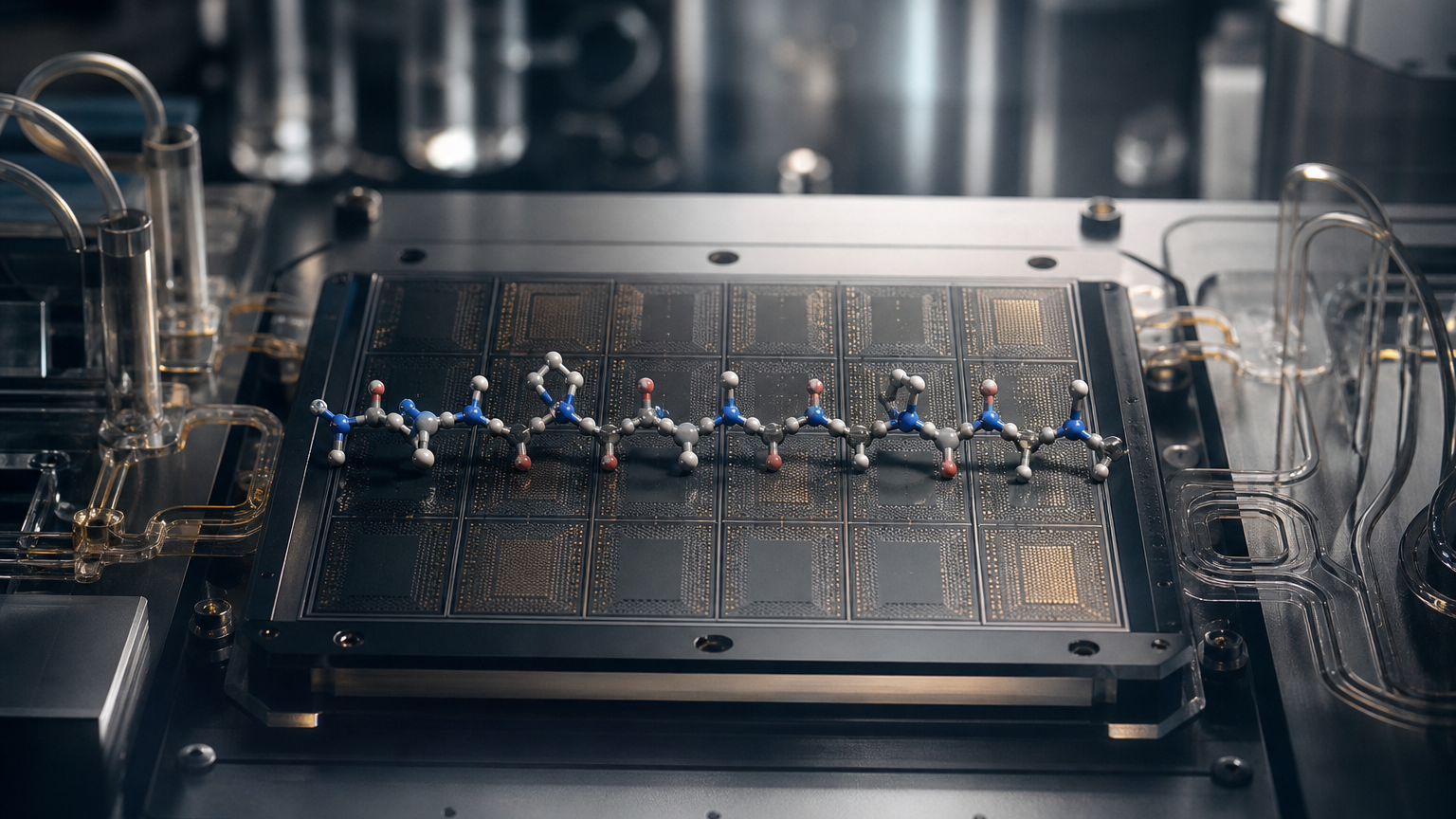
Forty-Six Qubits, One Small Cancer Dataset
What the 46-qubit result did
A cancer neoantigen may differ from an ordinary human peptide by one amino acid. The peptide must bind to a patient’s HLA molecule and then be recognized by a T cell. A Science Advances team used quantum convolutional neural networks to model those two filters and combined them in Q-CHIPP.
The largest hardware experiment represented a full nine-amino-acid peptide with 46 qubits. It used 150 training peptides and 50 test peptides, with 20,000 shots per circuit and two noise-mitigation methods. The model reached F1 0.70. The paper’s unrestricted classical network scored 0.65 and its random forest 0.66 on larger training and test splits.
The biological task is harder than binding
A peptide that binds to HLA may still provoke no T-cell response. Q-CHIPP therefore combines a binding model with an immunogenicity model trained only on confirmed binders. This design addresses a known confound: mixing binders and nonbinders can make binding performance look like immunogenicity prediction.
The patient result remains retrospective
The researchers applied Q-CHIPP to 209,889 candidate peptides from 111 people with HLA-A*02:01-positive lung cancer treated with immunotherapy. Predicted antigen burden was associated with overall survival, but the candidate peptides were not experimentally screened for immunogenicity. The study supports external biological testing, not prospective prediction for a new patient.
Does a Quantum Layer Change What a Medical AI Sees?
One layer makes the comparison unusually clean
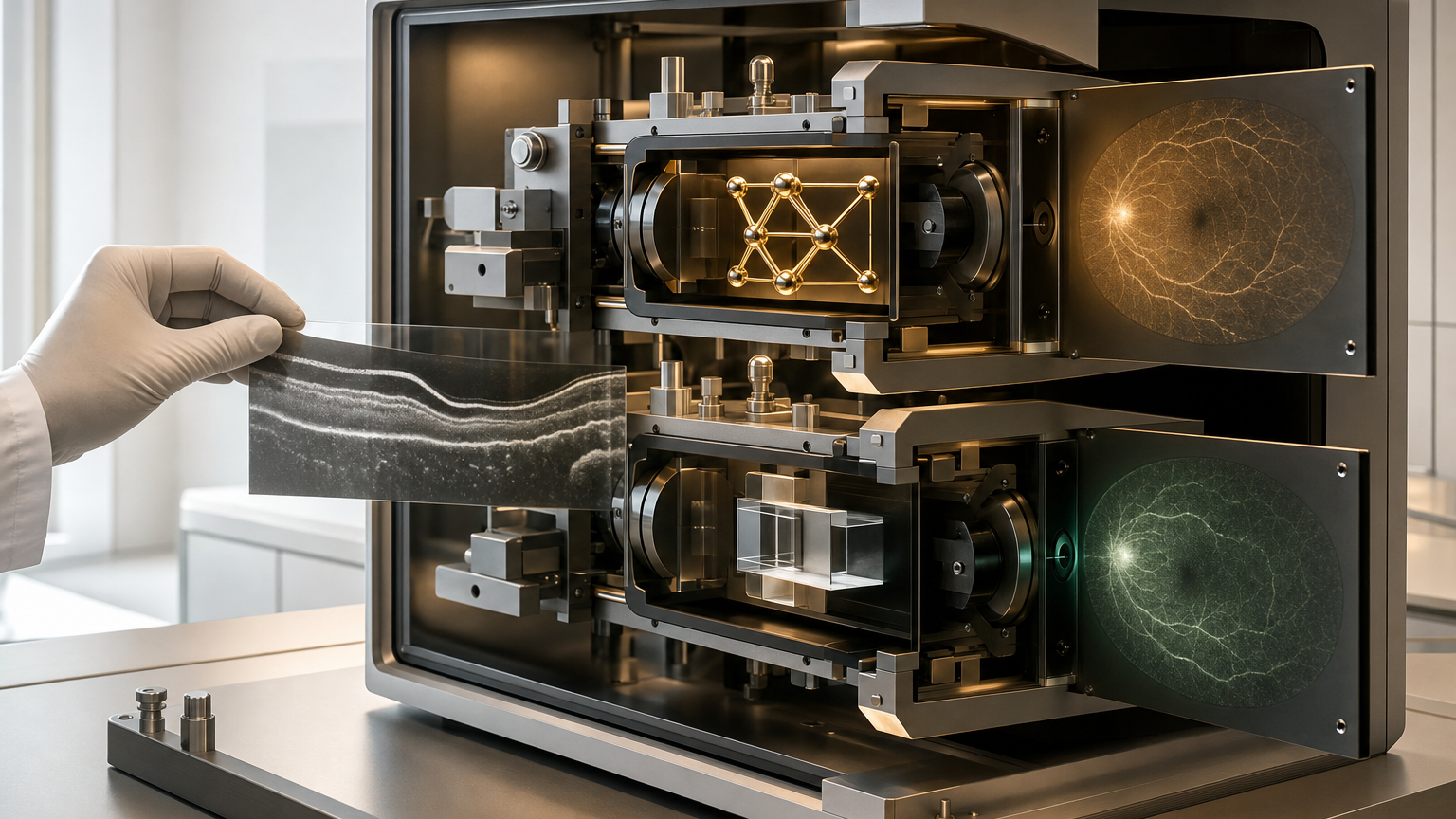
A July 2026 preprint compares two medical-image classifiers that share the same convolutional backbone and a comparable number of trainable parameters. They differ in one intermediate layer. One branch uses a dense classical layer; the other uses a four-qubit circuit emulated on a conventional computer. This parameter-matched comparison helps isolate the contribution of the circuit-shaped representation without changing the rest of the network.
The relative gain appeared between small and large datasets
The models classified retinal optical coherence tomography images, with training sets ranging from 200 to 30,000 examples. The hybrid model performed best relative to the classical comparator around 800 and 2,000 training images, an intermediate-data regime. At the largest sizes, the classical CNN moved ahead and reached the study's highest retinal test accuracy, 93.7 percent. A robustness check using two-dimensional slices from an OASIS-1 dementia MRI dataset followed the same broad pattern: the hybrid advantage narrowed with more data, then reversed slightly.
The attention maps changed with sample size
The researchers also compared SHAP attention maps, which estimate where image pixels influence a model's output. With 1,000 retinal images, the hybrid maps appeared more concentrated around retinal layers and disease-related structures, while the classical maps were more fragmented in the examples shown. At 30,000 images, the models' highlighted regions overlapped much more. These maps do not establish clinically validated biomarkers. The study includes no physical quantum-hardware run, prospective clinical test, external hospital validation, clinician reader study, or patient outcome. Its contribution is narrower and useful: a controlled account of when a small classically simulated circuit changed model performance and apparent visual focus, and when additional data favored the matched classical layer.
The Quantum Molecule Generator Hit a Chemistry Limit
A quantum generator enters the chemistry contest
A medicinal chemist can reject a proposed molecule in seconds. A model has a harder job: it must learn which structures are chemically legible, avoid repeating itself, and move toward useful properties without mistaking a score for a drug. A 2023 experiment placed a quantum molecule generator inside that contest. Researchers swapped variational quantum circuits into three parts of a molecular generative adversarial network and compared them on the QM9 dataset.
Fewer discriminator parameters, mixed chemical results
A quantum discriminator used only 50 learnable parameters, compared with about 22,000 in a deliberately reduced classical discriminator. The hybrid system containing the quantum discriminator produced 46.59 percent unique outputs among valid molecules, versus 2.08 percent for that reduced comparator, and had a better distributional-fit score. Its validity was only 31.34 percent, however, compared with 99.78 percent. Larger classical discriminators also surpassed it on uniqueness and distributional fit. In a separate goal-directed test, a quantum noise source improved mean drug-likeness and synthetic-accessibility scores, then produced far fewer valid, nonrepeated outputs. The selected objective rose as the useful range of generated chemistry narrowed.
What the benchmark can and cannot establish
The study is computational. It reports no run of the molecular generator on physical quantum hardware, no synthesized compound, no biological assay, and no drug candidate. Its contribution is architectural: different quantum components produce different bargains among parameter efficiency, property optimization, validity, uniqueness, and similarity to the training distribution. The quantum-generator variant also required roughly 3.5 days per epoch on the reported classical compute instance and struggled to generate unique and valid molecules after ten epochs.
For quantum medicine, that tradeoff matters more than the label on the model. A generator can look efficient while shifting work into chemical filtering. It can score well while returning to the same narrow family of structures. The study's lasting question is therefore precise: which chemical possibilities disappear when a quantum-assisted score improves? Better hardware will change runtime, but it will not answer that measurement question for medicinal chemists.