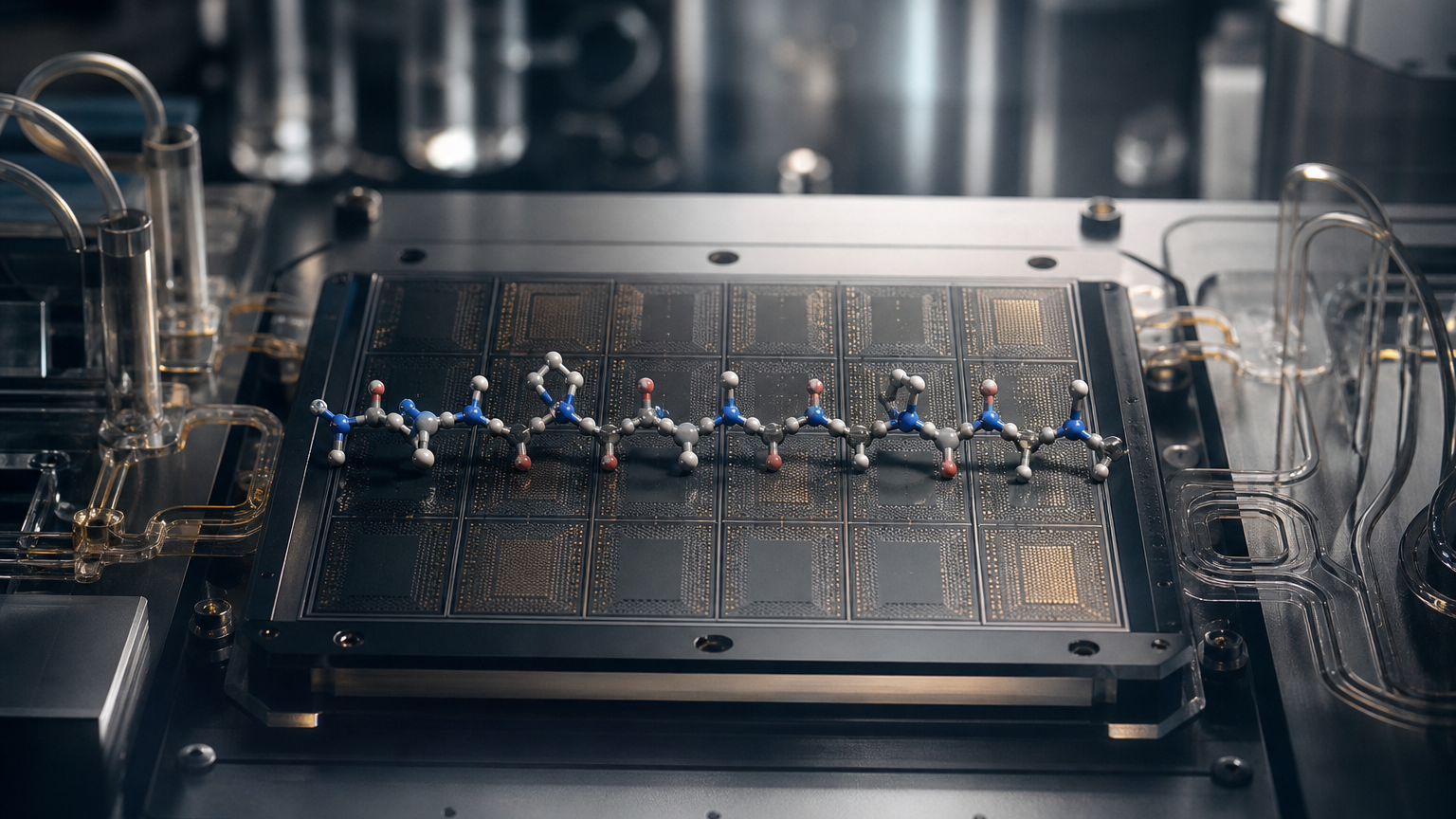
Forty-Six Qubits, One Small Cancer Dataset
What the 46-qubit result did
A cancer neoantigen may differ from an ordinary human peptide by one amino acid. The peptide must bind to a patient’s HLA molecule and then be recognized by a T cell. A Science Advances team used quantum convolutional neural networks to model those two filters and combined them in Q-CHIPP.
The largest hardware experiment represented a full nine-amino-acid peptide with 46 qubits. It used 150 training peptides and 50 test peptides, with 20,000 shots per circuit and two noise-mitigation methods. The model reached F1 0.70. The paper’s unrestricted classical network scored 0.65 and its random forest 0.66 on larger training and test splits.
The biological task is harder than binding
A peptide that binds to HLA may still provoke no T-cell response. Q-CHIPP therefore combines a binding model with an immunogenicity model trained only on confirmed binders. This design addresses a known confound: mixing binders and nonbinders can make binding performance look like immunogenicity prediction.
The patient result remains retrospective
The researchers applied Q-CHIPP to 209,889 candidate peptides from 111 people with HLA-A*02:01-positive lung cancer treated with immunotherapy. Predicted antigen burden was associated with overall survival, but the candidate peptides were not experimentally screened for immunogenicity. The study supports external biological testing, not prospective prediction for a new patient.
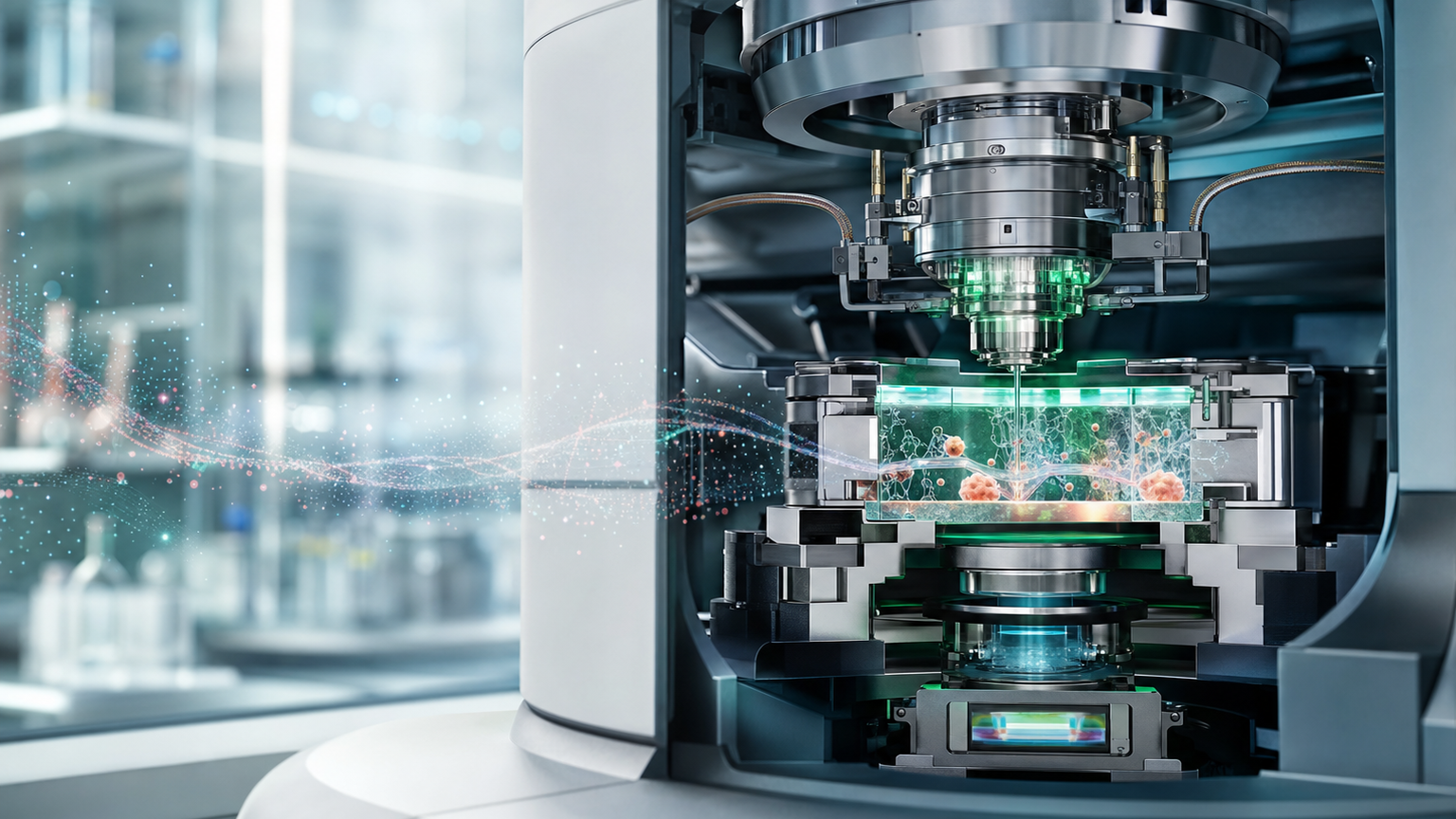
When Cancer Starves an Immune Cell, Quantum Sensors May Hear the Chemistry
Cell chemistry changes under pressure
In a solid tumor, an engineered immune cell may carry the right receptor and still lose function as nutrients disappear and suppressive metabolites accumulate. A proposed four-year project at Heriot-Watt University aims to watch that chemistry in real time. The planned platform combines single-electron sensors, optical spectroscopy, and microfluidics to follow radical activity across many cells. Its medical premise is specific: the local chemical environment may help explain why cellular immunotherapies that have changed treatment for several blood cancers remain much harder to use against solid tumors.
A diamond spin can report a local signal
The program has an experimental starting point. In a 2024 Carbon paper, Claudia Reyes-San-Martin and colleagues, including fellowship leader Aldona Mzyk, used diamond-based quantum sensing to detect free-radical signals in migrating human breast cancer cells with subcellular resolution. They observed radical formation after defined periods of starvation and low-serum migration, then changed NOX2 activity and found that the radical measurement, broader reactive-oxygen readings, and cell migration did not move together. That result makes the sensing method interesting as a mechanistic probe. It does not establish a cancer biomarker or a patient-facing diagnostic.
The next experiment moves to immune-cell failure
Heriot-Watt's December 15, 2025 announcement says the funded work will study how the tumor microenvironment disrupts immune-cell metabolism. The National Cancer Institute describes that suppressive environment as one of several barriers facing CAR T-cell therapy in solid tumors, alongside target selection and tumor variation. The proposed system could give researchers a closer view of when individual cells begin to fail and how differently cells respond under the same conditions. Important questions remain open: whether the signal is stable across instruments, whether thousands-of-cells throughput can preserve nanoscale sensitivity, and whether a radical pattern predicts later immune function. The project is best understood as a laboratory measurement program with a credible route into cancer immunology and a long clinical distance still ahead.