When Cancer Starves an Immune Cell, Quantum Sensors May Hear the Chemistry
Quentir Medicine Monitor
Evidence-based insights for quantum medicine. Published by Quentir Systems LLC · July 23, 2026.
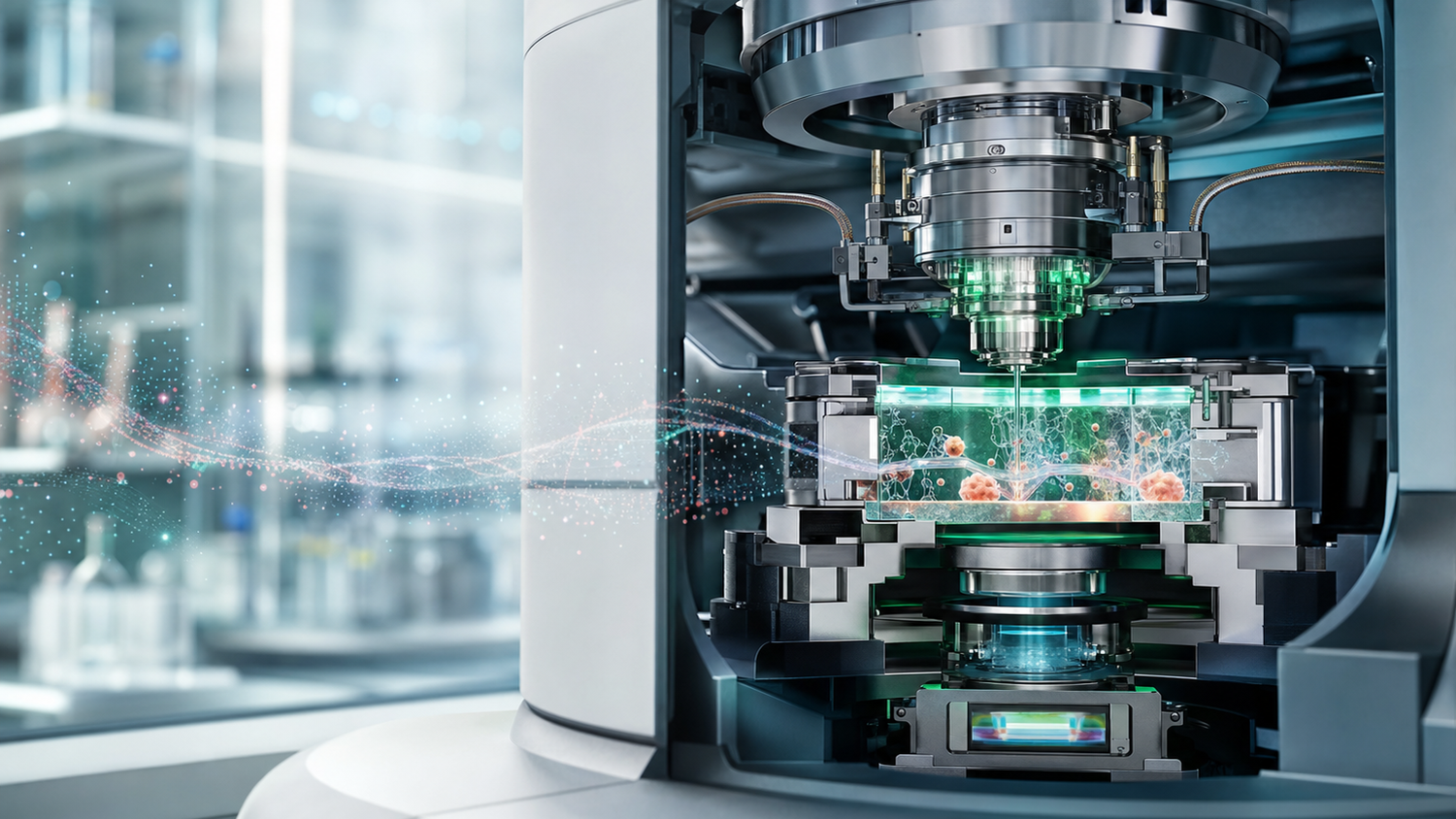
In a tumor, an immune cell can lose the chemical argument before it loses the physical fight. As nutrients disappear and metabolites accumulate, the cell's own chemistry changes; a proposed quantum-sensing project at Heriot-Watt aims to catch that shift while it is happening.
The instrument concept joins single-electron sensors with optical spectroscopy and microfluidics. Its target is a stream of free-radical signals that may reveal how the tumor microenvironment disables engineered immune cells. A 2024 cell experiment by members of the same research lineage offers a concrete starting point: diamond quantum sensing tracked radicals inside migrating human breast cancer cells in real time.
Practical takeaway. The funded work concerns a research platform for observing cell metabolism. The public sources report no completed diagnostic, treatment-selection tool, or patient result.
The magnetic whisper inside a living cell
Free radicals are chemically reactive and often short-lived. That makes them biologically useful and difficult to observe. They participate in signaling and stress responses, yet a measurement can disturb the chemistry it is meant to capture. Diamond quantum sensing offers a different route. A nitrogen-vacancy defect in diamond has an electron spin whose optical behavior changes with its magnetic surroundings. Researchers can read that change with light and infer local radical activity.
The relevant scientific anchor is a 2024 Carbon paper by Claudia Reyes-San-Martin and colleagues, including Aldona Mzyk. The team used diamond-based quantum sensing to detect radicals in migrating MDA-MB-231 human breast cancer cells with subcellular resolution. The experiment followed cells at several points during migration and paired the radical measurements with cell morphology and focal-adhesion analysis.
The paper reports radical formation after 16 hours of starvation and 24 hours of migration under low-serum conditions. It also describes a counterintuitive intervention. When the researchers inhibited the NOX2 enzyme with apocynin, measured radical levels fell, while broader reactive-oxygen measurements and migratory capacity rose. The result does not reduce cell stress to one meter. It shows why a radical-specific view can add information that a broader fluorescent assay may miss.
This matters for cancer biology because movement and metabolism are linked to oxidative chemistry. A cell preparing to migrate changes its use of energy and its contacts with the surrounding matrix. Local radical activity may carry part of that story. The experiment established a mechanistic probe in cultured cancer cells. It did not establish a biomarker that predicts metastasis in a person.
The next target is the immune cell beside the tumor
On December 15, 2025, Heriot-Watt University announced a four-year, £2 million UK Research and Innovation Future Leaders Fellowship for Mzyk. The proposed work shifts the biological question. The earlier paper observed migrating cancer cells. The fellowship aims to examine how immune cells behave when they meet cancer tissue and encounter a hostile metabolic environment.
The planned platform combines quantum sensing, optical spectroscopy, and microfluidics. Heriot-Watt says the system is intended to track cellular metabolism across thousands of cells within seconds. That throughput claim belongs to the project plan. The announcement supplies no completed benchmark for speed, sensitivity, false readings, cell viability, or reproducibility.
The combination is scientifically sensible. A quantum sensor can provide a highly local magnetic measurement. Spectroscopy can supply a broader optical account of the same cell. Microfluidics can move many cells through controlled conditions. Together, those layers could reveal cell-to-cell variation that disappears when a culture is averaged into one value.
Variation is central to immunotherapy. Two immune cells prepared in the same batch may respond differently once they enter a nutrient-poor, chemically suppressive tumor. A research instrument that watches those differences emerge could help scientists separate an early metabolic failure from a later loss of killing function. That remains a laboratory use case. Moving from an explanatory assay to a treatment-selection test would require a separate clinical program.
Why solid tumors are a harder home for a living drug
CAR T-cell therapy begins with a patient's T cells, which are engineered to recognize a target on cancer cells. The National Cancer Institute's February 26, 2025 overview explains the sharp divide in the field. CAR T-cell therapies have become established treatments for several blood cancers, while progress in solid tumors has lagged.
The NCI identifies several obstacles. Solid tumors may lack a clean antigen that appears on cancer cells and stays absent from healthy tissue. Tumors can differ across patients and even within one patient. The environment around a solid tumor also contains molecules that can make CAR T cells malfunction or keep them from reaching their target.
Metabolism sits inside that last obstacle. Tumor tissue consumes resources and releases metabolites. An engineered immune cell can still carry the right receptor while losing the chemical capacity to act. This is where the Heriot-Watt project could earn medical relevance. It aims to watch failure develop at the scale of cell chemistry, before that failure is compressed into a later count of dead or surviving cells.
The humane stake is clear. CAR T-cell treatment is demanding for patients and difficult to manufacture. A better account of why cells fail in solid tumors could improve research models and help developers design stronger cells or more realistic tests. The clinical threshold remains high: the sensing signal would need to be stable across laboratories, connected to a meaningful biological outcome, and tested prospectively before it could support care.
Throughput changes the question
Single-cell precision and high throughput usually pull in opposite directions. A beautifully resolved measurement from one cell may reveal a mechanism and still say little about a varied population. A fast screen can process many cells while blurring the local chemistry that explains why they differ.
The proposed platform tries to hold both scales at once. Microfluidics would present many cells under controlled conditions; spectroscopy and the quantum sensor would read complementary features. If the platform reaches its stated aim, researchers could compare distributions instead of averages: which cells show a radical shift, when it begins, whether it persists, and how it relates to later behavior.
That would also create hard design choices. Sensor proximity can affect sensitivity. Nanodiamond uptake can vary between cells. Optical and microwave conditions must preserve cell health. The system must distinguish biological variation from movement and background fluorescence while controlling temperature and instrument drift. Throughput makes each of those questions more demanding because an error repeated across thousands of cells can look impressively precise.
How Quentir Reads It
Quentir reads this program as a signal-chain experiment. The 2024 Carbon paper shows that diamond sensing can follow radical activity in living cancer cells under defined laboratory conditions. The fellowship moves the target to immune-cell failure near tumor tissue and adds the ambition of high-throughput measurement. NCI's account explains why that biological setting matters for solid-tumor cell therapy.
The interesting connection is between quantum sensitivity and population biology. Quantum medicine often celebrates the faintest detectable signal. Cancer immunology asks whether that signal explains meaningful differences among many living cells. A sensor can be exquisitely sensitive and still be medically unhelpful if its reading drifts, varies with uptake, or fails to track later cell behavior.
This follows the same boundary Quentir found in its analysis of an engineered protein quantum sensor: a new physical mechanism can deserve scientific attention long before it has clinical utility. Here, the project has a strong experimental ancestry and a credible biological question. Its next contribution may be a better laboratory view of immune-cell exhaustion. Whether that view becomes a useful guide for therapy will depend on the biology that follows the magnetic whisper.
Sources
Primary source: Reyes-San-Martin, Elias-Llumbet, Escobar-Chaves, Manterola, Mzyk, and Schirhagl, Carbon, September 2024. Also drawn on: Heriot-Watt University, December 15, 2025; and the National Cancer Institute, February 26, 2025.