
IonQ Will Supply SDT a Superion 256 Quantum Computer, Announced 21 September 2026, and a Korean Report Places It in a Cancer Center's Hybrid Data Center, With Deliveries From 2027
Quentir Medicine Monitor
Evidence-based insights for quantum medicine.
On 21 September 2026 the American quantum company IonQ and the Korean system integrator SDT announced a multi-year partnership under which IonQ will supply SDT with its newest quantum computer and a quantum memory module. The Korean newspaper Digital Times reported on 22 September, citing SDT, that the computer is meant for the hybrid data center of a cancer center in South Korea. For a hospital that buys imaging systems, sequencers and compute clusters on multi-year cycles, the announcement raises a practical question about what this machine can do for oncology.
The answer depends on dates and on the precise wording of two press accounts. IonQ will supply a Superion 256, a trapped-ion machine the company announced on 8 September 2026 and says it will begin delivering to customers in 2027. The cancer center has not been identified, and SDT says the project details will be disclosed later. What exists today is a purchase agreement, a plan for a hybrid quantum-classical data center, and a planned manufacturing site in the city of Gumi. The cited announcements report no medical workload or results.
That makes this a procurement story at an early stage, and procurement stories are where hospital leaders, research directors and health ministries decide whether to wait, pilot or budget. This Monitor sets out what each party said, what the machine is, and which questions a cancer center would need answered before the system becomes clinical research infrastructure.
The Korean detail matters because the English release and the Korean report differ in one respect that a buyer should notice. The difference concerns where the computer goes.

A Sleep App's Cough Data Showed a One-Week Lead on Flu and COVID-19 PCR Positivity in Retrospective Analysis: What UKHSA and Sleep Cycle Published on 3 September 2026
Quentir Medicine Monitor
Evidence-based insights for quantum medicine.
On 3 September 2026 the UK Health Security Agency published the results of a joint study with Sleep Cycle, a Swedish sleep-technology company, reporting that increases in coughing at night were often seen about a week before increases in influenza and COVID-19 activity in England. The underlying data came from a consumer smartphone app that listens while people sleep, and the preprint states that no raw audio is transmitted to Sleep Cycle's servers.
The claim worth reading closely is the smaller one. Across three years of weekly data the nocturnal cough measures moved almost in step with NHS 111 triage calls for acute respiratory infection, and only secondarily did they show a one-week lead in retrospective analysis over PCR positivity for influenza and COVID-19. The agency and the authors are careful about what that supports. The study looked backward at three respiratory seasons that have already happened, so what it establishes is a relationship in recorded data, and the authors write that operational usefulness would need a prospective evaluation against forecasting benchmarks in a live setting.

OpenAI Connected ChatGPT to Epic Charts on 1 September 2026, With Read-Only Access
Quentir Medicine Monitor
Evidence-based insights for quantum medicine.
A clinician preparing for an afternoon appointment spends the first minutes of it reading: the last visit note, the newest labs, the medication list, whatever the specialist sent over. On 1 September 2026 OpenAI said that reading can be handed to ChatGPT, working from the patient's own Epic record.
Two capabilities ship together. Health organizations can connect their Epic electronic health record environments to ChatGPT for Healthcare, and a separate Healthcare Public Data plugin wires the same workspace to nine official public datasets, among them ClinicalTrials.gov, CMS Coverage, RxNorm, DailyMed and PubMed. Access to the chart is read-only. The model writes nothing back into the record.
Two things carry this deployment to the bedside, and a regulatory clearance is neither of them. The first is a business associate agreement, the contract HIPAA requires before an outside vendor may handle protected health information. The second is OpenAI's own physician evaluation, which reports 4,363 ratings across 27 clinical use cases, with 99.1 percent of responses graded safe.
Those figures come from evaluation results OpenAI published itself, and the company says so. The denominator is ratings, and the announcement does not say whether one response could receive several of them, so 99.1 percent of 4,363 leaves approximately 39 non-safe ratings rather than a countable set of unsafe answers. No definition of the safety rating is published: the announcement does not say what the scale was, what those 39 ratings concerned, how severity was graded, or whether reviewers were blinded to the source of the answer.
Where the product lands against FDA's four criteria for clinical decision support software, the fourth of which asks that a clinician can independently review the basis for a recommendation, is an open question that read-only access does not settle on its own, and the announcement reports no determination. The decision support interventions criterion at 45 CFR 170.315(b)(11) reaches interventions a developer supplies with its own health IT module, which leaves the scope question for a hospital to settle with its vendors.
Stony Brook Aims Its Quantum Network at University Hospital Patient Data: What the 21 August Link to Brookhaven Actually Carried
Quentir Medicine Monitor
Evidence-based insights for quantum medicine.
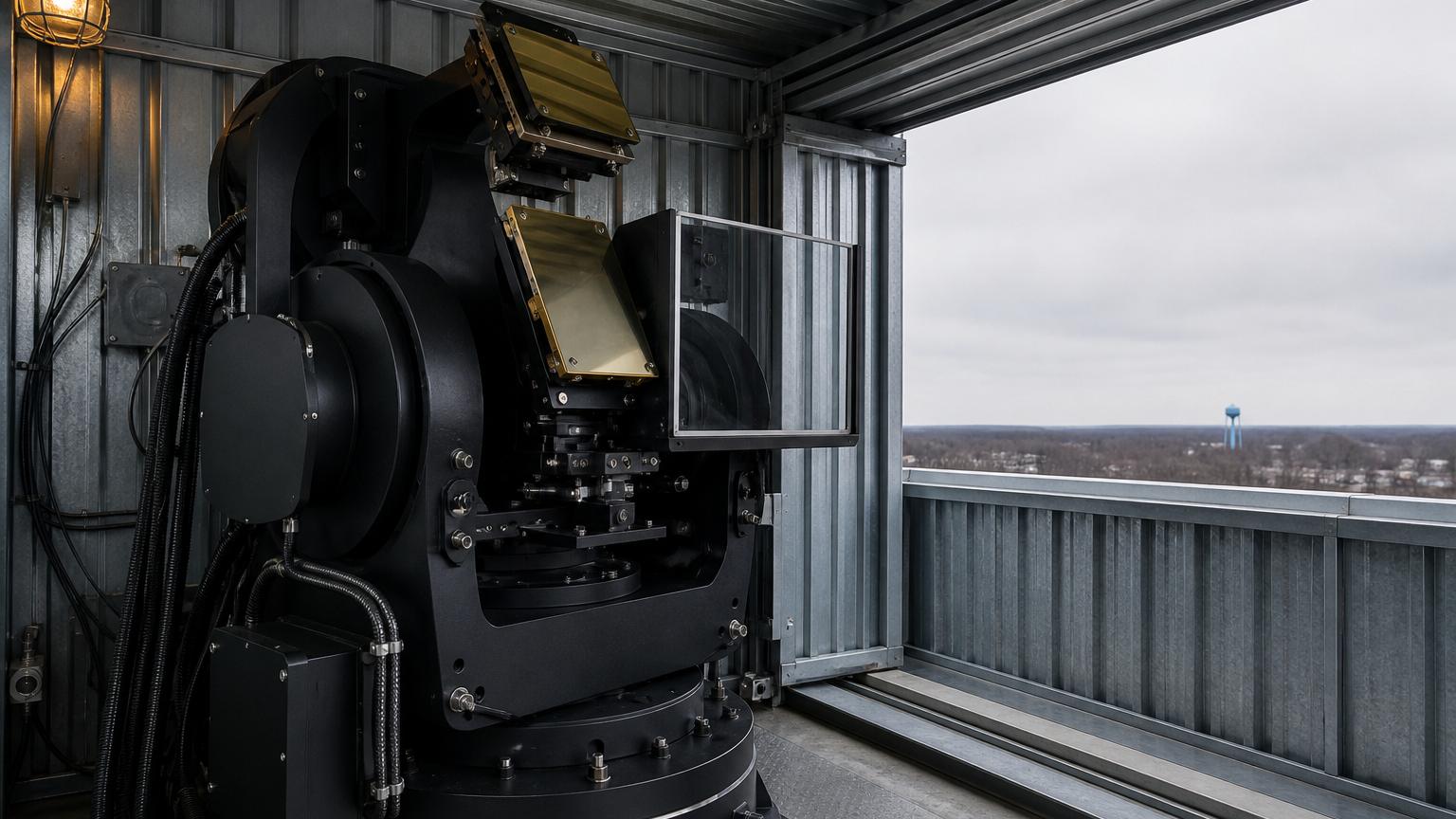
A 375-square-foot galvanized steel chamber now sits on the roof of Stony Brook University's Health Sciences Center, fourteen floors above the medical campus and reached by two final flights of stairs. Its builders call it the Quantum Watchtower, and they say the instruments inside will one day protect Stony Brook University Hospital patient data against cyberattack by teleporting quantum information.
That sentence was published on 28 August 2026 by Jess Stallone in Stony Brook Matters, the university's news site for alumni. One week earlier, on 21 August, Stony Brook and the Department of Energy's Brookhaven National Laboratory announced the demonstration behind it: a working free-space optical link carrying quantum information across 13 miles of open Long Island air. For a hospital reader the useful exercise is to hold the two statements next to each other, because they describe different stages of the same project.
What crossed the 13 miles between Stony Brook and Upton on 21 August 2026
The Watchtower is one end of a pair. The other is the Quantum Lighthouse, a nearly identical steel structure built by Brookhaven Lab at Upton, New York, 13 miles east, positioned for a clear line of sight back to campus. At the "First Light" event on 21 August, researchers generated quantum states of light at the Stony Brook rooftop and sent them across the open air to the Lighthouse. The university describes what was transmitted as "quantum states of light, each containing just a few individual photons," which is a weak coherent source rather than a true single-photon emitter. That daytime run demonstrated that the optical path could be aimed and held steady.
The entanglement work happened separately, at night, when the sky's background light drops far enough for faint signals to be picked out. Entangled photon pairs were generated in a Stony Brook physics laboratory, carried by fiber to the Watchtower, launched across the 13 miles, and measured at the Lighthouse. Justine Haupt, the Brookhaven engineer leading the link, came to it from astronomical instrumentation. "It's exciting to take capabilities we've spent years refining for astronomy and adapt them for a completely different scientific problem," she said.