IonQ Will Supply SDT a Superion 256 Quantum Computer, Announced 21 September 2026, and a Korean Report Places It in a Cancer Center's Hybrid Data Center, With Deliveries From 2027
Quentir Medicine Monitor
Evidence-based insights for quantum medicine. Published by Quentir Systems LLC · September 22, 2026.
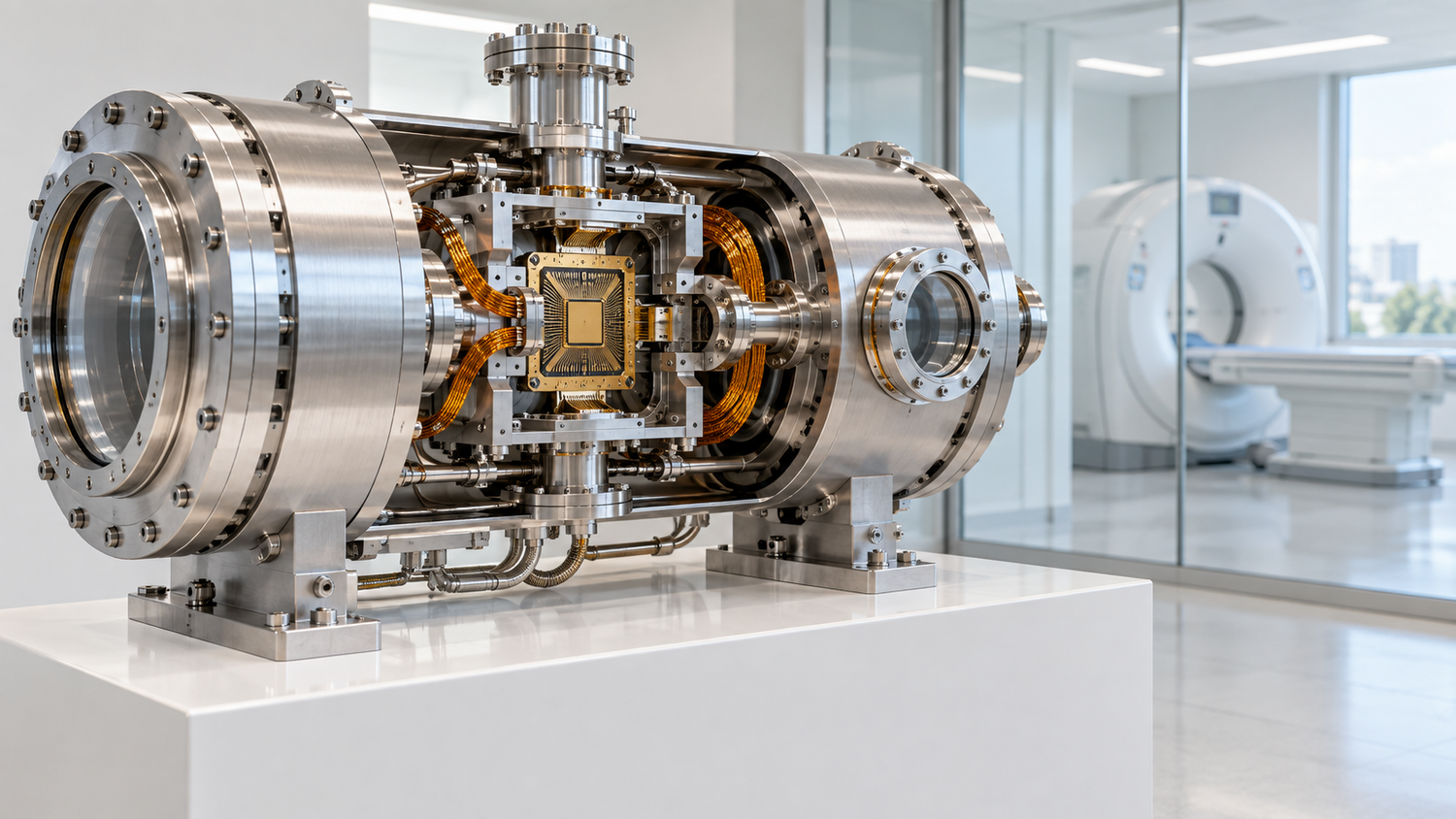
On 21 September 2026 the American quantum company IonQ and the Korean system integrator SDT announced a multi-year partnership under which IonQ will supply SDT with its newest quantum computer and a quantum memory module. The Korean newspaper Digital Times reported on 22 September, citing SDT, that the computer is meant for the hybrid data center of a cancer center in South Korea. For a hospital that buys imaging systems, sequencers and compute clusters on multi-year cycles, the announcement raises a practical question about what this machine can do for oncology.
The answer depends on dates and on the precise wording of two press accounts. IonQ will supply a Superion 256, a trapped-ion machine the company announced on 8 September 2026 and says it will begin delivering to customers in 2027. The cancer center has not been identified, and SDT says the project details will be disclosed later. What exists today is a purchase agreement, a plan for a hybrid quantum-classical data center, and a planned manufacturing site in the city of Gumi. The cited announcements report no medical workload or results.
That makes this a procurement story at an early stage, and procurement stories are where hospital leaders, research directors and health ministries decide whether to wait, pilot or budget. This Monitor sets out what each party said, what the machine is, and which questions a cancer center would need answered before the system becomes clinical research infrastructure.
The Korean detail matters because the English release and the Korean report differ in one respect that a buyer should notice. The difference concerns where the computer goes.
What IonQ and SDT announced on 21 and 22 September 2026 about a Korean cancer center
IonQ's press release of 21 September 2026 states that the Superion 256 "is planned for deployment with an SDT customer in South Korea, where IonQ and SDT intend to collaborate on a hybrid quantum-classical data center." It adds a silicon-vacancy quantum memory module, a component for future quantum networks, and a new SDT facility in Gumi for memory packaging, system assembly and commissioning. IonQ's chief executive, Niccolo de Masi, is quoted saying the company is "continuing to trailblaze quantum cancer and biomedical research." SDT's chief executive, Jiwon Yune, describes "a separate in-country cancer center project where we intend to develop hybrid quantum-classical infrastructure for medical and biomedical research with IonQ."
The Korean report is more direct. The Digital Times report of 22 September 2026 by Paeng Dong-hyun states that the Superion 256 will be deployed in a project to build a hybrid quantum-classical data center at a domestic cancer center, that SDT will combine high-performance computing with quantum computing to support medical data and biomedical research infrastructure, and that details of the cancer center and the project will be disclosed later.
Read side by side, the English release leaves the cancer center one step away from the machine, calling it a separate project, while the Korean report places the machine inside it. Both versions may prove consistent once the customer is named. Until then, a reader should treat the link between this specific computer and cancer care as SDT's stated plan as reported by Digital Times, and not as an installed system.
Quantum pillar: computing. Technology readiness: TRL 2 of 9. The level applies to the cancer-center use: a concept announced by two companies, with no hospital named and no medical workload or result publicly reported in the cited sources, while the computer itself is still a prototype that IonQ plans to deliver to customers in 2027.
What IonQ said on 8 September 2026 about Superion 256: 256 qubits, one server rack, deliveries in 2027
IonQ introduced the machine in a launch announcement on 8 September 2026. According to the company, Superion 256 is its sixth-generation system, built on a chip fabricated with its subsidiary SkyWater that controls trapped-ion qubits with integrated electronics instead of laser systems. IonQ says it has trapped the first ions in prototype systems at several of its US facilities, that the system fits in a standard server rack and draws less power than a rack of GPUs, and that its cooling fits a typical data center. The company states that Superion 256 "is available to order now, with customer deliveries in 2027."
Two further statements set expectations. IonQ's president of quantum computing, Chris Ballance, says full fault tolerance is expected "in a 2027 lab setting" and as a commercial reality in 2028, and ties that step to CMOS integration on a later generation called Superion 10K. The launch announcement does not specify what error correction the Superion 256 units delivered in 2027 will carry. Fault tolerance is presented as a later target, and a buyer would need that configuration in writing.
For a hospital, the server-rack claim is the most consequential line in the launch. If it holds, the machine could be placed among ordinary data-center racks, which changes the facilities conversation, even if the medical case still has to be made.
Which cancer-center workloads a 256-qubit machine could serve before fault tolerance
No source for this announcement names a medical workload. Research on quantum computing for medicine has included molecular simulation for drug candidates, optimization problems such as radiotherapy planning, and machine-learning experiments on genomic or imaging data, and any of these could be candidates. Neither announcement cites a result in any of them, and which ones a cancer center would pursue is not stated.
Korea already has one comparable effort. Earlier this month this Monitor reported that the Korea Research Institute of Bioscience and Biotechnology and the French company Quandela signed a memorandum in Paris to apply photonic quantum computing to drug-candidate discovery. That is a research institute pairing with a hardware maker for molecular work. The SDT plan differs in placing a machine in a clinical institution's data center. Whether patient data or imaging archives would ever reach it is not addressed in the announcements; if they would, consent, pseudonymization and access rules would have to be settled first.
The closest recent measure of what IonQ hardware does on industrial problems comes from engineering, where a 36-qubit IonQ Forte run inside the Ansys LS-DYNA simulation code shortened part of a workflow by a modest margin. That result concerns crash simulation and says nothing about medical workloads, which would need their own benchmarks. The hybrid label in the SDT plan does describe the architecture: the quantum machine would be one accelerator among classical high-performance systems.
What the announcements leave open for a cancer center and its patients
Several facts a hospital board or research ethics committee would need are missing from both accounts. The customer is unnamed. The delivery date for this unit is not given beyond IonQ's general 2027 window. No research program, principal investigator or patient-data protocol is described. The price and the division of operating costs between SDT, IonQ and the hospital are not public.
For patients, the relevant point is that nothing in this announcement changes diagnosis or treatment in the near term. A cancer center that installs the machine would first use it for research. If a tool from that research were later intended for diagnosis or treatment, it would need clinical validation, and depending on its intended use it could fall under Korea's medical-device rules.
For Korean industrial policy, the Gumi facility may matter as much as the computer. If SDT packages silicon-vacancy memory modules and assembles IonQ systems locally, Korea gains a supply base for quantum hardware in the region, and the cancer-center project, once named, would be one of its earliest publicly described uses.
How Quentir Reads It
For procurement, this announcement is a reservation of a place in line. A Korean hospital, or a European one watching the model, learns that a trapped-ion system is being marketed as rack-sized equipment for data centers and that at least one Korean integrator intends to place one in oncology research. It does not learn the price, the delivery date for this unit, the error-correction configuration or the research program.
The limit of the evidence is plain. Both accounts are company statements and press reports of them, and the cancer-center destination rests on SDT's description as carried by Digital Times. No peer-reviewed or preprint result links this machine to any medical task.
Three developments would change this reading: the naming of the cancer center with a research lead and protocol; a delivery and acceptance of the Superion 256 unit in Korea; and a first published medical workload run on it, with a classical baseline for comparison. Until then the readiness level for the medical use stays at the concept stage, and this Monitor will return to the story when any of the three appears.
Sources
Primary source: IonQ and SDT, joint press release of 21 September 2026, with statements by Niccolo de Masi and Jiwon Yune. Also drawn on: IonQ's Superion 256 launch announcement of 8 September 2026 and the Digital Times report by Paeng Dong-hyun of 22 September 2026; the comparison of the English and Korean accounts and the readiness assessment are this Monitor's own.