The MRI Implication of a Single Copper-Oxide Plane
The result is one atomic plane
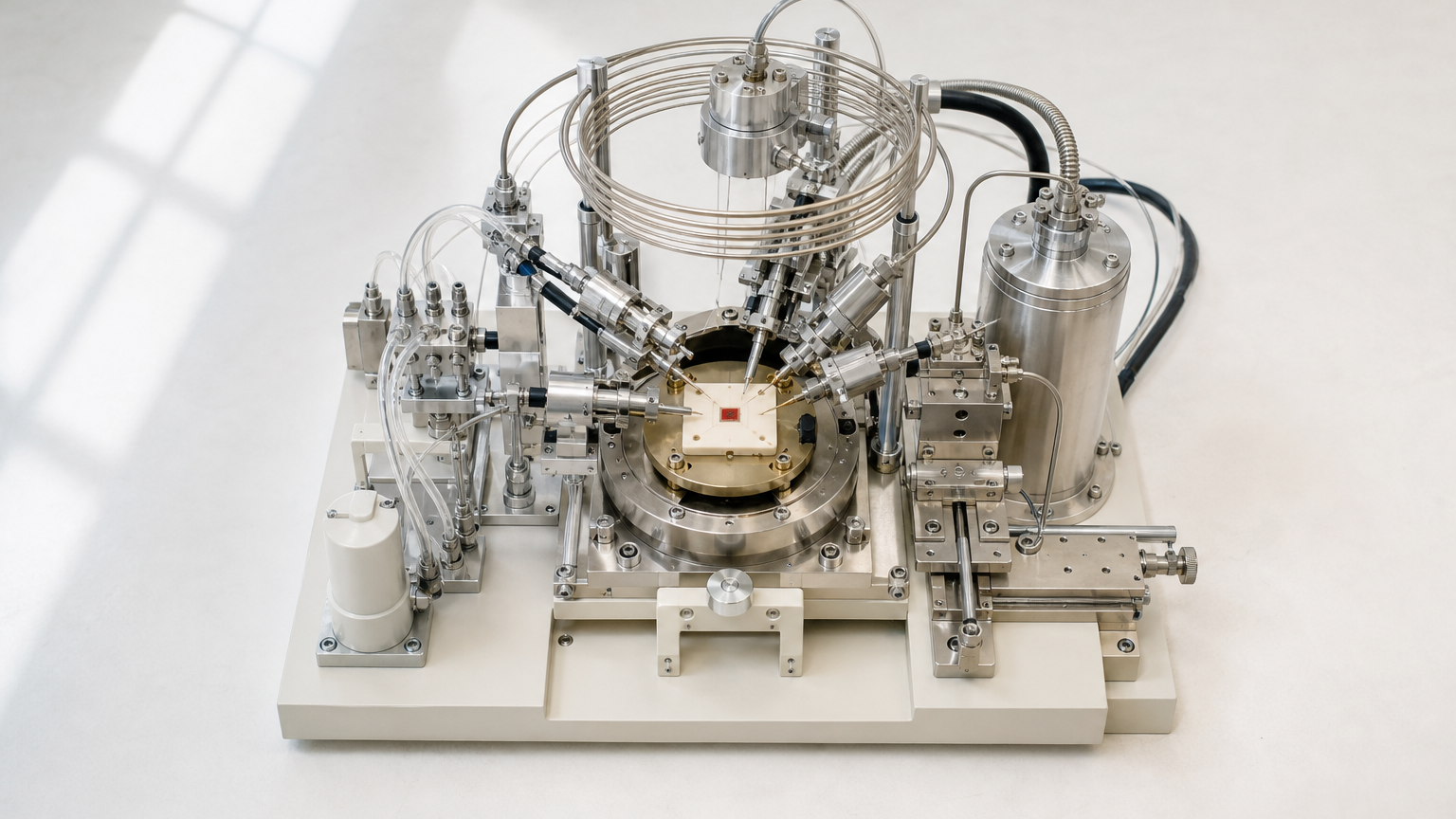
A team led by researchers at Fudan University and the University of Science and Technology of China has fabricated a single-layer cuprate containing one superconducting copper-oxide plane. Published in Nature on August 12, the experiment reduces Bi-2201 to its ultimate two-dimensional limit. The monolayer retained superconductivity, although its optimal transition temperature was about ten percent lower than in thicker material. Fine control of oxygen content then let the researchers follow the sample from an insulating state, through an anomalous metallic regime, and into superconductivity. This is a basic-physics achievement built on delicate fabrication and a laboratory instrument designed for precise in-situ tuning.
The medical relevance begins with the magnet
MRI depends on a strong, stable magnetic field to align protons in the body before radiofrequency pulses and sensors turn their response into anatomical images. That creates an MRI materials pathway for this research, but the connection sits far upstream. The paper reports no magnet winding, imaging coil, scanner prototype, patient study, or medical-device test. Its contribution is a cleaner experimental platform for understanding how high-temperature superconductivity changes when the active material is reduced to one copper-oxide plane.
The distance to care remains useful to measure
A hospital magnet requires far more than a superconducting transition. Engineers need scalable conductors, high current under strong fields, reliable joints, mechanical strength, controlled cooling, quench protection, field homogeneity, and compatibility with a complete scanner. The new monolayer does not answer those engineering questions. It helps make the earlier materials questions more exact. Quentir reads the result as a sensing story at the laboratory-materials stage: credible MRI relevance through superconducting magnet science, paired with a clear boundary around present readiness. The next meaningful step would connect the one-plane physics to a thicker, manufacturable material with measured current or field performance.
A 90-Degree Antenna for a Difficult Organ
The eye makes 7-tesla MRI work hard
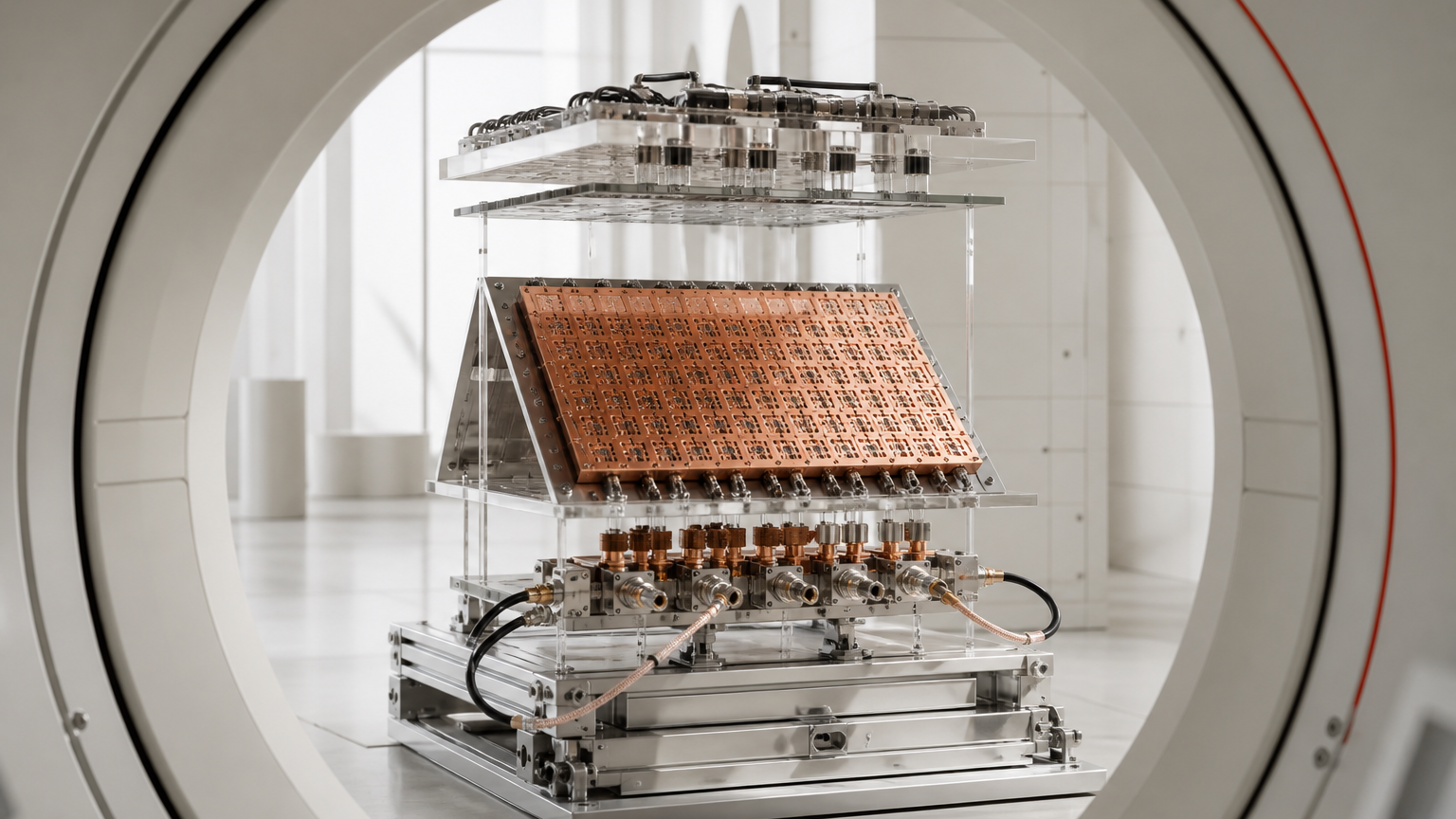
The human eye is small, moves easily, and sits among tissues that respond differently to a strong radiofrequency field. Higher magnetic fields can reveal finer anatomy, but they can also create shading, signal voids, and local heating. A team in Berlin and Rostock built a metamaterial antenna around that problem. The printed circuit board bends through 90 degrees over the eyes. Forty subwavelength copper cells are integrated with a two-channel transmit-and-receive loop to reshape the field at the operating frequency of a 7-tesla scanner.
The prototype reached human imaging
The antenna was tested in phantoms, five healthy adults, and one person with treated retinal disease. Three healthy volunteers received direct comparisons with a matched conventional loop. The new design increased transmit efficiency and received signal across the reported eye measurements. A flat version also extended coverage across the occipital region in two healthy volunteers. Safety work combined electromagnetic simulation, human voxel models, magnetic-resonance thermometry, and fiber-optic temperature probes. These results make the device a serious ocular MRI prototype, while the small cohort and technical endpoints stop well short of diagnostic superiority or routine care.
The quantum boundary matters
MRI reads signals produced by nuclear spin and magnetic resonance, placing this work in the quantum-sensing pillar. The metamaterial itself is an engineered radiofrequency structure rather than a quantum computer or algorithm. A contemporary UC San Diego account describes a separate line of quantum metamaterials built from nanoscale quantum elements and notes the broader use of metamaterials to shape MRI fields. The two research lines meet at materials control, but they should not be treated as the same mechanism. For hospitals, the relevant questions remain attached to the actual device: field uniformity, heating, scan performance, reproducibility, patient comfort, qualification, and whether better signal changes a clinical decision.