Karystianou's Quantum Scanner Claim on Open TV, 20 September 2026: 100,000 Times Sharper Cancer Detection, Read Against the Mainz Diamond Magnetocardiogram
Quentir Medicine Monitor
Evidence-based insights for quantum medicine.
On 20 September 2026 Maria Karystianou, the pediatrician who leads the Greek movement Elpida gia ti Dimokratia, said on the Open TV program Tora Mazi, as transcribed by the newspapers Documento and Ta Nea, that the quantum scanners of the future will have 100,000 times greater resolution in locating cancer cells and will also be able to treat. She said it while the health minister, Adonis Georgiadis, was on the public broadcaster ERT calling her a "quantum doctor". The exchange is the newest turn in a Greek argument over the words quantum medicine that began with the death of the artist Giorgos Mazonakis and a private practice in Kolonaki, Athens.
Two parts of her statement are physics and hold up. The third is a forecast with no supporting instrument or publication identified in the sources reviewed here. This Monitor separates them. The quantum scanner claim of 100,000 times sharper cancer detection has no counterpart in the sources this Monitor reviewed; a quantum sensing result published on a human body this month, a diamond magnetometer reading of a heartbeat, is a separate research example that works at the scale of the whole heart and needs hundreds to thousands of beats to do it. What the episode shows a clinician is how the phrase quantum medicine now carries two meanings in one sentence.
The Greek material is unusually complete. Named physicists, a former university rector, a patients' union and a ministry have all spoken within one week, so a reader can see where the physics ends and the sales language begins. All quotations below are this Monitor's translations from the Greek newspaper accounts, which are secondary reports of the broadcasts; no broadcast recording was reviewed.
According to LiFO's account of the interview, which carries the physics passage and the inspection passage, Karystianou opened on inspections: after the Mazonakis case, she said, the state and its inspectors must check whether a practice is licensed and whether the procedures performed there are the ones a license covers, and the minister should stop telling patients to be careful about which practice they visit. Told on air that Georgiadis had just called her a "quantum doctor" on ERT, she answered that the word is quantum physics, that quantum physics has transformed science and technology, and that lasers are entirely quantum mechanics, as is the magnetic scanner, which she attributed to the quantum spin of protons.
Mainz, Stuttgart, Freiburg and Q.ANT Recorded a Human Magnetocardiogram With Room-Temperature Diamond Sensors: What the 16 September 2026 Science Advances Paper Shows
Quentir Medicine Monitor
Evidence-based insights for quantum medicine.
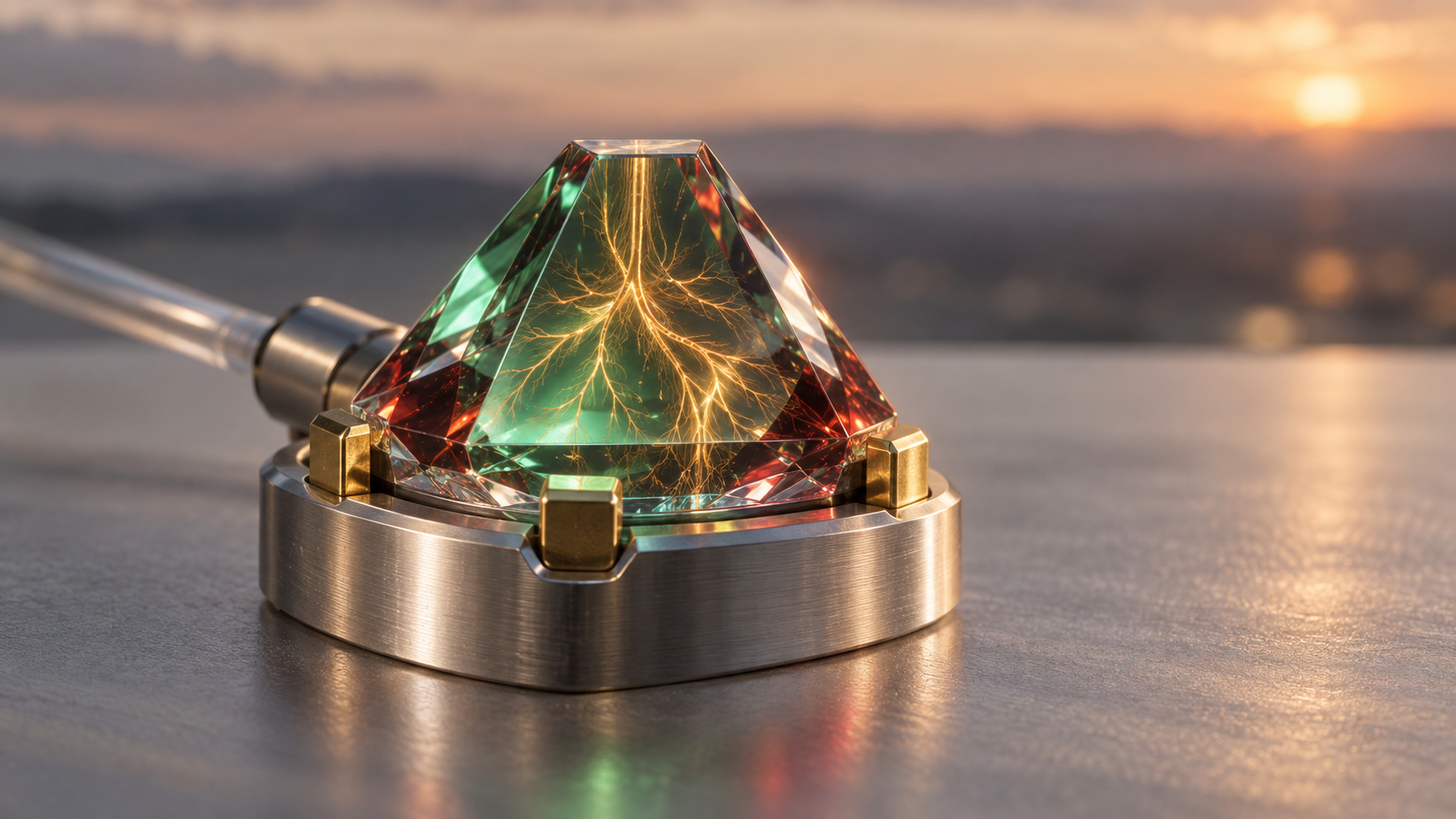
Three research groups in Germany have measured the magnetic field of a beating human heart with diamond sensing crystals smaller than half a cubic millimeter, at room temperature and without touching the skin. The paper appeared in Science Advances on 16 September 2026 under the coordination of Muhib Omar and Arne Wickenbrock of Johannes Gutenberg University Mainz, with Dmitry Budker and Jörg Wrachtrup among its 30 authors.
The instruments are diamond nitrogen-vacancy magnetometers: a nitrogen atom sitting beside a missing carbon atom in the diamond lattice, whose electron spin shifts its energy in proportion to the surrounding magnetic field. The three systems, built independently at Mainz, at the University of Stuttgart and by the Stuttgart startup Q.ANT GmbH, each produced a human magnetocardiogram in proof-of-concept self-experiments on members of the research groups, with sensitivities between 6 and 26 picotesla per square-root hertz. The result is a laboratory measurement on a handful of volunteers from the teams themselves, with no patient involved. It establishes that room-temperature diamond sensors can read the heart's field at all, after averaging, which is the step a cryogenic SQUID cleared decades ago and an optically pumped magnetometer clears with a heated vapor cell. The half-cubic-millimeter figure describes the sensing crystal, not the complete instrument with its fiber, optics and electronics, and the diamond heads recorded without touching the skin while a conventional electrocardiogram supplied the timing reference for the averaging, so the experiments did not show an electrode-free workflow.
The heart's magnetic signal is faint. The paper puts the average R-peak, the sharpest feature of each beat, at about 25 picotesla, roughly two million times weaker than the field of the Earth. That is why magnetocardiography has stayed inside hospitals that could afford superconducting detectors and the shielding around them, and why a SQUID magnetocardiograph still counts as deployable news when a Chinese manufacturer places one. The Mainz group's own line of work reached a related milestone on 6 August 2026 with a levitated-magnet sensor at 32 femtotesla per square-root hertz, a sensitivity reached only in a narrow resonance near 305 hertz, on a benchtop device that is far less suited than a diamond to sitting near a chest.
Hefei Mandi's Magnetocardiograph, 4 and 5 August 2026: Two Unresolved Deployment Descriptions in Chinanews and Xinhua
Quentir Medicine Monitor
Evidence-based insights for quantum medicine.
On 4 August 2026 a state press tour called Vibrant China Field Study visited the Institute of Health and Medicine at the Hefei Comprehensive National Science Center and watched a magnetocardiograph acquire signal in the laboratory of Hefei Mandi Medical Technology. Two reports came out of that visit on consecutive days, both from official Chinese outlets, both describing the same machine, and they describe its stage of deployment in different words that no public source resolves.
The company builds a magnetocardiograph around a superconducting quantum interference device, the detector class that reads magnetic fields at the femtotesla scale, and a 2022 industry profile says it obtained an NMPA registration in 2019. The 4 August report describes the machine as working with ten key hospitals in scientific research collaboration and entering a pre-mass-production stage. The 5 August report describes it as installed and in use at more than ten key hospitals in deployed application, with the company's production lines running at full load. A hospital deciding whether to buy one needs to know which of those two sentences is the current state of the product.