
What the Word Quantum Means on a Hospital CT Scanner
The label describes a detector
Siemens Healthineers has introduced a second generation of its photon-counting CT family in Vietnam. The NAEOTOM Alpha Class is a commercial imaging platform for hospitals, with versions aimed at routine imaging, cardiology, and tertiary or specialist centers. The word quantum points to the detector's handling of discrete X-ray photons. No qubits run a computation inside the gantry. Tiền Phong reports that all three models offer 0.2 millimeter ultra-high-resolution slices and multi-energy data. Alpha.Pro and Alpha.Peak reach temporal resolution down to 66 milliseconds, while Alpha.Peak reaches a reported scan speed of up to 737 millimeters per second.
One platform now serves three clinical settings
The product segmentation turns a physics story into a hospital procurement question. A routine radiology department, a cardiac service, and a tertiary referral center carry different case mixes, motion problems, staffing needs, and service expectations. The same detector principle can therefore produce different value across institutions. Configuration-specific comparisons remain essential: image quality for the intended examinations, radiation dose, contrast use, reconstruction performance, throughput, training, uptime, and the clinical decisions influenced by spectral information. The launch also included SOMATOM On.site, a separate mobile head-and-neck CT system. Its presence makes the distinction useful. One device changes the detector architecture; the other changes where imaging reaches a critically ill patient.
The technology is already in clinical use
Siemens says the first NAEOTOM Alpha entered clinical use in 2021. The company describes its detector as directly converting X-rays into electrical signals while measuring each photon's energy, making spectral information available with every scan. That places the underlying sensing technology at TRL 9 on the shared readiness ladder. Commercial maturity still leaves a local buying question. Hospitals need to establish which model and protocols fit their patients, clinicians, facilities, and budgets. Precise language helps: photon-counting CT is an advanced diagnostic-imaging technology grounded in quantum physics, and its performance belongs in ordinary clinical and operational comparisons.
Does a Quantum Layer Change What a Medical AI Sees?
One layer makes the comparison unusually clean
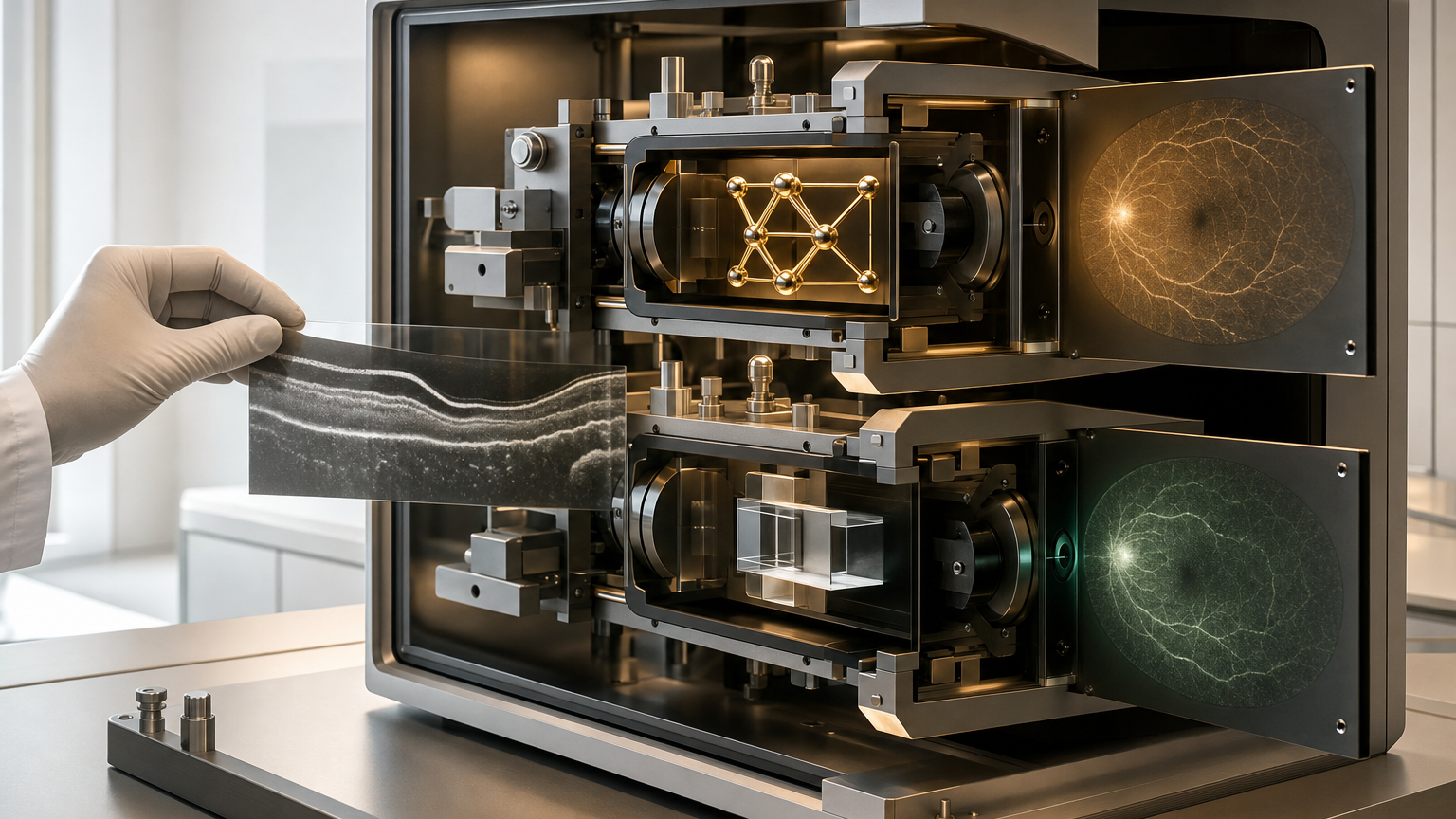
A July 2026 preprint compares two medical-image classifiers that share the same convolutional backbone and a comparable number of trainable parameters. They differ in one intermediate layer. One branch uses a dense classical layer; the other uses a four-qubit circuit emulated on a conventional computer. This parameter-matched comparison helps isolate the contribution of the circuit-shaped representation without changing the rest of the network.
The relative gain appeared between small and large datasets
The models classified retinal optical coherence tomography images, with training sets ranging from 200 to 30,000 examples. The hybrid model performed best relative to the classical comparator around 800 and 2,000 training images, an intermediate-data regime. At the largest sizes, the classical CNN moved ahead and reached the study's highest retinal test accuracy, 93.7 percent. A robustness check using two-dimensional slices from an OASIS-1 dementia MRI dataset followed the same broad pattern: the hybrid advantage narrowed with more data, then reversed slightly.
The attention maps changed with sample size
The researchers also compared SHAP attention maps, which estimate where image pixels influence a model's output. With 1,000 retinal images, the hybrid maps appeared more concentrated around retinal layers and disease-related structures, while the classical maps were more fragmented in the examples shown. At 30,000 images, the models' highlighted regions overlapped much more. These maps do not establish clinically validated biomarkers. The study includes no physical quantum-hardware run, prospective clinical test, external hospital validation, clinician reader study, or patient outcome. Its contribution is narrower and useful: a controlled account of when a small classically simulated circuit changed model performance and apparent visual focus, and when additional data favored the matched classical layer.