QTomo Says Quantum Computing Can Rebuild CT Scans From 10 Percent of the X-Ray Data: What Kyungtaek Jun's Papers From 2023 to 2026 Tested
Quentir Medicine Monitor
Evidence-based insights for quantum medicine. Published by Quentir Systems LLC · September 25, 2026.
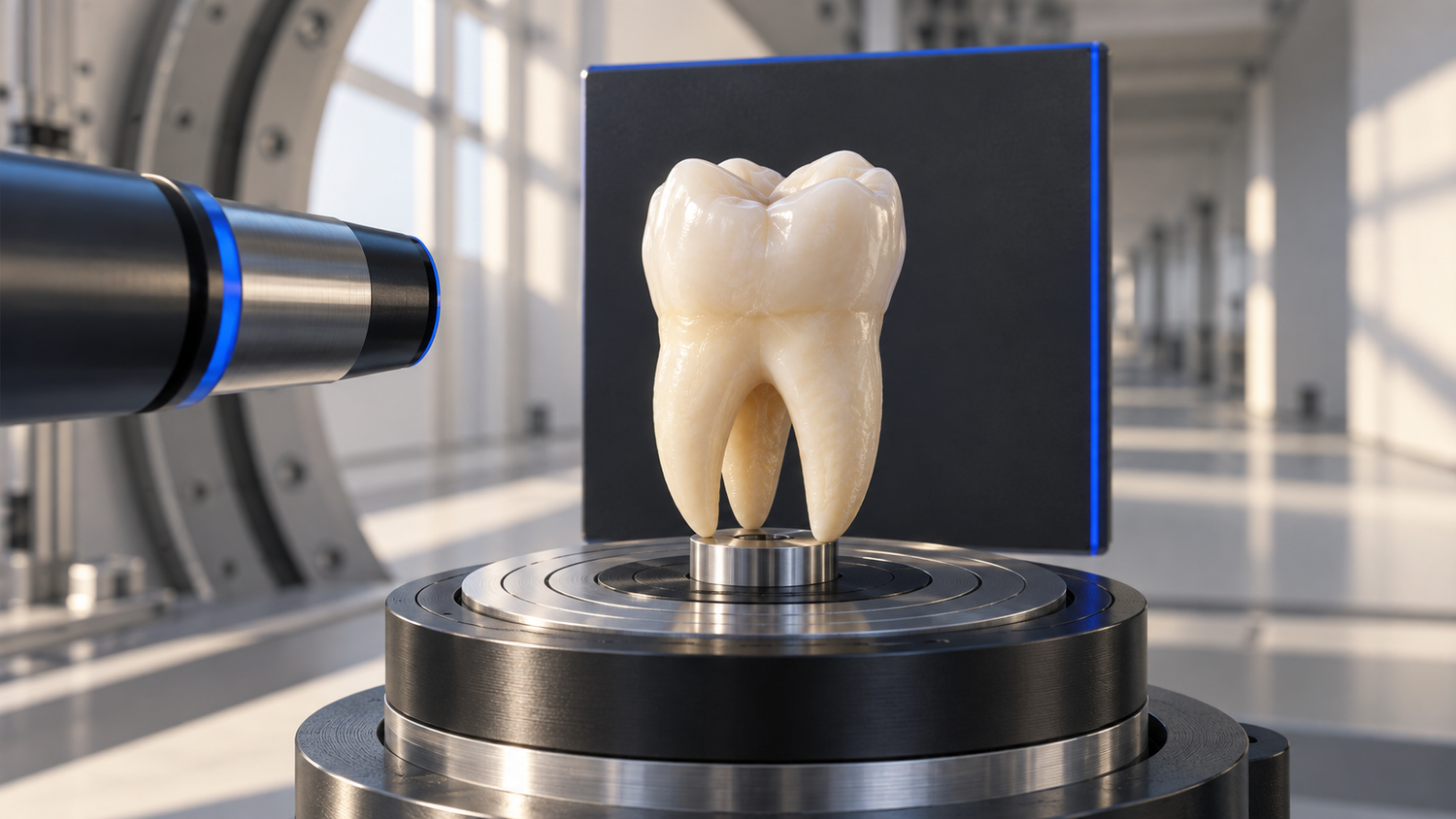
A Korean start-up called QTomo says its quantum algorithms can rebuild a CT scan from one tenth of the usual X-ray projections, which would cut a patient's radiation dose by 90 percent. The company's founder, Kyungtaek Jun, made those claims in a newspaper interview published on 24 September 2026, and his own peer-reviewed papers show how far the method has actually been tested.
Jun has published the core of QTomo's approach in Scientific Reports in 2023 and 2025, in two arXiv preprints in April and May 2025 and in EPJ Quantum Technology in July 2026. The experiments in those papers perform quantum CT reconstruction on images of at most 100 by 100 pixels, solve the problem on the D-Wave hybrid solver, which combines a quantum annealer with classical computing, and use test objects such as the Shepp-Logan phantom, a standard computer-drawn head outline, a model tooth or a single existing chest CT slice. The 90 percent figure appears as an estimate in the April 2025 preprint, and none of the papers reports a scan acquired from a patient for the study, a dose measurement or a clinical validation.
That gap matters for radiology departments and hospital buyers, because the interview lists early cancer detection, breast and heart imaging and dental work among the technology's proposed clinical applications. The published papers describe a careful and interesting research program at a much earlier stage.
Set side by side, the interview's figures and the papers' measurements separate into three groups: claims with peer-reviewed support on small test images, one estimate from a preprint, and figures that appear in no paper at all. The first group shows steady progress by a small research team. The second would need a scanner study to confirm it, and the third would need data that QTomo has not yet made public.
What QTomo's founder told a Korean reporter on 24 September 2026
The interview appeared on the Korean news site Youth Assembly under a Today Times byline, in a series on notable companies. Jun, introduced as QTomo's chief executive and a quantum computing specialist, describes CT as an image that is computed from projections rather than photographed, so that the reconstruction algorithm, more than the scanner hardware, decides image quality.
The article states several specific claims. QTomo is said to reach a precision of 99.99999999999 percent, thirteen nines, using only 10 percent of the X-ray projection data, a quality it says classical methods cannot reach even with the full data set. The article says this would reduce a patient's radiation exposure by 90 percent. It credits the result to quantum linear systems and quantum optimization, describes a region-of-interest strategy that spends quantum computing power only on the part of the image that needs detailed diagnosis, and lists clinical uses including 1-millimeter early cancer lesions, breast cancer, heart disease, dental implants and crowns.
The interview also says QTomo expects to receive synchrotron data from Australia's national science agency CSIRO and its nuclear science organization ANSTO to verify its algorithm, and that it has set up a base in Fairfax, Virginia. The article itself shows no data table and cites no paper for the thirteen-nines figure or the 90 percent dose figure.
Quantum pillar: computing. Technology readiness: TRL 3 of 9. The reconstruction method has been shown to work on small computer-generated test images, one laboratory X-ray scan of a model tooth and one resized chest CT slice, with no prospective patient scans, no clinical-size images and no dose study published so far.
What Kyungtaek Jun published in Scientific Reports in 2023 and 2025
The method first appeared in Scientific Reports on 1 September 2023, in a single-author paper by Jun with a QTomo affiliation. It writes each pixel of the unknown CT image as a set of qubits, computes the projections that image would produce, and turns the mismatch with the measured projections into an energy function of the kind a quantum annealer minimizes. The smallest test was a 2 by 2 pixel image, which D-Wave's Advantage annealer solved correctly in 515 of 1,000 runs. The larger tests used a 30 by 30 pixel Shepp-Logan phantom on the D-Wave hybrid solver. With one qubit per pixel the reconstruction matched the original exactly. With ten qubits per pixel, 9,000 logical qubits in all, the energy was within 0.01 percent of the minimum, yet the image still differed from the original.
Jun states the scaling problem himself in that paper. A commonly used CT image has 500 by 500 pixels or more, he writes, which would need at least 250,000 logical qubits. The test sinograms were produced mathematically from the phantom, so they carried none of the noise, scatter or patient motion of a real scan.
The second paper, by Jun and Hyunju Lee, appeared in Scientific Reports on 1 July 2025 and moved to real X-ray data. The team scanned a single-material model tooth at beamline 6C of the Pohang Light Source-II synchrotron, reduced each projection to 50 by 50 pixels and also tested 100 by 100 pixel images, 2,500 and 10,000 logical qubits. The algorithm reconstructed and segmented the tooth in one step. After post-processing, its result matched the classical two-step method except for some boundary pixels, which the authors say are hard to separate from true edges. That study used 360 projections, one every half degree, a full data set.
Where the May 2025 preprint and the July 2026 paper stand behind the 10 percent and 90 percent figures
The sparse-data idea does have published support, in a preprint. In arXiv 2505.11286, submitted on 16 May 2025, Arim Ryou, Kiwoong Kim and Jun add a total-variation term, a common way to favor smooth images, to the quantum reconstruction. Using sinograms computed from Shepp-Logan images and body CT images, the hybrid solver reconstructed 30 by 30 pixel images from 5 projections and 60 by 60 pixel images from 6 projections without error. The authors write that such algorithms could significantly reduce total radiation dose once quantum computing performance advances. The preprint has not been peer reviewed, and its projections were again calculated rather than measured.
The 90 percent figure comes from a second preprint by Lee and Jun, arXiv 2504.20654, submitted on 29 April 2025. It tackles the qubit shortage by starting from a coarse 50 by 50 pixel reconstruction and then refining the image region by region, each region solved as a separate small problem on the D-Wave hybrid solver. In its experiments, this rebuilt 100 by 100 pixel Shepp-Logan phantoms, one with black-and-white pixels and one with four gray levels, using 2,500 and 7,500 qubits, from full and from reduced sets of projection angles. The preprint's conclusion then estimates that rebuilding a 500 by 500 image from a 50 by 50 start could cut the projection data, and with it the radiation dose, by about 90 percent. That estimate was not measured on a scanner or in a patient.
The peer-reviewed version, published in EPJ Quantum Technology in July 2026, is more careful on dose. According to the published manuscript, it separates acquiring fewer projections from computationally downsampling the data and leaves the translation into clinical dose for future study. It also adds a chest CT slice taken from a public dataset, resized to 60 by 60 pixels with simulated projections, compares the results with the classical FBP and SART reconstruction methods, and reports runtime diagnostics. Those comparisons are useful, and they still stop short of showing a quantum advantage, because the quantum formulation is not set against a classical optimizer solving the same energy function.
Few projections for a small, noise-free image is a result in its own right. It does not yet translate into a 90 percent dose cut for a patient, because radiation dose in clinical CT depends on two separate choices: how many projection angles are taken, and how much X-ray exposure each projection receives. Fewer angles leave gaps in the data that the algorithm must fill, while lower exposure per projection makes each measurement noisier, and a clinical dose claim has to show how the method copes with both. The thirteen-nines precision figure does not appear in the papers we read.
This Monitor looked at a different use of the word quantum on a CT scanner in August, when Siemens Healthineers brought its photon-counting system to Vietnam. As that piece on what the word quantum means on a hospital CT scanner explained, the quantum element there sits in a detector that counts individual X-ray photons, in a machine hospitals already use. QTomo's claim concerns the computer that turns projections into an image, and it is much earlier in development.
Why a D-Wave hybrid solver leaves the quantum share of the result unmeasured
All of the larger reconstructions in these papers ran on D-Wave's hybrid solver, a cloud service that splits a problem between classical processors and a quantum annealer and returns the lowest-energy answer it finds. The papers report whether that answer was right. They do not isolate how much of the work the annealer itself did, and they do not compare speed or accuracy against a strong classical solver for the same energy function on the same computer budget.
That comparison is the one that would show a quantum benefit. A classical optimizer can minimize the same function, and classical compressed-sensing CT from sparse or low-dose data is a long-established field. Claims of quantum speed on D-Wave hardware have also been tested hard elsewhere: a Quentir post on a classical simulation of all four graph topologies from D-Wave's 2025 Advantage paper shows how quickly such questions become contested. The interview's mention of quantum supremacy has no measurement behind it in the papers reviewed here.
None of this makes Jun's research program weak. The papers are open about their image sizes and solvers, the 2025 study used real synchrotron data, and the 2026 paper addresses the qubit shortage directly. The gap lies between that careful literature and the interview's clinical language.
How Quentir Reads It
For a radiology chief or an imaging procurement team weighing a quantum CT offer, the useful questions are concrete. At what image size has the method run, and on how many measured patient or cadaver scans? Was dose measured on a scanner, with noise from reduced exposure included? What fraction of the computation ran on quantum hardware, and how did a classical solver do on the same problem? Which medical-device regulator, if any, has reviewed the software?
The planned synchrotron data from CSIRO and ANSTO could give QTomo higher-quality measurements than its earlier tests. A clinical claim would still need scans of patients or realistic phantoms at clinical resolution, with dose and reader studies. For patients, nothing about today's CT examinations changes: low-dose protocols and iterative reconstruction already running on classical computers remain the route to lower radiation.
Sources
Primary source: Kyungtaek Jun (QTomo), interviewed by Min Kyung-man for Today Times, published on Youth Assembly on 24 September 2026. Also drawn on: Jun in Scientific Reports (2023); Jun and Hyunju Lee in Scientific Reports (2025) and EPJ Quantum Technology (2026); and Arim Ryou, Kiwoong Kim and Jun on arXiv (2025), with the April 2025 arXiv preprint of the 2026 paper; the readiness assessment is this Monitor's own.