The Helmet That Brings Brain Mapping Closer to Childhood
A scanner that moves with the patient
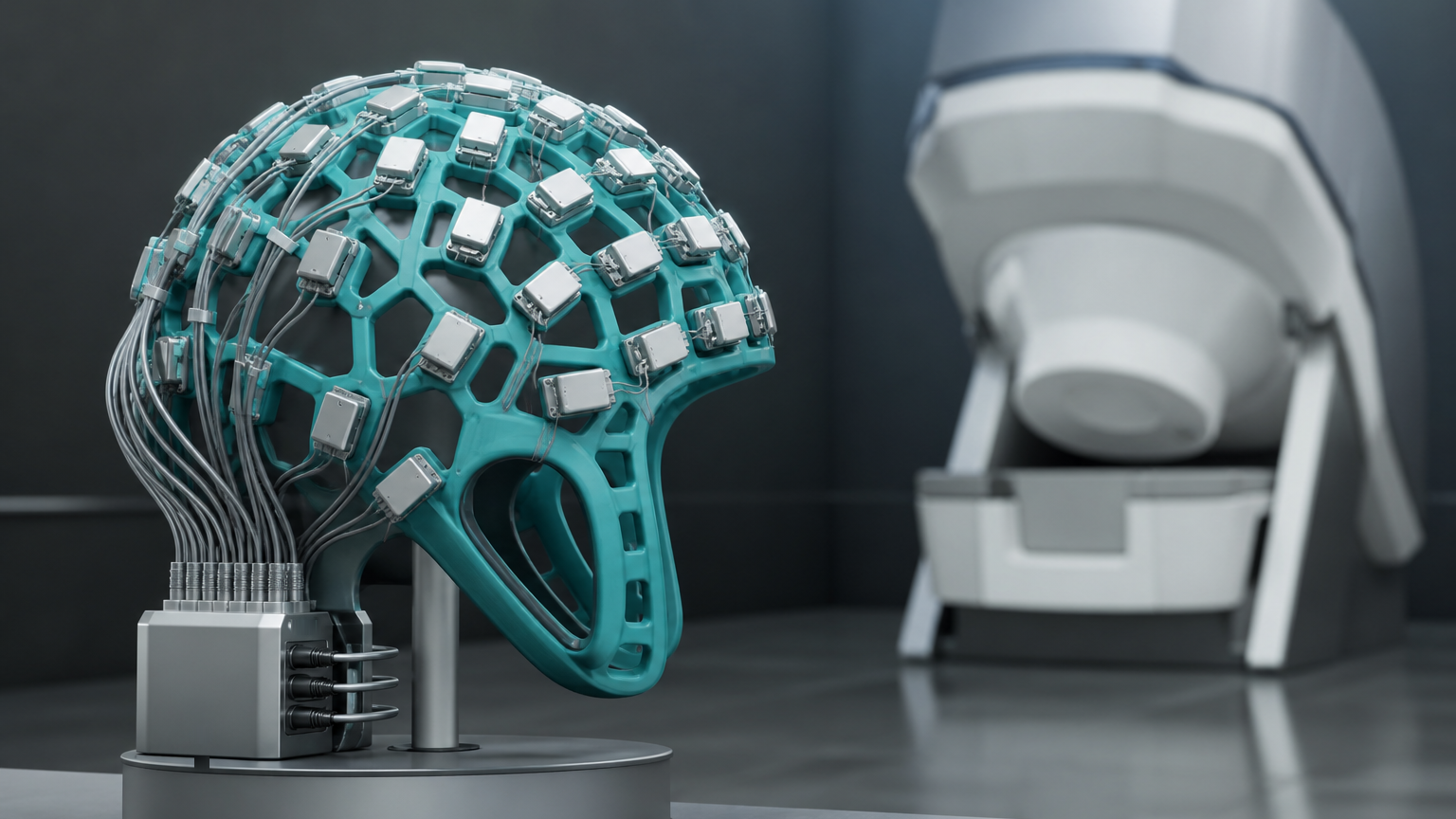
In a Wellcome impact story, Liberty can talk and move while a latticework helmet records the magnetic fields made by her brain. The seventeen-year-old is living with epilepsy, and Wellcome reports that her earlier diagnostic path included ten days in a hospital bed with electrodes placed directly on the brain. The helmet is an optically pumped magnetometer magnetoencephalography system, or OPM-MEG: a wearable brain scanner built around quantum sensors small enough to sit close to the scalp. That proximity matters for children, whose heads sit farther from the fixed detectors in conventional MEG equipment and whose movement can blur a scan.
The clinical comparison has arrived
A prospective Epilepsia study enrolled 68 people with refractory epilepsy for ninety-minute OPM-MEG recordings. The magnetic localization agreed with the epileptogenic zone defined by invasive intracranial recordings in 90 percent of the reported comparisons. Among 51 people who later underwent resection or thermocoagulation, sensitivity ranged from 73 to 85.7 percent depending on the outcome scale, while specificity remained near 65 percent. Those numbers make presurgical epilepsy mapping a clinically consequential use of wearable quantum magnetometry in the records reviewed here. They also keep the claim bounded: the system can contribute useful localization without carrying a surgical decision alone.
A pediatric clinic tests a different constraint
Wellcome reports that the United Kingdom's first dedicated pediatric OPM-MEG clinic is operating at Young Epilepsy with Great Ormond Street Hospital. The technology can fit smaller heads and tolerate more natural movement, bringing magnetic brain mapping into a setting where a rigid adult-sized scanner is especially difficult. The system still needs a shielded room, trained operators, calibration, broader multi-center validation, and regulatory qualification before ordinary hospital use. Its humane promise lies in time: earlier usable maps may shorten part of a long presurgical journey during years when seizures can disrupt development, education, and family life.