The Helmet That Brings Brain Mapping Closer to Childhood
Quentir Medicine Monitor
Evidence-based insights for quantum medicine. Published by Quentir Systems LLC · August 5, 2026.
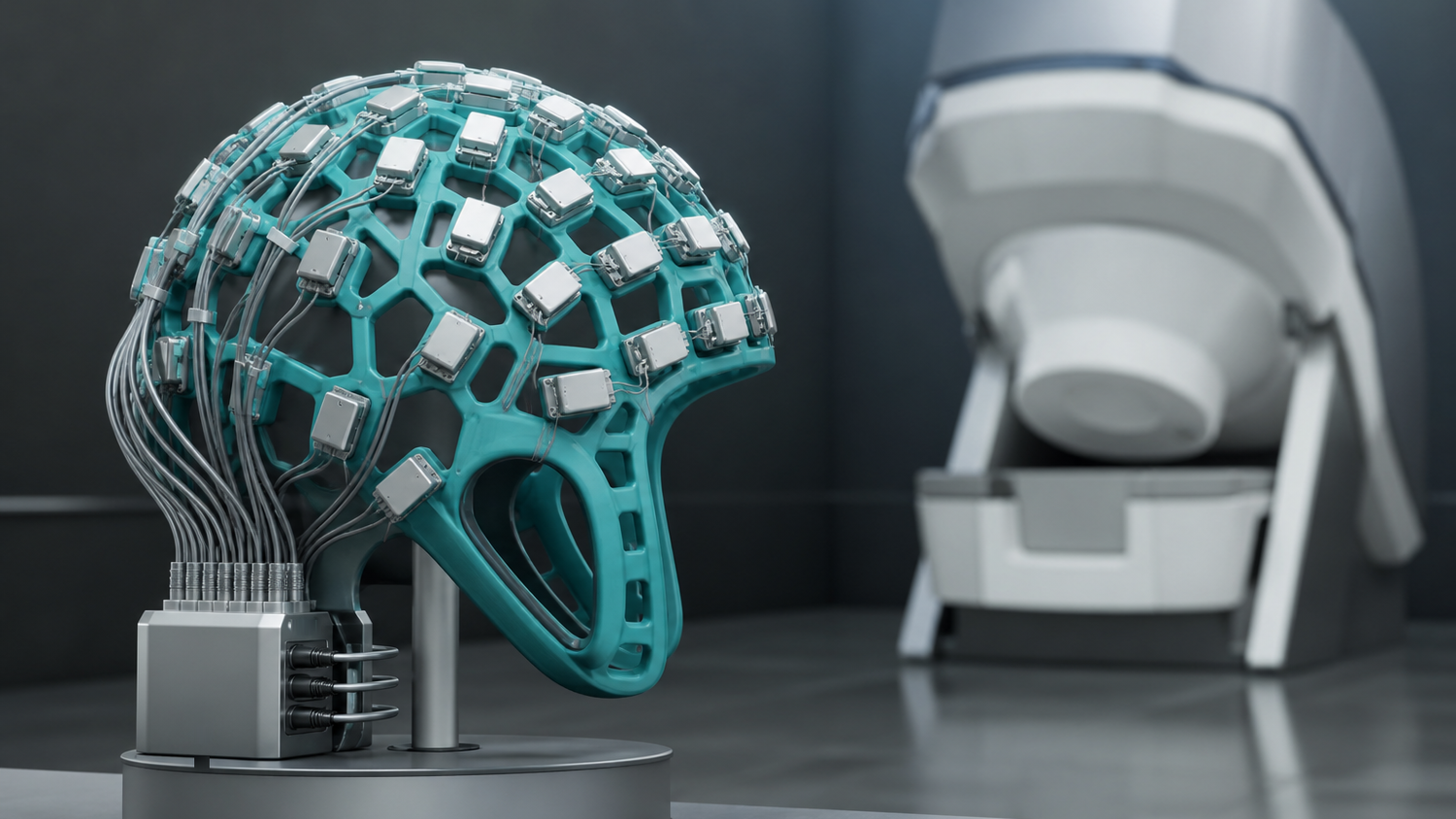
In a Wellcome impact story, Liberty can talk and move while a latticework helmet records the magnetic fields made by her brain. The seventeen-year-old is living with epilepsy, and Wellcome reports that her earlier diagnostic path included ten days in a hospital bed with electrodes placed directly on the brain. Her mother remembers thirty seizures a day when Liberty was seven.
The helmet is an optically pumped magnetometer magnetoencephalography system, usually shortened to OPM-MEG. It is a wearable brain scanner built around quantum sensors small enough to sit close to the scalp. That proximity matters for children, whose heads sit farther from the fixed detectors in a conventional MEG machine and whose movement can blur a scan.
The public story now has two different forms of support. A prospective study in 68 people with refractory epilepsy compared OPM-MEG localization with intracranial recordings and later surgical outcomes. Separately, Wellcome describes a UK clinic using the technology with children who face complex epilepsy surgery. Together they make presurgical epilepsy mapping a clinically consequential use of wearable quantum magnetometry in the records reviewed here.
Practical takeaway. OPM-MEG has moved into prospective clinical evaluation and a specialist pediatric clinic. It can localize epileptic activity with meaningful agreement against invasive recordings, while moderate specificity, specialized shielding, and an unfinished regulatory path still limit wider adoption.
Why a helmet changes the measurement
Magnetoencephalography measures the tiny magnetic fields generated by coordinated electrical activity in the brain. Conventional systems use superconducting quantum interference devices, or SQUIDs. The detectors operate near minus 269 degrees Celsius, so they sit behind insulation in a rigid shell. A patient places their head inside that shell and tries to remain still.
That geometry imposes a penalty. The sensors cannot touch the scalp, and the gap grows for a smaller head. Movement changes the relationship between the brain and the detector array. A fixed scanner can still produce valuable clinical maps, especially for epilepsy surgery. The equipment is expensive and requires substantial space. It also responds poorly to natural motion.
OPM-MEG uses atomic vapor sensors that work without cryogenic cooling. Laser light prepares and reads the spin state of atoms inside each sensor. A weak magnetic field from the brain changes that state, allowing the device to register the signal. The sensor package can be placed in a fitted helmet close to the head. The helmet can scale for patients across ages, while cables lead to a portable acquisition unit.
A Wellcome impact story published July 7, 2026 traces the UCL and University of Nottingham program from a five-year grant awarded in 2016 through prototype validation and deployment. It also names the practical infrastructure that remains: the wearer still sits inside a magnetically shielded room, and the array still needs careful calibration and field control. Portability describes the scanner and sensors, not an ordinary room becoming a diagnostic suite overnight.
The scientific connection is unusually direct. Components developed for smaller atomic clocks became sensitive magnetic-field detectors. A line of precision physics then entered neuroscience because the human brain produces fields those detectors can hear. The result is genuine quantum sensing with a clinical target, not a quantum-inspired label attached to conventional software.
Quantum pillar: sensing. Technology readiness: TRL 7 of 9. Quentir estimates this level from separate records: one near-final implementation completed prospective patient testing; another system is running in specialist pediatric care while regulatory qualification remains unfinished.
A prospective study reaches the invasive comparator
A current prospective clinical result comes from an Epilepsia study published June 2, 2026. Yuanzhong Shen and colleagues enrolled 68 people with refractory epilepsy for a ninety-minute interictal OPM-MEG recording. The researchers fitted dipoles to epileptiform discharges and compared the resulting localization with the epileptogenic zone defined by intracranial electroencephalography.
The overall concordance rate was 90 percent, with a Gwet AC1 agreement statistic of 0.885. Agreement was lower in temporal regions, at 80.1 percent, and higher in extratemporal regions, at 92 percent. The distance between the OPM-MEG and intracranial localizations was also shorter in concordant cases. Those results address an important clinical question: whether a noninvasive magnetic map points to the same part of the brain as electrodes placed inside the skull.
The study then followed a narrower group of 51 people who underwent resection or thermocoagulation. The reference combined the treated brain region with seizure freedom after at least twelve months. Under International League Against Epilepsy criteria, OPM-MEG had 85.7 percent sensitivity and 65.2 percent specificity, with a diagnostic odds ratio of 11.25. Under Engel criteria, sensitivity was 73 percent and specificity was 64.3 percent.
The sensitivity is encouraging. The clinical specificity deserves equal attention. A test that marks additional regions can still help form a surgical hypothesis, especially when clinicians read it alongside MRI, scalp EEG, history, and other functional studies. It cannot carry the decision alone. The published abstract also does not establish that OPM-MEG can replace intracranial monitoring in every patient or that the measured performance transfers unchanged to young children.
The pediatric clinic changes what counts as progress
Wellcome reports that the UK's first dedicated pediatric OPM-MEG clinic is operating at Young Epilepsy in collaboration with Great Ormond Street Hospital. The scanner is being used to map the brains of children facing complex epilepsy surgery. The story also says the developers hope for clinical approval in 2027, which confirms the present boundary: the system is in a clinical environment before broad qualification.
A specialist pediatric clinic is a demanding test setting. Children may find it hard to remain still, and some cannot tolerate a fixed helmet built for an adult head. Epileptic activity can also be intermittent. A wearable array improves fit and allows more natural movement, but recording quality still depends on sensor placement, shielding, calibration, and the chance of capturing useful interictal discharges during the session.
The humane stake appears in the calendar of childhood. Delayed localization can delay surgery. School years pass while seizures continue and medicines fail; families wait through repeated tests. Earlier mapping does not determine whether an operation will happen or succeed. It can give a multidisciplinary team another high-resolution view at an age when conventional MEG is technically less favorable.
That is a more important measure of progress than the novelty of a 3D-printed helmet. A child who can speak or move during a scan may provide usable data that a rigid system loses. A fitted helmet can also keep sensors at a more consistent distance from the scalp. The device therefore changes access to a measurement, as well as the measurement itself.
What hospitals would still need to know
Adoption will turn on workflow. The shielded room is a capital and facilities decision. Helmet sizing and sensor replacement affect throughput. Cable management adds work, as do cleaning and calibration for trained staff. A hospital also needs software that turns raw magnetic measurements into source maps that clinicians can interpret alongside established modalities.
Clinical validation has its own sequence. Multi-center studies would need to show that localization holds across operators and age groups, including different epilepsy types and surgical pathways. Prospective comparisons should report how often OPM-MEG changes an invasive monitoring plan or shortens a workup. They should also measure its effect on the confidence of a surgical conference. Outcome studies must separate useful additional information from attractive images that leave the decision unchanged.
Commercial dependence belongs in that assessment. A hospital buys more than sensors. It needs a shielded environment and acquisition hardware, plus analysis software. Maintenance and clinical support complete the system. Buyers need independent replication of performance across complete systems. Service arrangements also need to survive beyond the originating laboratory.
How Quentir Reads It
Quentir reads OPM-MEG as a rare quantum-medicine case in which the physics and device arrive at a visible clinical decision point. Atomic spin sensing supplies the measurement. The helmet solves a geometry problem. Epilepsy surgery supplies a comparison that matters: the location found by a noninvasive scan can be checked against intracranial recordings and later outcomes.
The 2026 prospective study supplies operational proof that the scanner can participate in a serious presurgical evaluation. The UK pediatric clinic supplies a separate test of fit, movement, and age. Neither record should absorb the other. The study's numerical performance does not automatically describe children at Young Epilepsy, and the clinic story does not independently validate the reported sensitivity or specificity.
The deeper connection is between metrology and childhood time. A more sensitive detector earns medical value only when it changes which patients can be measured, how early they can be measured, or what a clinical team can decide. OPM-MEG is approaching that threshold. The records reviewed here support a bounded clinical claim: quantum sensors can bring high-quality magnetic brain mapping closer to the moving child, and prospective results now justify rigorous clinical expansion.
Sources
Primary source: Shen and colleagues, Epilepsia, published June 2, 2026. Clinical-translation context: Wellcome's OPM-MEG impact story, published July 7, 2026.