Stony Brook Aims Its Quantum Network at University Hospital Patient Data: What the 21 August Link to Brookhaven Actually Carried
Quentir Medicine Monitor
Evidence-based insights for quantum medicine.
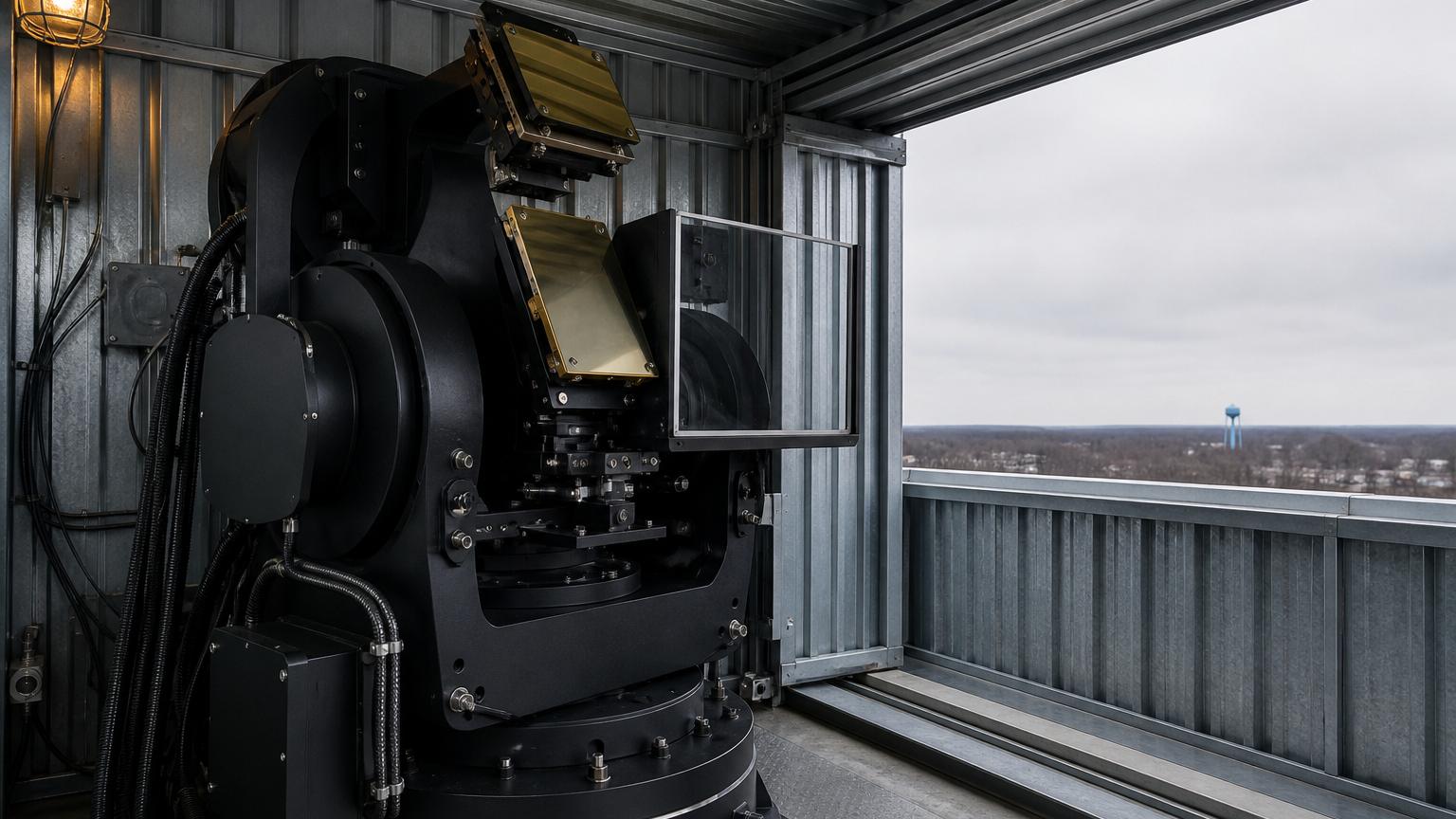
A 375-square-foot galvanized steel chamber now sits on the roof of Stony Brook University's Health Sciences Center, fourteen floors above the medical campus and reached by two final flights of stairs. Its builders call it the Quantum Watchtower, and they say the instruments inside will one day protect Stony Brook University Hospital patient data against cyberattack by teleporting quantum information.
That sentence was published on 28 August 2026 by Jess Stallone in Stony Brook Matters, the university's news site for alumni. One week earlier, on 21 August, Stony Brook and the Department of Energy's Brookhaven National Laboratory announced the demonstration behind it: a working free-space optical link carrying quantum information across 13 miles of open Long Island air. For a hospital reader the useful exercise is to hold the two statements next to each other, because they describe different stages of the same project.
What crossed the 13 miles between Stony Brook and Upton on 21 August 2026
The Watchtower is one end of a pair. The other is the Quantum Lighthouse, a nearly identical steel structure built by Brookhaven Lab at Upton, New York, 13 miles east, positioned for a clear line of sight back to campus. At the "First Light" event on 21 August, researchers generated quantum states of light at the Stony Brook rooftop and sent them across the open air to the Lighthouse. The university describes what was transmitted as "quantum states of light, each containing just a few individual photons," which is a weak coherent source rather than a true single-photon emitter. That daytime run demonstrated that the optical path could be aimed and held steady.
The entanglement work happened separately, at night, when the sky's background light drops far enough for faint signals to be picked out. Entangled photon pairs were generated in a Stony Brook physics laboratory, carried by fiber to the Watchtower, launched across the 13 miles, and measured at the Lighthouse. Justine Haupt, the Brookhaven engineer leading the link, came to it from astronomical instrumentation. "It's exciting to take capabilities we've spent years refining for astronomy and adapt them for a completely different scientific problem," she said.
A Village Health Kiosk, 70 Kilometers of Fiber, and 12.7 Bits a Second
Two links, two very different sets of numbers
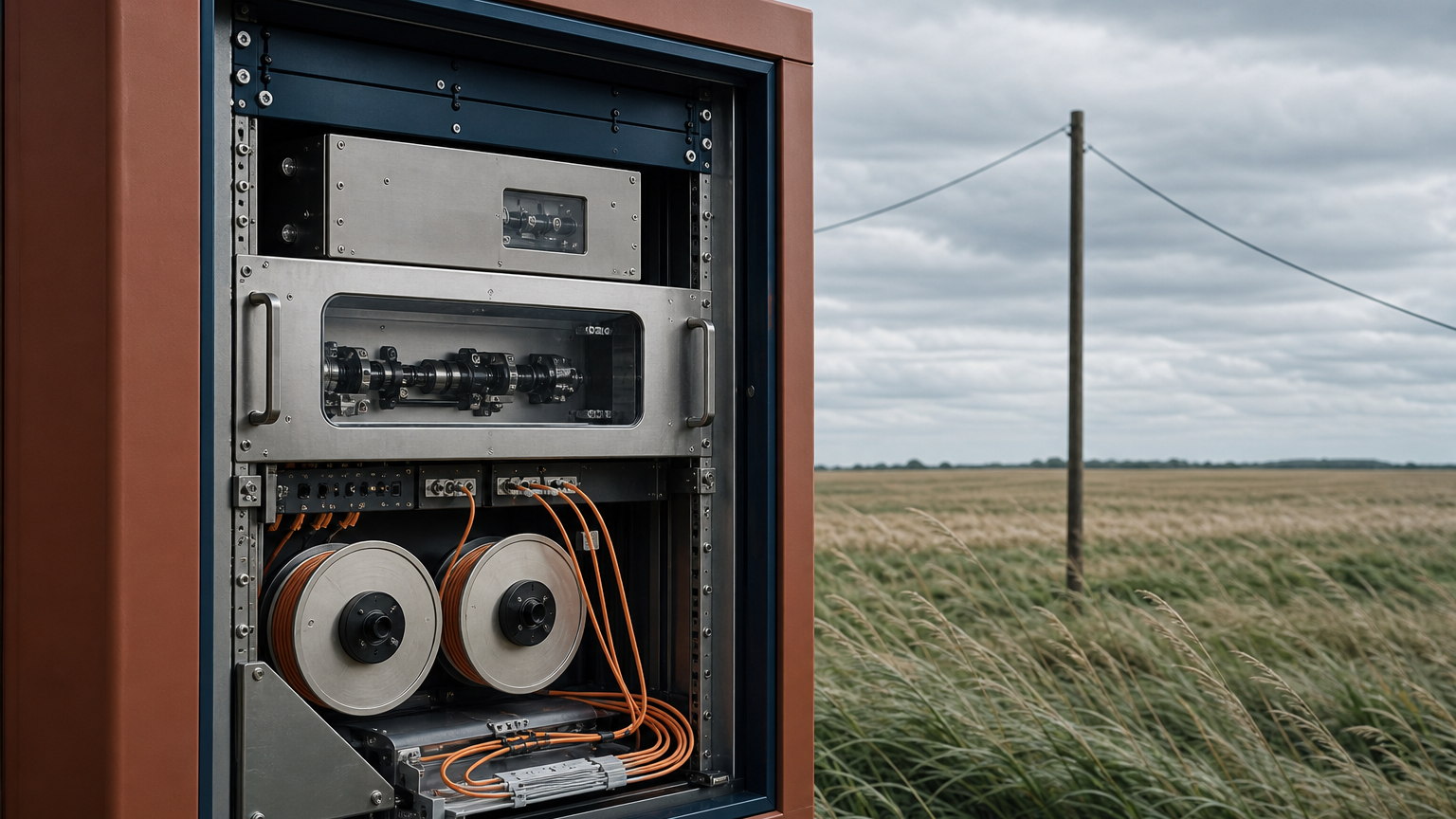
In a health kiosk in the Thuringian village of Sundhausen, a participant sat down for a fifteen-minute simulated consultation with a physician at the university hospital in Jena, and audio and video ran without interruption. The keys protecting that traffic came from polarization-entangled photon pairs sent down installed telecommunications fiber. A German research team has now published its field report, pairing entanglement-based quantum key distribution on the BBM92 protocol with end-to-end post-quantum cryptography running sntrup761 and ML-KEM-768. The network spans about 140 kilometers in total, arranged as two links through a trusted node at Erfurt: 70 kilometers from Sundhausen with 51 of them aerial, and 69 kilometers from Jena that are almost entirely buried.
The fiber construction shows up in the measurements
On the aerial-heavy village link the secure key rate averaged 12.7 bits per second with a standard deviation of 10.3, at a quantum bit error rate of 13.3 percent. On the mostly buried Jena link the same system produced 22.2 bits per second with a deviation of 4.7, at an error rate of 6.1 percent. Nearly twice the key rate on the buried link, less than half the error rate, and an error-rate spread of 0.8 points against 9.6. The authors report that error-rate variation on the aerial link correlated most strongly with wind speed. The two links were operated separately, for 22 days and 2 days respectively, so the 22-day endurance figure belongs to the village link alone, and the final hop into the hospital used previously generated keys from a local keystore.
What a hospital would actually be buying
The quantum keys were pushed straight into standard Linux VPN tunnels between adjacent nodes, with no dedicated key management system and no modification to the existing medical systems, which is the commercially load-bearing choice for buyers who cannot re-platform. Trusted nodes remain the structural caveat: four European cybersecurity agencies hold that end-to-end security cannot be achieved over long distances using fibre-based quantum key distribution, and place the clear priority on post-quantum cryptography. Set against a breach record in which vulnerability exploitation accounts for 20 percent of healthcare intrusions, a hardened regional link answers one threat model and leaves the other untouched.
Quantum entropy without the fiber
The debate usually settles into quantum key distribution versus post-quantum cryptography, and both depend on the randomness the keys are made from. Chip-scale quantum random number generators, such as Quantum eMotion's electron-tunneling design reported at 1.8 gigabits per second and already running with Becton Dickinson and GreyBox Solutions in remote patient monitoring, deliver that entropy at the endpoint itself, with no dedicated fiber, no weather exposure and no intermediate node to trust. Quantum-grade keys and quantum key distribution are separable purchases, and for most clinical endpoints the chip fits the installed base.