
Sunlight Replaced the Pump Laser in an Outdoor Entanglement Source
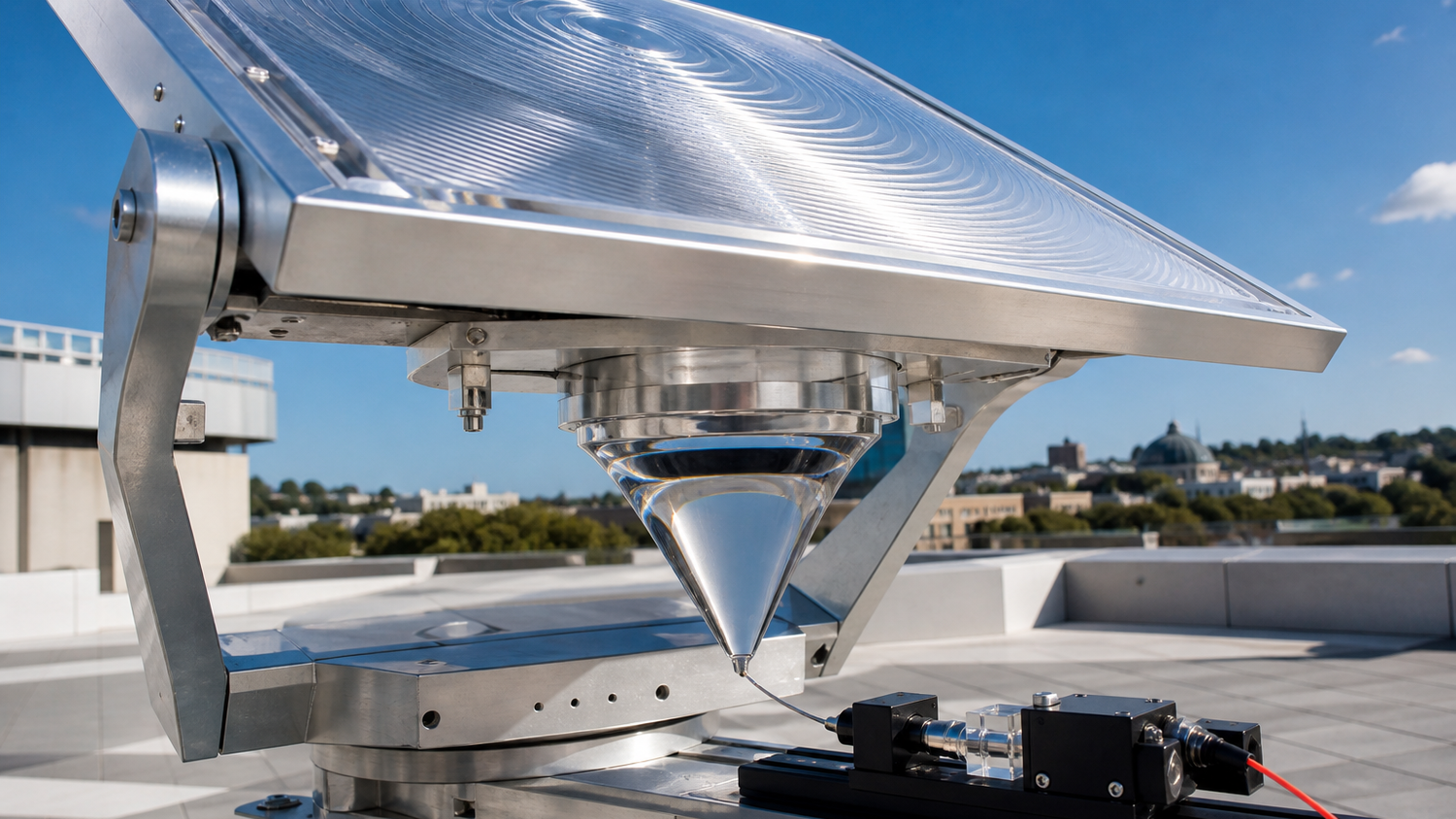
Augustin-Jean Fresnel designed his stepped glass lens in the 1820s to solve a problem of scarcity. A lighthouse flame was weak, the sea was wide, and every photon had to be gathered and thrown in one direction. Two centuries later a team laid a Fresnel collector about the size of a household window flat against the sky and ran the idea backwards, gathering daylight instead of projecting it, and used what it collected to make a pair of entangled photons.
The paper appeared in Optica on 6 August 2026: Generating quantum entanglement from sunlight, by Cheng Li, Jasvinder Brar, Michael Küblböck, Jeremy Upham, Hanieh Fattahi and Robert W. Boyd, of the University of Ottawa and the Max Planck Institute for the Science of Light, whose Erlangen site hosted the outdoor measurements. The claim is narrow and checkable. The team's preprint records a Bell-state fidelity of 0.939 ± 0.027 and a concurrence of 0.905 ± 0.053, with a CHSH value of S = 2.5408 ± 0.2171 against the classical bound of 2 — evidence against a local hidden-variable account of the correlation, under the experiment's own assumptions.
Practical takeaway. The energy overhead of the pump laser is what the authors set out to remove, and the experiment swaps it for a collector, a tracking mount and a custom concentrator. Whether that trade wins on total mass, power and heat is now an engineering question with a testable shape — and an assurance question arrives with it, because the pump is conditioned and monitored but never commanded.
Four years, three papers, and a documented objection
The history behind this result is the part worth reading closely, and the authors did not tidy it away. In October 2022, Cheng Li, with Boris Braverman, Girish Kulkarni and Robert Boyd, published polarization entanglement from down-conversion pumped by a spatiotemporally highly incoherent light-emitting diode, later carried in Physical Review A 107, L041701. The entanglement was thin, with a measured concurrence of 0.531 against a predicted 0.552, and the measurement mattered anyway: it came from a pump with none of the coherence a laser exists to supply.
In August 2025 a group at Xiamen University — Ye Xing, Deifei Xu, Yuan Li, Wuhong Zhang and Lixiang Chen — posted sunlight-excited down-conversion for quantum imaging, showing that photon pairs produced from sunlight are well correlated in position. They characterized correlation, not entanglement.
The 2026 measurement joins those two halves: sunlight as the pump, and entanglement characterized in the output. Li's account of how the idea was received is on the record in the Optica announcement: “Since the inception of this project, our idea has met with repeated doubt and pushback.” The doubt was specific and technically reasonable — that no photons at all, let alone entangled ones, would be detectable from a sunlight-driven nonlinear process. Publishing the objection alongside the result is a small act of scientific manners that makes the work easier to judge, and it is rarer than it should be.
What the apparatus had to solve
Spontaneous parametric down-conversion is an event that happens photon by photon. A pump photon enters a nonlinear crystal and splits into two of lower energy, and the pair can leave with correlated polarizations. Nothing in that description requires the incoming light to march in step. Laser-like coherence turned out to be unnecessary for polarization entanglement in this filtered geometry, which is what the 2022 LED experiment had already indicated in a laboratory — with the qualification that paper also carried, that pump coherence can limit the entanglement observed in the same degree of freedom.
Sunlight arrives scrambled in space and time, so the obstacle was delivery rather than principle: getting enough of it into the pump volume, roughly a millimeter across, inside a 10 mm ppKTP crystal. The answer was collection geometry. A Fresnel collector about the size of a household window concentrates direct sunlight; a conical all-glass concentrator, built in-house for this experiment, tapers it down; a fiber about as wide as a human hair carries it to the crystal. The optical principles are old, and the concentrator is not something a group can order from a catalog — a useful measure of how far the idea still has to travel.
The laser is a line item, and so is what replaces it
Satellite-based entanglement distribution has been on the record since Juan Yin and colleagues reported distribution over 1,200 kilometers from the Micius satellite in Science in June 2017, with entanglement-based key distribution and a finite secret-key rate following in Nature in 2020. Plenty of physics still constrains those links — channel loss, detection efficiency, background rejection and link geometry all bite. Alongside them sits a systems constraint that decides what gets built: the mass, power and thermal budget of the payload. The authors of the sunlight work state their motivation in those terms, as the energy overhead a pump laser imposes. Sunlight in orbit is unfiltered by atmosphere and free, which is why the idea is worth testing.
The honest description of what was demonstrated, though, is a substitution rather than a deletion. Removing the laser brought in a collector on the scale of a window, a mount that has to track the sun, spectral filtering, a custom concentrator, fiber coupling, polarization conditioning and crystal temperature control. Some of those get easier in orbit and some get harder. No published comparison yet shows the sunlight-pumped chain winning on total mass, power, thermal load, reliability or cost against a modern pump-laser payload. That comparison is the experiment the result now calls for, and it is a testable one.
The same movement toward existing infrastructure is visible on the ground, where quantum links have started arriving inside ordinary plant rather than beside it — the pattern behind the municipal fiber route in Chattanooga that carried an entanglement network into a utility's existing conduit.
What the record does not yet contain
The preprint reports roughly 1,600 pairs per second per milliwatt, which it describes as comparable to laser-pumped setups once the figure is normalized for effective phase-matching bandwidth. That qualifier is doing real work and should travel with the number. What has not been published is the part a procurement office would need: mission-level absolute throughput, a secure key rate rather than a pair rate, and a sustained duty cycle measured across sky conditions and, eventually, across an orbit. Pointing, air mass, cloud and season all move the input, and in orbit the geometry changes on an orbital period.
No independent group has replicated it yet either. These gaps are ordinary for a paper this new, and stating them is how the result stays useful: the failure mode for quantum announcements is the quiet promotion of a laboratory measurement into a capability claim somewhere between the press release and the procurement memo.
Certifying a pump you condition but cannot command
There is a symmetry here worth stating carefully. The Bell test that supports the entanglement claim is the same primitive device-independent key distribution uses as its security argument: trust the statistics, not the device. This experiment's margin does not carry that weight — loophole-free violation is a separate and much harder demand, and the authors make no such claim. The direction of travel still matters. The pump here is not raw sky: before it reaches the crystal the light is spectrally filtered to 405 ± 0.75 nm, polarized, and its power monitored in real time. What stays outside anyone's control is the supply — solar irradiance moves with cloud, air mass, season and, in orbit, with the orbital period. A source conditioned downstream of a variable supply has to make part of its assurance argument from what comes out rather than what went in.
That is where the institutional gap shows. Quantum hardware is now entering national procurement with quantities and delivery dates attached, and the calibration and verification layer that any other safety-relevant instrument would need is still being written. We made that argument about timing hardware when a defense agency ordered optical clocks by the unit while no standard existed for verifying what had been delivered. A sunlight-pumped source raises the same question one turn further out: a national metrology institute can characterize a laser on a bench, and characterizing an instrument whose supply varies with the sky is a different exercise.
How Quentir Reads It
Read this as an economics result wearing a physics jacket. The space segment of quantum communication is priced by mass, power and thermal budget, so the developments that move national programs are the ones that change the payload rather than the ones that improve a number. This is the first credible candidate for swapping the pump for ambient light, and the burden it now carries is a full system comparison, not another fidelity record. Institutions tracking quantum capability by qubit counts and fidelity tables will keep missing this class of result, and it is the class that decides who ends up owning secure space infrastructure rather than renting it.
The second reading is about how the work was published. A group stated in public that its idea had met repeated doubt, then answered the doubt with tomography and a Bell test, and put its numbers where the uncertainty is visible. Any organization assessing quantum claims should treat that shape — objection stated, objection measured — as a quality signal, and treat its absence as a reason to slow down.
The third reading is about sequencing, and it cuts against enthusiasm. Sunlight-pumped sources sit on a decade-scale path through replication, system comparison, space qualification and certification. The cryptographic exposure organizations carry today is not waiting for any of that; it runs on the algorithmic migration timetable that standards bodies and national regulators are already setting. Quentir's Signature Report, the PQC Migration Roadmap for Boards, covers that near-term track with a fixed scope, a dated source spine, refresh triggers and an internal-use license; this post covers the physics-layer option that may sit alongside it in the 2030s.
What to watch next is narrow. Watch for mission-level throughput and duty-cycle figures from the Ottawa and Max Planck groups, for a system comparison that puts collector, mount and concentrator against a pump laser on one page, for the first independent replication, and for the moment a space-agency work package mentions a passive source. Until one of those lands, the honest description of this result is a well-measured surprise, which is a better thing for a laboratory to produce than a roadmap.
Sources: C. Li, J. Brar, M. Küblböck, J. Upham, H. Fattahi and R. W. Boyd, “Generating quantum entanglement from sunlight,” Optica 13, 1508–1514 (2026), doi:10.1364/OPTICA.601797, published 6 August 2026; the same work as arXiv:2602.15655 (submitted 17 February 2026, revised 15 May 2026), the source of the fidelity 0.939 ± 0.027, concurrence 0.905 ± 0.053 and CHSH S = 2.5408 ± 0.2171 figures, of the pump conditioning described here (405 ± 0.75 nm filtering, polarization, real-time power monitoring), and of the generation rate of about 1,600 pairs per second per milliwatt, described there as comparable to laser-pumped setups after normalization for effective phase-matching bandwidth; Optica, “Researchers generate quantum entanglement using sunlight,” 6 August 2026, the source of the quoted remarks by Cheng Li; C. Li, B. Braverman, G. Kulkarni and R. W. Boyd, “Experimental generation of polarization entanglement from spontaneous parametric down-conversion pumped by spatiotemporally highly incoherent light,” arXiv:2210.16229, 28 October 2022, published as Physical Review A 107, L041701; Y. Xing, D. Xu, Y. Li, W. Zhang and L. Chen, “Sunlight-excited spontaneous parametric down-conversion for quantum imaging,” arXiv:2508.11207, 15 August 2025; and J. Yin et al., “Satellite-based entanglement distribution over 1200 kilometers,” Science 356, 1140–1144 (16 June 2017), doi:10.1126/science.aan3211. Public pages checked 17 August 2026.
Published intelligence, built to inform your own decisions. Published: August 17, 2026.